


Uncategorized
The most Jewish room in Fremont, Ohio, is in a county history museum
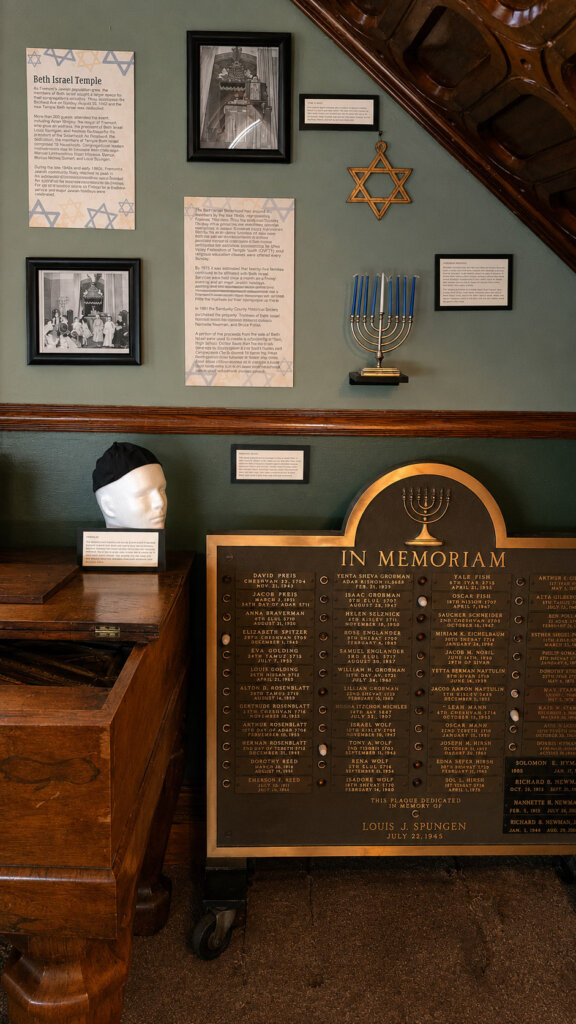
Beneath a mahogany staircase inside the Sandusky County Historical Society hangs a memorial plaque in a place both fitting and strange.
The sanctuary is gone. The Torah scrolls have long since been moved elsewhere. Military exhibits and county memorabilia fill the rooms. But the plaque remains, listing the dead of Temple Beth Israel, a congregation that closed more than four decades ago.
Across Ohio, when small-town synagogues closed, their history did not vanish all at once. Instead, it was scattered to neighboring congregations, local museums, regional archives and descendants who saved whatever they could. A siddur. A stained-glass window. A Star of David rescued before a building was demolished.
The story of Beth Israel’s plaque almost ended when someone proposed melting it down.
“That couldn’t be discarded,” said Dennis Newman, who grew up at the synagogue.
So he and his nephew drove to Sandusky, Ohio, to retrieve it from another closing congregation.
“It was really heavy,” he said.
Now it is back in Fremont, in the same building where Jewish families once gathered for Shabbat, Hebrew lessons, and holiday services, though most visitors do not know that when they walk in.
The building on Birchard Avenue still stands, a red-brick house set slightly back from the street. Inside, rooms that once held a wedding, Sunday school classes, and other scenes from synagogue life now house exhibits on Sandusky County’s past, including industrial history and local life. A Civil War battle flag serves as one centerpiece. The Jewish past is there too, a small exhibit Newman helped to create.
“Most people are surprised,” said Roy Wilhelm, a local volunteer with the historical society.
A congregation’s afterlife
Fremont is not unique. Throughout Ohio and the Midwest, other small-town congregations have closed, raising the same question: what becomes of the objects, records and stories they leave behind?
Toby Brief, executive director of the Columbus Jewish Historical Society, said her organization has increasingly become a repository for that afterlife. “The definition of Central Ohio has grown,” she said. In practice, she added, the society often functions as “much more of a regional archive between Cleveland and Cincinnati.”
That work, she said, is active rather than passive. “We find materials, we identify them.” Sometimes that means typed oral histories or photographs. Sometimes it means relationships with local historical societies. Sometimes it means preserving just one object from a vanished Jewish community. “We are always telling others not to forget to collect the artifacts,” Brief said.
One of those objects came from New Philadelphia, Ohio.
Like Beth Israel, the Tuscarawas County Jewish Center emerged in the 1930s, part of the same era when many small-town Jewish communities across Ohio were growing. The center was dedicated in 1937, two years after Beth Israel first gathered above a clothing store in Fremont. From its earliest days, the center also reached beyond its own members. At the dedication, the Rev. Frank Cody of First Presbyterian Church spoke. In 1938, when Joseph Wagner was installed as the center’s first rabbi, banquet guests included New Philadelphia’s mayor, Arthur Williams, along with the town’s chief of police and two Christian ministers.
But the ending in New Philadelphia was different. By 1967, the Jewish center had become inactive. The following year, the building was sold and razed to create a parking lot for employees of the local newspaper.
Almost nothing physical survived — just a Star of David rescued by a congregant before the building came down. Today it is preserved by the Columbus Jewish Historical Society.
“It is so simple,” Brief said. But “that star represents a synagogue, a Jewish center, it represents families.”
A home of their own
In Fremont, more remained. One artifact is the memorial plaque. But the building itself is an artifact, too.
For decades, Beth Israel sustained Jewish life in a town where Jews were always a small minority. At its peak in the late 1940s and 1950s, Fremont’s Jewish community numbered about 50 families. It was never large, but it had the elements of a full communal life: weekly services, a Sunday school, a Sisterhood, student rabbis traveling in from Cincinnati and New York, and ties to nearby towns like Tiffin, Fostoria, and Norwalk.
Before the congregation had a permanent home, it gathered in the mid-1930s in a rented room above a store on Front Street. On the day of its 1935 dedication, about 300 people crowded into the upstairs space. They sang “The Star-Spangled Banner” and “Hatikvah,” and the women of the newly formed auxiliary served a buffet luncheon.
A few years later, in 1942, the congregation purchased a former residence on Birchard Avenue and dedicated it as Temple Beth Israel. More than 200 people attended, including Amer Wrigley, the mayor of Fremont. Beth Israel now had a home of its own.
For the next two decades, Jewish life in Fremont settled into a modest but steady rhythm. The sanctuary seated about 65 people comfortably and filled for major holidays. Children attended Sunday school. The Sisterhood organized holiday events, charitable drives, and community programs. Church youth groups visited to learn about Judaism, and in 1948 Beth Israel hosted an interfaith Shabbat service that drew about 100 people. Local newspapers praised the congregation’s willingness to “cooperate with the other churches of the city and help make Fremont a leader in the pathways of better understanding.”
Jewish life extended beyond the synagogue, too. Families were tied to local businesses, including Joseph’s Department Store, and worked in medicine, jewelry, and scrap metal. The community was not large, but it was woven into the town.
Newman, who grew up in Fremont, remembers both the closeness and the isolation of that world. “I never knew another Jewish kid in Fremont,” he said. “Judaism was a lonely thing.”
“We were not deeply religious,” he said, “but deeply Jewish.”
By the 1960s, the patterns that had sustained small-town Jewish life in Fremont were thinning. Younger people moved away. Services, once weekly, became less frequent. Around 1967, Beth Israel discontinued its Sunday school, and the remaining children were sent to Sandusky or Toledo for Jewish education.
Still, the congregation persisted longer than some might have expected. In 1966, Beth Israel marked its diamond anniversary with a dinner at the Fremont Country Club attended by the mayor, a Catholic monsignor, and a Protestant minister — one more sign that even in decline, the synagogue understood itself as part of Fremont’s wider civic and religious life.
By the late 1970s, though, only about 15 families remained. Services continued once a month and on the High Holidays. In 1980, the trustees decided to close the congregation.
What remains

But closure did not mean immediate disappearance.
Some members joined Oheb Shalom in Sandusky. Torah scrolls and other ritual items were transferred to other synagogues, where they could still be used. A portion of the proceeds from Beth Israel’s sale established a scholarship at Fremont Ross High School for “average students” planning to attend college — an expression of communal values that continued for decades before fading from local records in the 2010s. Small gatherings and holiday observances in Fremont continued in private homes into the 1990s.
Looking back on Oheb Shalom’s closing in 2023, Newman described it less as an end than a transition: “This is not goodbye, just goodbye to the building.”
What remains is often harder to see and more fragile: names on a yahrzeit plaque, ritual items forgotten in a closet, a story carried from one generation to the next.
Brief knows stories from across Ohio. Many people, she said, are surprised by how widespread Jewish life once was in the state’s smaller towns and by how little visible evidence of it remains. Sometimes there was a formal congregation. Sometimes only “one or two families.” But there was still “a presence.” In some places, that presence stretches back earlier than most people assume, into the 1840s, 1850s, and 1860s.
“They wanted to be with other Jews,” Brief said. “They wanted a sense of Jewish life.”
In Fremont, memory survives in other ways too. David Detwiler, who grew up in town decades after Beth Israel’s peak, is not Jewish, but he remembers where the synagogue stood. He remembers the Jewish section of Oakwood Cemetery near his elementary school, and the peculiarity, in retrospect, of childhood games unfolding beside graves.
“Looking back, it was odd to have kids playing next to the dead,” he said.
He knew only one Jew growing up, an educator and school administrator who handed him his high school diploma. But a Jewish presence still lingered in the town’s memory and institutions, even after the congregation was gone. His own church, First Presbyterian, stood a block north of the synagogue and closed in 2025.
“You don’t really remember what happened,” he said. “You remember how it made you feel.”
Fremont’s Jewish memory also survives in stories about businesses and local relationships. Christine Burns, whose family owns Burns Iron and Metal, said her grandfather bought a scrapyard from Marcus Michles, a Jewish entrepreneur whose brother, Joseph, was among the leading figures in Temple Beth Israel, including serving as its president. He did so by borrowing money from Jewish community members and later became friends with many of them.
Joe Cheek, who worked for Michles in the 1970s, remembered him as demanding but fair. “He did not expect you to do anything he would not do himself,” Cheek said.
These memories are not always precise. Names fade. Timelines blur. Details collapse into one another.
But they have not vanished.
Back on Birchard Avenue, the former synagogue is open only seasonally, from May through October, for limited hours. Visitors can walk through the building, pausing at exhibits and reading placards about Sandusky County’s past. Few realize what the house once held.
There is no longer a sanctuary in any recognizable sense. No weekly services. No children’s classes. No steady ritual rhythm drawing people through the doors.
And yet the names remain.
The plaque is back in Fremont now, in the lobby of the old synagogue, beneath the staircase. It does not restore the congregation, or make the building a synagogue again. But it keeps the dead from becoming anonymous and the community from disappearing without a trace.
That is how continuity is carried: by a historical society, by a regional archive, or by a man who sees the names from his childhood and decides they cannot be let go.
The post The most Jewish room in Fremont, Ohio, is in a county history museum appeared first on The Forward.
Uncategorized
A synagogue and Jewish-owned shops damaged in French riots
(JTA) — PARIS – Jewish-owned shops in Marseille were set ablaze and a synagogue in Paris was vandalized as part of widespread property damage caused by riots across France Saturday and Sunday, according to the Jewish Community Protection Service.
It is too early to assess the full extent of the riots protesting the rising cost of living and the damage they’ve caused, but various elements in the media have described them as civil unrest and chaos.
From Lille in the north to Marseille in the south and in the major cities in between, media estimate that nearly 800,000 people took to the streets and some 2,000 shops were vandalized or looted. Public buildings were set on fire, and hundreds of people or more were injured, including 150 police officers, with thousands arrested.
The riots followed a student uprising that blocked entrances to high schools across the country in recent weeks. Palestinian flags and keffiyas have been a recurring motif in most of the violent protests, acts of vandalism and looting.
But according to SPCJ, known as the Service de Protection de la Communaute Juive in French, there was no evidence that Jewish institutions or businesses were deliberately targeted.
Vandals broke into the Ohalei Yaakov synagogue in Paris’ 19th district overnight between Saturday and Sunday. On Sunday morning, members of the Jewish community discovered that their temporary place of worship had been broken into. The permanent synagogue building is currently undergoing renovations.
Inside the sanctuary, prayer books, tefillin, and various objects — taken from boxes and cupboards — were found scattered on the floor. The rabbi’s office was also searched. Despite the mess, the Torah scrolls appeared to be unharmed.
According to a member of the synagogue committee, the incident primarily points to an attempted theft. The suspects may have been looking for money, but nothing was believed to be missing.
This article originally appeared on JTA.org.
The post A synagogue and Jewish-owned shops damaged in French riots appeared first on The Forward.
Uncategorized
How much will Trump’s endorsement help Netanyahu?
(JTA) — JERUSALEM – Within minutes of President Donald Trump endorsing Prime Minister Benjamin Netanyahu in a post on Truth Social Sunday, Netanyahu’s campaign team had released a 30-second clip showing all the times Trump has lavished praise on the Israeli leader over the past few years.
With polls showing that Netanyahu and his governing coalition are slipping in their struggle to retain power in the upcoming Oct. 27 election and lag behind the opposition bloc, an endorsement from the president of the United States is a powerful statement.
But is it enough to tip the scales?
“I don’t think it will change anything,” said Ilana Shpaizman, a senior lecturer in the Department of Political Studies at Bar-Ilan University.
Of course, she said, “Netanyahu will say this is the proof that I’m a leader and all that, and I can speak to Trump … But so what? His followers already know that and they believe in him. They don’t need the endorsement.”
Those who oppose him, Shpaizman continued, “know that Trump forced him (Netanyahu) to accept the ceasefire in Gaza and accept the hostage deal, and that Trump runs the show around Iran. So they also don’t need the endorsement either,” Shpaizman said.
Some pundits speaking on Israeli news outlets criticized Trump for “interfering” in Israel’s election, while others put it down to the fact that Trump does not want America to return to fighting Iran alone if Netanyahu, who is hawkish on Iran, is replaced by someone less willing to act militarily. If Netanyahu loses, that is a scenario that could play out.
“This is the first time ever that the president, at least publicly, endorses a candidate in Israel’s election,” Bushinsky, a political commentator and former adviser to Netanyahu, told the Jewish Telegraphic Agency.
Bushinsky said he remembered Netanyahu complaining about U.S. intervention in previous elections in 1999 and 2001, when presidents less enamored of him were in office. He even pushed for an initiative that would block foreign funding for election campaigns.
Now, Bushinsky said, “I guess he is not complaining,” adding that the endorsement serves Netanyahu in two ways.
First, it signals that Trump thinks that Netanyahu is the most suitable guy for the job. Second, it puts Netanyahu’s election campaign back on track, refocusing attention on an issue where Netanyahu is strong – Iran.
“It lets him say ‘I can now finish a job, and I can finish a job with Trump,’ and ‘without Trump or without me, the job will not be finished,’” said Bushinsky.
He said that in the last few days, the political debate had pivoted to other issues such as Ashkenazim vs Sephardim, the draft law and the contentious efforts by the outgoing government to overhaul the judiciary.
“This [endorsement] is the ultimate campaign boost for Netanyahu,” Bushinsky said.
But that boost might not be enough.
Most of the polls taken in recent days show the opposition bloc led by former IDF chief Gadi Eisenkot pulling ahead of Netanyahu’s ruling coalition, but give neither bloc enough seats to gain the necessary 61 of 120 seats in Israel’s parliament, the Knesset, to form the next government.
“I think this might give Netanyahu one more seat, one more mandate, but not more than that,” said Bushinsky.
Prof. Tamar Hermann, director of the Israel Democracy Institute’s Viterbi Center for Public Opinion and Policy Research, said that the timing of Trump’s support for Netanyahu in this election race had come both “too late and too early.”
“It’s too late because people have already decided electoral preferences. They may shift within each bloc, but will not move between the blocs because of this,” she said. “And it’s too early because there are nine days to go to the elections, and we can already see other American leaders spilling some cold water over what he said, even on the Republican side of the aisle.”
This criticism, Hermann continued, will be transmitted to Israeli voters, and they will see that Trump is facing a huge battle in the upcoming midterm elections.
“The image of President Trump has deteriorated significantly since April 26, when he started the negotiations with Iran,” she said, pointing to one of the IDI’s recent public opinion surveys that found the president’s popularity had plummeted after he stopped the war with Iran without totally removing the threats against the State of Israel.
According to that poll, the Israeli public’s confidence in Trump as someone dedicated to Israel’s security fell from around 70% to just 42%.
“In my view, the endorsement will not make a big change,” Hermann added. “It will just strengthen Netanyahu’s political supporters, who will see it as a sign that he is still the internationally known figure that even the president of the United States is endorsing.”
She concluded, “The meaning of endorsement in Israel is totally different than in the United States … we are not that used to this kind of move, and it will not make people change their minds.”
This article originally appeared on JTA.org.
The post How much will Trump’s endorsement help Netanyahu? appeared first on The Forward.
Uncategorized
Trump endorses Netanyahu for reelection, warning Israelis against choosing another leader
President Donald Trump endorsed Israeli Prime Minister Benjamin Netanyahu for reelection, giving his longtime ally a major boost just nine days before Israel’s Oct. 27 election, which polls indicate could end without a clear winner.
“Please let this letter serve to represent my complete and total endorsement of Bibi Netanyahu in his upcoming race for re-election as Prime Minister of Israel,” Trump wrote Sunday in a lengthy post on Truth Social, praising Netanyahu as a strong leader and trusted partner in confronting Iran.
Netanyahu, Israel’s longest-serving prime minister, is seeking a seventh term after surviving political crises that repeatedly appeared likely to end his career — most significantly after the Oct. 7, 2023, Hamas attack. Recent polls suggest neither Netanyahu’s right-wing coalition nor the opposition is sure to win the 61 seats needed to form a government in the 120-member Knesset.
In his endorsement, echoing the sentiment of Netanyahu’s campaign, Trump warned Israeli voters that choosing anyone else as prime minister could put more pressure on the United States to deal with threats in the Middle East alone. “If Israel has the wrong leader, which would be anyone other than Bibi, America will have to do this work ourselves, and I am not inclined to do so,” Trump wrote. “Bibi Netanyahu has been strong, brave, and brilliant in the face of tremendous opposition, including that coming from even Israel, itself.”
Gadi Eisenkot, a former IDF chief of staff whose son was killed in the Gaza war, has emerged as Netanyahu’s chief rival. Eisenkot has floated a path to a government that does not require a majority in the Knesset. However, one of his partners in the anti-Netanyahu bloc, Avigdor Lieberman, has said in recent days he would oppose such a move. Recent polling puts Lieberman’s party at an average of eight or nine seats — enough to give Lieberman leverage in who leads the government.
Trump’s endorsement came hours after Netanyahu appeared on another program, the Fox News show Life, Liberty & Levin hosted by journalist and commentator Mark Levin. Netanyahu spoke glowingly of Trump and the importance of his battle to destroy the Iranian threat, as the American public prepares to head to the polls for midterm elections on Nov. 3. In that race, Republicans are fighting to maintain control of the House and Senate.
The U.S. war with Iran, which has slowed the flow of oil through the Strait of Hormuz causing gasoline prices to rise, has been unpopular with American voters and is often cited as one of the reasons Republican politicians could lose their races to Democrats.
Netanyahu made the case on Fox that the defeat of the Islamic Republic and the elimination of its nuclear program was critical to ensuring a safe American future. In the U.S., some lawmakers have insisted that the war was unnecessary.
If Iran can destroy Israel, it will conquer the Middle East, control world waterways and oil supplies and proceed to Europe and proceed “to the next target, which is you,” Netanyahu said, addressing a U.S. audience in his Fox News appearance.
A boost for Netanyahu in the final stretch
Trump has taken a personal interest in Israel’s election, but he held off on endorsing Netanyahu for months, raising questions about whether he was keeping his options open in case the longtime Israeli leader lost. “I’m not involved in [Israeli] politics anymore,” Trump told Time magazine in September. In an interview with Newsmax on Thursday, when asked whether he trusted Netanyahu, Trump said he did not trust anybody.
Sunday’s endorsement comes as Netanyahu steps up his campaign to rally his base and convince undecided voters that his close relationship with Trump is essential to Israel’s security. Trump remains popular in Israel, though his approval has declined in recent months following the ceasefire agreement with Iran. But the move could also complicate the president’s ability to influence what happens after the election, if neither political bloc wins a majority.
Trump has previously shown a willingness to pressure Israeli political leaders, including his public campaign last year for President Isaac Herzog to pardon Netanyahu of corruption charges.
Nonetheless, by declaring that Netanyahu is the only acceptable leader for the U.S. administration, Trump may have made it harder to persuade opposition parties to join a unity government led by Netanyahu if the election produces a political stalemate. It also gives Netanyahu another reason to resist stepping aside in post-election negotiations, knowing that the American president has publicly declared him the only alternative.
Netanyahu has already begun sharpening that message, arguing that he and Trump have unfinished business and only two more years to accomplish their shared goals before Trump’s term ends in January 2029. The messaging carries an implicit warning about Israel’s relationship with Washington after Trump leaves office. Whether the next president is Republican or Democrat, any Israeli leader may find it harder to maintain the same level of personal access and cooperation.
The election also carries broader consequences for American Jewry. Netanyahu has become increasingly unpopular among American Jews and Democrats, many of whom oppose his alliance with far-right and religious parties. A change in leadership could allow Israel to rebuild ties with Democrats and reconnect with parts of the American Jewish community — even without bringing nearly as much change in Israeli policy as some might hope.
Rep. Dan Goldman, a Jewish Democrat from New York who was defeated earlier this year in a primary that focused on his support for Israel, posted on X that the U.S.-Israel alliance “will suffer permanent damage if this Israeli government continues to hold power after the election on October 27.”
Polls point to another deadlock
The latest polls show that Netanyahu faces a difficult path to reelection.
Surveys published over the weekend show Eisenkot’s Yashar party ahead of Netanyahu’s Likud, with the opposition parties holding a combined 55 seats. The two Arab lists — the United List, a coalition of three Arab Israeli parties, and Ra’am led by Mansour Abbas — are generally counted outside either bloc.
Those numbers help explain why Trump’s endorsement matters.
A few additional seats could change the balance of power and determine who gets the first opportunity to form a government. And even if Netanyahu fails to secure a majority, he could still benefit from a political deadlock if his bloc wins enough seats to prevent the opposition from forming a government.
In that scenario, Netanyahu would remain prime minister until a new government is sworn in, potentially setting the stage for another election.
JTA contributed to this report.
The post Trump endorses Netanyahu for reelection, warning Israelis against choosing another leader appeared first on The Forward.
