


Uncategorized
This gaming platform has ‘zero tolerance’ for antisemitism. Holocaust reenactments keep reappearing anyway.
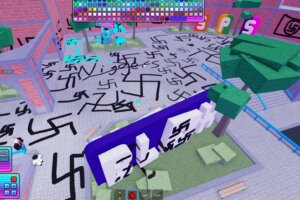
As the game “German Camp” begins, you arrive at a virtual building with a large German flag on display. There, on the gaming platform Roblox, your avatar can put on a helmet labelled “Stahlhelm,” the steel headgear worn by Nazi soldiers during World War II. Next door, soldiers stand watch over fenced-in barracks where characters labeled “noobs” — a derogatory term for inexperienced gamers — line up to be killed.
“This is the best place in the world,” a user named Bravado writes in the chat before shooting your character — as happened to this reporter.
Roblox, where users can create their own virtual worlds — and explore millions more made by other players — says it has a zero tolerance policy against antisemitism. But Holocaust scenes and imagery have continued to appear on the platform for years.
In 2022, Roblox removed a simulation of Nazi gas chambers, which users could operate by pressing “execute.” The Global Network on Extremism & Technology found a game titled “1941 – Konzentrationslager Auschwitz” on the platform in October 2025.
“Hate or harassment targeting Jewish people or any religious community is strictly prohibited on our platform,” Roblox spokesperson Eric Porterfield wrote in a statement, adding that “we take swift enforcement action against users we find violating our rules.”
Roblox removed “German Camp” shortly after the Forward’s inquiry about the game and confirmed it violated the platform’s policies. The game, advertised for ages 13 and older, had been played 174 times and was available for about two years.
‘No system is perfect’
Roblox prohibits content that “recreates specific real-world sensitive events” and “supports, glorifies, or promotes the perpetrators or outcome of such events,” including the Holocaust.
But “no system is perfect,” Porterfield wrote in a statement, adding that Roblox relies on a combination of AI detection, human reviewers, and community reporting to identify and remove antisemitic content.
In the case of the “German Camp” game, a member of Roblox’s public policy team told the Forward that the game would have been flagged immediately had it used the term “concentration camp.” Without such keywords, however, content can be more difficult to detect.
Roblox’s AI filters scan for terms like “Nazi,” automatically removing some content and identifying ambiguous cases for human review. The company works with thousands of contractors to evaluate flagged material, and players can also report misconduct directly. Roblox said it then evaluates player histories to help determine the severity of the offense, and disciplines players accordingly.
But Constantin Winkler, a researcher at the Global Network on Extremism & Technology who has studied extremist content on Roblox, said users evade these guardrails by intentionally misspelling words or communicating in code.
For instance, the Global Network on Extremism & Technology identified usernames such as “lolocaust,” “Atolf Zitler,” and the use of “88” — code for “Heil Hitler,” with “H” being the eighth letter of the alphabet.
Roblox said it found and removed 61 accounts, one game, and two groups that violated their policies after the Global Network on Extremism & Technology’s report in October about extremist content on Roblox.
But the Forward this month identified users named “konzentrationKamp,” “konzentrationausch,” “konzentrations_lager,” and “holowocaust,” and games titled “The Camp 1942” and “271k or 6 million,” referencing the conspiratorial claim that only 271,000 Jews were killed in the Holocaust. Other problematic content was more explicit: a game titled “JEWS,” featuring images of men in black hats clutching money bags, or “LIFE IN ISRAHELL,” featuring Stars of David set ablaze.
“They try to take some things down, but you can always find it again,” Winkler said.
Roblox works with organizations including the Anti-Defamation League, Tech Against Terrorism, and the Simon Wiesenthal Center to constantly audit and strengthen its moderation policies, according to its policy on safety and civility.
According to Winkler, Roblox users also frequently encounter players building or drawing swastikas during live gameplay. Because these actions happen in real time, he said, they are far more difficult to moderate than problematic usernames or pre-built worlds.
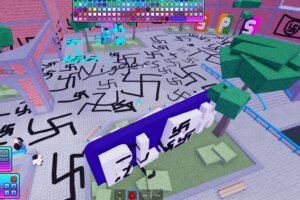
That’s a familiar challenge for Tristan Brown, a 19-year-old Jewish college student who was playing a Roblox spray-paint game when, suddenly, his player was surrounded by graffitied swastikas. He and his friends quickly logged off.
“It makes me want to stop playing on the platform, because if I’m gonna be playing, why can’t I be respected?” Brown told the Forward. “I wish there was more of a crackdown on things like that.”
A broader challenge
Video games reenacting concentration camps are not new: In 1991, a video game called “KZ Manager” circulated in Austria and Germany, where the player runs the Treblinka death camp.
Hate groups have also long used video games as a medium of choice. In 2002, the white supremacist group National Alliance created a video game titled “Ethnic Cleansing,” a first-person shooter game where players participate in a race war, killing stereotypically-depicted Jews, African Americans and Latinos.
But these games are generally created by extremists, for extremists, Winkler said. Roblox, meanwhile, is a mainstream gaming platform with 82.9 million daily active users last year. About 40% of its users are under the age of 13.
Roblox is far from the only popular gaming platform that’s struggled to crack down on hateful content: Minecraft, Steam, and Discord have all come under fire for neo-Nazi content — as has virtually every video game or streaming platform with a substantial following. In the digital era, it’s practically a given that platforms built around user-generated content will attract hate. Video games, many of which combine anonymity, creative freedom, simulated violence, and the ability to interact with other players, are especially fertile ground for extremism, Winkler said.
In response to the spread of extremist content, educational Holocaust-themed video games have emerged, including a virtual Holocaust museum hosted on Fortnite. But these efforts have also drawn harassment: The project’s release was delayed after white nationalist influencer Nick Fuentes urged neo-Nazis to target it.
A 2022 survey from the Anti-Defamation League found that 34% of Jewish gamers said they experienced identity-based harassment while playing. Players most often encountered white-supremacist ideologies in the games Call of Duty, Grand Theft Auto, Valorant, PlayerUnknown’s Battlegrounds, and Fortnite, the ADL found. Then last year, the ADL tried logging onto various video games with the username “Proud2BJewish” — and 38% of their gameplay sessions resulted in some form of harassment.
Meanwhile, overmoderation — particularly when it relies on unreliable artificial intelligence — can backfire, sweeping up innocent users and undermining trust in moderation systems. At the same time that Roblox has faced scrutiny for failing to curb antisemitism, its forums are rife with complaints that the platform’s moderation system is plagued by false positives.
Efforts to police content in video games have also long raised concerns about censorship and government overreach. After the 1999 Columbine High School massacre, a moral panic took hold around video games when the perpetrators, Eric Harris and Dylan Klebold, were revealed to be avid players of violent video games. Subsequent research has largely failed to establish a causal link between violent video games and real-world violence.
For Winkler, the central danger is not that a player will encounter a depiction of a concentration camp and immediately become radicalized. Instead, he said, the concern is more insidious.
“In our research, we don’t even care about, Is it ironic? Is it humor? Because extremist content is extremist content, and it’s available,” Winkler said. “It’s really dangerous because it’s part of a normalization process.”
The post This gaming platform has ‘zero tolerance’ for antisemitism. Holocaust reenactments keep reappearing anyway. appeared first on The Forward.
Uncategorized
High-Stakes US Special Forces Mission Rescues Airman From Iran After F-15 Crash

FILE PHOTO: A U.S. Air Force F-15E Strike Eagle aircraft takes off for a mission supporting Operation Epic Fury during the Iran war at an undisclosed location, March 9, 2026. U.S. Air Force/Handout via REUTERS/File Photo
US forces staged the audacious rescue of an airman behind enemy lines after Iran downed his fighter jet, officials said on Sunday, resolving a crisis for President Donald Trump as he weighs escalating the war, now in its sixth week.
The airman rescued by special operations forces, who Trump said was a colonel, was the weapons-systems officer on the downed F-15, a US official told Reuters.
“Over the past several hours, the United States Military pulled off one of the most daring Search and Rescue Operations in US History,” Trump said in a statement, adding that the airman was injured but “he will be just fine.”
The officer was the second of two crew members on the warplane that Iran said on Friday had been brought down by its air defenses. Iran’s Revolutionary Guards said several aircraft were destroyed during the US rescue mission, Tasnim news agency reported.
Reuters reported on Friday that the first crew member had been retrieved, triggering a high-profile search by both Iran and the United States for the remaining airman.
Iranian officials had urged citizens to help find him, hoping to gain leverage against Washington in the war Trump and Israel launched on February 28.
Trump has threatened to escalate the conflict in the coming days with attacks on Iran’s energy infrastructure.
Had Iran captured the airman, the ensuing hostage crisis could have shifted American public perception of a conflict that opinion polls show was already unpopular.
Trump said the airman was rescued “in the treacherous mountains of Iran” in what he said was the first time in military memory that two US pilots had been rescued, separately, deep in enemy territory.
The official told Reuters that as the weapons-systems officer was moved from near a mountain to a transport aircraft parked within Iran, US forces had to destroy at least one of the aircraft because it had malfunctioned.
U.S. AIRCRAFT HIT
The rescue effort, involving dozens of military aircraft, encountered fierce resistance from Iran.
Reuters reported on Friday that two Black Hawk helicopters involved in the search were hit by Iranian fire but escaped from Iranian airspace.
Separately, a pilot ejected from an A-10 Warthog fighter aircraft after it was hit over Kuwait and crashed, the officials said, though the extent of crew injuries was unclear.
Still, Trump was triumphant.
“The fact that we were able to pull off both of these operations, without a SINGLE American killed, or even wounded, just proves once again, that we have achieved overwhelming Air Dominance and Superiority over the Iranian skies,” he said in his statement.
US air crews are trained in what to do if they go down behind enemy lines, measures known as Survival, Evasion, Resistance and Escape, but few are fluent in Persian and face a challenge in staying undetected while seeking rescue.
The conflict has killed 13 US military service members, with more than 300 wounded, US Central Command says. No US troops have been taken prisoner by Iran.
While Trump has repeatedly sought to portray the Iranian military as being in tatters, they have repeatedly been able to hit US aircraft.
Reuters reported on US intelligence showing that Iran retains large amounts of missile and drone capability. Until just over a week ago, the US could only determine with certainty that it had destroyed about one-third of Iran’s missile arsenal.
The status of about another third was less clear, but bombings probably damaged, destroyed or buried those missiles in underground tunnels and bunkers, Reuters sources said.
The US and Israeli war on Iran has spread across the Middle East, killing thousands and hitting the global economy with soaring energy prices that are fueling fears of inflation.
Uncategorized
On Easter, Pope Leo Urges World Leaders to End Wars, Renounce Conquest

Pope Leo XIV waves from the main balcony of St. Peter’s Basilica after delivering his “Urbi et Orbi” (To the city and the world) message, on Easter Sunday at the Vatican, April 5, 2026. Photo: REUTERS/Remo Casilli
Pope Leo urged global leaders in his Easter message on Sunday to end the conflicts raging across the world and abandon any schemes for power, conquest or domination.
The pope, who has emerged as an outspoken critic of the Iran war, lamented in a special message to the thousands gathered in St. Peter’s Square that people “are growing accustomed to violence, resigning ourselves to it, and becoming indifferent.”
“Let those who have weapons lay them down!” the first US pope exhorted. “Let those who have the power to unleash wars choose peace!”
Leo did not mention any specific conflicts in the message, known as the “Urbi et Orbi” (to the city and the world) blessing. It was unusually brief and direct.
The pope said that the story of Easter, when the Bible says Jesus rose from the dead three days after not resisting his execution by crucifixion, shows that Christ was “entirely nonviolent.”
“On this day of celebration, let us abandon every desire for conflict, domination, and power, and implore the Lord to grant his peace to a world ravaged by wars,” Leo urged.
Leo, who is known for choosing his words carefully, has been forcefully decrying the world’s violent conflicts in recent weeks and ramping up his criticism of the Iran war.
In a sermon for the Easter vigil on Saturday night, he urged people not to feel numbed by the scope of the conflicts raging across the world but to work for peace.
The pope made a rare direct appeal to US President Donald Trump on Tuesday, urging him to find an “off-ramp” to end the Iran war.
In his address from the balcony of St. Peter’s Basilica on Sunday to the Square below, decorated with thousands of brightly colored flowers for the holiday, Leo offered brief Easter greetings in ten languages, including Latin, Arabic and Chinese.
The pope also announced he would return to the Basilica on April 11 to host a prayer vigil for peace.
Uncategorized
Temple Mount Set for Limited Reopening to Jews and Muslims

Israeli National Security Minister and head of Jewish Power party Itamar Ben-Gvir gives a statement to members of the press, ahead of a possible ceasefire between Israel and Hamas, in Jerusalem, Jan. 16, 2025. Photo: REUTERS/Oren Ben Hakoon
i24 News – Israeli authorities are preparing to partially reopen the Temple Mount in Jerusalem to both Jewish and Muslim worshipers for the first time since the start of the war with Iran, under a tightly controlled and highly restricted security arrangement, i24NEWS has learned.
According to details obtained by i24NEWS, the Israeli police, backed by National Security Minister Itamar Ben-Gvir, are also expected to permit limited access for Jewish worshipers to the Western Wall as part of the same phased plan.
Under the framework, access to the Temple Mount and surrounding holy sites would be restricted to small groups of up to 150 people at a time. In the event of a missile alert, all visitors would be immediately evacuated in accordance with emergency protocols.
The decision follows a recent Supreme Court ruling allowing demonstrations in a limited format. Police argue that a consistent standard must apply across both civic gatherings and religious sites, with Ben-Gvir insisting that “there cannot be one rule for demonstrations and another for the Temple Mount.”
However, the reopening contradicts recommendations from the Home Front Command, which has advised keeping sensitive sites closed due to the ongoing risk of missile attacks.
Israeli Justice Minister Yariv Levin has proposed transferring authority over such security-related decisions exclusively to defense officials, an initiative that could reshape the balance between the judiciary and security establishment regarding restrictions on public access.