



Uncategorized
Vance meets with Temple Israel rabbi on Michigan visit
(JTA) — Vice President JD Vance recently met with representatives of Temple Israel in Michigan to offer “his support in the wake of the attack on our community,” clergy from the synagogue told the Jewish Telegraphic Agency.
Vance’s Monday meeting with representatives of the suburban Detroit synagogue that had been attacked by a terrorist in March came as the vice president has upped his outreach to Jewish voters ahead of a likely 2028 presidential run. He also invited a rabbi and security guard to a rally Monday in the Detroit suburb of Sterling Heights, where he called them out from the podium and said he was “honored” to have them attend.
The Reform synagogue’s clergy later offered more details about his outreach, telling JTA that he had met with one rabbi, as well as with a security officer who had stopped the assailant from harming anyone at the preschool that was in session.
The meeting was held at Vance’s request, Rabbi Jen Lader told JTA, and the vice president did not visit the synagogue itself.
“This was an important opportunity to ask for the Vice President’s support in the fight against antisemitism, and for additional security funding through the Jewish American Security Act,” Lader wrote in an email to JTA, referring to a bipartisan bill introduced in the U.S. House this summer to increase federal funds for both Jewish organizations and synagogue security.
Lader continued, “We’ve made the same requests to elected officials on both sides of the political aisle.”
Later that day the vice president traveled to Las Vegas, where he met in a closed-door session with members of the Republican Jewish Coalition, who have been riled by his close relationship with podcaster Tucker Carlson and other points of contention.
Vance sought to draw a contrast with Abdul El-Sayed, Michigan’s Democratic U.S. Senate candidate, who spent the weekend offering apologies for his earlier comments about the temple attack, when he appeared to describe the attack as a response to Israel’s incursion in Lebanon.
Some Michigan Jewish leaders are publicly mobilizing against El-Sayed, a harsh critic of Israel: As of press time, more than 400 Jews in the state, including some who hold prominent community positions, have signed a petition pledging to vote for the GOP candidate, former U.S. Rep. Mike Rogers, in the Senate race.
A representative for Vance did not respond to a request for comment on the vice president’s Temple Israel meeting or for his views on the Jewish American Security Act.
At the RJC meeting, where he also received a standing ovation but did not address his Carlson ties, attendees told JTA that Vance highlighted his outreach to Temple Israel.
The nation’s largest Reform synagogue, Temple Israel was attacked in March by a man who had recently lost family in an Israeli strike on a Hezbollah position in Lebanon. In two statements following the attack, El-Sayed initially condemned it outright. He then changed his wording to include what he now says was “context” about Israel’s war in Lebanon, including the phrase, “Hurt people hurt people.”
Speaking with the state Democratic Party’s Jewish caucus at the party convention on Saturday, El-Sayed apologized for those remarks, saying, “I made a mistake.” He also attended the caucus’s “Summer Simcha” fundraiser the next day, where he repeated his apology and asked for forgiveness. He told JTA the “context” he’d sought to include in his initial remarks was related to “violence in all its forms, in all circumstances.”
Temple Israel clergy have declined to comment to JTA on El-Sayed’s two apologies for his past comments. Lader had penned an op-ed in The Free Press criticizing his response.
Vance’s Michigan visit also included a rally in Sterling Heights, where he discussed the synagogue attack and called it “a terrible, antisemitic terrorist attack.”
“It could have been so much worse, ladies and gentlemen,” Vance told the crowd, who had given the Temple Israel personnel a standing ovation. “That guy showed up at that synagogue, at that school with a desire to kill a lot of children, and he killed precisely zero children because of the brave security guards who did their job and did it very well.”
Vance also called El-Sayed, a progressive and a Muslim, “very, very evil” from the podium.
“Abdul El-Sayed made an apology for the very people who would perpetrate violence against hundreds of innocent American school children,” Vance told the crowd. “You’ve got to ask yourself, if he’s willing to empathize, not with the children who almost had their lives destroyed at the most innocent and what should be the safest place in the world, their school, what is he going to do when he goes to Washington, D.C. when the cameras aren’t on?”
Vance added, “What I see is a man who has sympathy and compassion for people who share his religion, but have nothing for people who don’t. A person who will apologize for a murderer so long as he looks the right way, but will not understand the plight of an innocent child if that person has the wrong faith.”
The Jewish voters petition, titled “Michigan Jews Against Extremism,” was spearheaded prior to El-Sayed’s apologies but has picked up more signatures in their aftermath.
The petition’s language states that “many” of the signatories “have been fiercely supportive of Democratic candidates and principles,” but that all of them “declare our intent to vote for Mike Rogers for US Senate in 2026.”
“If El-Sayed were to win the general election in this important swing state, we fear the far-left and anti-Jewish elements in the Democratic Party would become dominant, including in the imminent 2028 presidential race,” the petition says. “We cannot allow him to become the Democratic standard-bearer or Michigan’s senator.”
The petition specifies that their vote for Rogers “does not require that we agree with him on every issue or that we support President Trump.”
Benji Rosenzweig, a real-estate agent and music podcaster based in West Bloomfield, was one of the letter’s signers.
“I’ve watched Abdul El-Sayed, for the last number of months, surround himself with people who cheer for the destruction of our families and the annihilation of our community,” Rosenzweig told JTA. He signed the petition before El-Sayed’s apologies but wasn’t swayed by them: “What he said was, ‘I’m sorry that you were hurt.’ That’s not an apology.”
Rosenzweig describes himself as a “centrist” who holds “liberal values,” and who would have voted for El-Sayed’s primary opponent, U.S. Rep. Haley Stevens, in the general November election if she had won the nomination. He recently met Rogers at an event, he said, and told him that “I will be holding him accountable to the liberal values that I still value.”
As of press time, the petition’s signatories include Brian Hermelin, current president of the Jewish Federation of Metropolitan Detroit; Mark Davidoff, CEO of the Michigan Israel Business Accelerator; Rabbi Eli Mayerfeld, CEO of the Zekelman Holocaust Center in Farmington Hills; Amy Newman, CEO of Jewish Family Service of Metro Detroit; and David Victor, past president of the pro-Israel American Israel Public Affairs Committee.
The petition included their names but not their titles, suggesting they were signing as individuals and not as representatives of their organizations. The list also includes the names of several people who had previously told JTA they would commit to fundraising for Rogers if El-Sayed won the Democratic primary.
Local rabbi Asher Lopatin, currently on leave from his role as community relations director for the Ann Arbor Jewish federation, has stumped for Rogers but told JTA he does not have a formal role with the campaign. In the Forward this week, Lopatin again urged the state’s Jewish Democrats to back Rogers over El-Sayed.
“To show the Democrats that such candidates should never be nominated, we must show them that such candidates can never win,” the rabbi wrote on Monday.
The El-Sayed campaign did not return a request for comment from JTA about the petition.
For the approximately 100,000 Jews in Michigan, the question of whether to vote for El-Sayed has proven hugely divisive. At the same Sunday event that hosted the candidate, state Attorney General Dana Nessel, who is Jewish and has publicly sparred with El-Sayed over his rhetoric, implored the crowd to “place the needs of the world above even our own self-interest and, yes, even our own survival” — suggesting that Jewish voters should put their own feelings of personal safety aside in order to elect a Democrat.
Nessel’s comment, coming one day after she sat out a state Democratic convention over what she said was fear of antisemitic harassment, has sparked some backlash outside of Michigan. Ron Halber, CEO of the Jewish Community Relations Council of Greater Washington, called the attorney general “an absolute embarrassment.”
Mark Goldfeder, who runs the litigation group National Jewish Advocacy Center, wrote on the social network X, “Jewish voters can care deeply about democracy, climate, health care and the welfare of their neighbors while still treating Jewish safety as entirely nonnegotiable.”
Rosenzweig said he had once been an admirer of Nessel but that he was “really sad” over what he interpreted as her suggestion that voting for Abdul “may put Jewish people in danger, but do it anyways.”
“If Abdul wins she gets to say, ‘Well, Jews are endangered,’” he said. “It’s just such a crazy place to put people in.”
This article originally appeared on JTA.org.
The post Vance meets with Temple Israel rabbi on Michigan visit appeared first on The Forward.
Uncategorized
I wanted a Jewish future that didn’t force me to choose between Zionism and anti-Zionism. Here’s how I found it.
Like many people I know, I found myself after Oct. 7 observing my communities splintering before my eyes.
The Jewish institutions I once loved dug their heels deeper into Zionism, affirming it as the key to a unified Jewish future and castigating those who were less certain. The secular leftist spaces that had nurtured my political values demanded proof of anti-Zionism, rejecting Zionist Jews and insisting they had no future in their movements.
Suddenly, I was confronted with opposing visions of the future so narrow I would have to contort myself and cut myself off from one or the other to fit in. I began searching for places where leftist politics and Jewish tradition could coexist, rather than being seen as mutually exclusive categories. Three and a half years later, I found the Judeofuturism Project, which uses art as a creative launch pad to unite Jews across differences and explore how we can employ ancient wisdom to prepare for and respond to modern-day issues.
Drawing on her experience in democracy work and her formal liturgical training at the Harvard Divinity School, founder Becca Leviss also began exploring Jewish futures after Oct. 7.
“October 7 happened, and all the questions I was wrestling with … in my own studies became really proximate to my own life,” Leviss told the Forward.
She had previously worked for Democracy 2067, an organization that uses long-term thinking and strategy to protect democracy from authoritarianism and move people to action.
“I had learned about the ways that long-term thinking can bring people who are very disparate towards articulating some kind of shared vision, and also the ways that communities who have faced what seems like insurmountable amounts of violence and oppression have been able to envision different worlds,” Leviss told the Forward.
Seeing parallels between Democracy 2067’s goals and her own aspirations for her Jewish communities and institutions, Leviss mapped Democracy 2067’s work onto the Judeofuturism Project with hopes that she could move Jews to demand more than the Zionist or anti-Zionist futures being presented to them.
She quickly connected with Aimee Rubensteen, a curator and artist with an archivist background who had been grappling with many of the same questions.
The pair understood that art could provide the perfect entry point for the tough conversations that were yet to come.
“Art is a rare platform for people to learn something new without feeling threatened,” Rubensteen said.
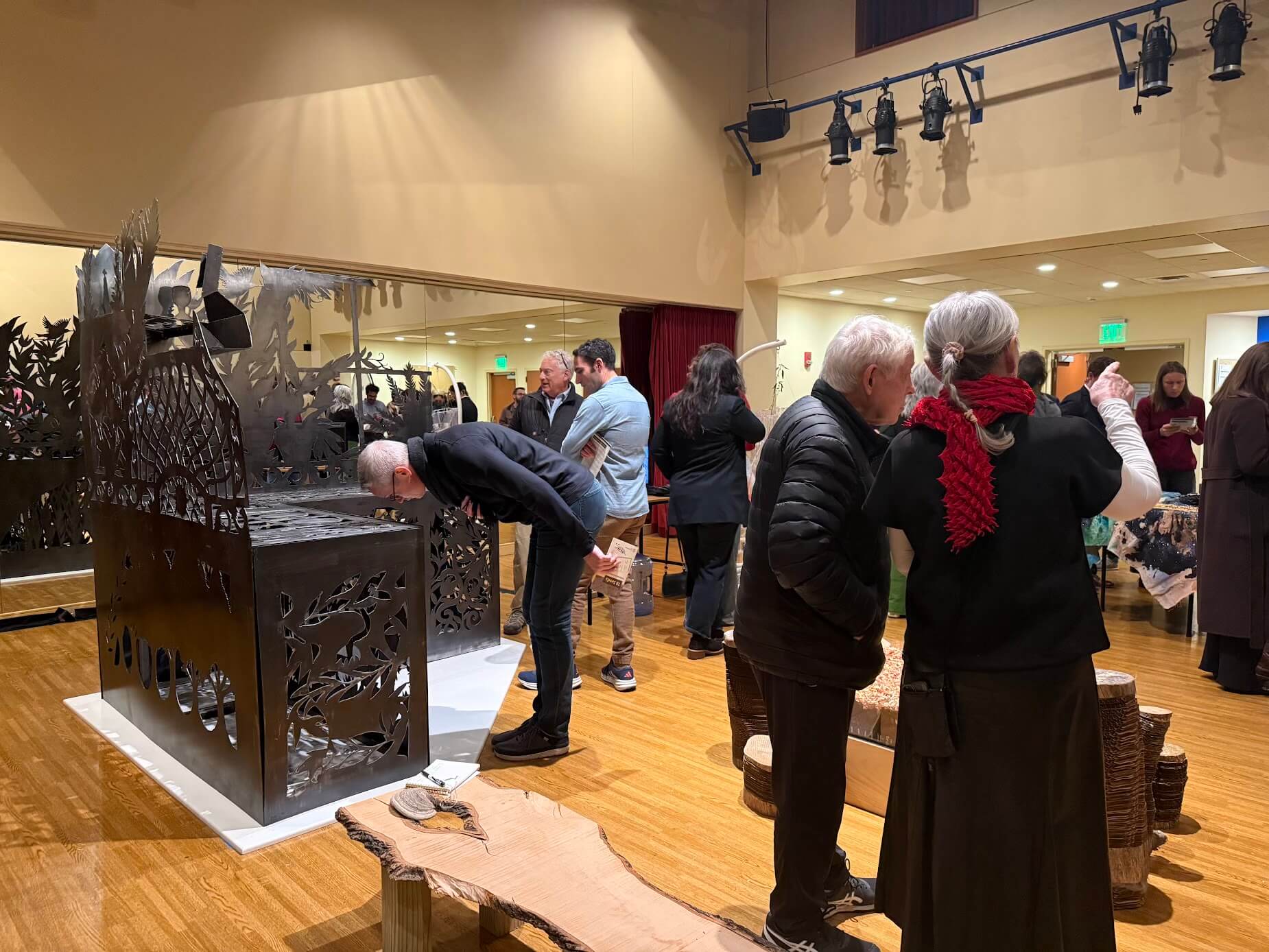
Leviss and Rubensteen launched the 70 Seeds exhibition in Boston’s South End. The exhibition ran from Oct. 27 to Nov. 8, and integrated panel discussions, immersive Shabbat rituals, theater performances, and artist workshops to engage community members and place them at the center of imagining a shared Jewish future beyond a Zionist/anti-Zionist binary.
The 70 Seeds opening was the first Judeofuturism event I attended, and it quickly became clear to me that this project was more than a typical Boston art opening: It was a newly emerging movement that encouraged collective visioning rather than the top-down compliance I’d seen controlling my communities since Oct. 7.
That night, I came upon Nicki Green’s soft-sided pickle fermentation jar, which offered a future where, regardless of belonging to a specific nation-state, Jews can continue to prepare the iconic diasporic food and transport it with them.

I sat on the wooden bench next to Beverly Sky’s reimagined genizah (sacred repository for old texts containing the word God), and was pushed to consider what traditions will continue to fuel Jewish culture and what no longer serve us.
As I moved from installation to installation, among about 100 attendees on opening night, the work created a balm for the festering wound of disconnection and division brought on by increased global turmoil.
These approaches to Jewish futures stood in stark contrast to the binary futures I had previously felt forced to choose between. Their grounding in Jewish ritual and history brought me closer to Jewish culture and to my own identity.
As the night drew on, Rubensteen and Leviss posed the same question to attendees as they had to the show’s artists: “What is your dreamed future of American Jewish life in 2070?”
The date marks two thousand years since the fall of the Second Temple, an event that prompted Jews to radically reimagine Jewish life.
At a moment today when our world is shifting dramatically, Rubensteen and Leviss’ question prompted me and my peers to consider how we might respond to growing pressures using Jewish knowledge. I parsed through the proposed futures laid before me by the exhibition’s artists, and, over the next week and a half, I participated with dozens of people in workshops and panels to see what other possible futures we had not yet considered.
The following night, at a workshop titled “Schism or Realignment? Emerging Identities in Jewish Life,” we negotiated our beliefs about Jewish life and spirituality by placing ourselves along a continuum, engaging with disagreement head-on.

Leviss posed questions to us, debating how open or closed Jewish practice should be to non-Jews, or what role Jewish institutions should play in attending to the needs of their communities. In hearing my peers’ perspectives, I found my own beliefs shifting and observed other participants experiencing the same changes. Rubensteen and her husband, Dr. Josh Eisenberg, even found themselves on opposite sides of the spectrum at times, demonstrating how, even in our most intimate relationships, we see the fractures of our increasingly polarized world emerging.
And yet, while disagreement occurred, our conversations seemed to bring us closer to one another, and closer to a shared vision of what Jewish life can look like outside of the narrow Zionist/anti-Zionist futures that are so well represented.
I realized that, at its core, the Judeofuturism Project was answering the call for a newly emerging Jewish identity, one defined by leftist politics and invested in reimagining ancient Jewish ritual to meet the present moment.
Isabel Mattia — whose work, “Amulet far der Kikh,” examines the kitchen as a site of solidarity, diversity, and potential intercultural connection — encapsulates this growing religious political moment. Drawing on ancient amulets that Jews used for protection and prayer, she examines how, when we turn our prayer towards our families and communities, we might recognize that the source of Jewish life is already within our own ovens and mixing bowls, rather than in a far-away place.
“In my conversations with others, I see a trend that we are sometimes made to feel that to oppose [Palestinian destruction] is somehow radical within Jewish culture. I don’t believe that it is radical at all. My opposition to this has brought me so much more deeply connected to my identity and values as a Jew and to my commitment to keeping Judaism alive and rich for my daughter,” Mattia told the Forward.
As I immersed myself in the Judeofuturism Project’s programs, I began to see Mattia’s sentiment reflected in my experience as well.
While the leftist spaces I previously frequented encouraged me to cut myself off from Judaism in order to access progressive theologies, and the Jewish institutions demanded that I couldn’t access Judaism without identifying as a Zionist, the Judeofuturism Project carved out a path for me and my peers where Jewish values could inform our politics and connect us more deeply to Jewish ritual and culture in the process.
And so, I returned, night after night, along with a handful of community members, to continue down this path.
“The Judeofuturism Project is really vital because it’s something that feels distinctly helpful right now,” Miriam Pellegrino, a design researcher and strategist, told the Forward. “It’s rooted in tradition, but also very imaginative … We’re in a kind of polycrisis, and I think people are hungry for community that helps them collectively parse out how to live a good life.”

And although the Judeofuturism Project’s November programming by no means provided a clear-cut answer to what a “good life” looks like, it placed the power to define a “good life” into the hands of community members, empowering them to build a dynamic, culturally responsive definition together. And, more than anything, it gave me and my fellow attendees the reassurance that we aren’t alone in wanting more than the two options currently on the table.
While the 70 Seeds exhibition concluded on Nov. 8, a digital version of the exhibition is now available for anyone to access and take the work of imagining new Jewish futures into their own hands.
Along with traditional installation photos of each artist’s work, Eisenberg has configured the site with additional resources and commentary, Talmudic-like, to welcome viewers into conversation with each artwork, rather than remaining passive onlookers.
Renderings of each artist’s workspace transport you into the artist’s shoes. Accompanying text offers each artist’s vision of American Jewish life in 2027. An attached workbook invites communities to utilize the exhibition as a tool and framework for their own future-visioning needs.
For Leviss’ part, she already has plans to present on the Judeofuturism Project at the upcoming annual Association for Jewish Studies conference, with the goal of bringing a multi-week exhibition with programming to other cities in the future.
And she’s sure to find more artists to imagine the futures that prompt these important conversations. Already the structures that Leviss and Rubensteen have provided are fueling future work.
“We’re navigating turbulent times, and I feel like we are all grasping for a way through it,” said artist Amalya Megerman, whose imaginative challah amulets draw on ancient Jewish challah rituals for contemporary use as protection against global crises. Finding the Judeofuturism Project was a turning point for Megerman and her creative process.
“The Judeofuturism Project gives me a guiding light to keep the work moving.”
The post I wanted a Jewish future that didn’t force me to choose between Zionism and anti-Zionism. Here’s how I found it. appeared first on The Forward.
Uncategorized
It shouldn’t be dangerous to wrap gifts at the mall for charity – but for Jews in North Carolina, it is
When news reports say antisemitism is rising, it can be hard to know what that means for each of us. As a Jewish American and North Carolinian active in my community, for a long time, nothing in my world seemed different. Now, it does.
Last December, I helped organize a gift-wrapping table at the Crabtree Valley Mall in Raleigh to raise funds for charity. The table was staffed by a group of Jewish women who wrap gifts to raise money for Hadassah, The Women’s Zionist Organization of America, a storied organization that brought modern healthcare to pre-state Israel and created one of the region’s leading hospital systems. Hadassah’s hospitals care for all, regardless of race, religion or nationality, treating more than one million patients a year – Jews and Arabs, Israelis and Palestinians, side by side. Staffed by physicians, nurses and researchers from diverse nationalities, they were once nominated for a Nobel Peace Prize for building bridges to peace through medicine.
Hadassah volunteers have been running the gift-wrapping table for 50 years. For me, this has always been a wonderful example of neighbors reaching out to neighbors during the holidays. But last year, this usually happy event became a dangerous one that put a target on the backs of our volunteers.
Just before Christmas, protesters stood outside the Hadassah booth, stopping customers to tell them, “You are giving money to kill babies in Gaza” and “You are paying for Israel to kill Gazans.” Mall security was called and asked the protesters to leave, but they came back, entered the booth yelling, and confronted our volunteers. At one point, a protester reached into their backpack to pull out something, which was a megaphone, not a weapon, but security escorted this individual out of the mall.
This year, we will not return to the gift-wrapping table. But we are not retreating. Hadassah volunteers have found another way to continue raising funds for healing, because antisemitism does not determine whether Jewish women participate openly in our community.
Amid a nationwide rise in antisemitic violence, including the murder of three people as the result of incidents last year in Washington, D.C., and Boulder, Colorado, we no longer feel it is safe to return to our gift-wrapping table. Being a Jew wrapping holiday gifts at a mall in North Carolina feels just too dangerous right now.
In January, a man who had traveled from South Carolina defaced Charlotte’s Shalom Park Jewish community center, a Jewish day school and a Holocaust memorial with flyers bearing a swastika and a noose. And two months ago, in our own Triangle community, someone identifying himself as the leader of the Goyim Defense League, whose stated goal is to remove Jews from the United States, broke into a Chapel Hill High School Zoom meeting and put up an antisemitic image before being removed. Worse, it happened during the Days of Awe between Rosh Hashanah and Yom Kippur, the holiest period on the Jewish calendar.
Since Oct. 7, 2023, antisemitism has surged across the U.S. and around the world to record levels, and it is not slowing down. This is not an abstract debate. A Hadassah report, From Fear to Resilience: Women Facing Antisemitism, found that nearly two-thirds of Jewish women surveyed said antisemitism affected their daily lives, and more than half of the respondents have taken steps to hide their Jewish identity in public.
Hadassah has not stayed silent in the face of these acts of hatred. We have advocated in Congress for legislation, including the Jewish American Security Act, which would allocate one billion dollars to secure houses of worship and nonprofit organizations, and hold social media platforms accountable for antisemitic content. We have also built local and national partnerships to advance interfaith dialogue and to fight antisemitic misinformation in schools and other community spaces.
These bills matter but are not enough. Laws alone will not change what happened at Crabtree Valley Mall and Shalom Park and on the Chapel Hill Zoom call. What is missing is leadership, and that starts at home.
Our experience highlights an important challenge for our communities: Our response to antisemitism cannot just be adding more security – though we certainly do need that. We checked to see what additional security would cost to keep our volunteers safe at the mall. It was over $20,000. That’s more than we raise with our annual event.
If we want to prevent antisemitism from becoming the new normal, we need a multi-pronged plan of action to push back against hate nationally and locally. Federal legislation isn’t enough. We stand ready to do this work. We also need North Carolina’s elected officials and community leaders to speak out against antisemitism and to back up their statements with action. Otherwise, we will see more incidents like those we’ve experienced – and perhaps worse.
The post It shouldn’t be dangerous to wrap gifts at the mall for charity – but for Jews in North Carolina, it is appeared first on The Forward.
Uncategorized
We are still drawn to holy ground, even as it shifts beneath us
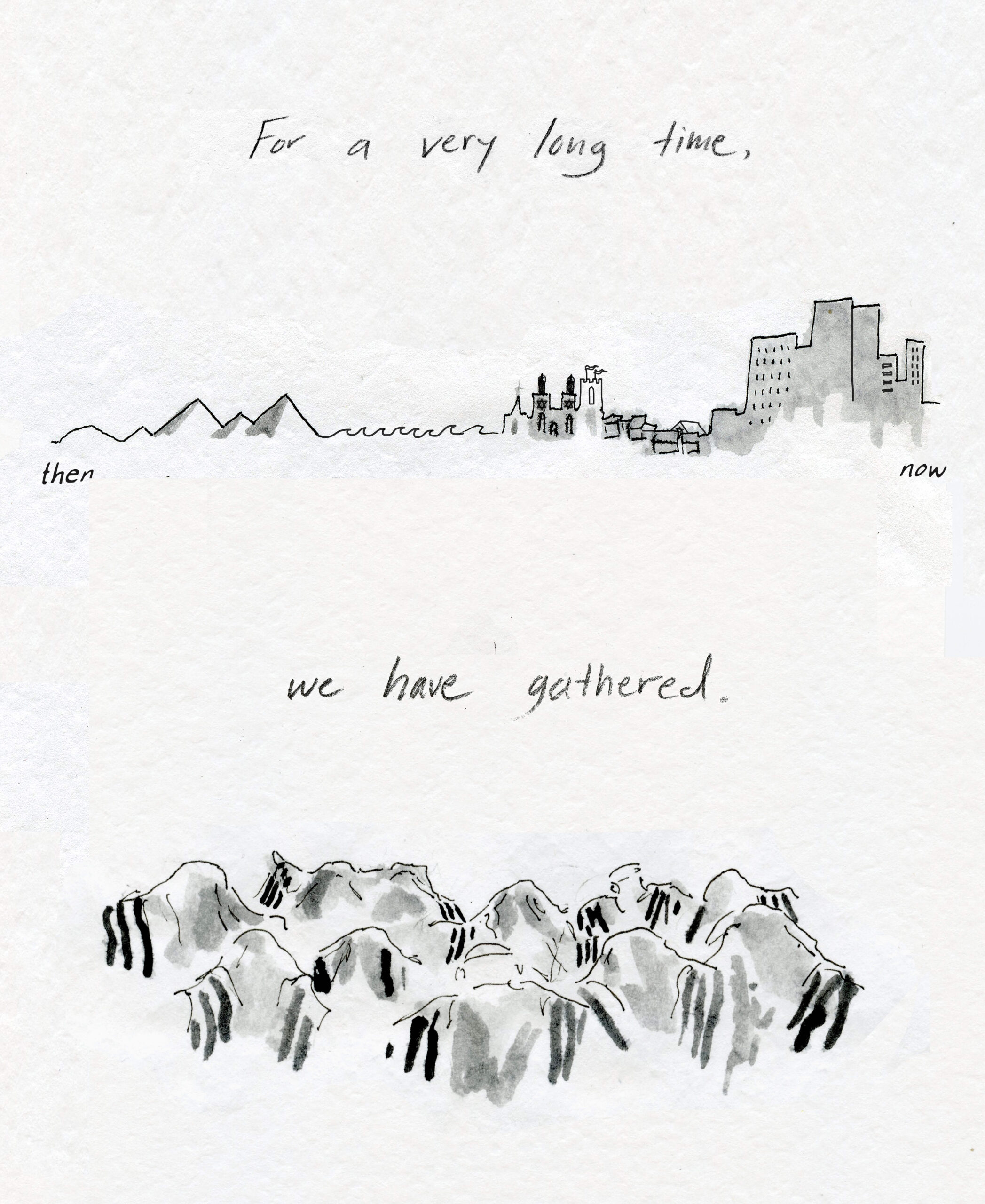
Cartoonist Mia Rose Kohn, inspired by our Holy Ground series about Jewish resilience and reinvention, considers what keeps us craving sacred spaces — even as we change.


The post We are still drawn to holy ground, even as it shifts beneath us appeared first on The Forward.
