


Uncategorized
‘We are not alright’: How Oct. 7 defined Eric Adams’ Jewish legacy
As New York City Mayor Eric Adams was welcomed to deliver remarks at his final Hanukkah reception — just a day after the horrific terror attack in Bondi Beach — he made a characteristically unscripted entrance, walking in from the side of the room holding a wireless microphone instead of stepping onto the stage in the center. Adams told the audience on Monday night that he did not want to be separated from them by ropes or barriers. “I just really wanted to remind all of you that I am on your level,” he said. “I want you to know that your pain, I feel your pain.”
That moment, signaling that he understood not just the community’s fear after the attack, but its need for visible solidarity, was the kind of instinctive gesture that, aides and allies say, has defined his relationship with Jewish New Yorkers during a tumultuous single term as mayor.
As he prepares to leave City Hall on Dec. 31, having failed to overcome his unpopularity citywide and win reelection, Adams remains personally popular among much of the Jewish community, which continues to grapple with uncertainty about his successor, Mayor-elect Zohran Mamdani, whose stance on Israel has been divisive.
Throughout his tenure, Adams cultivated a reputation for speaking the Jewish community’s language, understanding their concerns and being willing to step up in moments of crisis. Senior aides say he rarely reads prepared remarks, even when speeches are written for him, particularly at Jewish events.
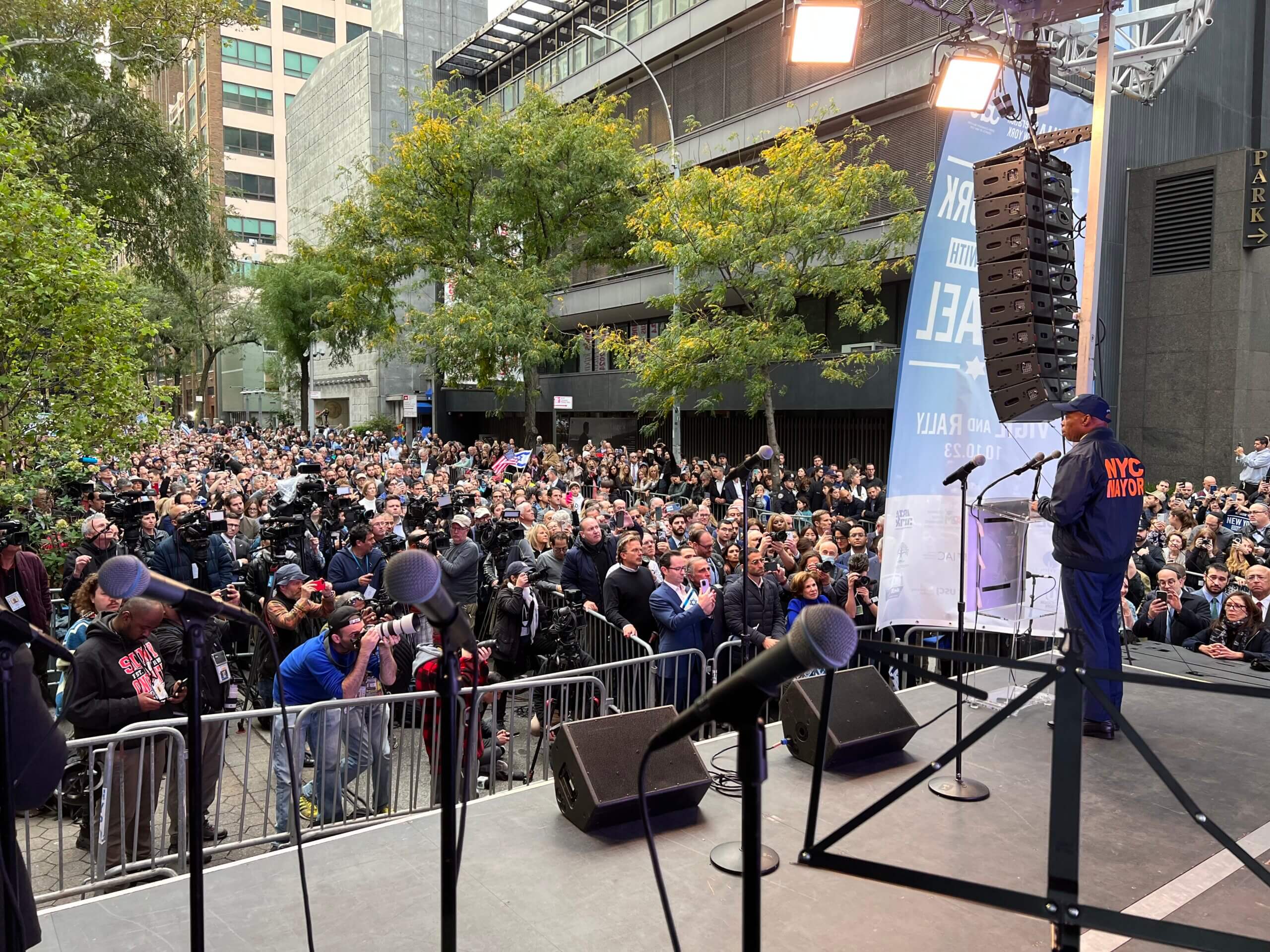
This spontaneity was most evident in a four-minute speech he delivered at a rally on Oct. 10, 2023, days after the Hamas attack on Israel. The moment raised his profile in Israel, when he declared, “We are not alright.”
“The fact that everybody in the Jewish world has seen that speech, such a short clip, speaks to the impact on Jews around the world,” said Fabian Levy, the deputy mayor for communications, who is Jewish. He recounted the behind-the-scenes moments leading up to the speech in a recent interview, growing emotional at times and struggling to speak. Before Adams took the stage, he met with the parents of Israeli-American hostage Omer Neutra.

Levy, 41, is considered one of Adams’ closest aides, frequently at the mayor’s side. He was first appointed as press secretary in 2021, and elevated to his current role in August 2023, becoming the first-ever deputy mayor of Persian or Iraqi descent. Levy said that some of his relatives in Israel, who knew he worked in government but did not realize he worked for Adams, had posted that Oct. 10 speech to a family WhatsApp group and suggested he “work for this guy.”
When I asked about his popularity in Israel in a recent interview, Adams said, “My clarity of message, I believe it resonated with people who have been there for others, yet did not see their allies stand up and fight with them. The friendship we have with Israel and our Jewish community is not one that ends during the time of conflict, but one that withstands difficult challenges.”
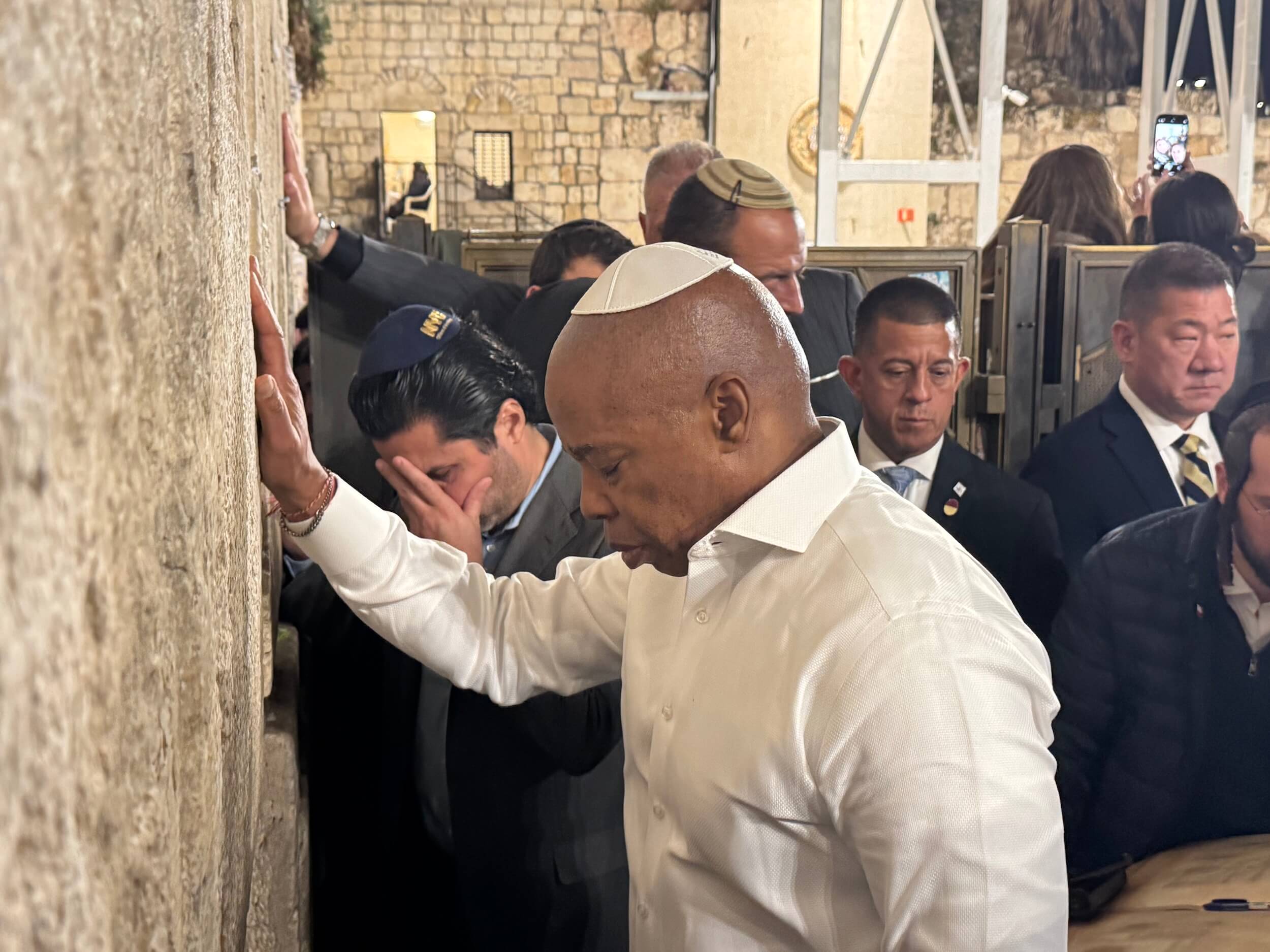
In Monday night’s farewell address to the community, following a final official trip to Israel, Adams cast himself as a modern-day Maccabee.
Eric Adams’ relationship with Jews
Adams, 65, has had a longstanding relationship with the Jewish community dating back to his time as a police officer in the 1980s, a connection that continued through his four terms in the state legislature and two terms as Brooklyn Borough President.
He aggressively courted Orthodox voting blocs, critical to electing him, in the 2021 crowded Democratic primary for mayor. “I don’t need a GPS to find Borough Park,” Adams said in a campaign stop in Borough Park a day before the primary. “I was there for this community for over 30 years, and I am going to be there as the mayor. I’m not a new friend. I’m an old friend.”
Adams initially moved his Jan. 1, 2022 inauguration — traditionally held at noon in the plaza outside City Hall in downtown Manhattan and drawing thousands of spectators — to the evening out of respect for Shabbat observers, since it fell on a Saturday. The ceremony was later postponed and scaled back altogether as the Omicron COVID-19 surge swept through the city at the time.
A large number of American Jews served in senior roles at City Hall and throughout Adams’ administration. That includes Jessica Tisch, who became police commissioner in 2024; Robert Tucker, commissioner of the fire department; Fred Kreizman, commissioner for community affairs; Zach Iscol, the emergency management commissioner; and Ed Mermelstein, commissioner for international affairs until July.
In the mayor’s office, Levy served alongside Menashe Shapiro, deputy chief of staff; Moshe Davis, Adams’ Jewish liaison and later also director of the newly-created mayor’s office to combat antisemitism; and Lisa Zornberg, his chief counsel, who inspired the mayor’s widely cited Oct. 10 line and resigned last year amid the federal investigations that rocked the Adams administration.
Joel Eisdorfer, a member of the Satmar Hasidic community in Borough Park, was senior adviser until he stepped down in 2024, citing family reasons, and was a close political ally who helped mobilize Jewish support during Adams’ campaigns. Adams’ personal photographer, Benny Polatseck, who is also Hasidic, documented many of his appearances at Jewish and other official events.
“You see yourself in my administration, in a very significant place,” Adams told Jewish reporters in 2024.
In speeches to Jewish audiences, Adams described New York City as the “Tel Aviv of America.”
But Adams faced criticism from parts of the broader Jewish community after launching a Jewish Advisory Council that met regularly to discuss Jewish-related issues. Some liberal groups argued the council was not representative of the city’s full Jewish diversity, noting that at least 23 of its 37 members were Orthodox Jews and only nine were women. The progressive group New York Jewish Agenda later met with Adams after raising concerns that he was primarily hearing from Orthodox leaders and those with more conservative political views.
Last year, Adams announced the creation of a new office to combat antisemitism, which led to a bitter feud with the city comptroller, Brad Lander, who is Jewish and who was at the time a mayoral candidate. (Adams and Lander have long had a strained relationship, sparring over policy and oversight.)
Adams also signed an executive order adopting the controversial International Holocaust Remembrance Alliance definition of antisemitism, which labels most forms of anti-Zionism as antisemitic. Critics, including progressives and Jewish advocacy groups, warned it could chill free speech.
Some Jewish elected officials also criticized Adams for his crackdown on the pro-Palestinian protests across the city and on college campuses. He was unapologetic about his opposition to the call for a ceasefire in Gaza.
Recently, Adams signed a measure barring city agencies from participating in Boycott, Divestment and Sanctions efforts, which would pre-empt any moves by city officials to divest from Israel Bonds and other Israeli investments. Adams maintained that it wasn’t an attempt to tie Mamdani’s hand but “to protect my legacy on the investment in Israel.”
During a roundtable with ethnic media outlets at City Hall on Monday, Adams didn’t elaborate when asked by the Forward how he would define his tenure in terms of curbing antisemitism and protecting Jewish New Yorkers. Antisemitism was up 18% in New York last year, with 68% of the 1,437 incidents occurring in New York City, according to the Anti-Defamation League. In the first quarter of 2025, NYPD data showed antisemitic acts made up 62% of all reported hate crimes citywide. Last month, anti-Jewish crimes were 37% of all reported hate incidents.
Adams said the numbers have been steadily dropping as a result of his moves to counter antisemitism, including his signature “Breaking Bread, Building Bonds” initiative, which encourages New Yorkers to host meals for 10 people from different racial, ethnic and religious backgrounds. “I think that the next administration must be extremely clear in their position around hate in general and antisemitism,” he said.
Levy said that Adams acted bravely in taking a firm stance on Israel, even when it carried political risk. “Some people are saying that it could have been the reason why he is no longer going to be mayor for another term,” Levy said. “He did it because it was the right thing to do.” Adams took a recent trip to Israel to bid farewell.
Shadowed by controversy
Despite his close and warm relationship with the Jewish community, Adams’ career has also been marked by recurring controversies. During the 1993 mayoral race, when he supported incumbent Mayor David Dinkins, Adams drew backlash after suggesting that then–state comptroller candidate Herman Badillo, who is Puerto Rican, would have shown greater concern for the Hispanic community had he not married a white Jewish woman. In the 1990s, Adams worked with the Nation of Islam as part of community crime patrol efforts and appeared publicly with its leader, Louis Farrakhan, who spewed antisemitism. He later came under fire for condemning former Rep. Major Owens during a 1994 congressional primary after Owens denounced Farrakhan.
As mayor, Adams faced renewed scrutiny in 2022 after defending his endorsement of a minister previously cited for antisemitic slurs in a race against a pro-BDS lawmaker. More recently, he faced criticism for invoking Adolf Hitler’s Mein Kampf while pushing back against allegations that he struck a quid pro quo with the Justice Department to end his federal corruption case, and for sitting for an interview at Gracie Mansion with Sneako, an influential antisemitic online streamer.
Adams made combating antisemitism central to his reelection effort. After withdrawing from the Democratic primary, facing a surging field of challengers, Adams sought to run on an independent line dubbed “End Antisemitism.” It came under legal challenge after creating another “Safe and Affordable” ballot. He ended his campaign in late September after failing to gain steam and in an attempt to clear the field for former Gov. Andrew Cuomo to stop Mamdani.
He also got into a dispute between Williamsburg Hasidim over the bike lanes earlier this year.
What his aides and Jewish leaders are saying

Adams’ senior aides and Jewish leaders all pointed to Adams’ response to the Oct. 7, 2023 attack on Israel as the high point of his tenure.
“His consistent support for the Jewish community after Oct. 7 was a model for what real leadership looks like,” said David Greenfield, a former member of the City Council who is now the chief executive of Met Council, the nation’s largest Jewish anti-poverty charity. “His remarks were, for many of us, the first time we felt genuinely seen and defended by leaders outside our community. At a moment of surging antisemitism, he didn’t hedge or look away.”
Sara Forman, executive director of the New York Solidarity Network, a pro-Israel political organization, said the expression of empathy he expressed toward the Jewish people by showing up “was very poignant and also a very significant legacy that Eric Adams is going to leave with all of us.”
In interviews, Adams’ Jewish staffers described a natural rapport with the community that often lessened the need for formal outreach or guidance on specific issues.
Shapiro, his deputy chief of staff, said that Adams’ unscripted nature underscored his familiarity and a genuine sense of belonging in the community. “He felt so comfortable in their presence, he knew exactly what he wanted to say,” Shapiro said.
“With Mayor Adams, you always felt like he practically went to yeshiva with you,” Davis, his liaison to the community, said. “He’s been in this so long and really knows what the community cares about.”
In his remarks at the Hanukkah event, Adams reassured the community that he will remain an ally after he leaves office. “I am going nowhere,” he said. Earlier in the day, Adams referred to what comes next as “God’s Plan A.” Adams is reportedly exploring a private-sector opportunity tied to an Israeli construction firm. “The end of the mayoralty means the beginning of what we are going to do together,” he said.
The post ‘We are not alright’: How Oct. 7 defined Eric Adams’ Jewish legacy appeared first on The Forward.
Uncategorized
Downed Planes Raise New Perils for Trump as Tehran Hunts for Missing US Pilot

Traces of an Iranian missile attack in Tehran’s sky, amid the U.S.-Israeli conflict with Iran, in Tehran, Iran, April 3, 2026. Photo: Majid Asgaripour/WANA (West Asia News Agency) via REUTERS
Two US warplanes were downed over Iran and the Gulf, Iranian and US officials said on Friday, with two pilots rescued and a third still missing and being hunted by Tehran’s forces.
The incidents show the risks still faced by US and Israeli aircraft over Iran despite assertions from US President Donald Trump and his Defense Secretary Pete Hegseth that their forces had total control of the skies.
The first plane, a two-seat US F-15E jet, was shot down by Iranian fire, officials in both countries said.
The second plane, an A-10 Warthog fighter aircraft, was hit by Iranian fire and crashed over Kuwait, with the pilot ejecting, two US officials said.
Two Blackhawk helicopters involved in the search effort for the missing pilot were hit by Iranian fire but made it out of Iranian airspace, the two US officials told Reuters.
The degree of injuries among the crew of the aircraft remained unclear. The status and whereabouts of the missing F-15E crew member was not publicly known.
Iran’s Revolutionary Guard Corps said it was combing an area near where the pilot’s plane came down in southwestern Iran and the regional governor promised a commendation for anyone who captured or killed “forces of the hostile enemy.”
Iranians, who have been pummeled by American air power for weeks, posted gleeful messages celebrating the plane downings. Iran’s Parliament Speaker Mohammad Baqer Qalibaf said on X that the U.S. and Israel’s war had been “downgraded from regime change” to a hunt for their pilots.
Trump has been in the White House receiving updates on the search-and-rescue operation, a senior administration official told Reuters. The Pentagon and US Central Command did not immediately respond to requests for comment.
NO SIGN OF END TO WAR
The prospect of a US service person being alive and on the run inside Iran raises the stakes for Washington in a conflict with low public support and no sign of an imminent end.
Iran has officially told mediators it is not prepared to meet with US officials in Islamabad in coming days and that efforts to produce a ceasefire, led by Pakistan, have reached a dead end, the Wall Street Journal reported on Friday.
The US and Israel opened the campaign with a wave of strikes that killed Iran’s Supreme Leader Ayatollah Ali Khamenei on February 28. The war has killed thousands and threatened lasting damage to the global economy.
So far, 13 US military service members have been killed in the conflict and more than 300 have been wounded, according to the US Central Command.
Iran has rained down drones and missiles on Israel. It has also taken aim at Gulf countries allied to the US, which have so far held back from joining the war directly for fear of further escalation.
In a security alert on Friday, the US embassy in Beirut said Iran and its aligned armed groups may target universities in Lebanon and urged US citizens in the country to leave while commercial flights are still available.
Israel has been waging a parallel campaign against Iran-backed Hezbollah in Lebanon after the militant group fired at Israel in support of Iran.
TRUMP THREAT TO STRIKE BRIDGES, POWER PLANTS
On Friday, as Trump threatened to hit its bridges and power plants, Iran struck a power and water plant in Kuwait, underlining the vulnerability of Gulf states that rely heavily on desalination plants for drinking water.
On Thursday, Trump posted footage on social media showing dust and smoke billowing up as US strikes hit the newly constructed B1 bridge between Tehran and nearby Karaj, which was due to open this year, and said more attacks would follow.
“Our Military, the greatest and most powerful (by far!) anywhere in the World, hasn’t even started destroying what’s left in Iran. Bridges next, then Electric Power Plants!” he wrote in a subsequent post.
On Friday, a drone hit a Red Crescent relief warehouse in the Choghadak area of Iran’s southern Bushehr province.
Kuwait Petroleum Corporation said its Mina al-Ahmadi refinery had been hit by drones. Other attacks were also reported to have been intercepted in Saudi Arabia and Abu Dhabi. Missile debris landed near the Israeli port of Haifa, site of a major oil refinery.
Oil markets were closed after benchmark U.S. crude prices gained 11% on Thursday following a speech by Trump that offered no clear sign of an imminent end to the war.
Uncategorized
US-Iran: Diplomatic Push Falters as Qatar Steps Back and Pakistan Talks Stall

Qatari Prime Minister and Foreign Minister Sheikh Mohammed bin Abdulrahman Al Thani speaks after a meeting with the Lebanese president at the presidential palace in Baabda, Lebanon, Feb. 4, 2025. Photo: REUTERS/Emilie Madi
i24 News – Diplomatic efforts to secure a ceasefire between Washington and Tehran appear to have reached an impasse, as key regional mediators pull back and broader talks stall.
According to reporting by The Wall Street Journal, Qatar has informed US officials that it does not wish to take a central role in mediating between the two sides. Officials familiar with the matter said Doha has made clear it is “not willing” to lead negotiations or act as the primary broker.
At the same time, Pakistan-led efforts to bring Iranian and American officials together have also stalled. Mediators say Tehran has refused to attend proposed meetings in Islamabad, calling Washington’s conditions “unacceptable,” further underscoring the widening gap between the two sides and the growing difficulty of restarting dialogue.
Despite the deadlock, diplomatic channels have not fully closed. Turkey and Egypt are continuing parallel efforts to revive talks, with discussions underway about potential alternative venues, including Doha and Istanbul.
US President Donald Trump downplayed the impact of recent military developments on diplomacy, including the destruction of a US fighter jet during operations in Iran. Speaking in a brief exchange with an NBC News journalist, he said: “No, not at all. It’s war. We are at war.”
He further fueled speculation with a cryptic social media post on Truth Social, writing: “Keep the oil, anyone?” criticising international allies on Friday over rising fuel prices. Trump appeared to mock allies such as the United Kingdom, writing that they should “keep the oil.”
Uncategorized
Report: Iran Retains Significant Missile Capability Despite Weeks of US-Led Strikes

Iranian missiles are displayed in a park in Tehran, Iran, Jan. 31, 2026. Photo: Majid Asgaripour/WANA (West Asia News Agency) via REUTERS
i24 News – Despite weeks of sustained airstrikes by the United States and its allies, Iran has reportedly managed to retain a substantial portion of its military capabilities, particularly its ballistic missile arsenal.
According to a report by The New York Times citing US intelligence assessments, Tehran has developed methods to mitigate the impact of the strikes, allowing it to preserve and restore key parts of its missile infrastructure.
While the Pentagon has claimed responsibility for striking more than 11,000 targets over five weeks and reducing the rate of Iranian missile fire, intelligence officials now caution that the actual damage may be more limited than initially assessed. Iranian forces are reportedly able to rapidly repair or reactivate missile launchers stored in heavily fortified or underground facilities, sometimes within hours of being hit.
Analysts also point to the widespread use of decoy sites, which may have drawn strikes away from operational assets. Many of the targeted locations are believed to have contained dummy installations, complicating efforts to accurately gauge the degradation of Iran’s ballistic capabilities. Combined with deep underground bunkers and dispersed storage networks, this approach is seen as enabling Tehran to maintain a higher level of readiness than publicly estimated.
US intelligence officials assess that this resilience reflects a deliberate strategy: preserving a credible long-range strike capability as both a deterrent and a bargaining tool in any future negotiations, while ensuring regime survival and continued regional influence.
Despite sustained air dominance claimed by Washington and its allies, Iran’s adaptive tactics continue to complicate battlefield assessments, leaving the true balance of power in the conflict uncertain.