


Uncategorized
What is the state of American Zionism today, and how did we get here?
As long as Jews have been Jews, from God’s call to Abraham in Genesis chapter 12, our identity has been measured by way of geographical and spiritual proximity to the land. A first principle which – and I can’t help myself – New York’s Mayor-elect elides and ignores when he calls himself an anti-Zionist but not an antisemite.
From Joseph being sold down to Egypt in this week’s Torah reading, through our wilderness wanderings, the first commonwealth, our laments by the rivers of Babylon, the second commonwealth and subsequent exile – whether exile be due to the hands of our oppressors, or, for the theologically minded, mipnei hata·einu, due to our own sins – our eyes and hearts have turned to Zion.
In good times and bad, as Jewish communities flourished in Bavel, in Spain, or anywhere else, by way of halakhic literature, poetry, or breaking glasses at weddings, we are ever reminded im eshkakhekh, If I forget thee. The foundation of Jewish existence has always been a connection to the land – when we were in the land, and when we were not.
– The emergence of Zionism –
As the limitations of the Enlightenment and Emancipation became evident in the second half of the nineteenth century, what was a distant hope for return took on new urgency with individuals like Leon Pinsker (Auto Emancipation, 1882), Theodor Herzl (The Jewish State, 1896), and Max Nordau (Jewry of Muscle, 1903). It was time for Jews to become the subject of their own sentence rather than the object of someone else’s.
As I always remind the rabbinical students I teach, Orthodox, Conservative and Reform Judaism are but three of a handful of responses to the challenge of modernity, the question of how to be a Jew in the modern world. The most famous and perhaps most successful response to the Jewish question, as Herzl best understood, is Zionism, a vision by which a Jew could be fully Jewish and a full citizen of the world, the Jewish people a nation like other nations.
No matter the passion of Zionism’s founding idealogues and the courageous first waves of aliyah, the vast majority of Jews did not heed the Zionist rallying cry, but instead emigrated to American shores or, as in the case of my grandparents, to the United Kingdom. The story of American Jewry is largely (but not entirely) the tale of two million Jews (out of 20 million immigrants) who arrived in America around the turn of the twentieth century in search of a better life for themselves and their descendants – seeking to balance the hyphen of American-Jewish identities.
It was not then, nor is it now, a straightforward proposition to hold multiple hyphenated identities – never mind loyalties. I think of Theodore Roosevelt’s infamous 1916 address entitled “America for Americans,” where he proclaimed: “I stand for straight Americanism unconditioned and unqualified, and I stand against every form of hyphenated Americanism.” Roosevelt decried what he dubbed the “moral treason” of anyone acting or speaking as a German-American, Irish-American, English-American, or any other hyphenated identity.
It was this context – the challenge of hyphenated identities – that was the backdrop for Justice Brandeis’s 1915 insistence that Zionism was consistent with American patriotism, in a landmark Zionist speech that was delivered to a group of Reform rabbis who feared that supporting the Yishuv (the early settlements in then Palestine) would be perceived as somehow incompatible with the aspiration of being accepted as an American. For American Jews, the task was a tricky one. A not-yet-established American Jewish community fearing the charge of dual loyalty figuring out what to do with the not yet established Yishuv.
– American Zionism takes root –
No discussion of American Zionism can occur without mention of Henrietta Szold. More than Brandeis, more than Stephen Wise or Abba Hillel Silver, it is Szold, the founder of Hadassah, to whom all American Zionists owe a debt of gratitude beyond repayment. Szold delivered her first lecture on Zionism in 1896 – prior to Herzl’s publication of Der Judenstaat.
As the daughter of Russian immigrants, Zionism held a central place for Szold and her conception of Judaism, a belief that Judaism could only be in “full flower” when normal human life was built around Jewish principles – Hebrew language, Hebrew literature, and beyond. Perhaps more importantly, it would be the organization that Szold established – Hadassah – that would forever change the face of American Judaism and American Zionism.
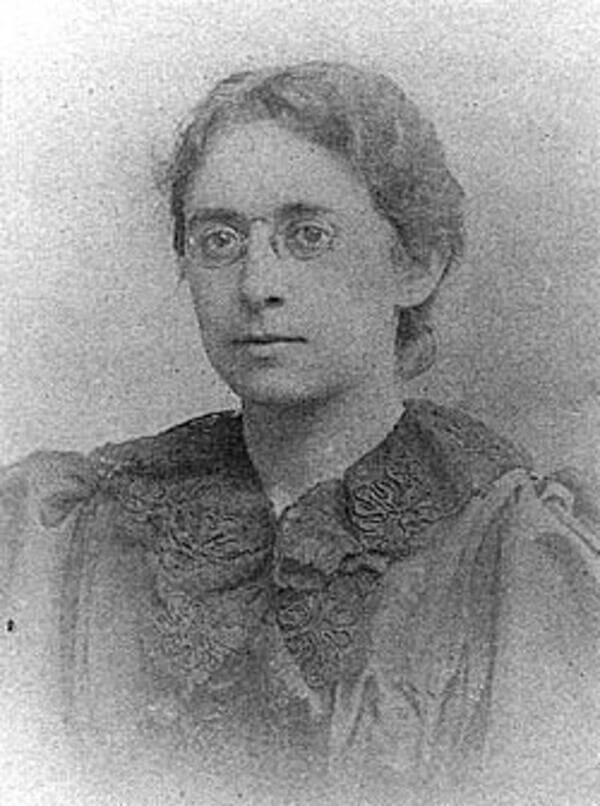
Hadassah grew from the shattered shards of Szold’s broken heart, founded by Szold with six other women in the vestry room of New York’s Temple Emanuel. Because while Brandeis was off telling people that patriotism and Zionism were compatible one with another, Szold and her Hadassah compatriots were showing people how it could be done.
In Francine Klagsbrun’s words: “Unlike male Zionists, with their often grandiose political and nation-building objectives, these women could identify with the down-to-earth goals and skills . . . that Hadassah emphasized.”
The cause of medical care in Palestine (Hadassah’s first hospital was dedicated some 100 years ago), the cultural work, the philanthropy, eventually youth aliyah – Hadassah provided a vehicle by which American Jews could do the pragmatic work of Zionism without living in Zion itself.
As Klagsbrun points out, the effects of Hadassah were not solely to elevate the lives of those in the Yishuv. Their work provided an organizing principle, a civil religion, that enhanced the lives of American Jews.
As Szold wrote privately in her diary: “We [American Jews] need Zionism as much as those Jews do who need a physical home.”
Not just women’s organizations, but every American Jewish organization aimed at the building up and uplifting of Jewish life in the Yishuv and subsequently Israel owes a debt of gratitude to Szold. The critical point, to which we will return soon enough, is that the work of Hadassah, as much as it was in service to Jews in Palestine, was also in service to American Jewry. A faith, a civic faith, by which American Jews, in doing good work on behalf of Jews in Palestine, could bring spiritual renewal to themselves.
American Zionism was not, by any stretch of the imagination, a given. Reform, Orthodox, and my own denomination, Conservative Judaism all had non-Zionist devotees. While there are books written on the subject, my favorite story comes from my alma mater, the Jewish Theological Seminary, in 1945.
Then chancellor Louis Finkelstein understood JTS and, for that matter, Judaism as whole to have a universal mission: to be, in his words, “a civilizing influence on the modern world.” Which also meant that his views on Zionism were lukewarm at best. Despite his love for the Jewish people Finkelstein could never quite square the circle of a Jewish nation-state.
Having come of age during the Great War, Finkelstein bristled against nationalisms of all kinds. As the head of the leading Jewish educational institution of America, his bets were on Jewish life in the diaspora, not Palestine; as a human rights advocate, he would only support a Jewish state that conferred equal status to Christians and Muslims; not to mention that Finkelstein’s fundraising base was dependent on Arthur Hayes Sulzberger and Lewis Strauss – two anti-Zionist JTS board members.
Thus, despite the Zionism of most American Jews, the rabbinical leadership of the Conservative movement, and the student body of the Seminary itself, Finkelstein stayed firm in his non-Zionism. So adamant was Finkelstein’s position, that at the 1945 pre-state JTS graduation, the students’ request to sing Hatikvah at commencement was turned down. In an act of defiance, the students arranged with the carilloneur at Union Theological Seminary across the street to play the melody so it could be heard during their processional.
A younger generation of students protesting the older generation for being too soft on Zionism. History, it would seem, has a wicked sense of humor.
– Zionism in the diaspora –
Oscar Wilde once said something to the effect of “there are two tragedies in the world – one is not getting what you want and the other is getting it.” The establishment of the state of Israel – l’havdil – marked an unprecedented opportunity and challenge for American Jewry as we finally “got” that which we had sought over the millennia.
When Israel’s first prime minister, David Ben-Gurion established the State of Israel on May 14, 1948, it was both a culmination of and a break with thousands of years of Jewish history. For those who lived in Israel, of course, but also for those who did not. Israel was no longer an abstraction. How would diaspora Jews orient themselves to the living, breathing Jewish state as they opted not to live there?
Prior to statehood, the term “Israel” referred to the entire people of Israel, wherever they might dwell. Following May 14, 1948, as Ben-Gurion made clear in a famous exchange with Simon Rawidowicz, Israel became a specific geographic and statist designation – no longer the name for the global people of Israel.
How does a Jew living in Moscow, Milan, or Milwaukee support the Jewish state while remaining a proud citizen of their own country of residence and citizenship?
Up until 1948, Zionism, loosely defined, stood for supporting efforts to establish the Jewish state in the land of Israel. In 1961, when Rabbi Joachim Prinz proclaimed to the AJC, “Zionism is dead – long live the Jewish people,” he did so because he believed that with the establishment of Israel, Zionism had fulfilled its purpose and what was needed was “a new and dynamic movement to preserve Jewish peoplehood and create an independent and positive link between American Jewry and Israel.” The landscape had changed.
“What is the new definition of Zionism for the person who has chosen to opt out of settling in the land?”
Rabbi Elliot Cosgrove
What is the new definition of Zionism for the person who has chosen to opt out of settling in the land? To what degree may, or must, a diaspora Jew engage with, support, defend, or critique the actions of the Jewish state, a state that, no different from any other state, makes both good and bad choices? Is Israel the Jewish state, or the state of the Jews – all Jews, wherever they may be? What does all this mean in practice?
From Israel’s founding, this debate over American Jewry’s relationship to Israel has taken many guises. In 1950, for instance, Ben-Gurion and Jacob Blaustein, the then president of the American Jewish Committee, agreed that Ben-Gurion would both tone down his calls for diaspora emigration and refrain from intervening in American Jewish life. In exchange, Blaustein (speaking on behalf of American Jewry) stated that while American Jewry could offer advice, cooperation, and help, it would not attempt to speak for Israel. The importance of the Ben-Gurion–Blaustein agreement is not so much its durability, but, with the hindsight of the last 75 years, that it is a benchmark more honored in the breach than in its observance.
The 1950s would see the building of a Zionist consensus for American Jewry. With the establishment of the State of Israel, any lingering non-Zionism had become a moot point. By 1952, Finkelstein was awarding an honorary doctorate to Ben-Gurion. The establishment of the Conference of Presidents, the registering of AIPAC as a lobbying organization, and for American Orthodox, the gushpanka (stamp of approval) of Soloveitchik’s Kol Dodi Dofek in the midst of the Suez Crisis – all signaled the Zionist transformation of American Orthodoxy.
In the wake of the Shoah, Israel’s founding had profound implications for the self-perception of diaspora Jews. At its most basic level, Israel provided refuge for world Jewry should they need it. Never again would Jews, as was the case in the Shoah, be denied safe harbor from their oppressors. But Israel was more than that. In diaspora hearts and minds, it was a source of pride: a new and more assertive identity that served as a counterpoint to the vulnerability of the Shoah and the thousands of years of pogrom-filled exile that preceded it. While opting out of living in Israel, diaspora Jews derived vicarious confidence as the first stages of Israel’s existence unfolded. Whether we were safer because Israel existed or not was beside the point; we felt safer because we lived in a time of a Jewish state.
– Israel became a secular religion –
American Jewry’s engagement with Israel became a constituent building block of American Jewish identity, a civil religion to complement our religious religion.
The pulpit of my synagogue, like so many others, is adorned with an Israeli flag, and the prayer for the State of Israel is central to our liturgy. Curriculum teaching the history of Zionism and modern Israel is integrated into congregational schools, Jewish day schools, and Jewish camping. In times of both comfort and crisis, American Jews raised vast sums of money for Israel. Summers in Israel, gap semesters, and gap years became normative expressions of Jewish life.
Politically, American Jews were expected to support elected representatives who prioritized the defense of Israel, important acts unto themselves but also a rallying cry to unify American Jewry in all its political and religious diversity. As the slogan goes, “Wherever we stand, we stand with Israel.” Two of the most impactful achievements of American Jewry over the past half-century are AIPAC, the American Israel Public Affairs Committee, and Birthright Israel, offering a free ten-day trip to Israel to all Jewish young adults, ages eighteen through twenty-six. Both efforts centered on Israel engagement.
In ways Henrietta Szold could not imagine, Israel came to serve as the bonding agent to keep American Jewry together. It focused our energies. We were proud of our Israeli cousins and wanted to help them, and the fact that we could provide Israel with philanthropic and political support served their needs and ours. Israel missions, Israel education, Israel advocacy — in good times and bad — became a secular religion for American Jews, sometimes supplanting Judaism itself. It is easier, after all, to write a check than it is to keep our children home on Friday night to light Shabbat candles. It is easier to call someone a self-hating Jew than to worry about your children or grandchildren’s non-observance.
Uninspired by the prayerbook, unfamiliar with the Talmud, American Jews became adept at new Jewish topics of conversation: how our elected leaders vote on legislation regarding Israel’s security or the terms by which the United States should or shouldn’t enter into a deal with Iran. The dividing lines between us no longer fell along the various levels at which we observed the Sabbath or dietary laws, or our beliefs as to whether the Torah is or isn’t of divine origin. Our views on Israel took the place of these. The decisions being made in a sovereign Jewish state in which we do not live, vote, pay taxes, or serve in the military became the basis of a new Israel-based religion.
And in many respects, engagement with Israel became more than a religion; it became an orthodoxy. Again, it makes perfect sense that the imperfect policies of Israel (or any state) might be worthy of objection – by Israelis, Israel’s Jewish supporters, or anyone – but sense has very little to do with it. For an American Jew to suggest that this or that policy of the Israeli government was not in the long-term best interest of Israel came to be understood by the American Jewish establishment as a form of betrayal.
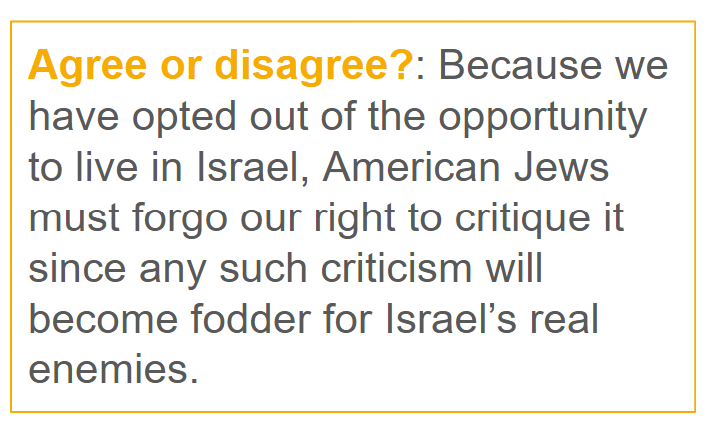
As the late Rabbi Arthur Hertzberg once observed, “The lack of support for Israel [is] the only offense for which Jews can be ‘excommunicated.’” Israel, the thinking goes, does not lack for external enemies. Because we have opted out of the opportunity to live in Israel, American Jews must forgo our right to critique Israel because any such criticism will become fodder for Israel’s real enemies.
“American Jews feel that the Israel they love so much does not love them back or even care that we exist.”
Rabbi Elliot Cosgrove
To make matters even more complicated for American Jews, while our Jewish identity obligates us to engage with Israel, for most of us it is a religious identity that is not recognized by Israel itself, where all matters of personal status (birth, marriage, conversion, burial) fall under the authority of the Chief Rabbinate.
The irony, of course, is that so much of my energy as an American rabbi is devoted to supporting and defending a Jewish state which neither supports, defends, nor recognizes Judaism as I teach and preach it.
A state of affairs whose effect is to make American Jews feel that the Israel they love so much does not love them back or even care that we exist.
I recall the shock and dismay my daughter shared upon returning from her Israel gap year, discovering that her Israeli pre-army mechina peers, on whose condition so much of her Jewish education had been directed, expended zero psychic energy on the well-being of diaspora Jewry.
And then, we have the nerve to send that kid to a college campus expecting her to defend the policies of a government that does not reflect her values or recognize her Judaism as Judaism. I myself may be constitutionally incapable of walking away from Israel, but others have and will continue do so – before October 7th and all the more since. There is a limit to the self-flagellating exercise of supporting a state that neither recognizes you nor represents your values. For the coming generation of American Jewry, the loyalties of yesteryear will no longer suffice.
– The Palestinian-Israeli conflict & Oct. 7 –
And of all the points of difference between the “civil religion” of American Jewry and the reality of Israel, none loom as large as the Palestinian-Israeli conflict. For the post-Shoah generation of American Jewish leadership, Israel’s claim to the land and need for a sovereign state were obvious, a simple matter of survival.
In the first decades of Israel’s existence, persistent Arab hostilities sidelined any concerns American Jewry might have harbored about the democratic rights of the indigenous Palestinian population. The facts didn’t help.
Arabs had long rejected any Jewish claim to the land, and mainstream American Jewry paid little attention to Palestinian aspirations to nationhood, focusing instead on the pressing needs of the Jewish people. Expressions of concern for the Palestinians and the conditions they lived in were beyond the bounds of Jewish communal discussions.
But the past fifty-plus years of Israeli settlement expansion have radically changed the facts on the ground and American Jewry’s perception of Israel as a Jewish and a democratic nation. Whether American Jews know about, or care to understand, the events leading up to the Six-Day War, through which Israel gained control of the territories known as the West Bank, matters little.
What matters is that Israel continues to occupy the territories. Whatever justifications (theological, historical, security, or otherwise) have been and continue to be marshaled in support of Israel’s ongoing presence there, in the eyes of American Jewry, the West Bank settlements and the illiberal policies they represent pose a threat to Israel’s founding promise – its commitment to democracy.
“For the coming generation of American Jewry, the loyalties of yesteryear will no longer suffice.”
Rabbi Elliot Cosgrove
For a progressive American Jew, the thinking goes that if the project of Israel is to provide a homeland and security to a historically vulnerable Jewish minority, then how can the state not respond to the needs of the vulnerable minority in its midst?
Leaving aside the role of historical revisionism and progressive identity politics, the unresolved status of the Palestinians – lacking as they are in freedom of movement and access, self-determination, and other accoutrements of sovereignty – forms a wedge issue between an increasingly liberal-leaning American Jewry and an increasingly right-leaning Israeli Jewry.
The mainstreaming of Jewish fundamentalism in Israeli society and government further compounds the problem. The fact that the same government that fails to recognize American Jewry also fails to recognize the Palestinian right to self-determination only serves to increase American Jews’ sense of estrangement.
And now, into the mix, October 7th and the war. Over 1,200 killed, brutally and viciously, and 251 taken hostage. A trauma beyond words, a trauma that continues to this day. Israel surrounded by Iran’s self-proclaimed ring of fire – Hamas, Hezbollah, Houthis, and beyond. The threats are real and existential, well beyond a debate about this border or that border or who is to blame for the latest cycle of hostilities.
Ours is a time of threat, for the 47% of world Jewry who live in Israel and – with the porous and pernicious blurring of line between anti-Zionism and antisemitism – for American Jews.
Traumatic and threatening as October 7th was – and remains two years later – I would reflect that it is a trauma that has been experienced differently by American Jews. Full throated as my defense is of Israel, unflinching as my advocacy on its behalf, I know, for reasons that I have just named, not every Jew holds as I do.
For a young person today, Israel is the Goliath to the Palestinian David.
Israel’s decades-long expansionist settlement policy is perceived to have precluded the emergence of a Palestinian state, and the only Prime Minister that anyone really knows is one who either is a part of or is beholden to extremist parties whose views are antithetical to pretty much every value that liberal American Jews have championed these past decades. One’s perception is one’s reality, and you can’t blame a person for when they were born.
Painful as October 7th was for Israel, real as the marginalization felt by way of antisemitism and anti-Zionism, for many American Jews October 7th was a marginalization twice over. First the horrific attacks of October 7th and the hatreds subsequent to it. And second, a marginalization from the organized Jewish community itself in whose presence a muzzling – implicit and explicit – occurred. An entire generation disenfranchised by the prior one.
You may not like the fact that 30% of New York Jews voted for Zohran Mamdani, but you shouldn’t be surprised by it. For a liberal Zionist disillusioned by the Israeli government, Mamdani’s anti-Zionism is a difference of degree, not of kind. He understood the fissures of our community better than we did. The question we face now is what we will do about it.
“For a young person today, Israel is the Goliath to the Palestinian David.”
Rabbi Elliot Cosgrove
A good starting point would be for the American Zionist community to engage in heshbon ha-nefesh, self-audit, as to how – by making unconditional support for the Israeli government a litmus test for Jewish identity – we ourselves have inflicted harm on the Jewish future.
Lest we forget, in 2023 prior to October 7th, the pro-democracy movement against judicial reform brought millions of Israelis into the streets to protest the Israeli government out of love for country.
For the first time in my memory, Israelis called on American Jews to engage in the process of advocating that Israel remain a state both Jewish and democratic. No different than my criticisms of this or that US administration come from a place of my patriotism, so too my critique of Israel.
The argument that it is somehow treasonous to criticize this or that Israeli policy simply no longer holds – as long as that criticism comes from a place of love, loyalty and investment in the well-being of the State of Israel.
And the heshbon ha-nefesh, goes both ways and on both sides.
For such a time such as this, when Israel is surrounded by enemies, Jewish critics of Israel need to be judicious in how they voice their dissent. It is one thing to attend a pro-democracy rally in a sea of Israeli flags that begins and ends with the singing of Hatikvah. It is another thing to stand in an encampment next to someone calling for global intifada.
October 7th did many things to us as American Jews, one of which is that it exposed a fault line that we have long avoided addressing. I would readily turn back the clock and forgo any wisdom wrought from these past two years. But if one outcome is that we can be more intentional about how we voice support and dissent, how we speak to each other, and how we seek to mend the rifts within our people – that is something I would readily welcome.
For such a time as this: A new chapter of American Zionism infused with an appreciation of our internal pluralism, whereby we avoid the reductive and destructive tactic of labeling people with whom we disagree either as self-hating Jews or colonialist oppressors. A big tent American Zionism, wide enough to house a diversity of views, as does Israel, on how best to secure a Jewish and democratic state of Israel. An American Zionism that recognizes that the Upper East Side is not the Middle East and must therefore be infused with a sense of humility.
No statement, to channel Emil Fackenheim, should be made about Israel’s war with Hamas that would not be credible in the presence of an IDF soldier who has risked life and limb fighting a merciless enemy, defending his own life and that of his fellow soldiers in the pursuit of liberating his captive kin.
An American Zionism that is capacious enough to hold multiple views at once: the just cause of securing Israel’s defense and standing, and an empathy-filled response to the horrific sufferings of Gaza. The knowledge that if every hostage’s life is of infinite worth, so too is the life of every Palestinian child. The understanding that while we champion the IDF, that support does not come with a moral blank check, and that support need not extend to every policy of the Israeli government before, during, or since October 7th. Against those who stand outside our tent, we must hold the line. And for all who seek to dwell within our tent, we must expand it. We need to do both; in short, we need to walk and chew gum at the same time.
For such a time as this. A new chapter of American Zionism that boldly asserts support for Israel as a constituent building block of contemporary Jewish identity but does not see Zionism as synonymous with Jewish identity. For far too many Jews, support for Israel became a vicarious faith, a civil religion masking the inadequacies of our actual religion. The only way Israel will learn from, listen to, or care about American Jews is if we show ourselves to be living energetic Jewish lives. In 1915 Brandeis said, “to be good Americans, we must be better Jews.” In 2025 I would say, “to be good Zionists, we must be better Jews.” A robust American Jewish identity can weather policy differences with this or that Israeli government; a paper-thin Jewish identity cannot.
For such a time as this. An American Zionism that refuses to let the ideological, institutional, and philanthropic extremes define the field of play and terms of debate. We who live between the forty-yard lines, who are capable of holding multiple views at once, who stand by our convictions and know we need to expand our tent – we have a unique role to play in American Zionism today. We can defend Israel, support religious pluralism and encourage efforts to achieve Arab-Jewish coexistence and dialogue. Because the stakes are so high, the sane center must speak with passion and with volume. We must be the change we seek to see in this world. We must protect each other from the ideologues on the extremes, rallying men, women, money, and discipline for a cause that is just.
If Zionism has a catchphrase or watchword, it is Herzl’s immortal line from Altneuland: “If you will it, it is no dream.” The English translation, however, misses the point – what Herzl first wrote in German, and what Sokolow then translated into Hebrew. Im tirtzu, if you – plural, all of you – will it, eyn zo Aggadah, then it is no dream.
The future dream of American Zionism depends not on my vision, or yours; not on the right or left, religious or secular. It is a dream that depends on all of us, together. An American Zionism for such a time as this – bold enough to embrace the voices, complexities, paradoxes, and even contradictions of our age. A Zionism of love and engagement: with Israel, with our tradition, and – perhaps above all – with one another, as we carry the dream forward together.
The post What is the state of American Zionism today, and how did we get here? appeared first on The Forward.
Uncategorized
Romania’s secret police trailed a Jewish photographer. Decades later, their files have become a film.
(JTA) — BERLIN — He had wild hair and wore jeans. He was American — and Jewish. He had a camera.
That was enough to trigger surveillance by the notorious secret police of communist Romania, the Securitate.
Now, 41 years after photojournalist Edward Serotta boldly stepped behind the Iron Curtain, we can see just how obsessed the Romanians were with him, thanks to a short documentary by renowned Romanian director Radu Jude and historian Adrian Cioflâncă.
“Plan contraplan/Shot Reverse Shot,” which had its world premiere at the Berlinale international film festival last month, gives equal time to Serotta’s reminiscences about Romania in the 1980s, and to the Securitate’s observations of him.
And of course, to the photos: After his Romania adventure, Serotta put down new roots in Europe, and has spent decades documenting the Jewish life that was nearly obliterated in the Holocaust. He has published several books of photographs documenting Jewish communities. He also documented the fall of the communist regimes in which he’d set foot as a young man.
Twenty-two minutes long, the film was one of several shown at the festival with themes related to Jewish life and history, or to the Israeli-Palestinian conflict.
The obsessive spying of the communist regime, as documented here, appears absurd today. But it was fully serious at the time.
In his narration, Serotta — born in 1949 in Atlanta — recalls how communist authorities in 1985 “had given me the permission to come to Romania under the idea that they would have glowing and fine articles and positive articles about Romania.” His stated intention was to document World War II memorials, of which at the time there were only a handful. Today, there are many more.
“He will be put under surveillance,” declares the spy, narrated in the film’s second half by Romanian political scientist Diana Mărgărit, “in order to prevent contact with parasitic protest elements.”
While Serotta was aiming his lens, the informants were sneaking around, snapping quick shots and jotting down observations. They also slipped into his hotel room one day, and exposed a roll of film.
The things they frantically recorded are “funny right now,” a reminder of a bygone regime that at the time was deadly serious, said Cioflâncă in an interview. Cioflâncă is on the advisory college of the National Council for the Study of the Securitate Archives, a state institution that deals with the history of communism. “I lived for 15 years when I was a child under communism. And it was not fun.”
For 41 years, until the regime’s fall and the execution of president Nikolae Ceaușescu and his wife, Elena, in 1989, the Securitate spied on and terrorized citizens of Romania, suppressing dissent. According to the virtual Cryptomuseum, based in the Netherlands, the Securitate had up to 11,000 agents and 500,000 informants monitoring a population of 22 million.
In 2006, a governmental commission reported that more than 600,000 Romanians — and potentially around 2 million — were incarcerated for political crimes, and more than 100,000 died.
Western journalists, though suspect and surveilled, were to some extent wooed — at least in the 1980s. When Serotta requested to visit in 1985, Ceaușescu had been president for some 11 years (after heading the communist party from 1965). Ceaușescu was seen as more friendly to the west: He had refused to contribute troops to invade former Czechoslovakia in 1968; and he kept up relations with Israel when other communist countries severed their ties.
At the time, the regime wanted to gain “most favored nation” economic status from the United States, which depended on their allowing some freedom of movement to its population.
“There were 855 western journalists coming to Romania during the Ceaușescu period, and 80 of them were American,” said Cioflâncă, who also directs the Bucharest-based Center for the Study of Jewish History, under the Federation of Jewish Communities in Romania.
“Many of these visits were organized as a propaganda instrument. In all the cases, they wanted to interfere with the journalist and to influence his work. They tried something similar with Edward when he came,” he added.
“They felt that the Jews are so influential, especially in the relationship with the United States,” Serotta said in an interview.
“In their mind, everything that was Israeli, Jewish, or American Jewish was deemed like an important piece of influence to use for their political PR at that time,” said Serotta, who eventually moved to Europe and in 2000 founded the Centropa nonprofit archive aimed at preserving Jewish memory in Central and Eastern Europe, the Balkans, the Baltics, and the former Soviet Union.
Centropa was purchased by the US Holocaust Memorial Museum in 2024.
Given Serotta’s obsession with documenting history, Cioflâncă said he was surprised to learn that his friend had never viewed his Securitate files. Several years ago, he asked Serotta if he’d like to see them.
“The funny thing is, I didn’t think I was important enough to have any,” Serotta recalled.
Cioflâncă found some 300 pages of documents. The informants had tried to influence the photojournalist, saying that the World War II killings of Jews in the region were “a marginal moment,” Cioflâncă noted. “They wanted to make sure that their reputation remained clean, that they were not collaborators” with the Nazis.
According to the US Holocaust Memorial Museum and Yad Vashem, at least 380,000 Romanian Jews were killed during the Holocaust.
“I was there for a matter of several weeks,” Serotta said. He recalled “a very tense atmosphere. Nothing worked properly. We barely found food in stores. It was awful.”
And he is still astonished that the Securitate spent so much time following him. “It’s funny stuff.”
“Many Securitate officers were pretty stupid,” Serotta said in the interview. “They were so distorted in doing their job that they didn’t have this sense of [the] ridiculous and humor.”
Moreover, “their [photo] equipment, first of all, was not very good. Secondly, they were usually doing it surreptitiously: behind a wall or a door or something or something like that. But as the old expression goes, the pictures are great because I look young. I look like a casting reject from ‘Flashdance.’”
Serotta, for the most part, ignored or was unaware of the surveillance, except for when the only two cars on remote roads, hour after hour, were his and that of a spy on his tail.
And yet the trip to Romania was priceless. On one of his first visits to a Jewish community in Romania, he said to himself, “Wow, this is interesting. This is like the old country.”
“Then I said, ‘It’s not like the old country. It is the old country, and I’m in it,’” he added. “From that moment on, I felt like I had opened a door, and I’ve never come back through it.”
The post Romania’s secret police trailed a Jewish photographer. Decades later, their files have become a film. appeared first on The Forward.
Uncategorized
Avraham Burg, longtime fixture of Israeli left, meets Tucker Carlson on his own turf
(JTA) — Tucker Carlson has set off alarm bells among many Jewish groups and even some conservative allies by hosting conspiracy theorists, grilling the U.S. ambassador to Israel and dabbling in sinister-sounding theories about Benjamin Netanyahu and Chabad.
But on Monday a notable Israeli opted to appear on Carlson’s show: former politician and left-wing figurehead Avraham Burg. And their talk was demonstrably cordial — though not without some gentle ribbing.
“Listen, Tucker, I cannot stand you,” Burg told his interviewer over a video call. “But you’re a nice person, so I talk with you.”
“I’ll take that as a half compliment,” Carlson responded, laughing.
A former speaker of the Knesset, interim Israeli president and onetime chair of the Jewish Agency for Israel and World Zionist Organization, Burg today remains an outspoken member of Israel’s dwindling left. A proponent of positions like post-Zionism and the Palestinian right of return that are deeply unpopular in Israel, he is also a frequent Netanyahu critic and current member of Hadash, an Israeli far-left party with Communist roots.
In his newsletter, Burg explained his decision to appear on Carlson’s show by saying the influential podcast host was “one of the most powerful voices in today’s American Right.”
“This interview was born out of a genuine desire to step outside familiar patterns and meet the person behind the public image that has been built around him, not out of prior agreement and not out of any need to adjudicate, but out of a willingness to seriously engage with the challenges he poses to the political and cultural discourse of our time,” Burg wrote in his Substack.
In a veiled swipe at other Jewish groups and Israeli leaders that have denounced Carlson, he added, “Carlson manages to touch a raw nerve of an American society whose doubts are deepening, and the temptation is to dismiss that with slogans. I chose not to do that.”
Indeed, throughout their 90-minute conversation, Burg did not push Carlson on the more outlandish claims the pundit has made on his shows in the past, even as he noted he watched the show frequently. He did object to Carlson’s past contentions that Israel would consider using nukes against Iran, as well as to Carlson’s rejection of the question of whether Israel “has the right to exist.”
Another area of pushback came when Burg insisted that, contrary to Carlson’s claims, Israel doesn’t have a consistent security policy, let alone a grandiose religious or conspiratorial vision.
“I listened to you very carefully in the last couple of weeks, and the way you try to conceive the Israeli strategy, from Netanyahu’s 40-year life mission to the greater land of Israel,” as biblical, “Messianic” or “eschatological,” said Burg. “I envy you that you really believe that we have something like that.” However, he added, “It doesn’t work that way.”
He instead focused on what he referred to as the Israeli mindset, which he called “a very, very hard, stiff-necked” one. Israelis, Burg said, do not believe in a “win-win” solution to their conflicts with their neighbors: “We live in a zero sum game.”
“‘I want to win alone. I want you to be dead. I want to humiliate you. I want to cancel you,’” Burg said, explaining that mindset. “‘Whomever you are, you are my enemy.’ And when you look at this philosophy, you understand where comes the political rhetoric that every adversary, never mind who [he is], minor or major, but at the end of the day, he is a Hitler.”
Israelis, Burg claimed, are also isolated from much of the English-language media, and reflexively dismiss any media criticism of their actions as antisemitic, creating “a thick filter that enables us to reject any kind of legitimate criticism.”
Carlson, who himself has offered various denunciations of the Israeli mindset on other episodes, took a soft approach to interviewing Burg. He praised Burg as “a pretty brave guy,” citing a recent op-ed in which the Israeli had opposed war with Iran, and ended by stating, “This conversation has really been a blessing for me.”
He avoided testier subjects he had raised with U.S. Ambassador to Israel Mike Huckabee and other guests in recent episodes, such as suggesting genetics testing for all Israelis to test the Jewish claim to the Holy Land, or musing that the Chabad Hasidic movement orchestrated the war as a means of building the Third Temple.
Whether his audience appreciated the apparent sincerity is an open question. On YouTube, commenters variously described Burg as complicit in Israel’s failings despite his politics or offered backhanded praise for the ways he confirmed their worst suspicions about Israelis. “If what he’s saying is true then what an unbearable group of people,” read one comment.
On X, Carlson’s other main platform, prominent pro-Israel Jews denounced Burg as a Communist and traitor to Israel.
Burg’s willingness to find common cause with Carlson was the latest sign of how some on the Jewish left, finding little appetite among institutional Jewish groups and Israeli society for sustained pushback against Israel’s actions in Gaza and Iran, may be looking instead to fringe voices on the right, where anti-Israel sentiment is also growing.
American Jewish left-wing intellectual Norman Finkelstein has appeared on Candace Owens’ podcast, while Israeli left-wing activist Miko Peled has aligned with Carrie Prejean Boller, a former religious liberties commissioner under Trump who was ousted over her stated Catholic opposition to Zionism.
Also this week Jewish journalist Peter Beinart, a leading progressive critic of Israel, praised former Trump counterterrorism director Joe Kent — another recent Carlson guest — as “a brave man” for resigning from his post while citing his opposition to war with Iran. Kent’s resignation letter accused Israel not only of manipulating Trump into war but also of having started the Iraq War and the Syrian Civil War, raising concern among American Jewish groups and providing further fodder for antisemitic elements on the right. (Beinart criticized aspects of the letter as “faulty” in his Jewish Currents essay, which was publicly assailed by a former magazine board member.)
For Burg and Carlson, the meeting revealed more similarities than differences in their worldviews. Toward the end of their talk, Burg expressed optimism that his grandchildren’s generation “will stand up and say, ‘We are ready to defend the legitimate Israel, but we’re not ready to sacrifice our life or to sacrifice the life of others on the altar of this craziness.’ This day is close.’”
“That’s a very reassuring thing to hear,” Carlson responded, in agreement.
The post Avraham Burg, longtime fixture of Israeli left, meets Tucker Carlson on his own turf appeared first on The Forward.
Uncategorized
King Charles named patron of British Jewish security nonprofit following ambulance attack
(JTA) — King Charles has been named the first-ever patron of a British Jewish security nonprofit, a move announced in the wake of an arson attack that targeted four ambulances owned by a Jewish volunteer emergency service in north London.
The Community Security Trust, Britain’s main antisemitism watchdog, announced that King Charles had accepted the role — indicating a royal’s endorsement of a cause — during an annual fundraising dinner Monday night, where British leaders condemned the attack.
“His Majesty’s longstanding commitment to promoting tolerance, inclusion and interfaith understanding align closely with CST’s mission to protect British Jews and CST is honoured by this recognition and looks forward to working under His Majesty’s patronage to further its vital work across the country,” CST wrote in a statement.
While the attack is being investigated as an antisemitic hate crime but not a terrorist incident, counterterror officers have been leading the investigation after an Islamist group claimed responsibility for the attack. (The same group also claimed responsibility for synagogue bombings in Belgium and the Netherlands.)
“It is too early for me to attribute last night’s attack in Golders Green to the Iranian state … but whoever was responsible, the impact is serious,” London police chief Mark Rowley said at the annual dinner on Monday.
Police believe three suspects were involved in the attack, although no arrests have been made yet. Security footage of the scene of the attack in Golders Green, a heavily Jewish neighborhood of London, appeared to show three individuals approaching the ambulances parked outside the Machzike Hadath Synagogue.
In the wake of the attack, Rowley pledged to deploy over 250 additional police officers to protect Jewish communities and the British government announced it would provide four replacement ambulances to Hatzola.
In a speech at the dinner, British Home Secretary Shabana Mahmood said that antisemitism was on the rise and vowed that those responsible would be “pursued and made to face the consequences of their vile actions.”
“It is so warped it defies words,” Mahmood said of the arson attack. “This was more than an attack on four ambulances; it was more than an attack on one organisation or on one community. It was an attack on this country and on us all.”
In the days following that attack, donations to fundraising campaigns on behalf of Hatzola reached nearly $2 million following a plea from the organization for urgent support.
“We are launching an urgent appeal to rebuild what has been lost — we cannot to afford to let our life-saving work be put on pause,” Hatzola said in a statement. “We need immediate support so we can source: new ambulances, strengthening security, equipping the teams, restocking and ensuring we can continue to respond safely and effectively in every emergency.”
The post King Charles named patron of British Jewish security nonprofit following ambulance attack appeared first on The Forward.