


Uncategorized
John Fetterman Signals ‘Enthusiastic’ Support for Pro-Israel Trump Cabinet Picks
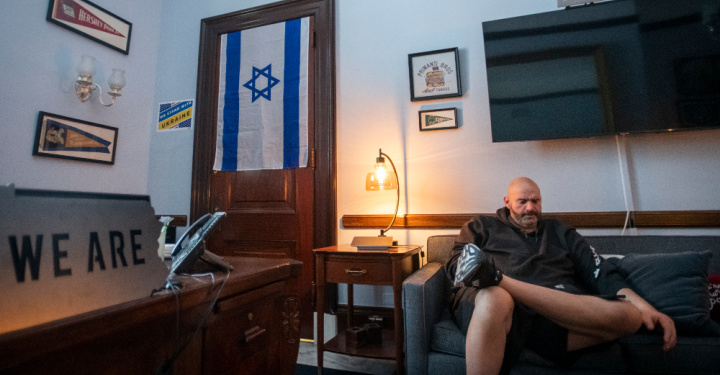
(Nov. 25, 2024) US Sen. John Fetterman (D-PA) expressed excitement about the incoming Trump administration’s seemingly pro-Israel posture, suggesting that he will seek bipartisan opportunities to advance policies that favor the Jewish state.
During an appearance on “Fox News Sunday” with host Shannon Bream, Fetterman reiterated that he wants Israel to continue its ongoing wars in Gaza and Lebanon until it decimates the Hamas and Hezbollah terrorist groups. The senator also praised the foreign policy selections for US President-elect Donald Trump’s cabinet, predicting that the incoming administration will allow Israel to continue its “progress” in thwarting neighboring Iran-backed terrorist groups.
“In terms of the incoming administration, I like what I see in terms of being very, very strong pro-Israel,” Fetterman said.
Fetterman affirmed that he will continue his vocal support for Israel when the Trump administration takes office in January.
“And when the administration will change, my vote and voice won’t change either, and that’s going to follow Israel,” Fetterman said, lauding the “magnificent” efforts of the Jewish state to secure peace in the Middle East by fighting against Hamas, Hezbollah, and Iran.
Though Fetterman campaigned as a progressive, he has emerged as a staunch ally of Israel in the year following Hamas’s Oct. 7 terrorist attacks. Fetterman has repeatedly condemned anti-Israel voices within his own party in the US Congress, as well as elite universities for tolerating what he has characterized as antisemitic and anti-Israel hate speech on their campuses.
Fetterman praised Trump’s selection of Sen. Marco Rubio (R-FL) to serve as the next secretary of state, stating that he will “enthusiastically vote yes” for the Florida Republican. The Pennsylvania Democrat signaled that he’s open to voting for several of Trump’s cabinet picks, claiming that he’s not going to “pre-hate” any of the candidates the president-elect has put forward without engaging in conversation with them.
Fetterman also took a swipe at his Democratic colleagues for expressing an increasingly adversarial stance toward Israel. He asserted that Israels military campaign against Hamas in Gaza was “very just” and touted his repeated refusals to support a “ceasefire” between the Jewish state and the terrorist group, praising Israel for having effectively “eliminated and broken” Hamas, Hezbollah, and their backers in Iran.
“For me it’s about standing on the side of democracy, and I was very supportive about that aid, and I don’t understand [why] the other side would now stop the delivering [of] that kind of aid,” Fetterman said, referencing efforts by some fellow Democrats to cut off US military assistance to Israel.
The senator added that it “was a pleasure” to vote “a big no” on three measures advanced and spearheaded last week by Sen. Bernie Sanders (I-VT) to impose an arms embargo on Israel.
“I don;t understand why anybody would bring that to the floor, but hey, if they want to go down you know [81 to 19] that’s up to you,” Fetterman stated.
The post John Fetterman Signals ‘Enthusiastic’ Support for Pro-Israel Trump Cabinet Picks first appeared on Algemeiner.com.
Uncategorized
Jewish treasures stolen by Nazis 88 years ago come home, thanks to an Arizona synagogue
(JTA) — What could one purchase with boxes of Crisco, bags of coffee and cartons of cigarettes in chaotic postwar Germany?
For Moishe Saksenhaus, a young Holocaust survivor from Belarus, the answer was: two Jewish ritual textiles, hundreds of years old.
The seller said he’d stolen them himself from a burning Berlin synagogue on Nov. 9, 1938 — the November Pogrom, commonly called Kristallnacht.
Moishe brought those two items — a Torah wimple, or sash, and a parochet, or Torah ark curtain — with him to America, taking them out of their suitcase only on special occasions. After Moishe’s death in 1993, his family donated them to his synagogue, Temple Chai in Phoenix, Arizona. They remained on display there until the building was deconsecrated in 2026. The congregation moved to a new location in nearby Scottsdale this spring.
Last week, nearly 88 years after Kristallnacht the two items made their way back to Berlin.
In a ceremony at the site of the New Synagogue Berlin Foundation-Centrum Judaicum museum and archive, on Oranienburger Strasse, Associate Rabbi Bonnie Koppell of Temple Chai handed them over to Berlin Jewish Community president Gideon Joffe.
“There were people who felt individually attached to the items” in Phoenix, Koppell told the Jewish Telegraphic Agency in a phone interview before her trip. “But ultimately, I think everyone realized that they belonged in their home. If the people from whom they were stolen wanted them back, that was where they belong.”
The handover took place Oct. 22 in the presence of Joffe, Rabbi Gesa Ederberg, historian Rabbi Andreas Nachama, members of the Berlin community and 29 visitors from Arizona.
“It’s been a very moving and touching journey, for both our guests from the United States and for these historical items,” said Nickolai Todorov, a Berlin Jew who accompanied the U.S. visitors as a tour guide. “It was just a special thing to be an eyewitness to.”
Rabbi Bonnie Koppell, left, and Sandy Koppell examine the Torah curtain (parochet) and Torah wimple during the handover ceremony at the New Synagogue Berlin–Centrum Judaicum, Oct. 22, 2026. (Nicolai Froundjian)
The large parochet is embroidered with the text of the Kiddush, the Jewish blessing over wine, in versions for the Sabbath and holidays. Along the lower edge of the text is what might be the signature of the artist, in Hebrew: “This handiwork of mine is not to bring me honor, rather to bring merit for the multitudes in accord [with the biblical verse] ‘And Yitzchak went out to pray at the field’ — Yitzchak Itzik ben C’harad Yehuda Leib z“l [of blessed memory] from Rivnitz,” a town in Moldova whose small Jewish community dated back to at least 1800.
The highly decorated wimple, which would have been used to bind a Torah scroll, bears a blessing for a child named Yitzchak “Itzik” ben Kavod Ha-rav Gistori, likely embroidered in honor of his brit milah, or ritual circumcision.
A spokesperson for the Berlin Jewish community, an umbrella for several congregations of various denominations, told JTA in an email that its experts had been unable to confirm which pre-World War II synagogue the Torah curtain came from, but that it would be added to the Centrum Judaicum collection. There are plans to display the wimple at the community center on the site of the former Fasanenstrasse synagogue.
Sol Saksenhaus, 72, a retired special-ed teacher, is one of those Arizona congregants who felt sad to let the objects go. It was his father who had bought them, protected and carried them across the ocean to his new home in America. Sol and his brother had grown up with these objects, which had taken on an aura of sacredness.
But they are “being given back as a sign of love from our community, to light them up again,” he told JTA in a telephone interview from Phoenix. “I can live with that, and I know my parents in heaven can live with that, too.”
Sol’s parents, Moishe and Rosa Saksenhaus, had escaped the Warsaw Ghetto through the sewers, and joined with partisans to commit acts of sabotage against the Germans. The Soviets eventually deported them to Siberia, where their first child died. After the war, Moishe and Rosa made their way back west, following American army lines and ending up in a Displaced Persons camp in the town of Feldafing, Germany.
Moishe, street-smart and multilingual, got a job translating for the U.S. military in Traunstein, Sol related. His father told him he became involved with black market activities, such as collecting British Army bicycles and having them sent to Palestine.
“My dad may have had a little bit of a reputation as one of the go-to guys, that if you wanted something, my dad knew how to get it,” Sol said.
Which may be why this particular German man approached him one day.
“He said he was a medical doctor. He kept approaching my dad with pictures” of the Jewish objects, Sol recounted. His father recalled the man’s name as “Ahgar.” He’d complained about conditions under American occupation: “’We don’t get anything; we’re on limited rations,’” the man told Sol’s father. “My dad said he was arrogant, and that he wanted the stuff he used to have from before.”
“He threatened my dad: He says, ‘I was part of the patrol that went into the temple’” on Fasanenstrasse in Berlin. He claimed to have taken the two items during the raid, and threatened to destroy them if Moishe did not procure Crisco, coffee, flour, cigarettes and cigars.
“My dad pretty much told him to ‘get the f–k away. I can’t look at you.’ But the guy was persistent. And the trade happened.”
Moishe Saksenhaus brought the objects to the U.S. when he and Rosa emigrated. “He cherished them, but he didn’t know what he was going to do with them,” said Sol. On rare occasions his father would show them to the family. “When that thing came out, it was like opening the holy ark… I kind of like froze, and just watched the emotions” on the family’s faces.
Sol’s father died in late 1993. There was a rise in Holocaust denial at the same time, Sol recalled; Deborah Lipstadt’s book, “Denying the Holocaust: The Growing Assault on Truth and Memory,” was published that June. It was also the year that Steven Spielberg’s Oscar-winning film “Schindler’s List” came out, sparking new interest in the Holocaust and its legacy. His mother and aunt decided to donate the tapestry and wimple to Temple Chai, to help with Holocaust education. Before handing the tapestry over to Rabbi William Berk, then the temple’s spiritual leader, Rosa Saksenhaus tore the swastika off an old tag on the tapestry. “This is not going into a temple like this,” she told her son.
The centuries-old Jewish ritual textiles, stolen during Kristallnacht in 1938 and traded after the war to a survivor for coffee and tobacco, are returned to the Berlin Jewish community during a ceremony at the New Synagogue Berlin–Centrum Judaicum, Oct. 22, 2026. (Nicolai Freundjian)
Sol recalled that Berk sent the items to an expert at the University of California in Los Angeles, who determined they were from the 16th century. Berk, who moved to Israel with his family in 2007 after more than two decades with the congregation, could not be reached for comment.
And so the tapestry remained hanging on the synagogue’s north wall. Rosa died in 1999. In 2006, Bonnie Koppell was installed as associate rabbi. In 2022, Rabbi Emily Segal took on the role of senior rabbi.
Two years ago, Sol brought a friend to see the wimple and the tapestry.
“I had seen these objects in our sanctuary for 30 years, knowing only that they had been ‘rescued’ during Kristallnacht,” recalled Joan Neer, assistant to Koppell, who heard Sol’s story for the first time that day. “In reality they were brutally taken,” she said.
The encounter “ignited my curiosity and set me on a journey to uncover their story,” Neer told JTA in an email. The more she learned, the more she became convinced: “It would be great if we could return them to the Jewish community in Berlin,” she wrote to Koppell and synagogue president Debbie Berkowitz.
“What began as a simple conversation in my office has become a journey of discovery, connection, and restoration,” she said.
Once the Berlin community said yes, the task of packing and transporting the objects began. The large tapestry was wrapped in artisanal paper and shipped.
“We had an AirTag on it, so we watched it sitting in the Cologne airport,” said Koppell. “And then it got moved to the customs building.”
“Then we got word that they wanted €5,000 [$5,567] in [customs] tax. And that if we didn’t pay it, they were sending it back in five days.”
The German Jewish community stepped in and used its tax-exempt status to get the package released, she said, adding that she carried the wimple in her hand luggage.
“We have come to remember, to learn and to return something that has traveled a very long road,” she told the Berlin Jewish community on Oct. 22. “This time, they are going home.”
The post Jewish treasures stolen by Nazis 88 years ago come home, thanks to an Arizona synagogue appeared first on The Forward.
Uncategorized
Israel revokes travel permissions for Brad Lander, American rabbis
(JTA) — Israel revoked travel authorizations for several American rabbis, activists and Jewish New York politician Brad Lander following their work last week with Palestinians harvesting olives in the West Bank.
Emails from Israel’s immigration authority, shared with the Jewish Telegraphic Agency, told the recipients that their electronic travel authorizations had been “revoked” following “a change in circumstances in your case.” No further reason was given.
A spokesperson for Lander, a Democratic congressional candidate whose detention by Israel last week sparked an international uproar, confirmed to JTA that his ETA was revoked following his detention.
The spokesperson added that Lander “intends to try to get it back” in order to join a planned congressional delegation with the liberal Zionist lobby J Street in February 2027. Lander is widely expected to win his race next week given that his district is heavily Democratic.
In a longer comment to the left-wing magazine Jewish Currents on Tuesday, Lander said Israel’s actions were “petty” and “one small step in this much larger infrastructure of occupation and ethnic cleansing.”
The travelers had been working at a Palestinian olive farm near an Israeli settlement when they were detained by Israeli authorities. T’ruah, a rabbinic human rights group, and the other participating Jewish groups said they were there to help Palestinian farmers harvest olives that the farmers had been unable to access for three years.
Rabbi Jill Jacobs, CEO of T’ruah, told JTA that she estimated “more than half” of the approximately 60 Jews detained last week have had their ETAs revoked over a span of several days. Some received notice while still in Israel, though they were allowed to leave without incident.
“It feels pretty random,” she said.
Jacobs said that number includes Reform, Conservative and Reconstructionist rabbis, as well as progressive Jewish activists. Also joining the olive harvest group were Israelis who had grown up in settlements and others who had lost family in the Oct. 7, 2023, Hamas attacks, according to a fellow participant.
Foreign visitors are required to hold ETAs to enter Israel. They are typically acquired by tourists, volunteers and business travelers for short-term stays. The process to apply for one is usually quick, involving the payment of a small fee online, and applicants tend to be approved within hours.
It is highly unusual for Israel, which allows almost anyone who can demonstrate Jewish heritage to become a citizen, to take steps to restrict the travel of diaspora Jews. The government has been cracking down more in the last year on ETAs for visitors who protest in the West Bank, Jacobs said. Israel over the weekend denied entry to Rabbi Alissa Wise, an American who leads the left-wing group Rabbis For Ceasefire, Wise told the Religion News Service.
Jacobs said Israel’s actions toward the American Jewish clergy in the group were especially troublesome to her in light of right-wing targeting of liberal Jewish movements in the country.
“They’re saying, ‘Actually we only want Jews who have certain political positions. This is not going to be a safe place for all Jews,’” Jacobs said. “They’re saying, ‘We actually don’t care about the mainstream of American Jewry.’”
Representatives for Israel’s Population and Immigration Authority, which processes ETAs, did not return a JTA request for comment. The country is holding elections Tuesday.
Rabbi Marisa James of Congregation Beit Simchat Torah in New York was among the clergy to have their ETAs revoked following their detention. James told JTA that she received the notification while at the airport on Sunday preparing to leave Israel.
“It’s just so sad to me,” James said. Her ETA had been valid through March 2027. For Jews traveling to Israel in the past, she said, “there’s never really been a political litmus test.”
James lived in Jerusalem for five years, working for part of that time with Encounter, a progressive group that arranges tours of the West Bank for American Jews. In her many times crossing into the territory, she said, she had never before encountered resistance from the Israeli military, until last week’s harvest.
She said the military had shown up at the harvest site to turn the activists away. They held James and her fellow international activists for several hours, though Lander was released quickly.
A statement earlier this week from the government office said Israel had deported 11 visa holders, including Americans, from the country following clashes with the Israel Defense Forces during a different protest in Hebron.
The Jews who had their ETAs revoked are allowed to reapply for new authorizations but are unsure of what would happen if they did. Jacobs said she was “hopeful” that a new Israeli government would grant authorizations to the group if they were to reapply.
“I hope there will be a government that actually cares about its relationship with diaspora Jews,” she said.
Just prior to her ETA being revoked, James had been cheering on Israelis arriving at the airport to cast election ballots. Israel does not have absentee voting, and many Israelis assume that the tens of thousands of citizens who have arrived there in recent days are motivated by opposition to the current government.
James, too, is hopeful that a new Israeli government would be friendlier to progressive Jewish visitors whom she says are trying to fight for a better future for the country.
“We feel deeply connected to the place and deeply invested in its future,” she said. “I always grew up thinking, well, that’s what they want, right?”
The post Israel revokes travel permissions for Brad Lander, American rabbis appeared first on The Forward.
Uncategorized
The real winner in Israel’s elections may be the haters
The world has been fixated on Israel since Hamas’ Oct. 7 attack, Jerusalem’s defensive, retaliatory wars in Gaza and Lebanon, and the tsunami of global antisemitism that has resulted from them all. And now, more than three years on, arrives a referendum not merely of Prime Minister Benjamin Netanyahu — but of Israelis themselves, and the nation they believe they are today and still hope to become.
This week’s election takes place as Israel has never been more prosperous or secure. Just last week, the Bank of Israel announced that the nation’s economy is predicted to grow a robust 5.4 percent this year — surging to 7.5 percent in 2027. That puts Israel in the same league as vastly-larger — and still modernizing — countries like Vietnam and India. Meanwhile, Israel has withstood round after round of ballistic missile attacks from Iran — and to a lesser extent, the Houthis in Yemen — while effectively defanging the Iran-backed terror networks operating along its borders. Israel, in other words, is doing just fine.
But none of that really matters to the legions of global politicians, commentators, columnists and diplomats now opining over what they’re endlessly describing as the most important general election in Israel’s 78-year history. “Seismic,” is how the Australian Broadcast Company termed the campaign recently; “An Election Like no Other,” declared The New York Times.
Because what matters is not the defeat of Israeli Prime Minister Benjamin Netanyahu and the potential accompanying regime change that many believe would deliver a much needed political reset after nearly three decades of his hawkish, right-leaning, confrontation- and allegedly-corruption filled rule.
Nor would it matter if Netanyahu’s chief rival, Yashar Party-leader Gadi Eisenkot, were to triumph this week, riding a wave of anti-Netanyahu sentiment that has thrust the former IDF Chief of Staff — whose son and a pair of nephews perished in Gaza — into the current front-runner position. (The two were deadlocked, based on exit polls, when this article was published.)
Described as a gruff and unpolished political newcomer, a victory for Yashar — which means “straight” or “honest” in Hebrew — would mean an end to Bibi-ism, which would matter greatly within Israel. But, ultimately, an Eisenkot win would be of little consequence beyond Israel’s borders.
Because even if Eisenkot were crowned Prime Minister, a big if, Israel’s public face might change, but its core fundamentals would remain relatively the same. Make no mistake, Eisenkot is no dove — he opposes the establishment of a Palestinian state and supports some West Bank settlement expansion. He’s committed to maintaining Israel as a Jewish state with a Jewish majority. And as part of Netanyahu’s government during much of the first year of the Gaza war, he’s determined to defeat Hamas just as forcefully as Bibi. Eisenkot even defended Netanyahu this summer after New York City Mayor Zohran Mamdani branded the Prime Minister a “war criminal,” calling such accusations “pure antisemitism.”
In fact, for Israeli Jews, security and foreign affairs are their chief concerns this election cycle, according to a September report from the Israel Democracy Institute. And whether Bibi or Eisenkot manages to form a coalition in the coming days (or even weeks, if it takes that long), neither will ever allow their nation’s safety to be so near-fatally compromised again.
And this is ultimately what the globally Israel-obsessed really care about: the legitimacy and inviolability of the nation itself — and the desire to see both as fatally compromised as possible. For Israel’s adversaries — whether on TikTok or in the UN — the goal has never been merely an end to Bibi, but an end to Israel and Zionism. Mamdani has repeatedly said so himself; he will never support Israel’s right to exist as a Jewish nation – and no Israeli leader will ever let that happen.
Which is why, just as the coordinated effort to “dismantle” Israel and Zionism kicked into gear even before the first Hamas madman crossed into Israel three Octobers ago, the campaigns to dismiss the results of this week’s election by Israel’s enemies are already hard at work long before the first vote has been cast.
“Israel’s Elections Can’t Fix What Netanyahu Broke,” read a headline from the far-left Nation late last month. If this is what the anti-Zionists are saying in public, just imagine what they’re saying behind closed doors.
The coming weeks will, of course, see voters determining Israel’s future, but they’ll be in America not Tel Aviv. There, most crucially in places like Michigan — where the openly anti-Zionist Senate candidate Abdul El-Sayed may triumph — the midterm elections on Nov. 3 could deliver a Democratic win that could compromise the ongoing arms shipments that are keeping Israel so prosperous and secure.
This would end the “complicity” that fuels anti-Zionist rage and deliver the “accountability” the anti-Zionists have long insisted is a first step toward quelling that furor. And whether it’s Netanyahu’s night or Eisenkot’s morning this week, ending American weapons transfers could also mean an end to Israel — which is what the anti-Zionists have always really wanted.
The post The real winner in Israel’s elections may be the haters appeared first on The Forward.
