


Uncategorized
Citing Brexit, European rabbinical group moves headquarters from London to Munich
(JTA) — One of Europe’s most prominent associations of Orthodox rabbis is moving its headquarters from London to Munich in a ripple effect from the United Kingdom’s withdrawal from the European Union.
“Germany is one of the only countries in Europe where the Jewish community is growing and the political climate is conducive to build Jewish life there,” Conference of European Rabbis President Pinchas Goldschmidt told the Jewish Telegraphic Agency in an email on Wednesday, confirming that Brexit was a leading factor in the move.
The rabbinical group had been based in London since it was founded in 1956 and has around 1,000 member rabbis from across Europe, from Dublin to Vladivostok.
The announcement came on Tuesday, as the CER presented its Lord Jakobovits Prize to Bavaria’s Prime Minister Markus Söder for his “outstanding commitment to the protection and promotion of Jewish life in Europe.” The ceremony took place in Munich’s Ohel-Jakob Synagogue, which was completed in 2006 in the center of the city.
The synagogue and its community center will also be home to the CER’s planned Center for Jewish Life, which will offer educational opportunities for traditional rabbis and their spouses.
In addition, the CER plans to host international conferences in the city. The Center is to be funded mainly by the Bavarian State Government, with additional funds coming from private donors, Goldschmidt told JTA.
At Tuesday’s award ceremony, Söder reiterated his commitment to fighting antisemitism. He emphasized that the new Center was about celebrating Jewish life, which “should be able to develop free and safe in Bavaria.”
The move has been a few years in the making. After Brexit, the CER leadership “felt that the headquarters should be in the center of Europe,” Goldschmidt said. Then, the Bavarian government invited the CER to hold its 32nd congress in Munich, and Söder and Munich Jewish Community President Charlotte Knobloch invited the group to move in.
Goldschmidt said his group has been working closely with the German Jewish community, on the local and national levels, as well as with the country’s Orthodox Rabbinical Conference.
Central Council of Jews in Germany President Josef Schuster, who also hails from Bavaria, told the JTA in an email that his group was pleased with the decision by the CER, “whose goal is to promote and protect Jewish life throughout Europe.”
“The fact that it will do this from Germany in the future …will enrich and strengthen Jewish discourse in our country,” he wrote.
Knobloch, president of the Jewish Community of Munich and Upper Bavaria, said at Tuesday’s award ceremony that she was “proud and happy to see that my hometown of Munich has become one of the most important Jewish centers in Europe today.”
Before Hitler came to power in 1933, there were about 500,000 Jews in Germany. After World War II, when most Holocaust survivors left Europe for the United States or Israel, there were some 25,000 Jews in former West Germany. Today, there are about 90,000 members of Jewish communities in Germany and as many as 100,000 more who are unaffiliated. The vast majority have roots in the former Soviet Union. In the past decade, many Israelis have also made Germany their home. More recently, a few thousand Ukrainian Jews have found refuge in Germany.
The current Jewish population of Munich is about 9,000, according to the Central Council of Jews in Germany.
Goldschmidt, the former chief rabbi of Moscow, himself fled to Israel last year after Russia’s invasion of Ukraine. In the future, he will be shuttling between Israel and Germany. He said that he and Schuster had been “discussing how to integrate rabbis, rabbinical schools and refugees from Russia and Ukraine in Germany.”
“To be a refugee and emigrant is never easy,” Goldschmidt said. “However, I see it as my mission to utilize these challenging times and waves of dislocated Jews and communities, to strengthen the Jewish communities of Europe. It is a one in a lifetime opportunity.”
—
The post Citing Brexit, European rabbinical group moves headquarters from London to Munich appeared first on Jewish Telegraphic Agency.
Uncategorized
American music producer Justin Goldner at work on a Yiddish album
How many Yiddish rock stars do you know?
Maybe more than you think.
If you watched the Grammy Awards back in 2018, you might have seen one of them, Justin Goldner, accompany Ben Platt as he sang “Somewhere” from the Broadway musical West Side Story.
A multi-instrumentalist who plays guitar, bass, mandolin, ukulele, and lute, Goldner has worked with an all-star array of artists as a session musician and producer, including Bruce Springsteen, James Taylor, Ricky Martin and Macy Gray. Goldner also appeared on Broadway and in Madison Square Garden, performed with the New York Philharmonic Orchestra, and recorded music for Disney’s live-action Snow White.
Goldner is no stranger to the spotlight, but for his latest project, he stepped away from the roaring arenas of pop stardom to inhabit a more intimate space: a dive into Yiddish culture. His work in progress, Songs of Longing and Belonging (Vi shturem a benken in Yiddish), sets Yiddish poetry to music, creating tracks that sound refreshingly contemporary even as they plumb the Yiddish literary archives for inspiration.
By the end of the project — which is being supported by a fellowship from the Jewish Writers Institute — the songs will comprise an entire album. Goldner estimates the full album will appear next spring. For now, he has been releasing them one at a time on YouTube under his Yiddish moniker, Reb Tsudek.
Like many younger people interested in Yiddish today, Goldner didn’t grow up with the language. Although Judaism was part of his upbringing in suburban Philadelphia, it was not a central part of his identity. “I grew up in what I would imagine is a pretty typical Reform family,” Goldner said when I spoke with him. “I had a bar mitzvah. I went to Jewish summer camp. But in retrospect, my memory of my Jewish upbringing was a little bit like: ‘Here’s Judaism. Don’t get too close to it.’”
If he had anything resembling religious commitment, it was to music, specifically the guitar, an instrument he took up at 13. “Relatively quickly it became an all consuming pursuit,” he recalled. “In high school, I barely did anything else. I was a very obsessive listener and wanted to devour as much music as possible.” After graduating high school, he earned a degree in music from NYU.
Goldner said he began to think differently about his Jewish heritage when he saw how his friends related to their own cultural backgrounds. “The thing that sort of primed the pump for me was getting into Greek and Spanish and Arabic and other languages and cultures,” he said. “I just found that so engaging. I was really inspired by my friends and colleagues who come from these backgrounds and carry their culture and their heritage with them, but they’re not living in the past.”
That epiphany, combined with the experience of getting to know a great-aunt with dementia who increasingly reverted to her native Yiddish, led Goldner to purchase a copy of College Yiddish, the classic textbook by Uriel Weinreich. For many years, Yiddish was a linguistic passion that he nurtured privately. Now it has become central to the evolution of his musical career.
The Yiddish title of Goldner’s project — Vi shturem a benken — comes from “Dos lid fun a meydl” (The Song of a Girl), a poem by Anna Margolin, a 20th-century Yiddish poet who immigrated to the United States from Lithuania in 1906. Previously unfamiliar with her work, Goldner was drawn to the “intensity” of Margolin’s lyric, which he translated for me as “it rocks me like a storm, this yearning.”
“I feel like she, as a writer, leaps off the page,” Goldner told me. “The intensity of wanting to do something or be something and not even knowing what, but just feeling like you can’t hold yourself back.”
Featuring vocalists Temma Schaechter and Ben Abraham, Goldner’s version of “The Song of a Girl” reveals another facet of Songs of Longing and Belonging: its blending of heritage languages and diasporic experiences. Besides Yiddish and English, “The Song of a Girl” also includes lyrics in Indonesian, one of the languages spoken by Abraham’s parents.
Future songs will take a similar approach. For example, “Meyerkepl” ( Seashell), based on a poem by the Yiddish writer Yehoash, will include words by Cuban poet José Marti. “I’ve been fascinated by Cuban music for a very long time,” Goldner said. “My wife’s family is Cuban. I was struck by how this sense of exile, of diaspora, of being far away from something or someone that we construe as home, manifested with these two very different authors in very similar imagery.”
In taking up Yiddish as a medium of musical expression, Goldner joins a growing group of artists recording contemporary music in the language, including Daniel Kahn, whose Yiddish versions of classics by Bob Dylan, Leonard Cohen, and Tom Waits are ingenuous feats of translation; Isabel Frey, whose 2020 debut album Millennial Bundist repurposes Yiddish labor and protest anthems; and the Bashevis Singers, a Melbourne-based folk band who, like Goldner, frequently turn to Yiddish poetry as a source of musical inspiration.
Meanwhile, independent record labels like Borscht Beat are producing Yiddish music that runs the gamut from traditional to experimental.
This thriving world of Yiddish popular music reflects a larger cultural and linguistic renaissance in which Goldner is a passionate participant. He has attended the Yidish Vokh, an annual week-long retreat for Yiddish speakers in upstate New York, takes online Yiddish classes, and has even developed a Yiddish keyboard app, YidShrift, that aims to bring familiar features like autocorrect and autocomplete to modern Yiddish communication.
Beyond the Yiddish lyrics he sets to music, Goldner has incorporated his affinity for the language into Songs of Longing by including Yiddish interviews with some of his collaborators, emphasizing the currency of Yiddish as a medium of colloquial expression.
While Songs of Longing and Belonging is firmly rooted in Goldner’s engagement with Yiddish language and lyrics, he also believes that the texts he is drawing on speak to shared human experiences.
“I think that there is a longing for connection that is universal and that manifests itself through the concepts and stories of who we are,” he said. That longing often pushes people to ask themselves probing questions of identity like “Who are my people?” or “where is my home?”
“I don’t think that there are ever simple answers,” he said.
The post American music producer Justin Goldner at work on a Yiddish album appeared first on The Forward.
Uncategorized
Katie Zacharia’s brief White House stint included a rebuke from the Auschwitz Memorial
Katie Zacharia’s five-day stint as White House Press Secretary ended almost as soon as it began. But before she was fired on Friday, she managed to draw a rebuke from the Auschwitz-Birkenau State Museum.
The museum’s reprimand came in response to a claim Zacharia posted to X in November 2025, asserting that the abortion pill is “connected to the manufacturer of the deadly gas Zyklon B, used in the World War II concentration camps.”
The supposed connection? A company descended from the conglomerate involved in producing Zyklon B later owned the company that developed the abortion pill, Zacharia intimated in her post.
The official Auschwitz Memorial X account rebuked Zacharia on Monday, calling the argument “a misleading chain of guilt by association.”
Mifepristone, commonly known as the abortion pill, was first synthesized in 1980 — more than three decades after World War II’s end — by Georges Teutsch, a chemist at the French pharmaceutical company Roussel-Uclaf, based on an idea developed by Jewish endocrinologist Étienne-Émile Baulieu.
The tenuous connection to the poison gas used in concentration camps goes something like this: Zyklon B was distributed by a company called Degesch, which was partly owned by the German conglomerate I.G. Farben. After World War II, I.G. Farben was broken up into successor companies, including Hoechst AG, which in 1997 acquired a majority stake in the French company that developed mifepristone.
“A corporate relationship between companies separated by decades is presented as if it proved continuity of products, purposes, or chemical composition,” the Auschwitz Memorial wrote on X. “That is not historical analysis, but the selective combination of unrelated facts to produce a predetermined conclusion.”
Zacharia offered another version of the claim in a June 2025 podcast episode of We the People with Gates Garcia, saying that “the abortion pill has the same chemicals that they used in the exterminant (sic) camps in Nazi Germany.”
Suffice it to say, mifepristone, a steroidal progesterone blocker, is not the same as cyanide. Zacharia, the Auschwitz Memorial wrote, “confuses corporate history with chemical composition.”
After the overturning of Roe v Wade in 2022, anti-abortion activists have increasingly set their sights on banning the abortion pill nationwide. Prescribing, dispensing, or mailing mifepristone is currently banned in 13 states. In May, the Supreme Court blocked a lower court ruling that would have effectively ended mail delivery and telemedicine prescribing of mifepristone nationwide, including in states where abortion is legal.
Zacharia has framed her opposition to abortion as deeply personal. Zacharia said that, when she met her biological mother at 18, she learned she was “approximately 20, 30 minutes away from being aborted.” A Christian counselor, Zacharia said, convinced her mother to place her for adoption instead.
On the podcast, Zacharia also spoke about her work on the board of the White Rose Resistance, an anti-abortion advocacy group named for the Nazi resistance movement of the same name.
Groups including the International Holocaust Remembrance Alliance and the Anti-Defamation League have condemned comparisons between abortion and the Holocaust, arguing that they trivialize the Holocaust and exploit its victims’ memory for political ends.
Zacharia has also made Nazi comparisons in other contexts: According to CNN, in September 2022, she reposted a Truth Social post comparing then-President Joe Biden and anti-fascist protesters to Nazis. It included the hashtags #Antifa, #PedoHitler and #WrongSideOfHistory.
The White House Press Office did not respond to the Forward’s request for comment Friday morning, before Zacharia’s firing had been announced.
The post Katie Zacharia’s brief White House stint included a rebuke from the Auschwitz Memorial appeared first on The Forward.
Uncategorized
After my dad died, I discovered a lost history of Iranian Jews in the US
I was a freshman in college when my dad died. An Iranian Jew who came to the United States four years before the Islamic Revolution to study at the University of Missouri, he went both by Farzad and by his Hebrew name, David. Eventually, he became a traveling jeweler — or, as he put it, a “merchant,” a word evoking an image of independence, shrewdness and valor on the Silk Road. After each business trip, he’d return home with stories of how nice people were in Raleigh, how cold it was in Minneapolis, and how beautiful the Florida Keys were.
Growing up in an Iranian Jewish community in Great Neck, a suburb on the North Shore of Long Island, I had spent my life mostly surrounded by people just like me, and rarely ever boarded a plane. The contrast between my dad’s cosmopolitanism and my provincialism mirrored another contrast, between his capability and my incapability. These differences made me distrust and worship him.
I knew my dad was getting older. The pace of his hair growth had slowed down, making his insistence on monthly haircuts a regular source of ridicule. But he was only 62; he wasn’t supposed to die. In 2019, he had a fatal heart attack on a flight to Key West — while he was in the air.
It seemed fitting that he — a cosmopolitan who had always seemed separate from the rest of my more provincial family — would die several hundred miles away from where we all lived. In the wake of his death, my desire to better understand his life led me to discover a forgotten chapter of Iranian Jewish history.
My community’s identity, like all identities, reflects a series of choices we’ve made about which parts of our experiences we wish to keep, and which we wish to throw away in the name of self-preservation. But despite our better efforts, the things we try to discard tend to remain with us, sometimes without us even knowing it.
Roots in Mashhad
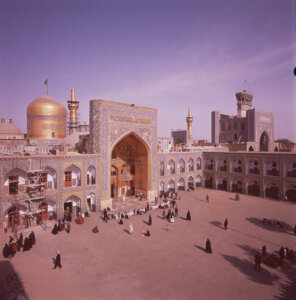
My Iranian Jewish community traces its roots back to Mashhad, a city in northeastern Iran. In 1839, a mob of Muslim Mashadis raided the Jewish ghetto and killed more than 30 people. They seized and married Jewish women, selling others into slavery. Some Jews converted to Islam to escape death; others fled the country.
My ancestors appeared to convert to Islam. But community lore goes that when no one was watching, they wore tiny tefillin, prayed in basements and kept kosher as best they could. On Saturdays, Jewish shopkeepers kept their stores open so as not to be seen keeping Shabbat — but jacked up prices so high no one would buy anything. Jewish parents arranged their children’s engagements at young ages, so that if a non-Jew came requesting their daughter’s hand in marriage, they could honestly say she was taken.

Decades later, under a new government, my ancestors slowly began practicing Judaism openly again. In the mid-20th century, my grandparents and other Mashadi Jews left the city and moved to Iran’s capital, Tehran. But they remained insular. In Tehran’s much larger Jewish community, Mashadis separated themselves, praying in Mashadi synagogues and marrying fellow Mashadis.
They did the same in the U.S., where they first settled in Queens, then later helped form the ethnic enclave where I grew up.
As a child, I learned that being Mashadi made me different from all the other Iranian Jews in Great Neck, whom we called Tehrani even though many of their families came from other cities. So, when I learned that my parents were actually born in Tehran, I was scandalized. If my parents came from Tehran, didn’t that make us Tehrani?
“Why are we Mashadi?” I asked my dad one night, a year before he died: Why was I defined by this city, and not the other Iranian cities where my ancestors lived? Why weren’t we just Iranian?
Unable to explain, my dad laughed off the question. But I know now why Mashadis are Mashadi. It’s because pretending to be Muslim while secretly continuing to practice Judaism was a defining experience, one that taught my ancestors ugly ways to survive.
“To omr-e mani,” my dad would tell me in Farsi, in lieu of a simple “I love you.” Translation: “You are my life.” He always had a flair for hyperbole. And though he didn’t intend it this way, my teenage brain twisted his words to mean: “It will kill me if you aren’t a good Mashadi girl.”
Going to Missouri
When I was little, my mom told me a version of the Mashadi immigration story that matched her own experience: It began in Tehran and ended in Forest Hills, Queens. But when my dad died, I became more invested in piecing together the parts of his life that my mom’s story didn’t capture.

I got his yearbook and attendance records from the University of Missouri; obtained his immigration records from the U.S. Citizenship and Immigration Services; pored over more than 100 old newspapers, magazines and other archival documents; read academic articles and history books; and spoke to about a dozen people who I thought might have relevant intel, including extended family members, scholars and people who attended or worked at my dad’s college.
Arriving in 1974, my dad was one of tens of thousands of Iranians who came to the U.S. in the 1960s and 1970s for college. In Iran, as in other major oil-exporting countries, economic development had led to increasing demand for skilled workers — but there weren’t enough colleges to meet this demand. So the Iranian government gave scholarships to students studying abroad.
Determined to develop allies during the Cold War, the U.S. government doled out scholarships, too. The idea was that students in Iran’s expanding middle class could study engineering in the U.S., then bring that expertise back to their home country, which needed it.
Many of these college students, seeking a lower cost of living, wound up in the Midwest. Plus, in the logic of a tight-knit ethnic community, where one person goes, others follow.
My dad followed a small group of Mashadi men to the University of Missouri in Columbia. His older brother, Behzad, had gone there for graduate school and still lived nearby. In Tehran, both he and my dad had attended an elite boys’ prep school called Alborz, named for the mountain range that stretches along the coast of the Caspian Sea. Historically run by American Christian missionaries, Alborz was considered the best high school in Iran, and American colleges knew it. Plus, if my dad’s kitchen-table bragging is to be believed, he was among Alborz’s top students in math.
Protest and persecution
By the time my dad arrived in Missouri, the tensions that would give way to the Islamic Revolution in 1979 had already emerged. Many Iranians protested the country’s then-leader, Shah Mohammad Reza Pahlavi, over restrictions he placed on democratic institutions, torture against political opponents under his leadership, and his significant expansion of the military.
The Iranian community in the U.S. — then disproportionately composed of college students — leaned into the opportunity this country gave them to express themselves politically. Articles from the Columbia Missourian, once my dad’s local paper, show that at one point in the mid-’70s, anti-Shah protests took place at least once a month at local colleges.

The protesters were embracing an American freedom: The Iranian secret police couldn’t get them, at least not while they were in the U.S. But American authorities had issues of their own.
In October 1975, police maced then arrested protesters at an anti-Shah rally at Lincoln University in Missouri. The protesters were denied food and prevented from calling lawyers because, a spokesperson for the Iranian Students Association said, “they were foreigners and had no rights.” The mayor sent the student-protesters’ names and photos to the Shah, even though students said that could get them executed or imprisoned for life.
At the University of Missouri, letters to the editor in the student newspaper, as well as classified ads, called for Iranian students to go back to where they came from. Graffiti on bathroom walls spread a similar message. Some people simply told their Iranian classmates face-to-face to return to the very place whose government they were protesting.
Many Iranian Jewish students liked the Shah, because he believed in secular government and undertook westernizing reforms. But 2,500 years of living as a minority had taught them to keep quiet. “Normally, Jews would stay out of politics,” mom’s brother Bahram, who studied in the Midwest beginning in 1969, told me. “If you were pro-Shah, you had a lot of students against you. If you were against, you had the embassy that would come after you.”
Two people I interviewed — Bahram and one of my dad’s cousins — both said something I can envision my dad also saying: that being Jewish protected them from anti-Iranian hostility on campus.
My dad’s cousin Sohrab, who went to New York’s Queens College, said that when encountering potentially hostile people, he made sure to emphasize being Jewish. “We feel like somebody’s uncomfortable, we made sure we told them first, ‘I am Jewish. I ran away from Iran,’” Sohrab said.
“We are first Jewish, then Iranian.”
What my dad and I never talked about
When my dad was 22, and a senior at the University of Missouri, his native country erupted into violence.
More than 40 years after the revolution, I sat in my college dorm, reading back issues of the Columbia Missourian, imagining my dad as a young, longish-haired man following the news from afar.
December 1978: “2 million protesters hit Tehran.” February 1979: “10,000 dead in Iran’s crisis.” March: “Firing squads execute 13 in Iran.” As the revolution took place, so did frequent earthquakes, which also claimed thousands of lives.
The college students who’d risked it all in order to advocate against the Shah seemingly got their way when he fled Iran in January 1979. But they were blindsided by the zealotry of the man who took his place: Ayatollah Ruhollah Khomeini, a Shi’ite Muslim cleric who established an Islamic theocracy. He offered a foil to Pahlavi’s friendliness with the West by preaching against the U.S., Israel and imperialism.
After the revolution, the new government tried to assure Iranian Jews that they’d be safe, yet some were executed on trumped-up charges of spying for Israel. My dad’s parents were quick enough to leave by air, landing in Queens. Those who waited too long to emigrate had to pay smugglers to help them over mountainous borders.
When the Mashadi community followed in the footsteps of its sons and immigrated en masse to the U.S., American-educated Mashadi men — now in their 20s and 30s — became informal secretaries, translators, immigration consultants, financial advisors, business consultants, and advocates for higher education, for their own families and for the wider community.
Despite what Sohrab said, de-emphasizing their Iranian origins didn’t always protect the new immigrants from bigotry. Mohsen Mobasher, an anthropologist at the University of Houston-Downtown, told me that because of anti-Iranian hostility that later grew rampant, “some Iranians developed deep feelings of anxiety, suspicion, insecurity and inferiority.”
Once, I asked my dad whether he ever experienced antisemitism or anti-Iranian hostility. He let out a hearty laugh, as though it was ridiculous for me to imagine that he had.
If the question was ridiculous, it was only because I asked it so casually; just as I might ask him to do my laundry or cut me a pineapple. It was as if I’d asked him to synthesize his whole experience of identity into some set of words that might satisfy me. My dad did not see fit to tell me, a girl he was charged with protecting, about times in his life when he may have felt small.
Singled out by the federal government
In November 1979, months after my dad graduated, a group of Iranian militant college students took over the U.S. embassy in Tehran and held 66 Americans hostage. The hostage crisis gave way to unprecedented levels of anti-Iranian sentiment in the U.S., and the animus fell hardest on college students. Members of Congress introduced resolutions calling for all Iranian students to be deported. At Mizzou, one professor announced that he would no longer advise Iranian students.

On Nov. 10, President Jimmy Carter ordered immigration checks on all Iranian college students in the U.S., saying that anyone found to be violating the terms of their student visa would be deported. More than 200 Mizzou students were told to report to an immigration office in Kansas City. To some of these students, the visa checks felt wrong, and they refused to participate.
“I would feel like a criminal,” an Iranian student who did not report told the Missourian.
“This is discrimination — singling out one nationality and investigating them,” said another, who also refused to participate in the check.
By this time, my dad had moved to St. Louis, where he was working for the chemical manufacturer Olin Corporation. But he still had to report for the visa checks. He had a visa for students and recent graduates who were gaining practical training in their field of study. In December, he received a frantic letter from Carl Leistner, the international student program coordinator at Mizzou, telling him to report to Kansas City the following week.
“I regret this delayed notice,” Leistner wrote in the letter. “However, we simply overlooked our practical training students in the rush associated with the registration of our 258 currently enrolled students from Iran.”
My dad traveled more than 200 miles for his interview, but when he arrived, he was sent home. A federal judge had ruled the visa checks were unconstitutional. If that ruling was overturned, my father was told, he might have to come back for an interview later.
Back on the Mizzou campus, some 600 students held a protest where some students advocated “deporting all Iranians from the United States.” “Deport, deport,” the crowd chanted at one point.
By being away from campus, my dad managed to evade these sorts of protests, plus other horrors that befell his collegiate counterparts. Abe Manzour, an Iranian American Jew who was my dad’s classmate at the University of Missouri, was still earning his degree.
“Sometimes, we were scared to go outside,” Abe told me over Zoom in 2021. “I almost got beat up by some guys on the street because they knew I was Iranian.”
Scared to go outside? Almost got beat up? Despite everything I had already read about anti-Iranian hostility, I was still surprised. What Abe was describing seemed a world apart from tales my dad used to tell — stories of beer, women and football games, which would’ve taken place just months beforehand.
“My dad always talked about his time in college,” I said. “He made it sound like the best thing ever.”
“For me it was, too,” Abe said.
A conservative enclave
Growing up in Great Neck, I lived a life very different from my dad’s. Our suburb was full of Iranian Jews, and until I was 18, I rarely ever left it. He was worldly; I was provincial, and in my senior year of high school, as I applied for college, I could no longer contain my jealousy.
“Can I apply to UC Berkeley?” I asked him one Sunday afternoon during my senior year, while he was making “early-bird breakfast.” I knew he’d say no, but wanted to see him squirm.
“I don’t see! I don’t see!”
“Dad!”
“Bache nazaideem ke befresteemesh Ca-lee-forn-yaw!” — “We didn’t have a child so that we could ship her off to California!”

“I know two people who sent their son to college on a different continent!”
“That was over 10 years ago!” At 61, my dad enjoyed describing events of his youth as having taken place “over 10 years ago.”
I never applied to Berkeley; instead, I stayed close to home and went to CUNY Hunter College in Manhattan. For better or worse, my life would be different from my dad’s, in ways that were tied up with the increasingly conservative nature of our community.
In Tehran, Mashadi Jews lived scattered around the city. In Great Neck, Mashadis are neighbors and attend a set of synagogues all within a mile of each other. And many Mashadi Jews in Great Neck have become more religious than their ancestors in Tehran were.
When most people think of assimilation, they envision people becoming more secular and better educated. But most Jewish people in Great Neck — Mashadi and otherwise — have assimilated into a different yet equally compelling idea of America, one that emphasizes religious freedom over other aspects of American culture.

In the Midwest, Mashadi men learned the valuable lesson that Abe Manzour expressed: that it’s possible to experience happiness and personal growth in the midst of a hostile environment. Years later, when they moved to Great Neck, their environment rendered that wisdom useless, like a vestigial organ at risk of evolutionary disappearance.
To the men who’d left Iran to study abroad, we, their children, must have at times seemed narrow-minded and irredeemably young. Especially when I think about my dad’s life, I sometimes resent that I wasn’t allowed to go to California and feel embarrassed to have attended a commuter school.
What made me want to study his life was a binary I imagined between him — worldly — and me — ignorant. But actually, I don’t really believe that a binary between cosmopolitanism and provincialism captures the nuances entailed in our father-daughter relationship. And I don’t believe that being poorly traveled is the same as being ignorant.
Regardless of where one lives or visits, there are many different ways to be ignorant, and many different ways to learn something new.
The post After my dad died, I discovered a lost history of Iranian Jews in the US appeared first on The Forward.
