


Uncategorized
Heritage Foundation staff confront president over antisemitism, defense of Tucker Carlson
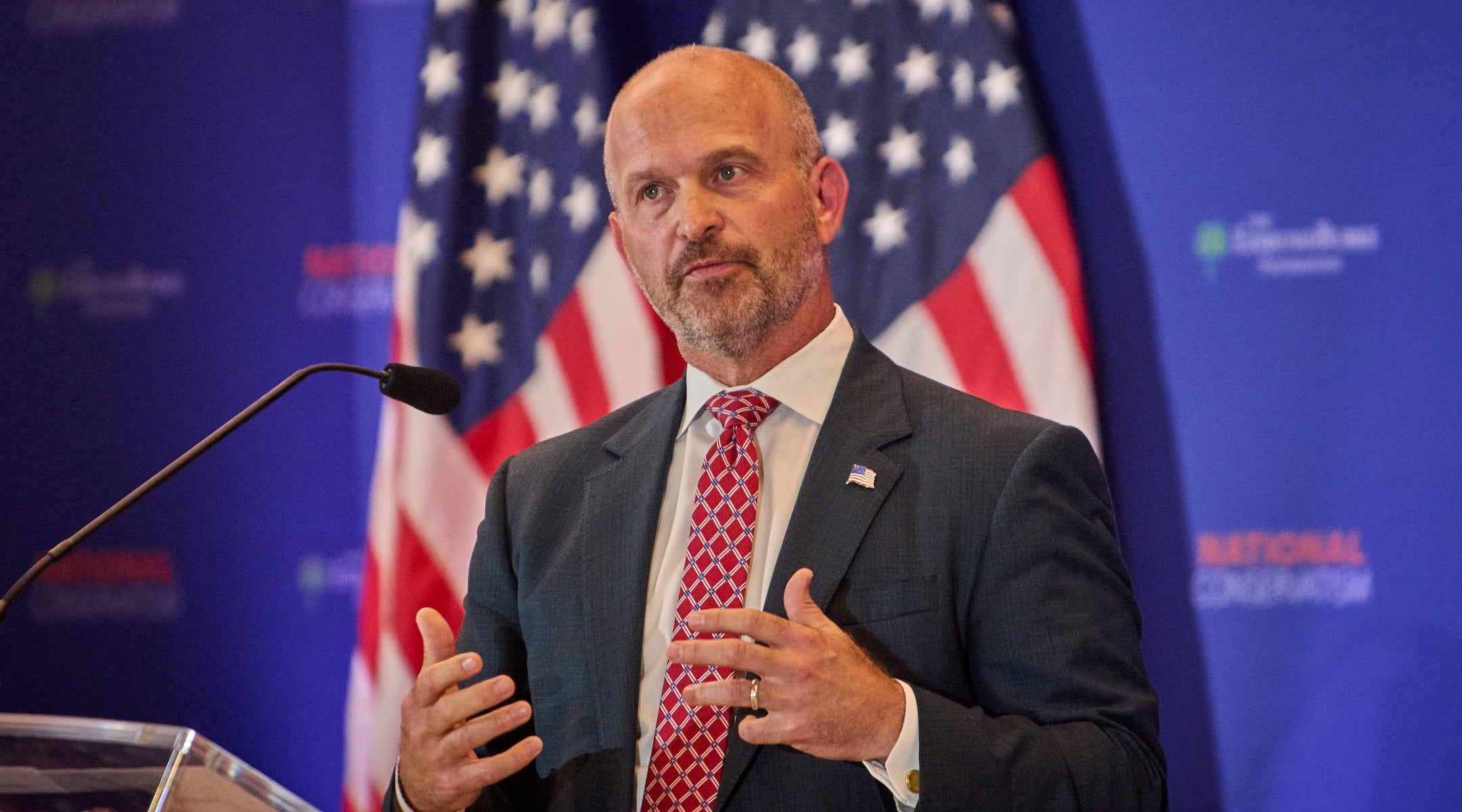
(JTA) — The president of the Heritage Foundation, Kevin Roberts, apologized to his staff on Wednesday for his refusal to condemn Tucker Carlson after the right-wing broadcaster aired a friendly interview with white nationalist Nick Fuentes.
During a tense, two-hour all-hands meetings, staff members challenged Roberts’ leadership, questioned Heritage’s credibility, and warned that his stance had gravely damaged the foundation’s relationships with Jewish partners and donors
“I made a mistake and I let you down and I let down this institution. Period. Full stop,” Roberts said.
He specifically apologized for a previous comment defending Carlson in which he decried a “venomous coalition” attacking the commentator. The phrase, he said, was “a terrible choice of words, especially for our Jewish colleagues and friends.”
The meeting, audio and video of which were leaked online, laid bare deep divisions inside America’s most influential conservative think tank, torn between Roberts’ attempt to mend fences and a staff revolt from within its senior ranks.
Several Heritage employees, including longtime fellows and legal scholars, told Roberts they no longer had confidence in his leadership. Others said his refusal to draw moral lines between Carlson and antisemites like Fuentes had caused lasting reputational harm.
“I made the mess, I want to clean it up,” Roberts told employees, adding that he had offered his resignation to the board but felt a “moral obligation” to stay and repair the damage.
Several staffers demanded that Roberts publicly repudiate Carlson. Two called for him to resign.
“You have shown a stunning lack of both courage and judgment,” said Amy Swearer, a senior legal fellow who has worked at Heritage for eight years. “I stand here today with no ability to say I have confidence in your leadership.”
“It has become increasingly difficult to continue to defend the Heritage Foundation,” added Rachel Greszler, another senior fellow. “I do not believe that you are the right person to lead.”
The confrontation followed days of turmoil triggered by Roberts’ decision to post a video in which he said Heritage would not “distance” itself from Carlson despite his friendly interview with Fuentes, a Holocaust denier who has praised Adolf Hitler. Roberts framed his position as a defense of “grace” and “free speech,” saying the right should avoid “canceling” its own.
That message sparked outrage across the political spectrum. Prominent Republicans, including Sen. Ted Cruz, denounced Fuentes as a “Nazi.” Jewish organizations that had partnered with Heritage on its antisemitism initiative, Project Esther, cut ties. Conservative commentators such as Ben Shapiro blasted Roberts for embracing a “no enemies to the right” ethos.
One of the most emotional moments at the meeting came during comments from Daniel Flesch, a Jewish staffer with Heritage’s Allison Center for National Security, who oversees Project Esther. He described being unable to defend Heritage to Jewish allies and friends.
“It has been six days… where as an organization we have been unable to utter the words…‘Tucker’s an antisemite, and we as Heritage do not want to associate with him,’” Daniel said. “We are bleeding trust, reputation, perhaps donors.”
Robert Rector, a Heritage veteran of 47 years, invoked conservative icon William F. Buckley Jr., who in the 1960s sought to expel antisemitic and racist elements from the conservative movement.
“Buckley’s view was that we have to expunge all antisemitism from the movement and expel the lunatics,” Rector said. “This is what built the conservative movement. We are now reversing that.”
Hans von Spakovsky, another senior Heritage figure, warned Roberts that the think tank’s credibility could not be salvaged without a clean break from Carlson.
“The damage done to the reputation of Heritage is the worst I have ever seen,” von Spakovsky said. “If the Heritage Foundation and you do not dump Tucker Carlson publicly, we are not going to repair that damage.”
The meeting also exposed generational and ideological divides on the right. One young staffer argued that Heritage should not prioritize defending Israel and accused the leadership of promoting “Christian Zionism” — a comment that drew audible gasps.
Roberts and his deputies reaffirmed the foundation’s pro-Israel stance, but the exchange underscored how some younger conservatives, animated by online populism and isolationism, are challenging traditional right-wing support for Israel.
The post Heritage Foundation staff confront president over antisemitism, defense of Tucker Carlson appeared first on The Forward.
Uncategorized
Argentina’s Jewish gauchos museum vows to stay open amid leadership feud
(JTA) — BUENOS AIRES – A museum dedicated to the history of Argentinian Jewish ranchers, farmers and the cowboys known as gauchos remains open and operating despite months of tension between its former director and the local government, the head of the Entre Ríos Jewish community confirmed to the Jewish Telegraphic Agency,
The Villa Domínguez Jewish Museum about the Jewish Colonies drew international attention late last year after visitors reported water damage affecting walls, documents and historical objects. The concerns arose months after the resignation of Osvaldo Quiroga, the local historian who had led the museum for nearly 40 years and was widely associated with its preservation.
In an interview, community head Marina Garber acknowledged the tensions that led to Quiroga’s resignation in January 2025, and that since then a successor has not been named.
“We are resolving the situation with an agreement in which the building belongs to the municipality, while the Jewish community is in charge of safeguarding the objects. The museum is still operating,” Garber told JTA, and the partnership between the local municipality and Jewish community would continue.
Villa Domínguez is a rural town of around 2,000 inhabitants located 225 miles north of Buenos Aires, where international tourism centered on the country’s earliest Jewish agricultural colonies brings considerable visibility to the area.
The fate of the museum matters far beyond Villa Domínguez’s nine remaining Jews. The Jewish agricultural colonies of Entre Ríos are a defining chapter in Argentine Jewish history, tracing how immigrants from Eastern Europe built new lives as farmers and gauchos. Its future is a test of whether a legacy that belongs to Argentine Jewry as a whole can be safeguarded.
Although its director was a municipal employee, the museum itself belongs to the Jewish community. This hybrid arrangement, with no clear responsibilities divided between the two, created tensions when the images of damage were spread online. Suggestions that the Jewish museum had fallen into a state of neglect circulated online as far as Europe.
According to some sources, tensions appear to stem from a combination of the government’s limited attention to the site and the apparent resentment by some government officials that Quiroga had received inordinate media attention.
The Jewish colonies of Entre Ríos, established in the late 1890s by Jewish immigrants mostly from Eastern Europe, represent one of the largest waves of Jewish agricultural settlement in the Americas.
The Jewish Colonies Museum was founded in October 1985 to safeguard the region’s documentary and material heritage. Since 1996, it has been housed in the town’s former pharmacy building.
The museum attracts Argentine and international visitors interested in the stories of the Jewish gauchos — the immigrants who blended their Jewish and Eastern European roots with Argentine ranching culture. Heritage tours, family-history trips, academic researchers and Jewish community groups contribute to a steady flow of visitors exploring the landscapes where the Jewish gauchos built their rural lives, a journey that began more than a century ago.
For the descendants of the gauchos — many now scattered across Argentina, Israel and beyond — the institution serves as a touchstone for genealogical research and family history. Its stability is also of concern to Jewish communal organizations and Argentine officials who have promoted the Jewish colonies circuit as a pillar of religious and cultural tourism in the province.
The first ship carrying Jewish immigrants from Europe to Argentina, the SS Weser, arrived in 1889 after sailing from Hamburg to Buenos Aires. Its arrival inspired Baron Maurice de Hirsch, a German Jewish financier and philanthropist, to recognize the potential of agricultural migration and, in 1891, to create the Jewish Colonization Association (JCA) to institutionalize, fund and organize the colonies.
A tourist trail linking the various Jewish settlements has been operating for more than 20 years, made up of four communities: Basavilbaso, Villa Domínguez, Villa Clara and Villaguay. Two- and three-day tours of the area’s main Jewish sites include visits to synagogues, cemeteries, cooperatives, and local museums. Villa Clara — or simply Clara — is a small town founded in 1892 and named after Hirsch’s wife. Its Jewish museum is located inside an old railway station. Another settlement, Lucienville, is named after the couple’s son, Lucien.
The last agricultural colony founded in Entre Ríos by the JCA is Colonia Avigdor, visited regularly by students of Fundación Judaica, a major Buenos Aires network of schools and synagogues, which brings groups there for educational programs, supports local schools, and works on community development.
The national government includes the tourist trail as part of a religious tourism program, and the Buenos Aires Jewish center AMIA has a site dedicated to the colonies’ history in Entre Rios, including Villa Domínguez.
The national government and some local municipalities also include the Jewish colonies among their cultural offerings.
According to Pablo Soskin, the representative in Entre Ríos of the Argentine Jewish political umbrella organization DAIA, the museum’s director stepped down on Jan. 24, but municipal officials initially declined to accept his resignation. He subsequently took an extended leave to use up a large balance of accrued vacation days, with the municipality’s approval. When that time ran out, he was reassigned within the museum to a different, non-directorial role. The director position has remained vacant since then.
“We maintain a close relationship with the government, which has expressed its commitment to making the museum and the Jewish circuit part of the province’s tourist attractions for locals and foreigners,” Soskin told JTA. “We will continue to coordinate community, public, and private mechanisms to ensure the preservation of our heritage sites.
“This is key to understanding the contributions that the Jewish community has made to Argentina,” he added.
This article originally appeared on JTA.org.
The post Argentina’s Jewish gauchos museum vows to stay open amid leadership feud appeared first on The Forward.
Uncategorized
Israeli police arrest suspects in Washington Post journalist attack
(JTA) — JERUSALEM – Israel Police arrested 10 people on Monday on suspicion of involvement in violent acts over the weekend against journalists, foreign diplomats and Palestinians in the West Bank during the annual olive harvest.
The arrests came after international condemnation of the attacks, including by U.S. Ambassador to Israel Mike Huckabee, who is generally supportive of the current Israeli government. Prime Minister Benjamin Netanyahu has insisted it is just a handful of individuals and not representative of Israelis who live in the West Bank settlements.
“Following reports of acts of violence over the weekend, including the suspected assault of a foreign journalist and the suspected assault of foreign diplomats, the Judea and Samaria District and the Israel Security Agency (ISA) carried out a pre-dawn arrest operation as part of the ongoing investigation,” the police said in a statement, referring to the West Bank by its biblical name.
The statement said the suspects were arrested during a special pre-dawn operation conducted by the district’s Central Investigations Unit and transferred to police stations in the area for questioning.
“Following questioning, and subject to the findings of the investigation, they will be brought before a court for a hearing,” the police statement said.
The arrests come after Heidi Levine, a veteran photojournalist for The Washington Post, was attacked on Friday while photographing Palestinians harvesting their olive trees in the West Bank, an annual event that often sees violent clashes between Palestinian farmers and Israeli settlers who have increasingly moved into the same areas.
Video footage from the scene shows a group of masked settlers surrounding and attacking Levine before ripping off her camera and other personal gear. Palestinians can also be seen throwing stones at the settlers before another journalist arrives to help Levine leave the area.
The photographer was taken to a Palestinian hospital near Ramallah and later transferred to Beilinson Hospital near Tel Aviv, which reported that she was in moderate condition with lacerations across her body, a broken rib and four broken vertebrae. She also underwent surgery on her finger, the hospital said.
On Saturday, European diplomats from France, Belgium and Poland came under assault by masked settlers who forced their convoy off the road in the area of Taybeh, near Ramallah. Bernard Baudoux, a leftist mayor of Aulnoye-Aymeries, a town in northern France, was beaten, according to witnesses who spoke to international media.
Data collected by Israeli human rights organization Yesh Din and published on Sunday showed some 538 alleged incidents of settler and soldier violence over the 20-day period from Sept. 27 to Oct. 16, across 181 Palestinian communities in the West Bank. Some 269 of the incidents were directly related to the olive harvest, the organization said.
Israeli right-wing legal-aid organization Honenu confirmed the arrests on Monday and said its criminal law department would be providing the suspects with “initial legal assistance.”
“At this stage, it is unclear what the detainees are suspected of,” the organization said in a statement.
The Israel Police said that “items linking the suspects to the alleged offenses were seized, and several vehicles were confiscated.”
“The law in Judea and Samaria applies to everyone, regardless of identity or affiliation. The Israel Police is committed to professional, equal, and impartial law enforcement, based on evidence and in accordance with the law,” Israel Police Commissioner Daniel Levy said in the statement.
The issue of settler violence in the West Bank falls into a gray area of law enforcement between the Israel Police and the Israeli military, the latter of which is responsible for civilian matters in parts of the territory that are not legally under Israeli sovereignty. Israel’s police force is under the authority of the National Security Ministry headed by Itamar Ben-Gvir, a far-right nationalist who has not made clamping down on settler violence a priority.
Levy said that the ambiguity over which agency is responsible for what must be addressed.
“At the same time, a distinction must be made between responsibility for preventing incidents in the field and responsibility for investigating and enforcing the law after they occur,” Levy said.
“We will continue to coordinate with all security agencies to strengthen security and the rule of law and ensure that anyone found to have violated the law is brought to justice,” he added.
Huckabee on Saturday called for a full investigation into the attack against Levine and for the perpetrators to be prosecuted “to the fullest extent of the law.”
“Attacking a female photographer is a despicable act of terror carried out by masked cowards. Dishonorable act of senseless violence,” he wrote on X.
Israeli President Isaac Herzog also condemned the “shocking violence” and said he had called Levine to apologize.
“I expressed my deepest sorrow to Heidi and apologized for what she went through. The despicable behavior of the perpetrators of this attack does not represent the citizens or the values of the State of Israel,” he said in a statement.
Netanyahu, who is in the midst of a closely contested election campaign to retain power, condemned violence generally, but also stated that the circumstances of the attack “remain unclear.”
“We will not allow disputed incidents to be exploited to demonize the hundreds of thousands of law-abiding Jewish residents of Judea and Samaria,” he said in a statement, using the biblical names for the West Bank.
Israel’s Ambassador to the U.S. Yechiel Leiter, however, stated on CNN on Friday “unambiguously and unequivocally, that gratuitous violence perpetrated by anyone, be they Jews or Arabs, is completely unacceptable.”
He added, “If we have not yet reached a passing grade to bring Jewish vigilantes to justice, then we’ve got to do a better job. But I’m convinced that we are going to do it. I’ve been in government meetings. I’ve heard the prime minister speak emphatically about putting a stop to this.”
In a statement Monday following the arrests, Defense Minister Israel Katz said that it was time for the Israeli police to handle such crimes.
“The IDF should not and cannot be engaged in civilian law enforcement. Its role is to fight Palestinian terrorism and defend the country’s borders and the Jewish communities in Judea and Samaria and along the seam line,” he said, adding that he was preparing, in coordination with the prime minister, “a comprehensive plan to regulate civilian law enforcement activities in Judea and Samaria.”
“The plan distinguishes between the IDF’s authority in the field and the transfer of responsibility for carrying out civilian law enforcement in practice to the Israel Police’s Judea and Samaria District,” Katz said.
This article originally appeared on JTA.org.
The post Israeli police arrest suspects in Washington Post journalist attack appeared first on The Forward.
Uncategorized
Israeli party leader Benny Gantz drops out of race
(JTA) — Benny Gantz said on Monday he is dropping out of the race with just eight days to go until Israelis head to the polls to elect a new parliament.
Gantz, who is a former defense minister and IDF chief of staff, had once been the leading contender to unseat Netanyahu. But in recent months, his party has been polling below the electoral threshold.
In a statement to the press, he said, “I will not run in the upcoming elections – I will continue to fight for unity. This is the only solution that will prevent another disaster and protect Israel against all challenges at home and abroad.”
Gantz argued last month in an op-ed for the Jewish Telegraphic Agency that unity among Zionist parties was critical in part to stop the erosion of support for Israel in the international arena.
His Blue and White Party was considered to be one of the parties that could join either the right-wing bloc led by Prime Minister Benjamin Netanyahu or the opposition bloc headed by Gadi Eisenkot of the Yashar Party. In the last election, Gantz and Eisenkot were in the same party.
Gantz’s departure is expected to improve the vote count of bigger parties and could give a boost to the Eisenkot bloc.
This is a developing story.
This article originally appeared on JTA.org.
The post Israeli party leader Benny Gantz drops out of race appeared first on The Forward.
