


Uncategorized
‘We are not alright’: How Oct. 7 defined Eric Adams’ Jewish legacy
As New York City Mayor Eric Adams was welcomed to deliver remarks at his final Hanukkah reception — just a day after the horrific terror attack in Bondi Beach — he made a characteristically unscripted entrance, walking in from the side of the room holding a wireless microphone instead of stepping onto the stage in the center. Adams told the audience on Monday night that he did not want to be separated from them by ropes or barriers. “I just really wanted to remind all of you that I am on your level,” he said. “I want you to know that your pain, I feel your pain.”
That moment, signaling that he understood not just the community’s fear after the attack, but its need for visible solidarity, was the kind of instinctive gesture that, aides and allies say, has defined his relationship with Jewish New Yorkers during a tumultuous single term as mayor.
As he prepares to leave City Hall on Dec. 31, having failed to overcome his unpopularity citywide and win reelection, Adams remains personally popular among much of the Jewish community, which continues to grapple with uncertainty about his successor, Mayor-elect Zohran Mamdani, whose stance on Israel has been divisive.
Throughout his tenure, Adams cultivated a reputation for speaking the Jewish community’s language, understanding their concerns and being willing to step up in moments of crisis. Senior aides say he rarely reads prepared remarks, even when speeches are written for him, particularly at Jewish events.
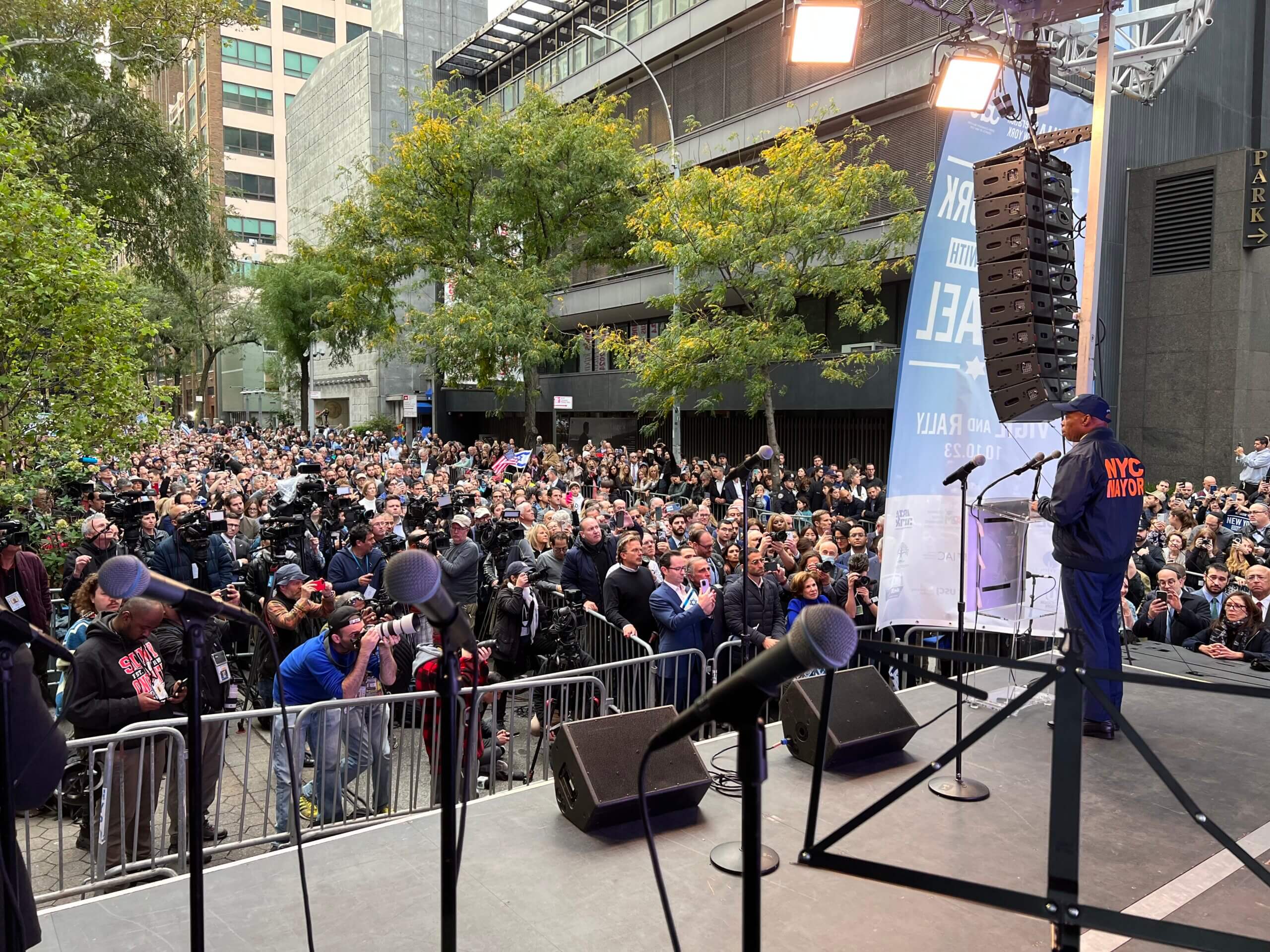
This spontaneity was most evident in a four-minute speech he delivered at a rally on Oct. 10, 2023, days after the Hamas attack on Israel. The moment raised his profile in Israel, when he declared, “We are not alright.”
“The fact that everybody in the Jewish world has seen that speech, such a short clip, speaks to the impact on Jews around the world,” said Fabian Levy, the deputy mayor for communications, who is Jewish. He recounted the behind-the-scenes moments leading up to the speech in a recent interview, growing emotional at times and struggling to speak. Before Adams took the stage, he met with the parents of Israeli-American hostage Omer Neutra.

Levy, 41, is considered one of Adams’ closest aides, frequently at the mayor’s side. He was first appointed as press secretary in 2021, and elevated to his current role in August 2023, becoming the first-ever deputy mayor of Persian or Iraqi descent. Levy said that some of his relatives in Israel, who knew he worked in government but did not realize he worked for Adams, had posted that Oct. 10 speech to a family WhatsApp group and suggested he “work for this guy.”
When I asked about his popularity in Israel in a recent interview, Adams said, “My clarity of message, I believe it resonated with people who have been there for others, yet did not see their allies stand up and fight with them. The friendship we have with Israel and our Jewish community is not one that ends during the time of conflict, but one that withstands difficult challenges.”
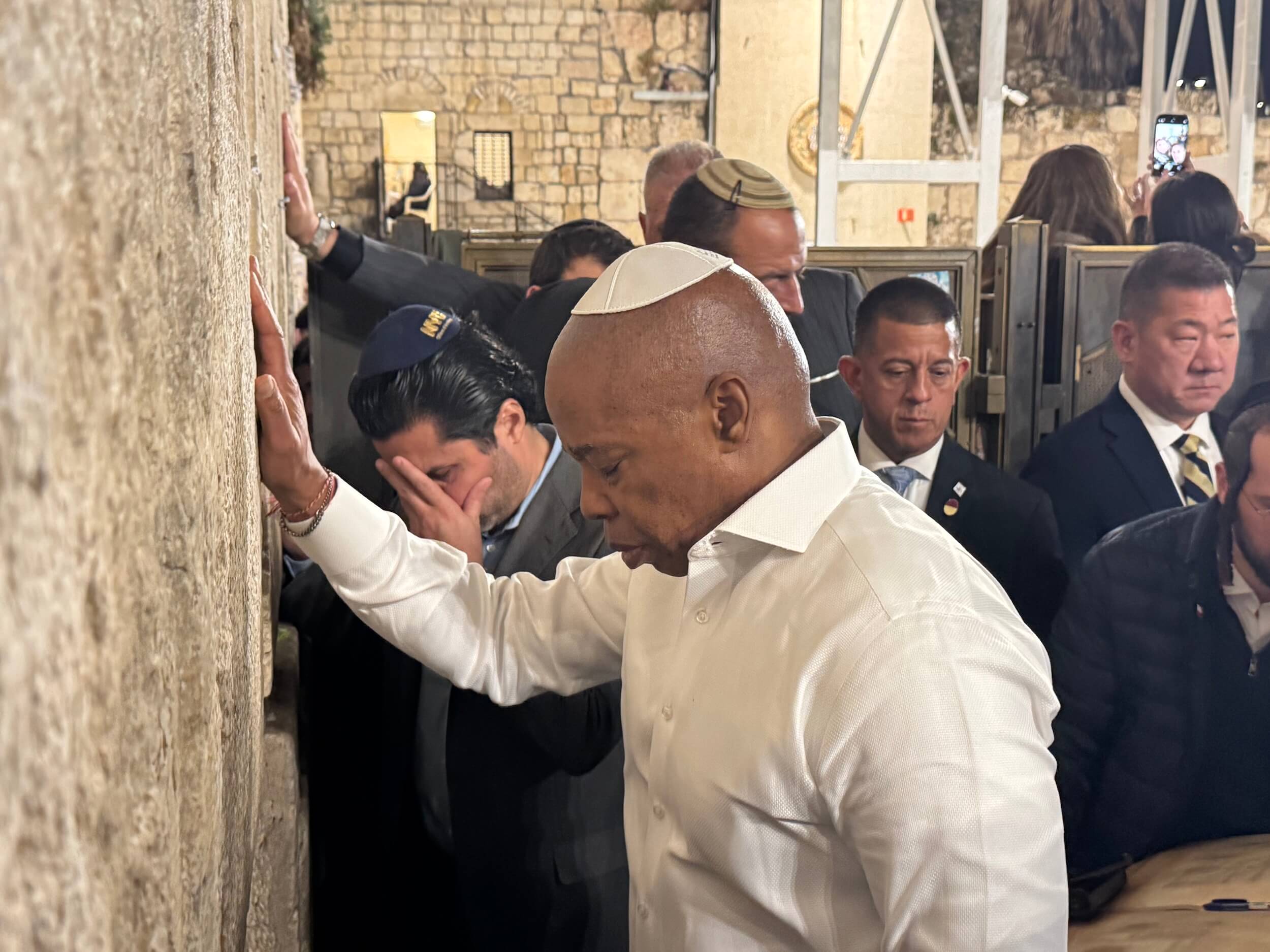
In Monday night’s farewell address to the community, following a final official trip to Israel, Adams cast himself as a modern-day Maccabee.
Eric Adams’ relationship with Jews
Adams, 65, has had a longstanding relationship with the Jewish community dating back to his time as a police officer in the 1980s, a connection that continued through his four terms in the state legislature and two terms as Brooklyn Borough President.
He aggressively courted Orthodox voting blocs, critical to electing him, in the 2021 crowded Democratic primary for mayor. “I don’t need a GPS to find Borough Park,” Adams said in a campaign stop in Borough Park a day before the primary. “I was there for this community for over 30 years, and I am going to be there as the mayor. I’m not a new friend. I’m an old friend.”
Adams initially moved his Jan. 1, 2022 inauguration — traditionally held at noon in the plaza outside City Hall in downtown Manhattan and drawing thousands of spectators — to the evening out of respect for Shabbat observers, since it fell on a Saturday. The ceremony was later postponed and scaled back altogether as the Omicron COVID-19 surge swept through the city at the time.
A large number of American Jews served in senior roles at City Hall and throughout Adams’ administration. That includes Jessica Tisch, who became police commissioner in 2024; Robert Tucker, commissioner of the fire department; Fred Kreizman, commissioner for community affairs; Zach Iscol, the emergency management commissioner; and Ed Mermelstein, commissioner for international affairs until July.
In the mayor’s office, Levy served alongside Menashe Shapiro, deputy chief of staff; Moshe Davis, Adams’ Jewish liaison and later also director of the newly-created mayor’s office to combat antisemitism; and Lisa Zornberg, his chief counsel, who inspired the mayor’s widely cited Oct. 10 line and resigned last year amid the federal investigations that rocked the Adams administration.
Joel Eisdorfer, a member of the Satmar Hasidic community in Borough Park, was senior adviser until he stepped down in 2024, citing family reasons, and was a close political ally who helped mobilize Jewish support during Adams’ campaigns. Adams’ personal photographer, Benny Polatseck, who is also Hasidic, documented many of his appearances at Jewish and other official events.
“You see yourself in my administration, in a very significant place,” Adams told Jewish reporters in 2024.
In speeches to Jewish audiences, Adams described New York City as the “Tel Aviv of America.”
But Adams faced criticism from parts of the broader Jewish community after launching a Jewish Advisory Council that met regularly to discuss Jewish-related issues. Some liberal groups argued the council was not representative of the city’s full Jewish diversity, noting that at least 23 of its 37 members were Orthodox Jews and only nine were women. The progressive group New York Jewish Agenda later met with Adams after raising concerns that he was primarily hearing from Orthodox leaders and those with more conservative political views.
Last year, Adams announced the creation of a new office to combat antisemitism, which led to a bitter feud with the city comptroller, Brad Lander, who is Jewish and who was at the time a mayoral candidate. (Adams and Lander have long had a strained relationship, sparring over policy and oversight.)
Adams also signed an executive order adopting the controversial International Holocaust Remembrance Alliance definition of antisemitism, which labels most forms of anti-Zionism as antisemitic. Critics, including progressives and Jewish advocacy groups, warned it could chill free speech.
Some Jewish elected officials also criticized Adams for his crackdown on the pro-Palestinian protests across the city and on college campuses. He was unapologetic about his opposition to the call for a ceasefire in Gaza.
Recently, Adams signed a measure barring city agencies from participating in Boycott, Divestment and Sanctions efforts, which would pre-empt any moves by city officials to divest from Israel Bonds and other Israeli investments. Adams maintained that it wasn’t an attempt to tie Mamdani’s hand but “to protect my legacy on the investment in Israel.”
During a roundtable with ethnic media outlets at City Hall on Monday, Adams didn’t elaborate when asked by the Forward how he would define his tenure in terms of curbing antisemitism and protecting Jewish New Yorkers. Antisemitism was up 18% in New York last year, with 68% of the 1,437 incidents occurring in New York City, according to the Anti-Defamation League. In the first quarter of 2025, NYPD data showed antisemitic acts made up 62% of all reported hate crimes citywide. Last month, anti-Jewish crimes were 37% of all reported hate incidents.
Adams said the numbers have been steadily dropping as a result of his moves to counter antisemitism, including his signature “Breaking Bread, Building Bonds” initiative, which encourages New Yorkers to host meals for 10 people from different racial, ethnic and religious backgrounds. “I think that the next administration must be extremely clear in their position around hate in general and antisemitism,” he said.
Levy said that Adams acted bravely in taking a firm stance on Israel, even when it carried political risk. “Some people are saying that it could have been the reason why he is no longer going to be mayor for another term,” Levy said. “He did it because it was the right thing to do.” Adams took a recent trip to Israel to bid farewell.
Shadowed by controversy
Despite his close and warm relationship with the Jewish community, Adams’ career has also been marked by recurring controversies. During the 1993 mayoral race, when he supported incumbent Mayor David Dinkins, Adams drew backlash after suggesting that then–state comptroller candidate Herman Badillo, who is Puerto Rican, would have shown greater concern for the Hispanic community had he not married a white Jewish woman. In the 1990s, Adams worked with the Nation of Islam as part of community crime patrol efforts and appeared publicly with its leader, Louis Farrakhan, who spewed antisemitism. He later came under fire for condemning former Rep. Major Owens during a 1994 congressional primary after Owens denounced Farrakhan.
As mayor, Adams faced renewed scrutiny in 2022 after defending his endorsement of a minister previously cited for antisemitic slurs in a race against a pro-BDS lawmaker. More recently, he faced criticism for invoking Adolf Hitler’s Mein Kampf while pushing back against allegations that he struck a quid pro quo with the Justice Department to end his federal corruption case, and for sitting for an interview at Gracie Mansion with Sneako, an influential antisemitic online streamer.
Adams made combating antisemitism central to his reelection effort. After withdrawing from the Democratic primary, facing a surging field of challengers, Adams sought to run on an independent line dubbed “End Antisemitism.” It came under legal challenge after creating another “Safe and Affordable” ballot. He ended his campaign in late September after failing to gain steam and in an attempt to clear the field for former Gov. Andrew Cuomo to stop Mamdani.
He also got into a dispute between Williamsburg Hasidim over the bike lanes earlier this year.
What his aides and Jewish leaders are saying
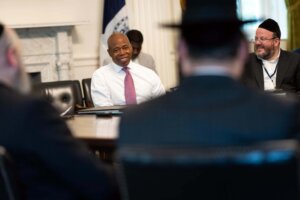
Adams’ senior aides and Jewish leaders all pointed to Adams’ response to the Oct. 7, 2023 attack on Israel as the high point of his tenure.
“His consistent support for the Jewish community after Oct. 7 was a model for what real leadership looks like,” said David Greenfield, a former member of the City Council who is now the chief executive of Met Council, the nation’s largest Jewish anti-poverty charity. “His remarks were, for many of us, the first time we felt genuinely seen and defended by leaders outside our community. At a moment of surging antisemitism, he didn’t hedge or look away.”
Sara Forman, executive director of the New York Solidarity Network, a pro-Israel political organization, said the expression of empathy he expressed toward the Jewish people by showing up “was very poignant and also a very significant legacy that Eric Adams is going to leave with all of us.”
In interviews, Adams’ Jewish staffers described a natural rapport with the community that often lessened the need for formal outreach or guidance on specific issues.
Shapiro, his deputy chief of staff, said that Adams’ unscripted nature underscored his familiarity and a genuine sense of belonging in the community. “He felt so comfortable in their presence, he knew exactly what he wanted to say,” Shapiro said.
“With Mayor Adams, you always felt like he practically went to yeshiva with you,” Davis, his liaison to the community, said. “He’s been in this so long and really knows what the community cares about.”
In his remarks at the Hanukkah event, Adams reassured the community that he will remain an ally after he leaves office. “I am going nowhere,” he said. Earlier in the day, Adams referred to what comes next as “God’s Plan A.” Adams is reportedly exploring a private-sector opportunity tied to an Israeli construction firm. “The end of the mayoralty means the beginning of what we are going to do together,” he said.
The post ‘We are not alright’: How Oct. 7 defined Eric Adams’ Jewish legacy appeared first on The Forward.
Uncategorized
Planned auction of a Holocaust-era Torah fragment sparked outcry, then intervention
(JTA) — A Torah scroll fragment believed to have been used as parcel paper by Nazi SS soldiers is expected to be donated to a US Holocaust remembrance organization after a Norwegian auction house listed it for sale last week, sparking an outcry.
A spokesperson for Israel’s Foreign Ministry told JTA that Foreign Minister Gideon Sa’ar had directed the ministry and Israel’s embassy in Norway to intervene to prevent the sale of “a sacred manuscript looted by the Nazis.”
“Thanks to the embassy’s efforts, the auction was canceled and the parchment will be donated to a Holocaust remembrance organization in the United States,” the spokesperson said.
The Torah fragment is expected to go to Remember Us The Holocaust (RUTH), a San Diego Holocaust remembrance organization working to establish a permanent museum. In a statement sent to JTA, RUTH said it had worked over 48 hours to “secure the fragment for preservation” and Holocaust education.
The organization also enlisted Adolfo Roitman, the former curator of the Dead Sea Scrolls and head of the Shrine of the Book at the Israel Museum in Jerusalem, to advise on its “appropriate treatment and respectful exhibition,” the statement said.
Moisés Salinas Fleitman, RUTH’s executive director, told JTA that the donation had been confirmed by email last Tuesday but had not yet been finalized. He said there was “no expert confirmation as of yet of the provenance of the scroll,” and that the consignor had told RUTH the parchment was “found on a public market in Poland” over three decades ago. RUTH had not yet inspected the fragment or any evidence supporting that account, he added.
Salinas Fleitman said his understanding was that the fragment had been withdrawn from the auction, but RUTH could not confirm what had happened amid conflicting news reports. The organization also declined to identify the person in possession of the fragment, citing its policy of protecting anonymous donors. RUTH’s procedures for verifying authenticity and legitimate provenance take time, the organization said, adding that the organization would not accept the fragment unless both could be established.
The controversy began when the fragment was put up for auction Oct.18 by Oslo-based Valkyrie Historical Auctions, an online auction house specializing in Third Reich memorabilia.
The handwritten calfskin parchment, estimated to fetch between $1,500 and $2,000, was advertised as a “sad and powerful symbol” of the destruction of European Jewish life.
Valkyrie identifies its president as Norbert Podlesny, a historian and author of a trilogy on the Holocaust. The auction house says its items are examined by experts and carry a lifetime guarantee of authenticity. Neither Valkyrie nor Podlesny responded to repeated inquiries from JTA.
The auction house’s original listing explicitly described it as having been plundered by SS soldiers during the Holocaust, an account its representative subsequently disputed in comments to a Norwegian newspaper. The parchment was also described as having been used to wrap a package sent to Germany.
The Valkyrie website recorded a winning bid of $8,500 on the Torah fragment, more than four times the upper estimate for the parchment.
Video footage of the live auction reviewed by JTA shows bidding on the fragment proceeding, with offers rising incrementally. The footage does not establish who placed the bids or whether a transaction was ultimately completed.
Conflicting accounts have left it unclear whether the fragment was formally withdrawn, purchased by the auction house itself or simply withheld from the winning bidder.
Other lots in the same auction included a death certificate for a Polish prisoner at Dachau, a book from the scientific library at Auschwitz, and a dress bearing a yellow Star of David marked “JUIF.”
The controversy went public after the Foreign Ministry condemned the planned sale in a post on X headed “A Nazi celebration in Oslo.”
The ministry also criticized Norway’s proposal to end dedicated funding for school trips to former Nazi concentration camps, with the funding instead transferred to general local government allocations.
“Auctions of sacred texts looted by the Nazis: IN. Visits to extermination camps: OUT,” the ministry wrote.
Gideon Taylor, president of the World Jewish Restitution Organization (WJRO), said that the auction house had taken steps to remove the fragment from public sale but added that those measures “in no way” resolved the issue.
“There are many unanswered questions,” Taylor told JTA.
He urged Valkyrie to identify the seller, explain how the fragment had been acquired, disclose what provenance information accompanied it and undertake further research into its history. He also questioned why the auction house had agreed to sell the parchment despite its original description as Nazi-looted property.
“There is a profound contradiction in recognizing an object as a symbol of the Holocaust while treating it as something to be bought and sold,” he said.
He said the case exposed a “lack of historical awareness” of how the systematic plunder of Jewish property, both private and communal, formed part of the Nazis’ campaign to annihilate European Jewry.
“This is not simply an antique or a historical curiosity. It is a sacred Jewish object that represents a community’s religious life and the devastating destruction of that life during the Holocaust,” he added.
WJRO has called on the Norwegian government to launch an investigation into the auction house’s handling of the fragment, Taylor said, adding that similar questions had arisen concerning other objects previously sold by it.
Taylor also called for “a coordinated international effort” to tackle the trade in sacred Jewish objects looted during the Holocaust and still held by private collectors.
“This is not about private collections, this is about the memory of the Jewish people,” he said.
Norway is among 35 countries that have endorsed the 2024 Best Practices for the Washington Conference Principles on Nazi-Confiscated Art. The nonbinding guidelines cover Holocaust-looted religious and communal property, including sacred scrolls, manuscripts and synagogue objects, and recommend returning objects determined to have belonged to Jewish communities to successor communities or institutions. They do not automatically require restitution of an item offered through a private auction.
The dispute follows other controversies over the sale and ownership of Holocaust-era artifacts. Last November, a German auction house canceled a planned sale of more than 600 concentration camp-related objects, including prisoners’ correspondence, identification documents and a yellow Star of David, following protests from Holocaust survivors and Jewish organizations.
Earlier this year, Poland returned 91 Jewish religious objects to Greece, decades after they were seized by the Nazis from synagogues in Thessaloniki. WJRO helped coordinate their restitution following years of research and negotiations.
This article originally appeared on JTA.org.
The post Planned auction of a Holocaust-era Torah fragment sparked outcry, then intervention appeared first on The Forward.
Uncategorized
People accusing El-Sayed of Muslim Brotherhood ties will accuse Jews of dual loyalty too
Abdul El-Sayed, Democratic candidate for Senate in Michigan, has said that he has no ties to, and disavows, the Muslim Brotherhood. It does not matter how many times he is asked about this, or how many times he answers, because there will be those who insist that it is a real concern. Their position relies not on reality, but on a deep-rooted idea Jews should recognize: that people who are “other” hold dual loyalties, and that those dual loyalties are a danger to America.
El-Sayed has had ample reason and opportunity to assert his distance from the group, as he has been asked about it over and over again. (The connection to the Muslim Brotherhood specifically seems to be a tweet from El-Sayed’s half-sister saying their mother was once involved with the organization.) He was asked at a town hall earlier this month to disavow the Muslim Brotherhood; he was asked about the Muslim Brotherhood earlier this month on Meet the Press; he was asked about it by Fox News; and he was accused without evidence by his opponent, Republican Mike Rogers, of being “bought” by the Muslim Brotherhood and of being a national security risk in their debate last week. Other Democrats were also asked to weigh in: CNN, for example, asked Sen. Chris Murphy if Democrats were “concerned about this with El-Sayed.”
American Jews should object to this cynical, baseless fearmongering because it is wrong and destructive in and of itself to charge that a person who is Muslim is a threat to national security. American Jews should also recognize it for what it is: a charge of dual loyalty, and one they should speak up against if they do not want similar charges leveled against Jewish politicians. This is true even if they disagree with El-Sayed or do not want to see him win in next week’s midterm elections.
For American Jews, dual loyalty is an old and familiar antisemitic trope. It’s a suspicion and accusation that has followed us around the globe and across decades and says that we can never really be loyal to the country or society in which we find ourselves because we are secretly loyal only to each other or, more recently, to Israel.
American Jews — understandably, given the history of this trope — are attuned to politics that smack of dual loyalty. For example, Pennsylvania Governor Josh Shapiro wrote in his book that, when he was being vetted as a potential running mate for Kamala Harris in the 2024 presidential election, he was asked if he had ever been an Israeli agent and felt that that was inappropriate. In fact, being asked about loyalty to other countries is a regular occurrence in obtaining a security clearance.
Nevertheless, Shapiro’s alertness to it speaks to the sensitivity American Jews, and particularly politicians, feel around being accused of dual loyalty, especially as Israel becomes a “litmus test” in Democratic party politics. For example, was congressional candidate Scott Weiner chased from a rally for trans rights solely because he had declined to say that Israel committed a genocide in Gaza (before he said they did days later), or was it because he’s Jewish?
And this past weekend, a RebellionPac ad in which a couple can’t buy eggs because, they say, the United States sends money to Israel, concludes with “Mike Rogers is for they/them” — cutting to photos of Israeli politicians — “Abdul El-Sayed is for you,” suggesting that being supportive of Israel is at odds with being supportive of Michigan, which some Jews feel creates a permission structure for antisemitism and suspicion toward Jews.
U.S. President Donald Trump, meanwhile, once again put forth his specific version of the dual loyalty trope, in which to be a true American Jew is to vote for him because he supports Israel, by saying American Jews should be “ashamed of themselves” if they voted for El-Sayed.
It is not enough for American Jews to be against dual loyalty when it is leveled against us. We just need to be against it. Because if you do not want it to be acceptable to cast aspersions regarding a candidate’s race, religion, or ethnicity, and if you do not want there to be different, special, higher bars that candidates need to meet because of their culture or where they pray, then you need to be against that for anyone. Otherwise, you’re accepting it for everyone.
I am not equating Israel with the Muslim Brotherhood, nor am I defending the Muslim Brotherhood. What I am saying is this: If you are offended by the idea that Jews need to prove that we are not first and foremost loyal to Israel, or by the notion that Jews should be punished for perceived connections to Israel, then you should also be offended by what politicians and pundits are demanding of El-Sayed. You should do this not only because not doing so is hypocritical (though we, as a nation, seem long past the point of hypocrisy mattering), but because the more comfortable we are having charges of dual loyalty in our politics, the more comfortable we are having charges of dual loyalty in our politics for everyone, including Jewish candidates.
I made a similar point last week on X (formerly Twitter) and was promptly accused of hating myself and Jews, loving the Muslim Brotherhood, and having my priorities wrong. In one response to my post, which read, “You don’t get a more tolerant, accepting, pluralistic, liberal country by accusing people of another religion of inherently hating and being disloyal to it and you, it is simply not going to work,” someone wrote, “I don’t want a more tolerant society you stupid twat, I want my kids to be safe at Jewish day school and I don’t want 24/7 security at shul.”
What I found most fascinating about this person’s reply was the idea that Jewish institutions could be safe in the United States, where we are a small minority, without ours being a tolerant society. That struck me as almost as fanciful as thinking that we could allow charges of dual loyalty for Muslim candidates and then turn around and ask that Jewish candidates not have to face dual loyalty accusations or special extra litmus tests.
Much as a society in which antisemitic conspiracy theories are allowed to flourish is ultimately a more conspiratorial, paranoid, and less trusting place for everyone, a polity where candidates are regularly charged with dual loyalty or disloyalty on the basis of their religion or ethnicity is just that — a political discourse where charges of dual loyalty are leveled against ethnic and religious minorities. We don’t get to choose against whom dual loyalty cards are played. We only get to choose whether we think it’s acceptable to play them at all.
The post People accusing El-Sayed of Muslim Brotherhood ties will accuse Jews of dual loyalty too appeared first on The Forward.
Uncategorized
Eight years after Tree of Life shooting, a Jewish burial society’s ranks have nearly doubled
After preparing five victims of the Tree of Life synagogue massacre for burial, members of Pittsburgh’s New Community Chevra Kadisha stood in a circle and held hands.
They had gathered like this before, taking a moment after their work to process what they had done. This time, they were caring for people murdered in their own community.
Volunteers from outside Pittsburgh had come to help. David Zimmer, a longtime member, remembered one visitor bringing a custom from another chevra kadisha.
“He passed around a piece of chocolate,” Zimmer recalled, “so that there should be something sweet.”
Eight years later, NCCK has nearly doubled in size. Before the attack, it had about 38 members, according to records reviewed by Patricia Cluss, one of its founders. Within four months, 11 people had joined. Today, it has 70.
The growth has brought more volunteers into some of the least visible work in Jewish communal life. A chevra kadisha, traditionally translated as a “holy society,” washes and prepares the dead for burial, dresses them in plain white shrouds and helps ensure they are treated with dignity. The work is considered a chesed shel emet, or true kindness, because the dead cannot repay those who care for them.
For NCCK, the aftermath of the attack also revealed another dimension of that care: The people accustomed to supporting others through loss needed support themselves.
Caring for their own
Pittsburgh’s NCCK was founded in 2004 to encourage greater participation in the Jewish tradition of caring for the dead. An Orthodox chevra kadisha already existed, and NCCK’s founders hoped to involve more Jews in the practice, regardless of their level of religious observance.
Cluss was among them. She had encountered an article about Reform Jews reviving Jewish burial practices that had fallen away in some communities. Until then, she had never heard of a chevra kadisha.
“I gotta do that,” she remembered thinking.
Deane Root joined early, too, drawn by an idea: What if Pittsburgh had a chevra kadisha open to anyone in the Jewish community? Root remembered a small group gathering, often in a member’s living room, to figure out the logistics of working with funeral homes and training volunteers.
Then came Oct. 27, 2018.
Root and his wife, Rabbi Doris Dyen, were approaching the Tree of Life synagogue building that Saturday morning when they heard a series of loud noises. They pulled into the parking lot and saw shattered glass.
Two NCCK members had been inside the synagogue, and the dead and wounded included people its members knew. At the Jewish Community Center of Greater Pittsburgh after the shooting, where families and friends gathered and waited for news, Root recalled that “not everybody knew for sure” what had happened to their loved ones.
When the victims were released for burial, NCCK began the work for which it had trained. Members also kept shmira, remaining with the dead and reciting Psalms until burial.
Allen Baum, who coordinates the NCCK men’s members, remembered that by the end, nearly every man in the group had participated in shifts. After the final tahara, the ritual preparation of a body for Jewish burial, they stood in a large circle, joined by women from NCCK as well.
Later, members gathered in a home, bringing food, reading poems and speaking about the people they had lost.Root was carrying the trauma of what he experienced that morning. He described a “video playing in my head constantly.”
Being together helped. “Let the community carry some of that burden,” Root remembered, “rather than keeping it all inside our own emotions and our own minds.”
A growing circle
Following the attack, younger Jews contacted NCCK after reading about its work. Some described joining as something they felt they needed to do as Jews. Others spoke of it as a form of social action.
Elana Glick, who joined NCCK around 2014 after her grandfather died, remembered that the group sometimes struggled to find enough volunteers before the massacre. Afterward, she said, the work became more public, even as members sought to preserve the privacy of the rituals.
At its annual dinner, Glick has watched the group grow. There have been “more and more tables added year after year because of people who have found this and wanted to be a part of this work,” she said.
“Being part of the chevra is one of the ways I feel most attached to my Judaism,” Glick said.
Sarit Wishnevski, executive director of Kavod v’Nichum, a national organization supporting chevrot kadisha and Jewish burial practices, has watched the movement become increasingly multigenerational. At the organization’s November 2025 gathering in Ojai, California, participants ranged from their 20s to their 80s, with one in their 90s.
The Jewish phrase l’dor v’dor is usually understood as passing something “from generation to generation.” Wishnevski suggested it can also mean practicing a tradition with generations alongside one another.
NCCK has also become a resource for other communities. Wishnevski called it a “really strong model,” citing materials its members have shared and their help with questions ranging from starting a group to making the work more inclusive of gender diversity.
The possibility of mass-casualty events has prompted other questions, too. “How will we be prepared?” Wishnevski said. “How will we show up if God forbid this happens here?”
Kavod v’Nichum is developing an emergency preparedness pilot effort. Wishnevski said the goal is not for a chevra kadisha to respond “in a silo,” but to build relationships with first responders, government agencies and other Jewish organizations.
Earlier this month, three NCCK members traveled to Chicago to teach other volunteers about something none would ever want to need: developing tahara liturgy for young children.
But most of the chevra kadisha’s work remains unseen, and the calls come without warning. “The only predictable thing is the unpredictability,” Baum said.
One summer, the men’s group went 11 weeks without a tahara. More recently, Cluss said, the women’s group performed 11 in two weeks. Sometimes volunteers arrive at a funeral home for one person and are asked whether they can stay for another. In recent years, NCCK has performed roughly 90 taharot annually.
For Cluss, the work had long been meaningful. After Tree of Life, she struggled to explain how that meaning had changed. Her daughter noticed something she hadn’t.
“Mom, do you ever notice when you’re talking about the chevra you always put your hand on your heart?”
Cluss hadn’t noticed.
The post Eight years after Tree of Life shooting, a Jewish burial society’s ranks have nearly doubled appeared first on The Forward.
