


Uncategorized
Art by women portraying their experiences in the concentration camps
דאָס איז איינער פֿון אַ סעריע קורצע אַרטיקלען אָנגעשריבן אױף אַ רעלאַטיװ גרינגן ייִדיש און געצילעװעט אױף סטודענטן. די מחברטע איז אַלײן אַ ייִדיש־סטודענטקע. דאָ קען מען לײענען די פֿריִערדיקע אַרטיקלען אין דער סעריע.
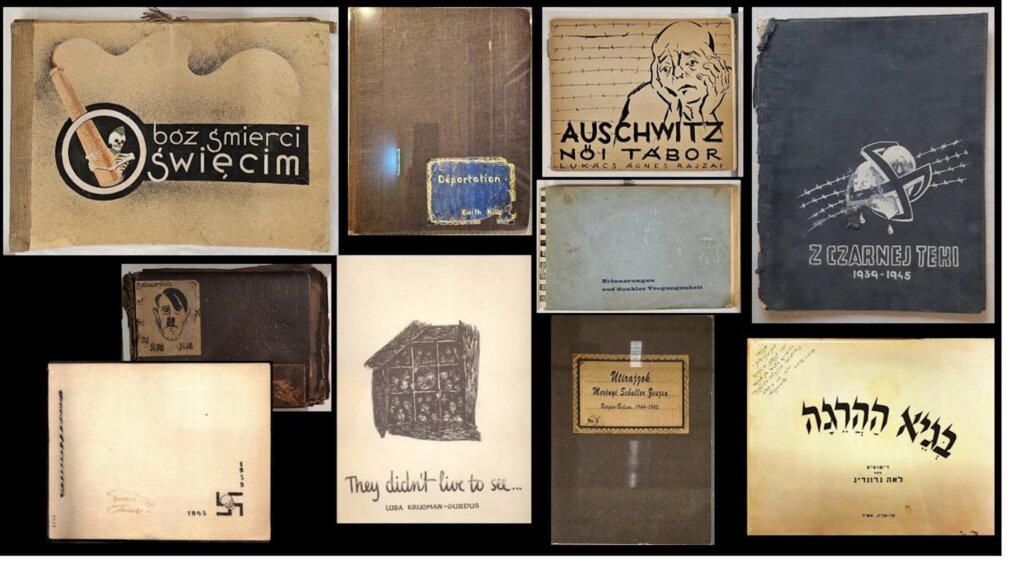
צענדליקער יאָרן אײדער דער קאַרטוניסט אַרט שפּיגלמאַן האָט פּובליקירט „מאַוס“ האָבן עטלעכע ייִדישע פֿרױען — מערסטנס לעבן געבליבענע פֿון די נאַציסטישע קאָנצענטראַציע־לאַגערן — געשאַפֿן אַלבאָמען בילדער וואָס זיי האָבן געצייכנט אָדער געמאָלט װעגן די אײגענע גרױליקע איבערלעבונגען.
אַ נײַע אױסשטעלונג אין בראַנדײַס־אוניװערסיטעט, „װער װעט צײכענען אונדזער געשיכטע׃ װײַבערשע װיזועלע דערצײלונגען פֿונעם חורבן, 1949-1944“, פּרעזענטירט צען פֿון די דאָזיקע בילדער־ביכלעך. דאָס ערשטע האָט געשאַפֿן אַ קינסטלערין װאָס איז אַנטלאָפֿן קײן ארץ־ישׂראל בעת דער מלחמה. זי האָט באַזירט אירע װערק אױף די אַכזריות־באַריכטן װאָס זענען אָנגעקומען אינעם ייִשובֿ. די אַנדערע אַלבאָמען זענען געמאַכט געװאָרן באַלד נאָכן חורבן — אַ מאָל בעת די װאָכן און חדשים נאָך דער קינסטלערינס באַפֿרײַונג.
די אױסשטעלונג, געשטיצט פֿונעם הדסה־בראַנדײַס-אינסטיטוט, איז די ערשטע װאָס באַװײַזט אַ גרופּע װײַבערשע חורבן־אַלבאָמען צוזאַמען. עטלעכע פֿון זײ זענען קײן מאָל פֿריִער נישט אױסגעשטעלט געװאָרן.
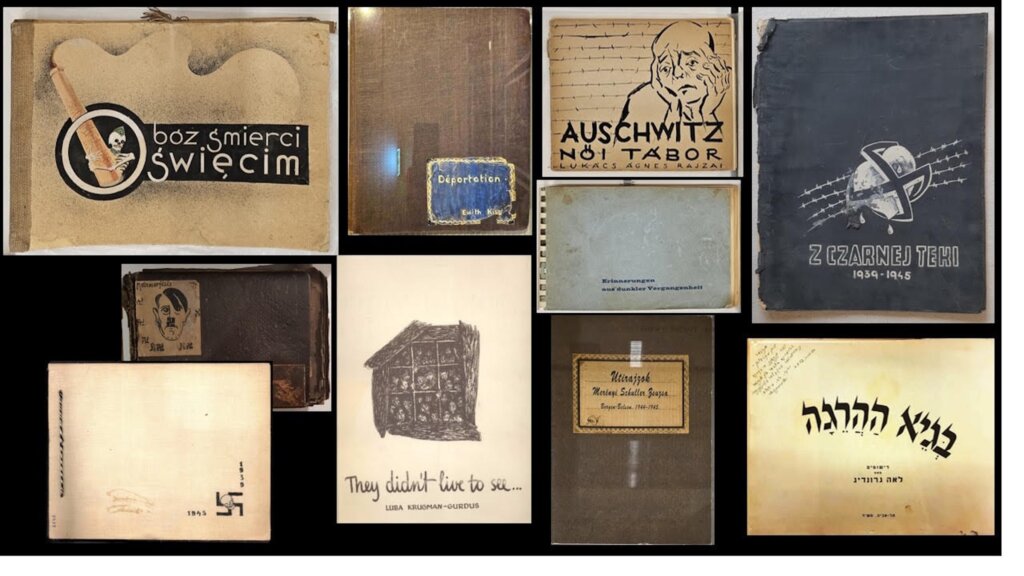
לעצטנס האָב איך באַזוכט די גאַלעריע און געשמועסט מיט דער אױסשטעלונגס קוראַטאָרשע רייטשל פּערי, װאָס איז אַ קונסט-היסטאָריקערין און פּראָפֿעסאָרשע פֿון חורבן־לימודים אין חיפֿהר אוניװערסיטעט. זי האָט מיר דערקלערט אַז די פֿרױען װאָס האָבן געשאַפֿן די בילדער־ביכלעך זענען זײער אַ פֿאַרשײדנאַרטיקע גרופּע. זײ זענען געבױרן געװאָרן אין פּױלן, אונגערן און דײַטשלאַנד אין כּלערלײ סאָציאַלע, עקאָנאָמישע און רעליגיעזע באַדינגונגען. אַ פּנים האָבן זײ זיך קײן מאָל נישט געטראָפֿן, און האָבן געמאַכט די אַלבאָמען אומאָפּהענגיק איינע פֿון דער צווייטער.
עטלעכע פֿון די פֿרױען זענען שױן פֿאַר דער מלחמה געװען פּראָפֿעסיאָנעלע קינסטלערינס. אַנדערע זענען געװען יונגע קונסט־סטודענטקעס װעמענס אױסשולונג איז איבערגעריסן געװאָרן פֿון דער דעפּאָרטירונג. אַ טייל האָבן אַנטדעקט אַ טאַלאַנט צו צײכענען אָדער מאָלן אין די געטאָס און לאַגערן — װוּ צוליב דער סיסטעם פֿון שקלאַפֿן־אַרבעט איז אַזאַ פֿעיִקײט אַ מאָל געקומען די נאַציס צו ניץ. דאָס מאַכן קונסט איז געװאָרן אַ קיום־סטראַטעגיע.
פּערי האָט מיר אױך דערקלערט אַז ס׳רובֿ פֿון די װײַבערשע בילדער־אַלבאָמען זענען נישט לאַנג נאָך דער מלחמה פֿאַרגעסן געװאָרן. אַ פּאָר פֿון די פֿרױען האָבן אױסגעשטעלט זײערע ביכעלעך נאָך דער באַפֿרײַונג, אַ מאָל אין קונסט־אױסשטעלונגען אָרגאַניזירט פֿון לעבן געבליבענע אין די לאַגערן װוּ זײ זענען אַ מאָל געװען אַרעסטאַנטן. ס׳רובֿ אַלבאָמען זענען אָבער פֿאַרשװוּנדן געװאָרן אין אַרכיװן, װוּ מען האָט זײ קנאַפּ אױסקאַטאַלאָגירט — למשל אָן דעם נאָמען פֿון דער שאַפֿערין. (לױט פּערין איז אַזאַ טענדענץ אַ מאָל אַ סימן פֿון אומדרך־ארץ צו פֿרױענס װערק.) אַנדערע אַלבאָמען זענען געבליבן בײַ דער קינסטערלינס יורשים.
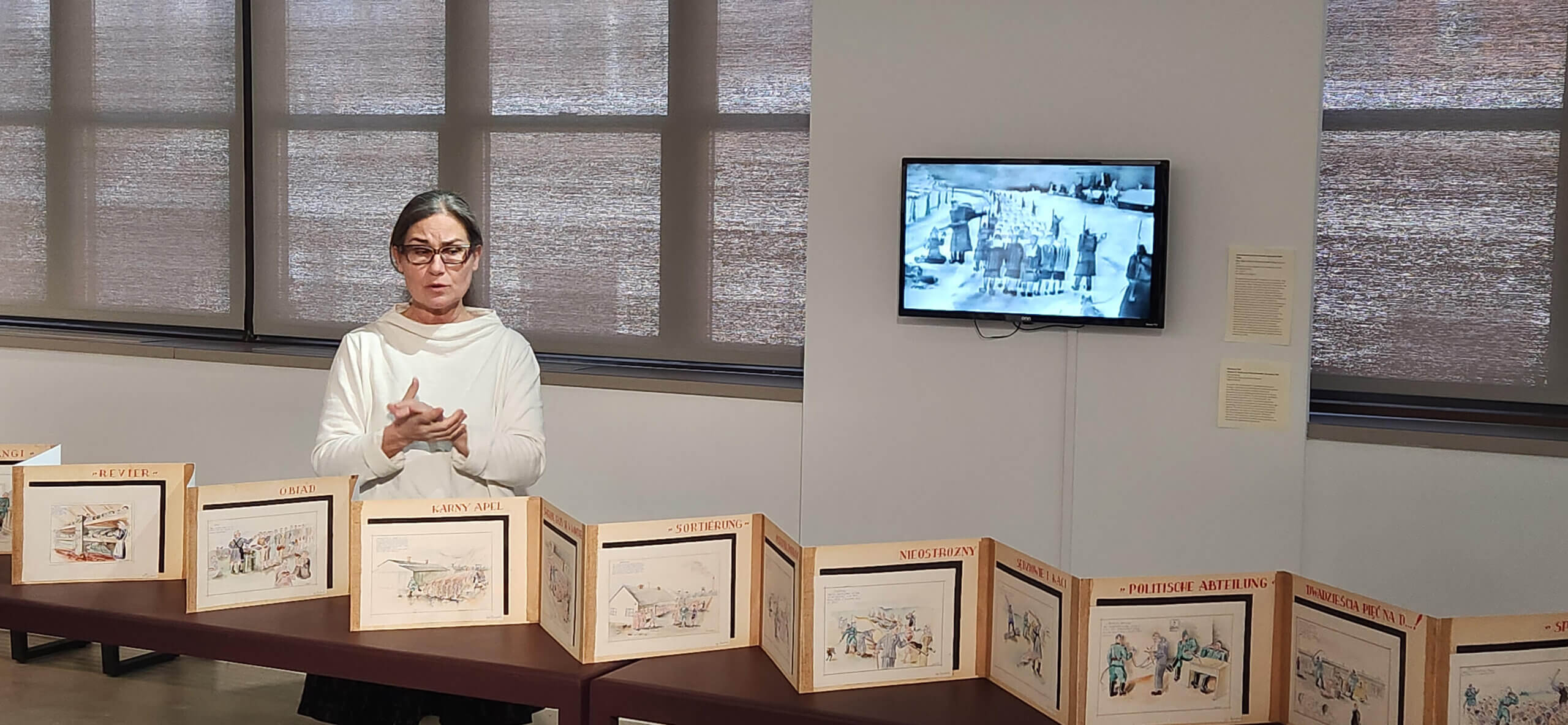
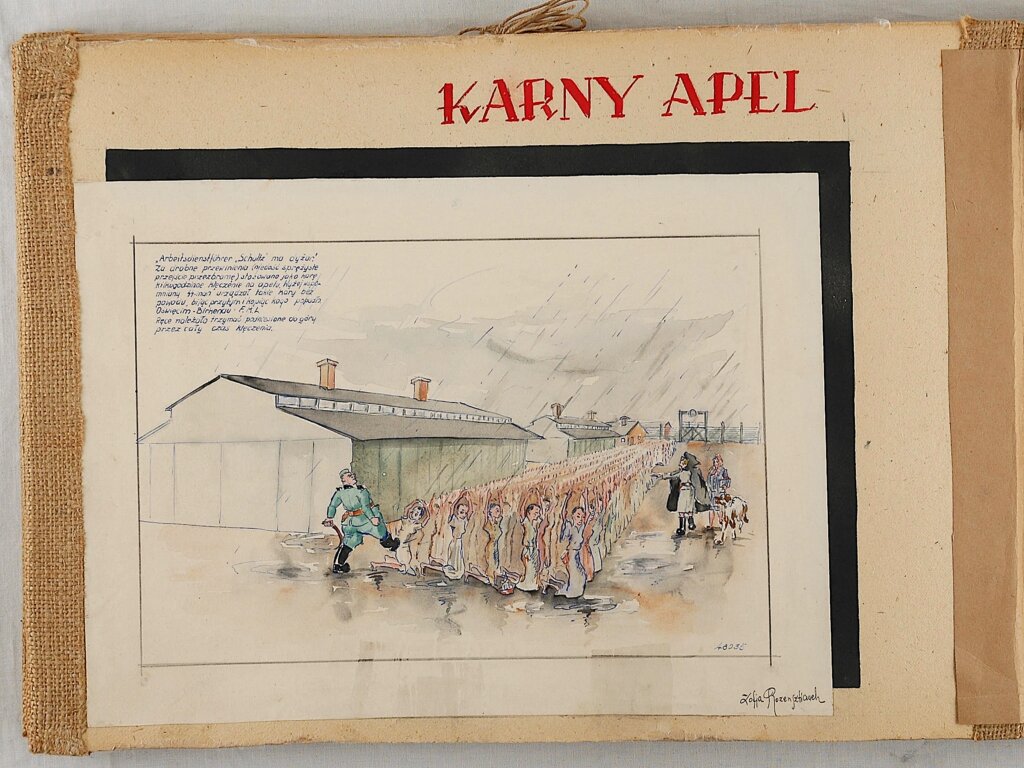
אַ װיכטיקער אױסנעם איז „אױשװיצער טױט־לאַגער“, געמאַכט פֿון זאָפֿיאַ ראָזענשטראַוך (1996-1920) אין 1945. דער דאָזיקער אַלבאָם — װאָס איז איבער 30 פֿוס די לענג און צעעפֿנט זיך װי אַן „אַקאָרדיאָן“ — איז געװען איינע פֿון די ראַיות אינעם פּראָצעס פֿון אַדאָלף אײַכמאַן אין 1961. אױף דער װאַנט אין דער אױסשטעלונג קען מען זען אַ װידעאָ פֿונעם פּראָצעס, װוּ אַ פֿרױ באַשטעטיקט דעם אמת פֿון די אילוסטרירטע סצענעס. ראָזענשטראַוכס אַלבאָם געהערט הײַנט „יד־ושם“ און איז גוט באַקאַנט אין ישׂראל.
פּערי האָט אַנטדעקט די פֿאַרגעסענע װײַבערשע אַלבאָמען צופֿעליק, װען זי האָט זיך אָנגעשטױסן אין אײנער פֿון זײ אין אַן אַרכיװ. „שוין 20 יאָר וואָס איך פֿאָרש די װיזועלע קולטור פֿונעם חורבן, און ביז דעמאָלט האָב איך נישט געװוּסט אַז אַזעלכע אוצרות עקסיסטירן אין די אַרכיװן“, האָט זי געזאָגט. דאָס געפֿינען מער איז געװאָרן אַ שליחות. „איך האָב זײ אַרומגעזוכט אין ניו־יאָרק, ישׂראל, פּױלן, אונגערן, דײַטשלאַנד און אַנדערש װוּ. אַ מאָל האָבן די יורשים מיר געהאָלפֿן אָדער מיר אַפֿילו געשאָנקען מאַטעריאַלן, װאָס זענען געװען בײַ זײערע משפּחות.“
אָט זענען אַ פּאָר בײַשפּילן פֿון דער אױסשטעלונג. מען דאַרף אָבער האַלטן אין זינען אַז די דאָזיקע אינדיװידועלע בילדער זענען טײלן פֿון אַלבאָמען װאָס דערצײלן אָפֿט כּסדרדיקע מעשׂיות׃
— „אױסרוף־שטראָף׃ אױשװיץ“ פֿון ראָזענשטראַוכס פֿריִער־דערמאָנטן אַלבאָם (װאָס מען זעט אין בראַנדײַס אין אַ גוטער פֿאַקסימילע צוליב דער דעליקאַטקײט פֿונעם אָריגינעל). פֿילצאָליקע אָפּגעצערטע פֿרױען קניִען אינעם רעגן פֿאַר אַ קאַזאַרמע מיט די הענט אין דער לופֿט, בעת מען רופֿט אױס זײערע נעמען. אַ הויכער, גראָבער נאַציסטישער אָפֿיציר גיט אַ פֿרױ אַ בריקע אין די ריפּן. אױבן איז אַ באַשרײַבונג פֿון דער סצענע אױף פּױליש.
— אַ בילד פֿונעם אַלבאָם „1945-1939“, געשאַפֿן פֿון רעגינע ליכטער־ליראָן (1995-1920) אין 1945 אין אַ די־פּי לאַגער אין איטאַליע. דאָ זעט מען נאַקעטע פֿרױען און מײדלעך װאָס קלאַמערן זיך אײנע אין דער צװײטער אױפֿן ראַנד פֿון אַ מאַסן־קבֿר בײַ נאַכט. זײ זענען אַרומגערינגלט פֿון נאַציס מיט ביקסן װאָס װעלן זײ באַלד אױסשיסן. אױף רעכטס ברענט אַ גרױסע שׂרפֿה װאָס האַלט די קרבנות נאָענט צום קבֿר.
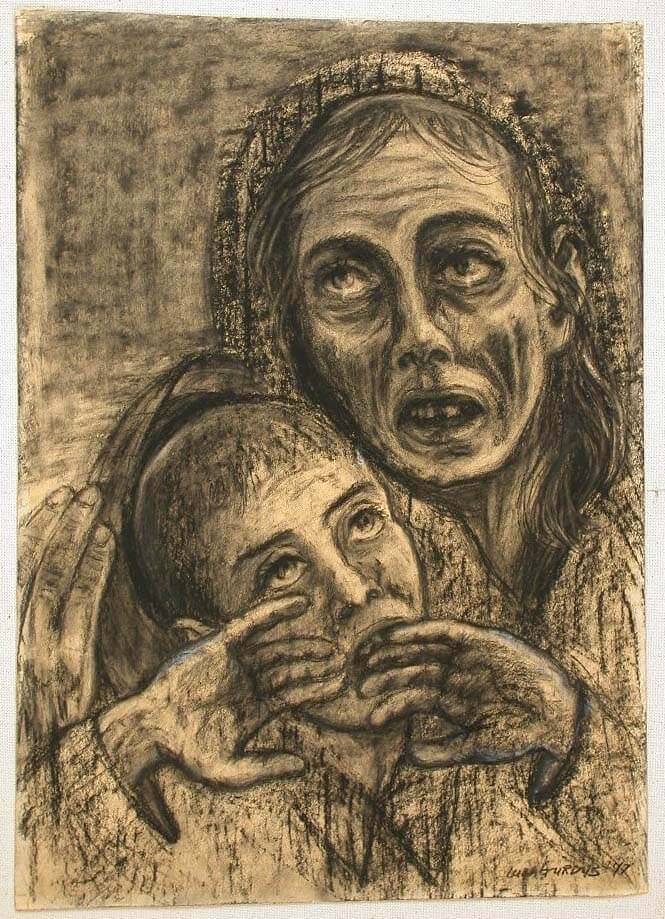
— „מוטער“ פֿון „זײ האָבן נישט דערלעבט צו זען…“, פּובליקירט פֿון לובאַ קרוגמאַן גורדוס אין 1949. דאָס בילד פֿון אַ מטורפֿדיקער פֿרױ װאָס פּרוּװט אומזיסט צו באַשיצן איר יונג קינד רעפּרעזענטירט אַ סך ענלעכע אילוסטראַציעס אין די װײַבערשע אַלבאָמען. די אָפּזונדערונג פֿון זײערע קינדער און די אוממעגלעכקײט זײ צו ראַטעװען איז בײַ די מאַמעס אַװדאי געװען אַן אומדערטרעגלעכע טראַוומע.
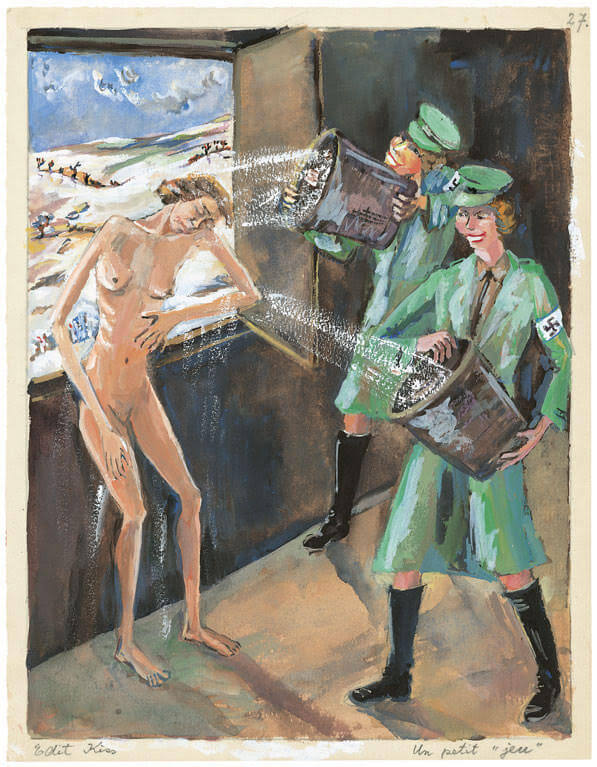
— „אַ קלײנע שפּיל“ פֿון „דעפּאָרטירונג“, געמאַכט פֿון עדיט באַן קיש אַרום 1950, אָבער באַזירט אױף פֿריִערדיקע נוסחאָות (אײן נוסח איז געשאַפֿן געװאָרן אין ראַװנסברוק לאַגער און איז חרובֿ געוואָרן). צװײ נאַציסטישע היטערינס לאַכן אַ סאַדיסטישן געלעכטער בעת זײ װאַרפֿן קאַלט װאַסער איבער אַ נאַקעטער, סקעלעטישער פֿרױ. זי שטײט פֿאַר אַן אָפֿענעם פֿענצטער מיט אַ שנײיִקן פֿעלד אין הינטערגרונט. זי פּרוּװט זיך צו באַהיטן פֿון קעלט און פֿון זייער זילזול מיט די מאָגערע הענט.
פּערי האָט מיך דערמאָנט אַז נישט געקוקט אױף די שױדערלעכע בילדער זענען די אַלבאָמען אױך בײַשפּילן פֿון װײַבערשער פֿעסטקײט און אַלײן־באַשטימונג. „דער נאָמען פֿון דער אױסשטעלונג, ׳װער װעט אױסצײכענען אונדזער געשיכטע?׳ איז אַ פֿראַגע װאָס די קינסטלערינס ענטפֿערן אַלײן. זײ האָבן שאַפֿעריש רעאַגירט אױף זייער פּערזענלעכער און קאָלעקטיװער טראַװמע. דורך זײערע בילדער רעדן זײ אין נאָמען פֿון אַלע ייִדישע פֿרױען װאָס האָבן דורכגעמאַכט אַזעלכע גרױלן.“
The post Art by women portraying their experiences in the concentration camps appeared first on The Forward.
Uncategorized
Israel’s election may hinge on whether Netanyahu’s opposition will accept Arab support
Israel’s approaching election is developing into an extraordinary paradox: Prime Minister Benjamin Netanyahu, whose government presided over the catastrophe of Oct. 7 and whose record since has been a succession of security failures, assaults on democracy, capitulations to Haredi interests and international embarrassments, may yet survive politically because his opponents cannot bring themselves to accept the parliamentary support of Israel’s Arab citizens.
The polls have tightened, the opposition has conducted a strangely timid campaign, and U.S. President Donald Trump’s endorsement of Netanyahu over the weekend introduces an unpredictable element into a contest that should by any reasonable accounting be a referendum on utter failure. Yet given the picture emerging in the polls, the decisive question is whether the opposition’s leaders possess the courage to reach out to the one-fifth of Israelis who are Arabs – who are expected to vote in very high numbers on Oct. 27.
Since 1973, Israel’s classic center-left has never secured an election-day parliamentary majority without the seats of Arab parties. Yitzhak Rabin’s victory in 1992, for example, depended on a parliamentary balance that included Arab representatives, whose support later became essential to his government’s survival. By most credible polls, that is the picture that emerges now, and with that support, the opposition could become a comfortable majority of close to 70 of the 120 Knesset seats.
But things are not so simple. In 2020, most of the Joint Arab List – an alliance of Arab parties in Israel – recommended opposition leader Benny Gantz for prime minister, producing a numerical majority that collapsed because several opposition lawmakers simply could not stomach the prospect. But the Naftali Bennett-Yair Lapid government that removed Netanyahu in 2021 included the Arab party Ra’am, demonstrating that cooperation across this divide was possible even among politicians with profound disagreements about national identity and the question of a Palestinian state.
Throughout these episodes, the challenge was the elementary democratic principle that the votes of Arab citizens should carry precisely the same weight as those of Jewish citizens. And yet there are complications with these political alliances: the Arab parties are not “Zionist” – and more relevantly, they have real difficulty in a situation that involves conflict with the Palestinians, who are their non-citizen brothers and sisters.
Netanyahu has spent years exploiting the discomfort of his opponents with this reality, transforming the prospect of Arab political influence into a weapon against anyone seeking to replace him. During this election, his campaign has placed particular pressure on Gadi Eisenkot, the former IDF chief of staff, portraying any government of his, if it’s dependent on Arab parties, as compromised from the outset.
Eisenkot, Naftali Bennett and other opposition leaders are trying to win over former right wing voters who may have tired of Netanyahu’s endless scandals and failures – but those voters also have serious reservations about the Arab parties. So their prevarications are not hard to understand.
There is, of course, a double standard: Netanyahu routinely counts on the ultra-Orthodox parties, whose demands for military exemptions, public subsidies and educational autonomy have profound consequences for Israel’s security, economic resilience and civic solidarity. Their representatives are treated as legitimate negotiating partners whose seats belong automatically in the right-wing bloc, even when, indeed, they call themselves non-Zionist.
Arab political leaders are now offering the opposition passive support in parliament for free, meaning they do not even demand a seat at the government table. According to all credible polls, the opposition plus the Arab parties should have a comfortable majority after the Oct. 27 vote.
Mostly Muslim, with Christian communities and the distinct Druze population, these citizens share aspects of the language, culture and historical grievances of the surrounding Arab world while participating in the institutions, economy and daily life of the Jewish state. Two stories convey this complexity.
The first: A wounded Jewish reservist, a new immigrant and Technion engineer, was driving toward a hospital for treatment of a hand injured during service in Lebanon when police stopped him for speeding last year. As the Maariv newspaper’s columnist Ben Caspit reported, the reservist presented documentation of his medical circumstances, yet the officers, who were Jewish, issued a fine and delayed him despite the potential danger to his injured finger, behaving at times with an astonishing lack of consideration.
The case eventually reached a court, where the fine was canceled in a ruling that criticized the enforcement as falling short of reasonable, proportionate and fair administrative discretion. The judge was Rasha Saadi Atamna, an Arab woman whose decision recognized the wounded soldier’s service and circumstances while holding an institution of the Israeli state accountable to its own standards. It was a recognition denied by fellow Jews.
The second: On the morning of Oct. 7, 2023, Youssef Ziadna, a Bedouin minibus driver from Rahat who had dropped off a group of young people at the Nova music festival, showed extraordinary courage.
When Hamas launched its massacre, one of his passengers called desperately for help, and Ziadna drove toward the festival, entering an area where gunmen were murdering civilians and vehicles were fleeing in panic. Near the Gaza border communities, a man running from the slaughter warned him to proceed no further, and moments later gunfire sent Ziadna and others diving into a roadside ditch.
The danger was clear, the route home was available, and every ordinary instinct of self-preservation pointed toward escape. Ziadna instead continued toward the festival, found the people who had summoned him, collected other terrified and wounded Israelis and eventually squeezed roughly 30 passengers into a minibus designed for 14. Drawing on his knowledge of the terrain, he drove across fields and away from the gunmen, with other fleeing Israelis following behind him.
The people Ziadna carried to safety were Jewish Israelis, while his own Bedouin community was suffering murder and abduction in the same assault. Speaking to Israel Radio during Oct. 7 commemorations, he explained his decision in words that deserve to resonate far beyond the immediate story of his heroism: “I could have turned around and did a U-turn, but my conscience wouldn’t let me. I am a human being first. We have to live together in this very fine country of ours.”
The election, of course, will be decided by parliamentary arithmetic rather than inspiring anecdotes, and the stakes extend well beyond the composition of the next coalition.
Consider the government’s continuing failure to confront Jewish terrorism in the West Bank, where extremist settlers have now assaulted an American journalist and European diplomats in successive days. Heidi Levine, a Washington Post photographer whom I have known for decades, was brutally beaten while covering the Palestinian olive harvest, suffering injuries requiring surgery.
The following day, settlers attacked European diplomats and a French mayor near the Christian village of Taybeh. Netanyahu’s response was to question the evidence, emphasize the diplomats’ failure to coordinate with the army and suggest a campaign to smear settlers. Such indulgence of violent extremists disgraces Israel and accelerates its international isolation.
Trump’s endorsement this weekend of Netanyahu may influence some voters, but the fundamental choices belong to Israelis.
Let’s hope they are more thoughtful than to listen to the U.S. president and reelect a leader who would endanger lives by continuing to block an Oct. 7 inquiry, redouble efforts to instill an elected dictatorship, continue to absolve the Haredim of military duty, do nothing to stem the disgrace of Jewish terrorism, and hasten the onset of global economic sanctions upon the Jewish state.
The post Israel’s election may hinge on whether Netanyahu’s opposition will accept Arab support appeared first on The Forward.
Uncategorized
Bob Dylan is changing his lyrics and his set list; what is he trying to tell us?
Nobel Prize-winning rock poet Bob Dylan once famously wrote, “You don’t need a weatherman to know which way the wind blows” (in his 1965 song “Subterranean Homesick Blues”). That may have formerly been the case, but it didn’t stop Dylan from kicking off his “Lights of Autumn Tour” in Oslo on Saturday, Oct. 17, with a setlist chock full of warnings about floods and extreme weather — a veritable apocalypse of natural disasters. He even rewrote some lines in one of his most famous and beloved songs, “Tangled Up in Blue,” to make the weather a new character in the song.
Playing “Tangled Up in Blue” in concert for the first time since 2018, Dylan revised a few verses. Where he originally sang “I had a job in the great north woods working as a cook for a spell” to kick off the third verse, Dylan instead sang “Way up in the frozen woods, teardrops touch the sky / The leaves are falling one by one, and the moments passing by,” in keeping with the “Lights of Autumn” theme. (It should be noted that Dylan has been rewriting and changing the lyrics to “Tangled” at least since 1984, when he also included the song on his opening concert of a European tour.) “Way up in the frozen woods” may also refer to Dylan’s hometown of Hibbing, Minnesota, which is so far north that you can practically see Canada from there.
On Saturday, Dylan continued to rewrite that third verse with the line “Sometimes I get so tired, sometimes I’m getting away / Lucky you found another, tomorrow’s another day.” In a clever twist, Dylan inserts the new word “lucky” into the number, which recalls the phrase “I can’t help it if I’m lucky” from the song “Idiot Wind,” also found on the 1975 album Blood on the Tracks where “Tangled Up in Blue” originated. “Lucky” also resurfaced as a cryptic moniker for Dylan himself when, in the superstar group the Traveling Wilburys that included George Harrison, Tom Petty, and Roy Orbison — all of whom took new names ending in “Wilbury” — Dylan opted for “Lucky Wilbury.” He can’t help it, indeed!
Dylan kicked off another rewritten verse with the phrase, “Things were gettin’ to cost too much,” leaving one to wonder if this was a pre-midterm election reference to the state of the U.S. economy and therefore an implicit criticism of the MAGA leader and his acolytes. Dylan also revised the music somewhat, slowing the tempo of what was once a mid-tempo rocker to a rubato ballad; he also inserted a minor chord that doesn’t exist in the original.
As noted, Dylan’s 19-song setlist included copious references to weather disasters. “The Man in the Long Black Coast” opens with the line “Crickets are chirpin’, the water is high,” and refers to trees that are “bent over backwards from a hurricane breeze.” The aptly titled “Crash on the Levee (Down in the Flood),” which he performed for the first time in over two decades, includes the lines:
Crash on the levee, mama
Water’s gonna overflow
Swamp’s gonna rise
No boat’s gonna row….
If you go down in the flood
It’s gonna be your own fault…”
Even Dylan’s choice of cover tunes seemed oriented toward the apocalyptic theme. For the first time ever, Dylan sang a Randy Newman song in concert. Keeping with the flood theme, he chose Newman’s “Louisiana 1927,” which recounts one of the worst floods ever to strike the U.S.
What’s happened down here is that the wind have changed
Clouds roll in from the north, and it starts to rain
Rained real hard, it rained for a real long time
Six feet of water in the streets of Evangeline
River rose all day, the river rose all night
Some people got lost in the flood, some people got away all right
Dylan also covered “Share Your Love” — originally recorded by Bobby “Blue” Bland in 1963 but also recorded and performed by Dylan’s former backup group, The Band — which kicks off with the line “Well, it’s an ill wind that blows no good.”
But Dylan didn’t have to go far from his own catalog to rack up mentions of climate insanity. He performed “Tryin’ to Get to Heaven,” which includes the lines “The air is getting hotter, there’s a rumbling in the skies / I’ve been wading through the high muddy water, with the heat rising in my eyes.” In “You Ain’t Goin’ Nowhere,” Dylan sang, “Clouds so swift, rain won’t lift / Gate won’t close, railings froze / Get your mind off wintertime, you ain’t goin’ nowhere.” And on “I’ve Made Up My Mind to Give Myself to You,” the seasonally appropriate narrator says, “I saw the first fall of snow, I saw the flowers come and go.”
Dylan’s tour continues tonight (Oct. 19) in Gothenburg, Sweden, before making its way through Denmark, Germany, Belgium, Switzerland, Italy, Slovenia, and Austria, and concluding in the UK in November and early December. The forecast for Sweden tonight is clear, but later in the week, the weather report says there’s a chance of a hard rain.
The post Bob Dylan is changing his lyrics and his set list; what is he trying to tell us? appeared first on The Forward.
Uncategorized
Argentina’s Jewish gauchos museum vows to stay open amid leadership feud
(JTA) — BUENOS AIRES – A museum dedicated to the history of Argentinian Jewish ranchers, farmers and the cowboys known as gauchos remains open and operating despite months of tension between its former director and the local government, the head of the Entre Ríos Jewish community confirmed to the Jewish Telegraphic Agency,
The Villa Domínguez Jewish Museum about the Jewish Colonies drew international attention late last year after visitors reported water damage affecting walls, documents and historical objects. The concerns arose months after the resignation of Osvaldo Quiroga, the local historian who had led the museum for nearly 40 years and was widely associated with its preservation.
In an interview, community head Marina Garber acknowledged the tensions that led to Quiroga’s resignation in January 2025, and that since then a successor has not been named.
“We are resolving the situation with an agreement in which the building belongs to the municipality, while the Jewish community is in charge of safeguarding the objects. The museum is still operating,” Garber told JTA, and the partnership between the local municipality and Jewish community would continue.
Villa Domínguez is a rural town of around 2,000 inhabitants located 225 miles north of Buenos Aires, where international tourism centered on the country’s earliest Jewish agricultural colonies brings considerable visibility to the area.
The fate of the museum matters far beyond Villa Domínguez’s nine remaining Jews. The Jewish agricultural colonies of Entre Ríos are a defining chapter in Argentine Jewish history, tracing how immigrants from Eastern Europe built new lives as farmers and gauchos. Its future is a test of whether a legacy that belongs to Argentine Jewry as a whole can be safeguarded.
Although its director was a municipal employee, the museum itself belongs to the Jewish community. This hybrid arrangement, with no clear responsibilities divided between the two, created tensions when the images of damage were spread online. Suggestions that the Jewish museum had fallen into a state of neglect circulated online as far as Europe.
According to some sources, tensions appear to stem from a combination of the government’s limited attention to the site and the apparent resentment by some government officials that Quiroga had received inordinate media attention.
The Jewish colonies of Entre Ríos, established in the late 1890s by Jewish immigrants mostly from Eastern Europe, represent one of the largest waves of Jewish agricultural settlement in the Americas.
The Jewish Colonies Museum was founded in October 1985 to safeguard the region’s documentary and material heritage. Since 1996, it has been housed in the town’s former pharmacy building.
The museum attracts Argentine and international visitors interested in the stories of the Jewish gauchos — the immigrants who blended their Jewish and Eastern European roots with Argentine ranching culture. Heritage tours, family-history trips, academic researchers and Jewish community groups contribute to a steady flow of visitors exploring the landscapes where the Jewish gauchos built their rural lives, a journey that began more than a century ago.
For the descendants of the gauchos — many now scattered across Argentina, Israel and beyond — the institution serves as a touchstone for genealogical research and family history. Its stability is also of concern to Jewish communal organizations and Argentine officials who have promoted the Jewish colonies circuit as a pillar of religious and cultural tourism in the province.
The first ship carrying Jewish immigrants from Europe to Argentina, the SS Weser, arrived in 1889 after sailing from Hamburg to Buenos Aires. Its arrival inspired Baron Maurice de Hirsch, a German Jewish financier and philanthropist, to recognize the potential of agricultural migration and, in 1891, to create the Jewish Colonization Association (JCA) to institutionalize, fund and organize the colonies.
A tourist trail linking the various Jewish settlements has been operating for more than 20 years, made up of four communities: Basavilbaso, Villa Domínguez, Villa Clara and Villaguay. Two- and three-day tours of the area’s main Jewish sites include visits to synagogues, cemeteries, cooperatives, and local museums. Villa Clara — or simply Clara — is a small town founded in 1892 and named after Hirsch’s wife. Its Jewish museum is located inside an old railway station. Another settlement, Lucienville, is named after the couple’s son, Lucien.
The last agricultural colony founded in Entre Ríos by the JCA is Colonia Avigdor, visited regularly by students of Fundación Judaica, a major Buenos Aires network of schools and synagogues, which brings groups there for educational programs, supports local schools, and works on community development.
The national government includes the tourist trail as part of a religious tourism program, and the Buenos Aires Jewish center AMIA has a site dedicated to the colonies’ history in Entre Rios, including Villa Domínguez.
The national government and some local municipalities also include the Jewish colonies among their cultural offerings.
According to Pablo Soskin, the representative in Entre Ríos of the Argentine Jewish political umbrella organization DAIA, the museum’s director stepped down on Jan. 24, but municipal officials initially declined to accept his resignation. He subsequently took an extended leave to use up a large balance of accrued vacation days, with the municipality’s approval. When that time ran out, he was reassigned within the museum to a different, non-directorial role. The director position has remained vacant since then.
“We maintain a close relationship with the government, which has expressed its commitment to making the museum and the Jewish circuit part of the province’s tourist attractions for locals and foreigners,” Soskin told JTA. “We will continue to coordinate community, public, and private mechanisms to ensure the preservation of our heritage sites.
“This is key to understanding the contributions that the Jewish community has made to Argentina,” he added.
This article originally appeared on JTA.org.
The post Argentina’s Jewish gauchos museum vows to stay open amid leadership feud appeared first on The Forward.
