


Uncategorized
This isn’t Barbra Streisand’s ‘Yentl’ — it isn’t I.B. Singer’s either
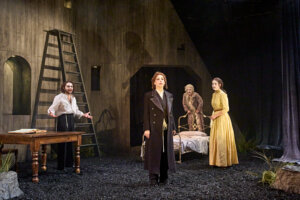
There’s an FAQ on the website of the London theater where the Kadimah Yiddish Theatre of Melbourne’s production of Yentl is running through April 16. The very first item reads:
Is this a stage version of the 1983 musical film starring Barbara Streisand?
No — the London production of Yentl is a play. It is a new adaptation of Isaac Bashevis Singer’s 1962 short story,“ Yentl the Yeshiva Boy“ — just like the Streisand film was at the time.
This explanation does more than relieve box office staff of the tedious duty of informing Mrs. Lipschitz and Mrs. Rosenblatt from the sisterhood that no, they shouldn’t come expecting to sing along to “Papa, Can You Hear Me.” It argues that this theatrical “reimagining” (to use Kadimah’s own term) of Yentl is no less authentically Singerian than the musical. It also hints at how Kadimah prevailed, against considerable odds, in adapting a story whose rights Streisand still owns and fiercely guards.
As Gary Abrahams, Kadimah’s executive director and the director of the production, recently told the Jewish Telegraph, Singer’s estate gave him their approval on the condition that it be a Yiddish language, non-musical production. The London transplant, which comes on the heels of earlier stagings in Melbourne and Sydney, is enjoying a six-week run at the Marylebone Theatre, which is housed inside of an anthroposophical center. Both the limited duration of the run and the Off West End venue were critical to securing the Singer estate’s approval.
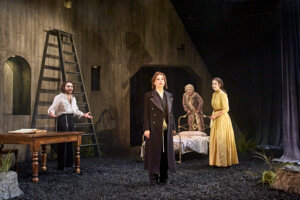
Kadimah’s production, a bilingual Yiddish-English chamber piece that has gained a certain notoriety for featuring male and female nudity, is the latest chapter in the long and unruly afterlife of Singer’s deceptively simple tale.
In “Yentl the Yeshiva Boy,” which first appeared, in English translation, in Commentary in September 1962, a rabbi’s daughter, shut out from the Talmud learning reserved for men, cuts her hair, dons male clothing, changes her name to Anshel, finds a chavrusa, the heartbroken Avigdor, and enters a yeshiva. But Singer’s tale is considerably stranger than both that simple summary and Streisand’s popular version suggest.
Yentl is not simply a tale of female exclusion and feminist defiance. It is also a story of impersonation, erotic confusion, spiritual hunger and metaphysical trespass. Yentl does not cross one line and stop there. Once she begins living as Anshel, all the categories meant to keep life orderly — male and female, study and desire, law and transgression — begin to blur.
That instability may explain why Yentl has proved so durable. Before Streisand made it famous on screen, Singer had already adapted it for the stage in the mid-1970s together with Leah Napolin. The show opened at the Brooklyn Academy of Music in 1974 and transferred to Broadway the next year, with Tovah Feldshuh in the title role.
“As a play it is altogether too anecdotal,” wrote Clive Barnes in the 1974 Times review. “The storyline wanders on and on like a river through a landscape, but the landscape happens to be worth looking at.” Napolin, who died in 2018 (and who claimed that Singer didn’t write a single word of the script) suggested that the second wave feminism of the time made the story and its themes feel relevant to contemporary audiences.
“This dark little gender-bending tale had an impact on many people who identified, as I did, with the heroine’s struggle to reinvent herself, to redefine herself,” Napolin once told an interviewer.
Half a century later, Kadimah’s Yentl leans heavily, and not always successfully, into our contemporary discourse about sex and gender. The story reemerges in a markedly — and overtly — queerer form than in previous versions.

Streisand’s film absorbed the title character so completely into her own star persona that for many people Yentl is now synonymous with Babs, not Singer. Her approach is expansive where Singer is compressed, ardent where he is dry-eyed, and schmaltzy where he is severe. Streisand gave the story glamor, emotional clarity and uplift. It also tilted the material away from Singer’s sharper ambiguities and toward the all-American theme of becoming oneself. The film, which Streisand also directed, produced and co-wrote, even ends with Yentl aboard a ship bound for America! (In Singer, Yentl simply ups and vanishes, an ending that has been interpreted as a reference to the legend of the Wandering Jew).
Yet Streisand’s victory over the material came with at an expense. As Linda Besner notes in an essay on Singer and Streisand and published in the Canadian arts review Arcade, the film’s feminist reclamation of Yentl also trims away some of the story’s deepest instability. Singer’s Yentl tells Avigdor, “I’m neither one nor the other,” and the story allows a degree of erotic and ontological confusion that the film flattens into a drama of self-realization.
Kadimah’s production, adapted by Abrahams, Elise Esther Hearst and Galit Klas, starts from dissatisfaction with that inheritance. Hearst has said the team wanted to get back to the story’s darker, more transgressive roots. In an interview with The Times of London, Abrahams said he had been struck by how unlike the movie Singer’s story really was, and described the original as a work about spirituality, identity, gender, sexuality, as well as plain old sex.
Those ambitions are evident from the outset. This is not a shy Yentl. It foregrounds the body, goes hard on the story’s sexual unease and sharpens its queer implications. Amy Hack is alluringly androgynous in the title role, both attracted by and attractive to Avigdor and Hodes (Genevieve Kingsford in a very stiff performance), Avigdor’s erstwhile fiancée, who Yentl marries in bad faith. As in the film, she casts a prurient gaze at the bathing Avigdor (Ashley Margolis bares all onstage, one-upping Mandy Patinkin, whose naked tush is one of the film’s most memorable sights). Singer’s story can accommodate plenty of sexual discomfort and frustration, but Abrahams’ production lays it on too thick. Did he really need to make Avigdor a mikveh peeper?
The production also never settles on a convincing tone and register. The one-set production, with its vaguely Expressionist look, goes for too much shtetl schlock. The acting keeps sliding between modes without enough control to make the shifts meaningful: naturalistic for a few minutes, then suddenly pitched into something like Yiddish melodrama. Additionally, there isn’t any discernible logic to why certain passages are spoken in English while others are in Yiddish (with subtitles projected onto the set). The result is less daring than uncertain. No performance fully steadies the evening, although Evelyn Krape comes the closest. As the spectral “Figure,” she hovers, narrates, inhabits minor roles and hangs over the proceedings like a comic dybbuk. The device of a spectral conferencier does not entirely cohere, but Krape — hammy in a grotesque-vulgar-goofy way — almost pulls it off.
Kadimah’s production was lauded in Melbourne and Sydney but has met with a very different reception in London, which is, of course, a no-nonsense theater town. Despite the tepid and sometimes outright negative reviews (“Even with nude scenes, this is a schlep,” The Times of London’s critic wrote), the Thursday evening performance I attended was nearly full. And, the mostly grey-haired audience members, several of whom I recognized, from a nearby kosher deli where I wolfed down a pastrami sandwich before the show, were enthusiastic. A Yiddish Yentl in London now is enough of an event to draw not only the usual suspects but the theatrically adventurous — and, no doubt, some Streisand fans who should know to check their expectations at the door.
Kadimah Yiddish Theater, which recently passed its centenary, is, by some counts, Australia’s oldest theater company. This Yentl might well be the biggest hit they’ve had in their long history. Despite its shortcomings — and there any many, both in concept and execution — the production shows that the company understands the need to strive for more than nostalgia and sentimentality, à la Streisand, and to be a little impious and even impish.
Today’s most interesting Yiddish theater (and also film, to an extent) inscribes itself within tradition while treating that heritage as unstable, literate and vulgar. That is what makes the Yiddish work of another Australian director, Barrie Kosky, so refreshing and bracingly alive.
Earlier this season, Kosky directed K., a “Talmudic vaudeville” inspired by Kafka’s “The Trial” at the Berliner Ensemble. In interviews, Kosky has spoke of the polyglot, code-switching, cross-dressing Yiddish theater that formed part of Kafka’s world. His haunting and unsettling production moves between German, Hebrew and Yiddish (including a gorgeous translation of Schumann’s Dicherliebe into mamaloschen) and injects intellectual seriousness with showbiz energy.
There’s another reason I bring up Kosky, a prolific, influential, and deeply Jewish theater and opera director. In summer 2027, he will present a fresh musical version of Yentl at the Fisher Center for the Arts at Bard College, created together with Lisa Kron (the Tony-winning writer and lyricist of Broadway’s Fun Home) and Adam Benzwi, one of the director’s regular musical collaborators in Berlin. According to Bard’s announcement, Benzwi’s score will draw on American and European Yiddish theater, music hall and Hasidic choral traditions. That sounds less like an attempt to strip Yentl back to some pristine original than like an effort to push through the whole layered history of the piece and make something gloriously heterodox.
By this point Yentl exists not as a single work. Singer gave it severity, mischief and danger. Streisand gave it melody and yearning. Kadimah has tried, admirably if unsuccessful, to restore taboo, Yiddish abrasion and folkloric unease, sometimes vividly, sometimes crudely. Kosky may prove better placed than most to let those elements collide without trying to reconcile them too neatly.
The post This isn’t Barbra Streisand’s ‘Yentl’ — it isn’t I.B. Singer’s either appeared first on The Forward.
Uncategorized
Mamdani joins Theo Von’s podcast. They find common ground in criticizing Netanyahu.

(JTA) — New York Mayor Zohran Mamdani appeared for an interview with “manosphere” podcaster Theo Von, during which he called for the United States to join the International Criminal Court and enforce its arrest warrant for Prime Minister Benjamin Netanyahu.
“If I had my say, the U.S. government would have joined the ICC, honored every single warrant that they issued,” Mamdani said near the end of the 75-minute interview that was posted on Thursday.
“F–k yeah,” Von replied.
The interview came one week after Netanyahu visited the United Nations and delivered a speech during which he called Mamdani an “antisemite” and a supporter of Hamas. (Mamdani has condemned Hamas as a terrorist organization.)
Von, meanwhile, is part of a growing ecosystem of everyman “manosphere” podcasters who host sprawling conversations with a wide array of famous guests — he has hosted Donald Trump, Bernie Sanders, JD Vance and Mark Zuckerberg — and increasingly are seen as representing a crucial sector of the electorate. He drew an invite to Trump’s inauguration in 2025 after hosting him on the campaign trail the year before.

Since then, Von has become increasingly critical of Israel and pressed the case in his Vance interview that Israel is committing genocide in Gaza. The International Court of Justice, which is separate from the ICC, is adjudicating charges Israel committed genocide — which the country rejects — but has not issued a ruling. Von has also hosted guests who have spread conspiracy theories about Israel and Jews.
At the end of his interview with Mamdani, Von thanked the New York mayor for “talking a little bit about the genocide” during their podcast, noting that “a lot of people are afraid to speak about it in politics.”
“One thing I would just say is, your curiosity is a beautiful thing,” Mamdani told Von.
The chummy conversation was notable, arising as it did out of a meeting between an icon of the libertarian-leaning “manosphere” and a self-declared socialist.
Mamdani decried Israel’s campaign in Gaza during their conversation.
“People talk about a ceasefire — just last week, the Israeli military killed an 11-year-old boy, Palestinian boy in Gaza, in a section that’s considered to be a safe zone,” he said. “This is continuing.”
He also recalled hosting Palestinian families at Gracie Mansion, the mayor’s official residence, where they told him about “the ways that their lives have been shattered.”
Von asked Mamdani how he keeps people “from misdirecting energy that’s against Israel towards their Jewish friends,” especially as the mayor of the country’s most Jewish city.
Part of that, Mamdani said, is being clear that “no Jewish person in New York City is responsible for the actions of the State of Israel. And if you want to hold anybody accountable, it’s the people who are making those decisions — the prime minister, the State of Israel, also our complicity as American taxpayers knowing how many billions of dollars we have sent in bombs and continue to send.”
Mamdani also pointed to his administration’s official strategy to combat antisemitism, which it released earlier this week, as an effort to both condemn and prevent antisemitism. Some groups said the strategy “failed to address” anti-Israel rhetoric and links between anti-Zionism and antisemitism, while applauding aspects like security funding boosts and Holocaust education expansion.
Finally, he added, it takes “being very clear that critique of the State of Israel, the policy actions, the genocide — that in and of itself is not being antisemitic.”
“Yeah, I agree, speak up about it,” Von said.
Von, who has nearly 700 podcast episodes and more than 4.7 million YouTube subscribers, has interviewed or spoken positively about multiple controversial figures who have spread conspiracy theories about Israel and Jews, including former Fox News personality Tucker Carlson, streamer and Holocaust denier Nick Fuentes and commentator Candace Owens.
During an episode from this past January with comedian Dave Smith, Von called Fuentes “fascinating” and said, “He’s f–ing brave, dude.”
Von hosted Carlson on his show in December 2025. The two men spoke at length about Israel and Von criticized what he said was a lack of transparency in the control that Israel and corporate interests have over American politics.
“If they would just say, ‘Hey, America is a country that’s owned by Israel,’ or that it’s always been this outpost or this LLC of Israel — or maybe not even of Israel, it could just be of corporate entities, I’m not really sure exactly — but if they would just tell us, you can operate from a place of knowing what’s going on,” Von said.
Pro-Israel lobbies have repeatedly defended their role as no different than any other interest group seeking influence, citing the successes over the years of pro-choice and anti-abortion groups, environmental groups and gun owner groups, among others.
During that interview, Von also played a clip of CBS News editor-in-chief Bari Weiss calling Carlson anti-American and anti-Jewish, which elicited laughter from both Von and Carlson. Von then read out an AI-generated overview that described Weiss as “a vocal supporter of Israel.”
“If her allegiance isn’t to America first, how is she the head of an American network?” Von said.
“Well that’s of course an entirely fair question, that you’re not allowed to ask,” Carlson replied.
Von’s conversation with Mamdani this week covered a number of topics including socialism, the achievability of the American Dream and their preferred fish.
When asked about Netanyahu’s U.N. speech, Mamdani explained that he’d been meeting with the prime minister of the Netherlands about an LGBTQ center and the community’s history in New York.
“Then I get back from that meeting and it’s like, ‘Oh by the way, here’s what he was saying at the U.N.’,” Mamdani said.
“It’s so bizarre. Did it feel personal then?” Von asked.
Mamdani replied that “all of this is an attempt to distract from responsibility, name as many people as possible, try and make it into a back and forth.”
He added, “It’s not about me and him. It’s about the fact that he’s the architect of a genocide.”
This article originally appeared on JTA.org.
The post Mamdani joins Theo Von’s podcast. They find common ground in criticizing Netanyahu. appeared first on The Forward.
Uncategorized
A Jewish journalist recorded pro-Palestinian protesters outside services. He was reportedly suspended from his job
(JTA) — TORONTO – A number of Canadian groups are demanding answers in the wake of media reports that the country’s national broadcaster suspended a Jewish reporter after he posted a video of pro-Palestinian protesters outside Yom Kippur services and wrote about his pained reaction.
The reported suspension came after Neil Herland shared footage of protesters gathered outside the Meridian Arts Centre in north Toronto, which on Sept. 20 was hosting Yom Kippur services for The Song Shul.
Herland, who has worked for the Canadian Broadcasting Corporation for nearly 30 years, began his post on X, “On Yom Kippur I went to a synagogue service in Toronto and was met by protesters trying to taunt and intimidate me from entering the building.”
A man can be heard yelling “Zionist alert!” through a megaphone, while another masked protester approaches the camera and screams, “You’re going to hell.”
A pro-Palestinian group, Canadians for Justice and Peace in the Middle East, filed a complaint against Herland with the CBC, saying he had mischaracterized the protest.
“It is clear to CJPME that Mr. Herland was aiding the pro-Israel side of these demonstrations defending Mark Regev’s presence, while smearing these pro-Palestine protesters as antisemitic for their criticisms of Regev’s awful record on Palestinian human rights,” their complaint said, referring to the presence of a former Israeli diplomat at the event.
The Toronto Sun reported the suspension on Sept. 24. CBC declined to confirm the suspension and said reporting had mischaracterized what had happened.
“We don’t comment on internal matters,” a spokesperson said. “That said, we are aware of reporting on this matter which has errors and mischaracterizations but we can’t get into the specifics given the confidentiality of the situation.”
Reached by JTA, Herland declined a request for comment.
A press freedom group decried the reported suspension, however.
“Recording events in a public place and reporting them to the public is not misconduct,” Sheila Gunn Reid, president of the Independent Press Gallery — a non-profit advocating for independent and nongovernmental journalist organizations — said. “It is journalism. It is not the role of a public broadcaster to punish its journalists for doing their jobs to appease activist groups. Its role is to defend their right to report.”
In a thread under his tweet about the protest, Herland noted that “The guest speaker at the Toronto synagogue tonight was an Australian-born university teacher who lives in Israel and once served as Israeli ambassador to the UK. His speech was about making peace in the Middle East. Let’s hope that happens this year.”
He was referring to Regev, formerly the Israeli ambassador to Britain, who gave a talk during Yom Kippur services. Online defenders of the protesters chided Herland for not personally naming the prominent media defender of Israel’s war in Gaza in his post.
Commenters also scored Herland for describing the venue as a synagogue even though the service was held in a public events space.
However, Jewish groups who reviewed the video or otherwise tracked the protest said that Regev’s presence did not seem germane to the protesters’ chants, and noted that synagogues often move to event venues for the High Holidays because of the volume of congregants attending.
“The protesters claimed to have been demonstrating against the speaker, but I don’t recall seeing anything that particularly said they were targeting [Regev],” Rochelle Direnfeld, senior criminal counsel for the Alliance of Canadians Combatting Antisemitism, said in an interview. “It seemed to be much more general against Jews and supporters of Israel.”
Criticism of Israel is not inherently antisemitic, Direnfeld said, but the protesters’ apparent targeting of worshipers was worrying. “It’s not okay to blame Canadian Jews for what’s going on in the Middle East,” Direnfeld said. “Given what [the protesters] were saying to the people trying to enter the building for services, that’s what they were doing.”
Simon Wolle, CEO of B’nai Brith Canada, said the protests on Judaism’s holiest day amounted to intimidation. “It is deplorable that members of the Jewish community are subject to these incessant acts of hatred and intimidation,” he said. “It is especially alarming when these protesters target members of the community as they enter their houses of worship, in this instance on Kol Nidre, the holiest night of the year.”
Wolle said the CBC needed to explain its reported disciplinary measures. “Neil Herland had every right to document his lived experience, and the very idea that he would face disciplinary action for that is deeply concerning,” he said. “As Canada’s public broadcaster, the CBC owes the public an explanation for its inexplicable treatment of Mr. Herland.”
Vivian Bercovici, a lawyer as well as former ambassador of Canada to Israel and a CBC board member, said the alleged discipline Herland has faced is cause for concern.
“Herland didn’t say anything derogatory, rude or inappropriate,” said Bercovici. “He told us what was happening in a very clear and factual way, and so I think that the CBC owes us an explanation as to why that post was so egregious.”
Herland’s tweet thread also included a post noting that his late father was an Austrian Jew who survived the Holocaust in Romania, and that he “came to Canada as a refugee. This year I got an Austrian passport, in case Canada becomes unsafe for me as a Jew. I fear that moment is approaching, here in Canada and elsewhere.”
Herland’s expression of his own distress at the alleged harassment is not usual practice for reporters, but it is also not unheard of.
His comments echo those of many Canadian Jews, who increasingly are saying they do not feel safe in the country and even considering taking up potential offers to move to the United States as refugees.
Direnfeld said the incident reflected what is becoming a pervasive complaint among Canadian Jews that the authorities are not doing enough to decrease tensions. The police practice of deescalation was failing, she said.
“De-escalation can quickly turn into capitulation, which only serves to embolden these protesters to continue,” she said. “We’re now seeing the fruits of that capitulation in conduct such as what happened in Belleville,” she continued, referring to a gunman who tried to attack the Sons of Jacob synagogue on Yom Kippur but was killed in a shootout with police.
Bercovici said the protest was no less distressing because the Meridian Arts Centre is an events space.
“A synagogue can be anywhere, and there are a lot of religious groups that rent space over specific holidays because they don’t have their own building,” she said. “That’s just a fatuous, ridiculous argument.”
Herland has posted only once to X since his reported suspension: A photo of Shabbat candles on Friday, Sept. 25.
This article originally appeared on JTA.org.
The post A Jewish journalist recorded pro-Palestinian protesters outside services. He was reportedly suspended from his job appeared first on The Forward.
Uncategorized
A great Jewish intellectual understood the Kafkaesque horror of Tennessee’s botched execution
Two days ago, the state of Tennessee tried to kill Christa Pike, the Death Row prisoner who, in 1995, was found guilty of the torture and murder of her classmate Colleen Slemmer. After spending more than 30 years on death row, Pike was strapped to a prison gurney and, as journalists watched through a window, an execution team cycled through at least a half-dozen syringes before finding a vein suitable for the injection of pentobarbital.
Or so they thought.
After Pike herself tried to help the team find a vein, they injected her with a supposedly lethal dose of the barbiturate. Though it caused an intense burning sensation in Pike’s arm, the dose failed to do its job, leading the executioners to empty a second dose into what they thought was a vein but turned out to be the surrounding tissue. Shortly thereafter, a curtain was drawn across the window and, for an hour, the journalists heard Pike continue to breathe and snore. Pike’s legal team eventually learned that their client, barely but still stubbornly alive, had been rushed to the emergency room of a nearby hospital.
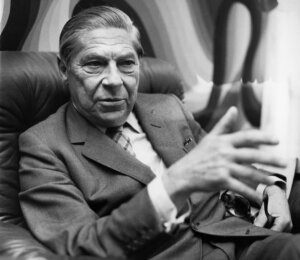
While Pike’s physical prognosis is uncertain, there is nothing uncertain about the ethical diagnosis of this event. At least this would be the case for two earlier journalists who wrote at length on the death penalty: Arthur Koestler and Albert Camus. Long after they both became celebrated novelists and intellectuals, the two men each wrote essays on state-sanctioned killing, which were combined and published in France with the title Réflexions sur la peine capitale, or Reflections on the Death Penalty.
These reflections are as relevant in our own age of drug-induced executions as in Koestler and Camus’ era of where the delivery system of death was a noose or the guillotine.
Born into a secular Jewish family in Budapest, Koestler was, as the phrase goes, a child of his century, one convulsed by catastrophic wars, murderous ideologies, and multiple genocides. Described by his friend George Orwell as an “outstanding figure” of his time, Koestler, like Orwell, fought in and reported on the Spanish Civil War. As a member of the Spanish republican forces, he was captured by Franco’s intelligence service and sentenced to death — a fate Koestler escaped when, after several months of imprisonment, he was released in a prisoner exchange.
Yet this experience deeply marked him. In the mid-1950s, he rallied to the campaign to end capital punishment in Great Britain, penning the essay “Reflections on Hanging.” Serialized in two newspapers, the essay galvanized public opinion and played a pivotal role in the parliamentary vote that, while not entirely abolishing the death penalty, severely limited it. Given the clarity and ferocity of Koestler’s writing — which, Rebecca West observed, was as historically misleading as it was rhetorically moving — this sea change in the public’s attitude and parliament’s position is not surprising.
One passage seems especially relevant for the recent events in Tennessee. “There is indeed a Kafkaesque horror attached to an execution,” Koestler writes, “which goes beyond the mere fear of death or pain or indignity. It is connected not with the brutality but with the macabre, cold-blooded politeness of the ceremony, in which the person whose neck is going to be broken is supposed to collaborate in a nice, sensible manner, as if it were a matter of a minor surgical operation…it is present in the delinquent’s knowledge that in the embarrassed stares of the officials he is already mirrored as a dead man with a blue face and ruptured vertebrae; and that what for him is the final, violent termination of life is for them merely an unpleasant duty, followed by a sigh of relief and a plate of bacon and eggs.”
Did the unnamed doctor, I wonder, stare with embarrassment as he repeatedly tried but failed at killing the — perhaps this is not the best word — patient? How, I also wonder, should readers respond to the description of Pike’s attempted execution? (With embarrassment, I admit while I was revulsed, I also continued sipping from a mug of coffee as I read the New York Times’ account.)

We can guess how Lucien Camus might have responded. His son, Albert Camus, told and retold the story in his writings of his father who, having witnessed a public execution by guillotine, returned to the house, vomited in the sink, and never spoke about the experience. In the essay “Reflections on the Guillotine,” which accompanied Koestler’s, Camus suggested that rather than telling the condemned man or woman that they will pay the ultimate price or their debt to society for their crime, they instead be told the truth. “If you kill you will be imprisoned for months and years, torn between impossible death and constantly renewed terror, we shall slip into your cell…tie your hands behind your back [and] bind your arms with a strap to that you are forced to stoop [and] then carry you through the corridors [and] seize you by the seat of your pants and throw you on a board [then] let fall from a height of seven feet a 120 pound blade that will slice off your head like a razor.”
What, then, did the judge overseeing the 1995 trial tell Christa Pike when the sentence was rendered? The delivery system for death then was the electric chair and, to the judge’s credit, she did inform Pike that she would be subjected to a degree of electroshock sufficient to kill her. I do not know when the agent of death shifted from electroshock to pentobarbital nor do I know if a judge explained to Pike how the drug would act on her brain and organs to bring about her death. But I am pretty certain that none of the judges informed Pike of one legal scholar’s assessment of this form of death: “It is not the most humane, it is the most humane-looking.” I am even more certain they did not inform her, in case she survived another botched execution by the state of Tennessee, which boasts a history of such botches, that her brain would be irreversibly damaged.
Finally, I am most certain that, whether strangled by a tightened noose, decapitated by a sharpened blade, or injected by what was possibly an expired dose of pentobarbital, the sheer barbarism exercised by officials wearing white coats remains constant.
The post A great Jewish intellectual understood the Kafkaesque horror of Tennessee’s botched execution appeared first on The Forward.
