


Local News
Synagogues working on Yom Tov plans with minimal in person attendance
By MYRON LOVE
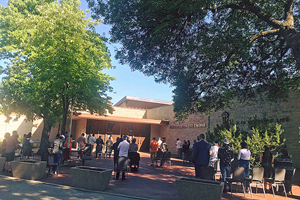
It is most definitely an understatement to say that this will be a yom tov like no other. In my last year’s reporting about high holiday attendance at Winnipeg synagogues (including services held at Camp Massad) in The Jewish Post & News yearly survey of high holiday synagogue attendance I noted that about 4,500 Jewish Winnipeggers at least could be found in shul – at least at peak times – for shofar-blowing, Kol Nidre and yizkor.
This year, however, – due to COVID-19 – in-person attendance will likely be no more than 500.
To begin with, there will be two fewer options: Camp Massad, which usually hosts services for one day of Rosh Hashonah, will not be having any services – and the Saul and Clarabelle Simkin Centre, which has made a practice of including family members of residents in the synagogue services, this year – due to government pandemic regulations – will be restricting services to residents in their units.
“As we did for Pesach and Shavuos, we will be videotaping parts of the Yom Tov services with our chazan, Stephen Hyman, and we will be broadcasting them in each of our five units,” says Marilyn Regiec, one of the spiritual health support staff at Simkin. “We will be doing the same thing for Sukkot.”
Regiec will be leading the services – with assistance from Aviva Tabac. Regiec also would like to extend a grateful thank you to Barry Kay and his Cherry Tree Productions for doing the video-taping.
As for our community’s largest congregations, both Congregation Etz Chayim and the Shaarey Zedek will be offering virtual Yom Tov services – just as they have since the province went into lockdown in late March.
“We still have to be cautious,” says Ian Staniloff, Congregation Shaarey Zedek’s Executive Director. “Although the government has raised the maximum number of people who can gather indoors to 30% of capacity or 500 (whichever is less) and we may allow some in-person attendance, all of our High Holiday services will be live-streamed.”
(Last year, the Shaarey Zedek reported an attendance of more than 1,700 for the High Holidays.)
“We have begun asking the members of our congregation if they would be interested in attending in person, but there has not been much response yet. If we do have some people who would want to come, we would limit the numbers, have people at the door to take their temperatures, maintaining social distancing and sanitizing the seats.”
Staniloff adds that the synagogue has a new set of mahzorim that would be distributed to people who are following online so that they could better follow the service.
He points out that Shaarey Zedek has been livestreaming services for several years now.
He further adds that, although the synagogue has been closed to the public since the lockdown began, Shaarey Zedek will soon begin to host B’nai Mitzvahs again – including some that were scheduled for the spring and had been postponed.
“We will be limiting the number of people in attendance to 50 and requiring everyone to wear masks except when called to the Torah,” he notes. “We will be maintaining social distancing.
“And, rather than buffet kiddushes, we will have servers behind plexiglass partitions.
“We will be trying to phase our services back in on a smaller scale at first and see what shortcomings we may have to address.”
Congregation Etz Chayim (where High Holiday attendance last year was about 850) will be offering only a virtual service this year – with the exception of ten people to form an in-person minyan.
“After careful consideration, for the safety of our members and Clergy, and given the uncertainty of distancing requirements, Congregation Etz Chayim concluded that we must offer our High Holiday Services online this year,” writes executive director Jonathan Buchwald in a letter to congregation members.
“While services are going to look, sound and feel very different than what we are used to, Rabbi Kliel, Cantor Tracy and our entire Ritual team will offer a most meaningful and memorable “Virtual Sanctuary” for Rosh Hashanah and Yom Kippur”. Our own Virtual Voices choral ensemble under the direction of Sarah Sommer will bring a special depth and beauty to our services. We are also excited to announce that we will be using a new Mahzor this year, made possible by the very generous gift of a member family.
Also in Etz Chayim’s planning is an outdoor patio Selichot service (Saturday, September 12); Erev Rosh Hashanah Mincha and Ma’ariv services (Friday, September 18); and Tashlich the 2nd day of Rosh Hashanah (Sunday September 19) – weather permitting.
Rounding out our community’s Conservative congregations is the Chevra Mishanyes congregation in Garden City. The Chevra Mishnayes Synagogue is planning on having in-person services for the High Holidays but, congregation President Marshall Kneller reports, “we are not sure what it will look like yet. We are still working on the details in consultation with our members.”
Temple Shalom, our community’s only Reform Congregation, will hold high holiday services entirely online – accessible either via a Zoom link or streamed live on the congregation’s website: , or on Facebook Live at -– as has been the practice for Shabbat services for the past several months. Ruth Livingston, the congregation’s co-President, reports that certain parts of the High Holiday service will only be available online for Temple Shalom members.
For Orthodox congregations in the city, virtual services are not possible. The board of Adas Yeshurun Herzlia congregation – our communty’s largest Orthodox shul – is still working out the details for Yom Tov. “We plan to be open and have services indoors,” says President Jack Craven. “We are considering shorter services for Rosh Hashonah and may have two same day services if time permits.”
He notes that attendance will be restricted to 50 or, possibly 75 people (now that the province has raised the maximum number of people allowed in an indoor venue) and masks will be mandatory. (The sanctuary under normal circumstances can accommodate up to 300.)
The Lubavitch Centre resumed twice-daily minyanim several weeks ago. “We have even hosted three bar mitzvahs over the past few weeks,” reports Rabbi Avrahom Altein, Chabad’s long time spiritual leader in Winnipeg. “We have moved the women’s section out of our big shul, are only allowing family members to sit together and, for kiddushes, all of the food is prepared and packaged ahead of time with people eating at their tables.”
What will make preparing for Yom Tov a little more difficult, he notes, is that the Lubavitch Centre traditionally doesn’t sell seats. “We are going to have to try to get people to register this year,” he says. “We could take out the tables to create more room – but we have to be careful about numbers. We will have lesser numbers though.”
And, whereas the tradition is that men being honoured with aliyahs come up to the bimah, recite the brachas while standing beside the Torah reader, and then follow along as the Torah reader reads, now those receiving aliyahs will say the bracha, then sit down again.
In north Winnipeg, the three Orthodox shuls are the Chavurat Tefila Congregation in West Kildonan, the Talmud Torah Beth Jacob Synagogue on Main Street and the House of Ashkenazi on Burrows Avenue.
The House of Ashkenazi has, over the past few years, been open only for morning minyanim during the week (and Sunday) and for Yom Tov. President Gary Minuk reports that the congregation is planning to restart morning services in mid-August and is planning on High Holiday services. Masks will be compulsory.
The Chavurat Tefila Congregation began having Shabbat morning services and yahrzeit minyanim again in late May. Masks will be on hand at Yom Tov for those who require them and hand sanitizer is also by the entrance.
The Talmud Torah Beth Jacob’s plans are still uncertain.
Local News
Quick action by archivist Ava Garfinkel saves Jewish Heritage Centre of Western Canada archives from disaster
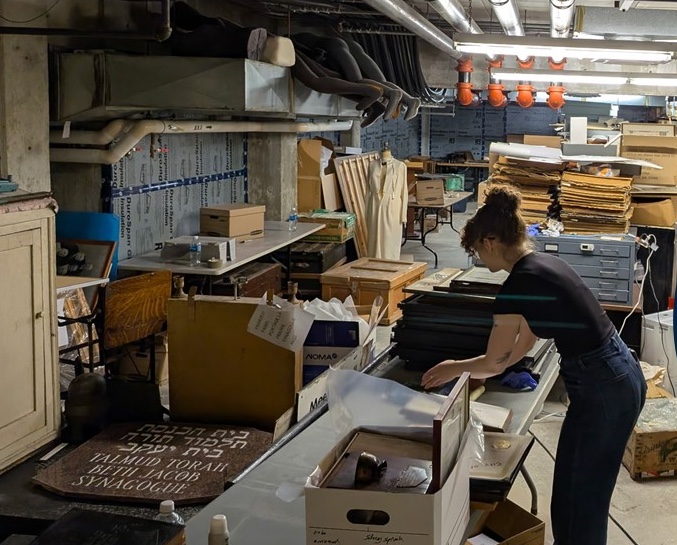
By MYRON LOVE The downpour that struck our city on Tuesday, June 9, left a trail of basement flooding and other damage in its wake. As reported elsewhere in this issue of the Post, Temple Shalom, our community’s Reform Congregation, has been forced to relocate its services to other venues because of water damage that has made its building unusable for the foreseeable future.
Another of our institutions that was affected by the storm is the Asper Jewish Community Campus – and specifically the lower level, where the Jewish Heritage Centre of Western Canada stores a good portion of its archives. It was the quick action of archivist Ava Garfinkel and her brother, Max, as well as a number of volunteers in the following days – and the miracle of modern technology – that saved those archives from destruction.
“This was a potentially devastating and irreversible crisis,” notes Belle Jarniewski, the JHCWC’s executive director. “Thanks to the quick and diligent work of our staff and a team of kind volunteers, we were able to implement an emergency disaster plan, separate the affected material and move the damp archives to a frozen storage facility within 48 hours. These crucial actions successfully saved the archive, avoiding any mold growth that would have spread throughout the entire collection at a rapid pace, eventually destroying even the parts of our collection that were left untouched by the flood.”
Jarniewski reports that Garfinkel reached out to conservators across Canada for help. The frozen materials have now been transferred to an out-of-province facility where they will be vacuum freeze-dried in a restoration process overseen by a conservator.
“Our dry and unaffected archives and artifacts were also quickly removed from the basement and brought upstairs to be stored in several places around the Campus,” Jarniewski says. “The directors of the Gray Academy and the Asper Community Campus were kind enough to offer us the space we required to temporarily store our collections.
“The JHC Archive,” she points out, “preserves the precious history and physical memory of our community, also that of the communities across Western Canada and Northwestern Ontario whose histories have been entrusted to us. It dates back to the late 1800s. Information about the delicate, old, and irreplaceable items is frequently accessed by students, researchers, educators, genealogists, and community members. Simply put, the archive constitutes the very heart and memory of our community.”
Jarniewski recounts that when the Campus first opened almost 30 year ago, several rooms on the first floor were specifically designed with climate control suitable for an archive or museum. But, as different community needs arose, the archives were moved out of the specialized spaces and into the basement.
“With space at a premium in the building, we have had to do our best with the cards we were dealt,” she says.
For security and other reasons, Jarniewski points out, moving the JHCWC archive out of the Asper Campus has never been a viable option. “Our museum, our offices, and the other half of our archive are all firmly situated in this building on the main floor,” she notes. “We work within our basement archive daily and we rely on the safety that the security within the Asper Campus affords us.”
To prevent this kind of near disaster again, she added, the lower level storage area has to be renovated for safety while maintaining the standards of practices for long-term preservation. “We have already put a plan into motion for more effective humidity control and the sealing of the room,” Jarniewski reports.
“All of our textual records must be placed in specialized archival enclosures, our artifacts must be re-boxed/wrapped according to their individual preservation needs, and we must purchase adequate shelving that will keep our collections away from the ground and the walls while allowing for effective air circulation. These protective measures will be costly, requiring specialized materials, but they are necessary.”
The overall estimated budget for this project, Jarniewski says, is approximately $100,000. So far, she reports, the JHCWC has received a quarter of that amount through donations..
She expresses the hope that Post readers will consider donating to this essential project so that the JHCWC can continue protecting the priceless history of Western Canadian Jewry for generations to come. A tax receipt will be provided to all donors.
“With the funding in place, we should be able to have everything in place in less than six months,” Jarniewski says.
Readers who may want to consider donating to the JHCWC in support of this vital project can either phone 204 478-8590 or go online to jewishheritage@jhcwc.org. Donations can also be made online though Canada Helps: https://www.canadahelps.org/en/charities/jewish-heritage-centre-of-western-canada-inc/
Local News
A response to Isha Khan’s op-ed in the August 1st, 2026 issue of the Winnipeg Free Press
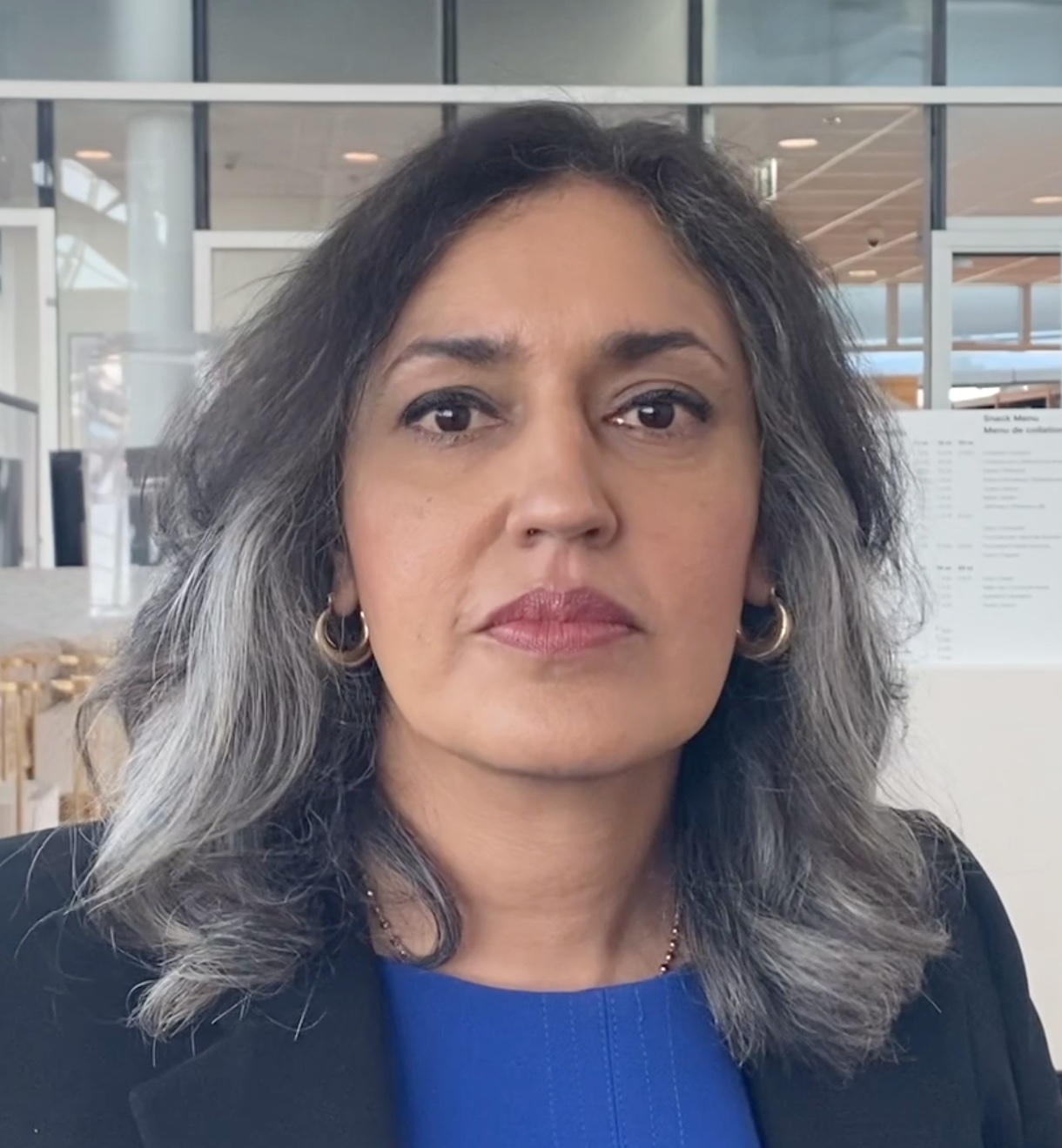
By SIMONE COHEN SCOTT Ed. note: Isha Khan is the CEO of the Canadian Museum for Human Rights. In the August 1st issue of the Winnipeg Free Press Ms. Khan wrote an op-ed defending the museum’s decision to mount the exhibit titled “Palestine Uprooted: Nakba Past and Present.” The Free Press has published many letters about the exhibit, but some readers of that paper are frustrated that their letters were not published. We were asked by Simone Cohen Scott whether we would print a letter that she had sent to the Free Press, but which was not published.
Since there is always room on this website to publish as many articles as we’d like, we agreed to publish Simone’s letter, which follows here:
Isha Khan states in her op-ed piece that the choices of what to exhibit, what to examine, what to feature, were made according to certain parameters, which she called a “framework.” What, specifically, comprised this so-called framework? It is obviously exclusive of elements relative to the history of the period displayed. She said the purpose of the exhibit was….”to promote reflection and dialogue.” Reflection and dialogue about what? Did the Arabs who left the area know that the United Nations had offered them a state too? If they had known, would they have wanted to accept? If, given the choice, would they have stayed and lived beside the Jews? Or, did they indeed, want five Arab nations to attack the Jews? Such questions as these would have promoted “reflection and dialogue.”
What is the understanding implicit in the exhibit? Khan quotes from a banner that hangs in the museum: Article 1 of the Universal Declaration of Human Rights, “We are all born free and equal in dignity and rights.” Should the Jews have rights? If so, what should they be? May they have a state? When a people is attacked by 5 nations, as Israel was in 1948, wherein lie the human rights?
Why did Khan’s advisors choose to use the word Nakba in the exhibit title? The original use of the Arab word ‘nakba’, meaning disaster, was intended to depict, that in spite of being assured by the Arab/Islamic leaders that it would be a quick war and that they would win, that did not happen. The word disaster was meant to mean the shock and the disappointment. The real disaster, or tragedy, ‘Nakba’ if you will, is that the Arab/Islamic countries in the world, (and there are plenty of them), have refused to welcome refugees of a war their own leaders chose to start. They have allowed these displaced persons to stagnate in UNRWA, an industry in itself. Where are the stories of the people in UNRWA housing? Another group it would have been enlightening to hear from is today’s Israeli Arab population – the doctors, dentists, nurses, lawyers, judges, entrepreneurs, business moguls and more, the descendants of those who stayed in the country in 1948, who had and whose offspring have had the same opportunities as every Israeli citizen. There is much easily accessible research that has been neglected in the preparation of this exhibit. This blatant lack of effort is shameful.
Kahn explained, when asked, that the context of the conflict of the time is too complex to have been included. Is she saying that people who go to museums can’t handle broad, multi-faceted ideas… that she deliberately designed a walk-though soundbite, not a process for mind-expanding grasp of history?
Simone Cohen Scott,
(sent to the Free Press August 13th, 2026)
Post script from Bernie Bellan: This website has never refused to carry any post that may be critical of the CMHR, despite what some readers of this website might think. We do allow comments to articles, but anyone commenting through our “Comment” portal has to register by giving their name and email address so that we can confirm they are a real person. In addition, we welcome longer contributions from readers. Many of the posts you will find on this website come from regular contributors, such as Henry Srebrnik. If you have something you’d like us to consider publishing – and the only criteria are that it be reasonably well written and void of slanderous remarks, email to us at jewishp@mymts.net.
Local News
Young Winnipegger Dr. Yale Michaels receives $550,000 Canadian Cancer Society research grant
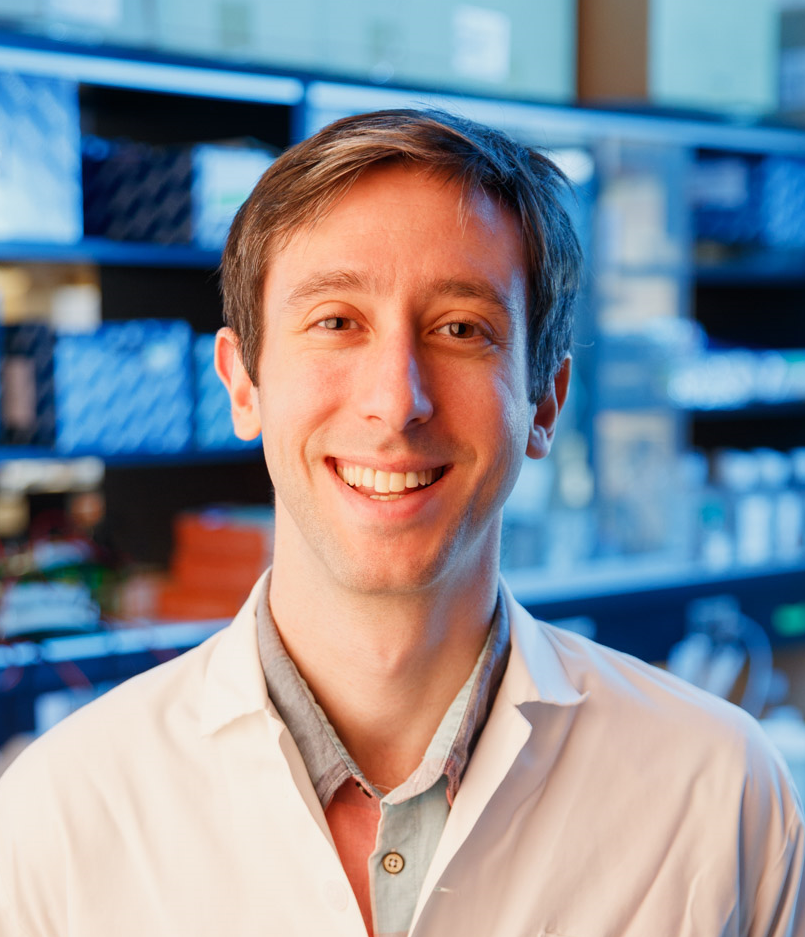
By MYRON LOVE It has been shown on many occasions that a teacher can have an outsized role in shaping a young person’s life. Dr. Yale Michaels’ life story is one example.
During a recent interview with the young cancer researcher – the son of John Michaels and Karen Stern – Yale recounted how a Grade 7 teacher at Grant Park High School was largely responsible for his decision to pursue a medical career in medicine.
The young Michaels attended Brock Corydon Elementary School and was a long time Massad camper. In junior high school at Grant Park, however, he recounts, “I was having a tough time staying on task. Thankfully, my Grade 7 science teacher suggested that I might find it interesting volunteering to help in a cancer research lab. He had a contact and got me in. I loved it. It was a good fit for me. I never looked back.”
Michaels (whose zaida, Leon Michaels, was a leading cardiologist here) spent much of his free time during his high school years volunteering in the lab. After graduation, he enrolled in Harvard –with help from the university’s financial aid program – where he earned his Bachelor’s degree. He followed that up with a Ph.D. from Oxford in 2019, followed by three years as a post-doctoral Fellow – before returning to Winnipeg in 2023 to work at Cancer Care Manitoba, as well as teach at the University of Manitoba.
“I enjoyed my time both at Harvard and Oxford,” he says. “What made England even more enjoyable is that Yale has family there. His grandparents – Leon and Joan Michaels – were born and raised in London and Yale’s time there overlapped for a few months with his brother Jamie (about whom there was a story in a July issue of the Post), who earned his Master’s Degree in Creative Writing at the University of London.
This past June, the young researcher learned that he was to be the recipient of a $550,000 Canadian Cancer Society Emerging Scholar Research Grant, covering five years of research.
Michaels’ field of research focuses on new ways of combating blood cancers – specifically in the new area of immunotherapy. He is being aided in his research by lab tech Dana Segal and graduate student Serena Dembowksi.
Michaels adds that he is collaborating with a number of other researchers from Winnipeg – and throughout Canada, including Drs. Harinad Maganti, David Szwajcer, Jody Haigh, Versha Banerji, and David Knapp.
Using the patient’s own immune cells – specifically CAR T cells -to treat blood cancers was first approved in 2017, Michaelsreports. “The treatment has shown itself to be really successful. Many patients go into remission and some may have the potential to be cured.”
One of the drawbacks, he explains, is that the treatment is prohibitively expensive. Each dose costs about $500,000 U.S.
“What we are trying to do in my lab and elsewhere is find a way to greatly reduce the cost,” he explains. “It becomes a matter of scale. Other drugs used in treating cancer can be produced in amounts of 1,000 doses per production run. But right now CAR T therapy is made on a one-off basis with an individual manufacturing run for each patient. We are attempting to instead make CAR T cells from stem cells – which can be grown in large quantities. We are trying to use genetic engineering to manipulate them so that they can be administered safely to patients.
“We (Michaels and fellow researchers) are making good progress in this area,” he adds.
He cautions that the research is still in the formative stages and that clinical trials are still several years away. “Our research so far though has shown that our treatment would seem to be effective at killing cancer cells,” he reports. “This grant from the Canadian Cancer Society will help us to further that research.”
Outside of work, Michaels notes, much of his time is spent with his family – Dr. Allison Marmel and their two-year-old daughter, Rose.
(Ed. note: We should note that Yale Michaels was also the punter for the Harvard University football team – by far his greatest achievement.)
