


Local News
Congregation Etz Chayim’s new program director very happy to be living in Winnipeg

By MYRON LOVE Monica Neiman, Congregation Etz Chayim’s new Program and Engagement Director, comes to her new role with impressive credentials. For the past seven years – up until she landed here in June – she served seven years at her home congregation –Temple De Hirsch Sinai in Seattle, Washington – as Assistant Director of the congregation’s religion school.
With about 1600 member families, she notes, Temple De Hirsch Sinai is the largest Reform Congregation for the Pacific Northwest in the United States. The K-12th Grade religion school has an enrollment of approximately 350 students divided between two campuses.
(Monica notes that Seattle has a Jewish population of about 70,000.)
Her duties included developing the Judaica curriculum and programming for students and families, supervising and creating professional development for the teachers,
coordinating logistics for large school events and programs involving both campuses; organizing the transition to online learning at the start of the COVID-19 Pandemic program; involvement in school budget decisions: teacher hiring and monthly payroll submissions and involvement in student and new family registration.
So, what led Neiman to leave her family, community and dream job and move halfway across the continent to our fair city? The answer is “love”.
In early 2019, Neiman was in the midst of spring break – one quarter away from finishing her first year of graduate school at University of Washington – when she connected through a Jewish Dating App called JSwipe with Javier Gore, a recent immigrant to Winnipeg from Argentina.
Initially, Neiman recalls, she assumed that Gore was living in Seattle but, in fact, the former University of Winnipeg HR student was only in Seattle to visit a cousin. Although Neiman was skeptical about the prospect of a long-distance relationship, her new suitor persuaded her to exchange numbers and they started texting. After a week, they arranged to begin meeting via FaceTime and liked what they saw.
In June, 2019, Gore flew to Seattle to meet Monica in person and things progressed from there in a positive direction. In January, Neiman came to Winnipeg to marry Gore in a civil ceremony – a traditional Jewish family wedding is scheduled for next summer – and she began the six-month process of becoming a landed immigrant through spousal sponsorship.
She officially arrived in Canada on August 15 and started in her new position at Etz Chayim on September 20.
“I learned about this opening at Etz Chayim,” she says, “from Lori Binder (Gray Academy of Jewish Education Head of School and CEO) who is a very good friend of Tracy Kasner (Etz Chayim’s cantor). With my background, it seemed to be a good fit.”
In her new role, Neiman will be organizing and co-ordinating programming that encompasses adults and children and families. “We are working on bringing back a modified, in-person Chanukah dinner and other Yom Tov celebrations throughout the year,” she reports. “We are also planning some new educational series every couple of months. In November, for example, we will be starting our next Beit Chayim online education series with a Talmud scholar and, starting during Holocaust Education Week, we will also be offering a three-part series focusing on Jewish art during and after the Holocaust.’
She says of her new home city that she is enjoying the slower pace of life. “I have told my husband that I feel more relaxed and calmer here,” she observes. “The vibe here reminds of what life used to be like in Seattle when I was growing up. I appreciate that people in the neighbourhood still say “good morning” to you.”
Socially, she notes that she and her husband have many friends among Winnipeg’s Argentinian Jewish community.
“We also enjoy outdoor activities,“ she says of herself and her husband, such as picnics at Assiniboine Park and hikes.”
She is also looking forward to visiting our city’s museums, taking in some Jets games and signing up for art classes.
Monica adds that she and Javier are both foodies and enjoy cooking together and trying out different restaurants.
And, while neither has any family here – her parents and siblings are all in Seattle while his parents are in Argentina and he has a sister in Miami – there is always Zoom and other online means of face to face communications.
Then, of course, there is a wedding to prepare for – by which time it is to be hoped that most Covid restrictions will have been lifted.
Local News
Marty Green expands his protest against extremist Jewish settlers to two more venues – and is arrested twice more
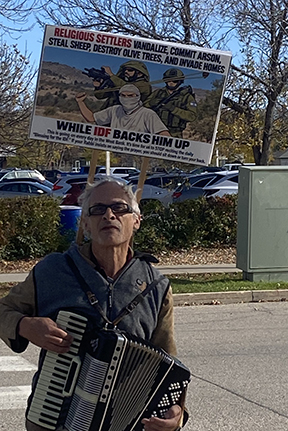
(Tuesday, October 27) We received the following press release about Marty Green being arrested again, both at the University of Manitoba and at Shaarey Zedek Synagogue:
Both sides came to blows on Saturday, October 24, at the Shaarey Zedek Synagogue as security personnel sought to prevent Marty Green from interfering with synagogue traffic as he protested just outside synagogue grounds against the actions of religious settlers in Israel’s occupied West Bank territory. Synagogue Executive Director Rena Secter Elbaze quickly intervened to prevent further escalation. Police arrived shorty thereafter and detained Green for 45 minutes before driving him home and releasing him. It is not clear whether their decision not to lay charges was the result of their own onsite investigation or whether it was at the request of the synagogue executive.
Green has now been arrested four times in the last month and faces multiple charges for disturbing the peace, including two episodes at the Asper Campus and one more this past Friday (Oct. 23) at the University of Manitoba. While Green says initially he was merely handing out leaflets (at the Asper Campus), since his first arrest on September 23, he has returned to the campus with a large placard and an acccordion, accompanying himself while singing songs with lyrics that include such phrases as “The Jews Are Bananas….B-A-N-A-N-A-S”. In addition to listing actions of the religious settlers as including arson, vandalism, and theft, he pointedly alleges that the IDF has been backing up the settlers in their actions.
Green had earlier notified the Shaarey Zedek that he was contemplating bringing his protest to the synagogue. He was told that if he attempted to enter the grounds he would be prevented from doing so. At that time, Secter Elbaze told Green that his intentions were inappropriate, declaring the synagogue to be “a house of worship dedicated to prayer, learning, community, and spiritual engagement.” Green responded that if the synagogue were willing to contact the Crown and inform them that “that there was never any legal basis for their claims that I was conducting myself inappropriately at the Asper Campus” (with regard to his earlier arrests) that he would “voluntarily refrain from carrying his informational campaign to the synagogue(s).”
Green further argues that the recent “psak” (religious ruling) by leading Israeli rabbi Rov Dov Lior, in which Lior declares that it is not merely permissible but praiseworthy for Jews to steal olives from Arab orchards….that this ruling brings his protest within the proper realm of religious discourse. He says further that if the local rabbis were willing to speak out to their congregations against the aforesaid psak, that he might have refrained from taking his campaign to their grounds.
Although Green was released on Saturday without charges, police confiscated his placard. They explained that it was being held as evidence pending an investigation by Major Crimes as to whether it constituted hate literature.
There was no further information given as to what happened at the University of Manitoba.
Local News
Third annual JFest Winnipeg will be offering programs for all ages

By MYRON LOVE JFest Winnipeg is back with a good variety of musical performances, a book launch, popular Jewish-themed films, children’s activities, and a family-oriented Shabbat dinner.
“JFest,” observes Laura Marjovsky, the Rady JCC Director of Programming, “is an opportunity for our community to experience Jewish art and culture. With our range of JFest events, we are trying to reach out beyond what has been our base audience and appeal to all ages. We have a commitment to bring top notch Israeli performers to share the highest caliber of Israeli entertainment with our audiences.”
The week-long festival (November 14-21) kicks off with a performance by top-ranked Israeli singer-songwriter Harel Skaat. The popular Israeli star began singing as a child. He shot to fame when he finished second in the second season of “Kochav Nolad” – Israel’s version of “American Idol.” His first album was released in 2006 and achieved Platinum status – with one of the songs being ranked as “song of the year.” He followed that up in 2009 with a second album that reached Gold status. In 2010, he represented Israel at the Eurovision competition.
Skaat’s performance is scheduled for the Seven Oaks Performing Arts Centre (which is attached to Garden City Collegiate) beginning at 8:00 P.M. on Saturday, November 14. Patrons will have the opportunity to purchase an enhanced ticket to attend a meet and greet with Harel.
All other JFest programs and activities will be at the Rady JCC.
Music Producer Karla Berbrayer says Ben Caplan’s performance on Saturday, November 21 will also be another highlight. “Ben Caplan redefines what it means to be a modern folk artist,” Berbrayer says. “His music and stories are matched by his larger-than-life stage presence. This concert focuses on how his Jewish upbringing has influenced his entire performance career.”
“Flatland Famous” is returning by popular demand. This quintet, known for its performances at Winnipeg Jets games, will be presenting its concert, “Jewish Soul of Rock and Roll,” on Wednesday, November 18, at 7:30 pm. This year’s show will feature songs by Amy Winehouse, Neil Diamond, Barbra Streisand, Simon and Garfinkel, and other famous Jewish icons.
On Tuesday, November 17, local author Deborah Schnitzer will be taking centre stage with the launch of her new book, “The Woman Who Swallowed West Hawk Lake.” The University of Winnipeg English Professor Emeritus’s new novel explores intergenerational trauma related to Nazi breeding programs. Joining Schnitzer on stage will be a panel of professionals who have experience working with children who have experienced trauma.
And of course, “Best of the Fest” is back. Films to be presented will include“The Floaters” and “We Met at Grossingers,” two wildly popular movies at last spring’s Winnipeg International Jewish Film Festival.
“The Floaters,” to be screened on Monday , November 16 at 7:00 pm is a funny and bang-on depiction of Jewish summer camp culture.
“We Met at Grossingers” is a loving look back at the Borscht Belt in New York’s Catskills, where generations of young Jewish performers earned their dues and developed their acts. The film will be screened on Thursday, November 19 at 7:00 P.M.
On Friday November 20, JFest will host a Family Shabbat dinner featuring Anat Kriger, an Israeli-born, Toronto-based musician, actor, and children’s performer, who has made several appearances in Winnipeg at major communal events.
Kidfest on Sunday, November 15, will be a day-long potpourri of programming that will include live performances, workshops, bouncy castles, games and crafts, and much more.
Readers seeking more information about JFest can contact Laura Marjovsky at 204 477-7539 or lmarjovsky@radyjcc/com
Local News
Hen Mazzig, leading Israeli advocate, makes first Winnipeg appearance
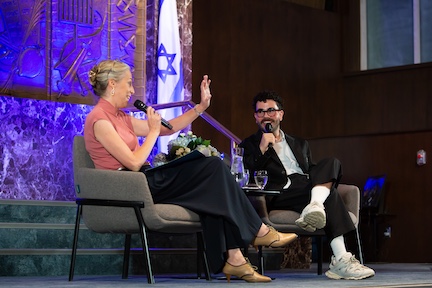
By MYRON LOVE On Tuesday, October 6, a large number of members of our community packed the chapel at the Shaarey Zedek Synagogue, eager to welcome Hen Mazzig in his first appearance in our community.
Over the past few years, the Israeli-born Mazzig – who was appearing at the invitation of our Jewish Federation and Combined Jewish Appeal team – has become one of Israel’s and the Jewish people’s leading advocates on the international stage. His online platforms reach as many 100 million viewers a month with a regular following of almost 1 million. He has been interviewed by numerous leading media outlets and has given addresses at close to 500 universities in recent years.
Mazzig’s presentation in Winnipeg (which was funded by the Asper Family and the Asper Foundation) took the form of a question and answer format with Sarah Mali, the Director General of JFC-UIA (Jewish Federations-United Jewish Appeal) Canada in Israel, asking the questions.
Mali , who was visiting Winnipeg for the third time in the past three years, began by expressing how honoured she felt about having the opportunity to converse with Mazzig – referring to Jewish Federation of Winnipeg President Carrie Shenkarow’s comments regarding Mazzig’s “devotion to Israel and the Jewish people”, his “deep sense of purpose, moral clarity” and “willingness to enter some of the most difficult spaces and conversations.”
The first question that Mali posed to Mazzig was related to his visit to the Canadian Museum of Human Rights and its controversial and one-sided take on the longstanding and ongoing Israeli-Palestinian conflict. She referred to a comment that Mazzig had made on X the day after visiting the museum, in which he wrote that while he “has no problem with people learning about Palestinian history,” he wished that “Palestine Uprooted” didn’t “distort the regional events, including the displacement of 800,000 people just like my grandmother, Hela, who became a refugee when Iraq turned on its Jewish community” post-1948.
“History can only lead to reconciliation when it is told honestly,” he observed. “Otherwise, it is just fuelilng an agenda.”
What most disturbed him about the exhibit, Mazzig told his audience, is that it erased his own family’s history. Expanding upon his family’s roots, he noted that his father’s family came to Israel from Tunisia and his mother’s side from Iraq. He spoke in particular about his maternal grandmother, Hela, who left behind “a beautiful civilization” – Jews had been living and thriving in Iraq since before the Roman destruction of Jerusalem 2000 years ago – to a new land (Israel), where she had to learn a new language (Hebrew) and rebuild her life.
Mazzig added that his grandmother is his anchor in life and the inspiration for all that he has accomplished.
Mali asked Mazzig about his ability to empathize with Palestinians. It was difficult to do, he answered. He got to know Palestinians, he recalled, during the Covid epidemic when he was serving as a medic with the Israel Defense Force and found himself responsible for helping Palestinians through that difficult time and transporting sick Palestinians to Israeli hospitals.
“Even though I fight so hard for Israel,” he observed, it doesn’t mean that I can’t feel empathy for anyone else.”
Mali asked Mazzig how October 7, 2023, changed him.
“I chose not to become a victim,” he said, “but rather to engage more with the world, bear witness, share our stories and talk about genocide. While I was actively advocating for Israel before October 7, I have been much more in demand since. I have become a lot more visible.
”I have found that a lot of people support us,” he continued. “They see what is happening and are on our side.”
On the other hand, he added, a lot of people don’t know anything about Israel. “It is a matter of education,” he said. “I encourage people to go to Israel and talk to Israelis.”
Mali’s last question was what Mazzig means when he writes that “I promise to love being Jewish ten times more than anyone hates me for it.” What does it mean to him to love and find joy and happiness in being Jewish”, she added?
It means cherishing our rich history, Mazzig responded, enjoying Shabbat dinners with family and friends, celebrating all of our holidays and traditions.
“The Jewish People have been through so much over the past 2000 years,” he said. “Many people have tried to destroy us, but we have survived. We are arisen from the ashes numerous time and continued to move forward. Not only are we still here but we have returned as an independent people living again in our ancestral homeland.”
Also addressing the audience at the Shaarey Zedek was Steven Shulman, the president and CEO of the Jewish Federations of Canada. Shulman heaped much praise on our Jewish community in Winnipeg.
“Winnipeg is special,” he noted, “not just in Canada but worldwide. Your CJA campaign continues to be the most successful in North America. You have an outstanding CEO (of the Jewish Federation of Winnipeg) in Jeff Lieberman, who is universally respected.”
He further praised Gray Academy and our community’s highly successful GrowWinnipeg campaign – which has attracted thousands of new families to our community over the past 25 years.
He noted that he was particularly impressed with how our community has come together to protest the biased Nakba exhibit at the Canadian Museum for Human Rights.
He also spoke of the many supporters that we have among non-Jewish Canadians – singling out, as an example, the police officer in Belleville who put his own life on the line protecting the city’s only Jewish congregation from a terrorist attack during yom tov services.
The last word went to Jeff Lieberman, who thanked all the members of our community who have contributed to the CJA campaign this year, as well as our many non-Jewish friends who continue to stand with Israel and the Jewish community.
