



Local News
Jewish Federation launches new program: “TAP” (Teens and Philanthropy) – to give teens a voice in fundraising
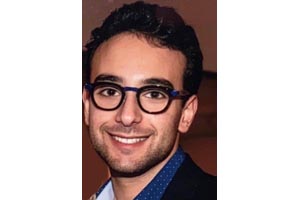
By BERNIE BELLAN When Sam Slutchuk was still a student at Gray Academy – five years ago, he developed a keen interest in working with the Jewish Federation of Winnipeg.
As he told me in a recent phone interview, “I’ve been connected to the Federation since high school. I began as an intern, then when I started university, I was asked to work for the Federation part-time.”
In the five years since he first began an internship with the Federation, Sam, now 22, has taken on increasingly important roles.
“I was first involved in community outreach,” Sam says. “Then I started working with Dalia Szpiro” (the Federation’s GrowWinnipeg Director, who helps to introduce new families into the community).
Sam also worked with Madeline Lopez Ficher, the Federation’s Creative Director, helping to design the Federation’s revamped website, “jewishwinnipeg.org”, nearly two years ago. Sam was also responsible for managing the “Community Connects” initiative during the early stages of the pandemic, which offered check-in calls to over 4000 Jewish households.
More recently though, Sam has moved into a different role – as a “Development Associate” for the Federation, a role in which he is directly involved in fundraising for the Combined Jewish Appeal.
In addition to working for the Federation, Sam is a student at the University of Manitoba.
How Sam came to be involved in fundraising is itself an interesting story.
“I’ve always been interested in fundraising,” he says. “I enjoy my days spent at the Federation because I am helping raise funds for an organization I care deeply about.”
Part of Sam’s new role involves educating young people, in this case high school students, about the importance of the Jewish Federation to the Jewish community, and concomitantly, the importance of the Combined Jewish Appeal.
As Sam says, “I’m emotionally connected to the CJA and the Federation.”
Now, while many young people have volunteered at one time or another with various beneficiary agencies of the Federation, it’s Sam’s job to prepare young people for future roles with the Federation and the community at large.
As such, Sam has been tasked with running a program called “Teens and Philanthropy”.
A little while ago the Federation sent out a marketing campaign to 500 families of teenagers in the community. The email promoted the TAP program to the teenagers to see whether they might be interested in serving on a committee comprised of 14-17 year-olds that would meet once a month for two hours, and whose members would become educated in the important role that philanthropy plays in the community.
Altogether, nearly 40 students expressed interest in serving on the TAP committee through the CJA. As Sam says, “I am thrilled with the response of our teens and excited to get this project off the ground.”
The students come from a variety of different schools, including Gray Academy, Grant Park High School, Garden City Collegiate, and the University of Winnipeg Collegiate.
I asked Sam whether there was one common denominator that he could identify among the students on the committee, other than their ages? He thought about it for a moment, then said that they almost all had been involved with PJ Library at one time or another – which. by the way, shows how successful PJ Library has been at integrating families into the community.
So, what is it that the students will be asked to do when they’re on the TAP committee?
Sam explains that the committee will be given $3600 to work with. Over the course of the next few months, the committee will research the beneficiary agencies that receive funding from the Jewish Federation. The members of the committee will be asked to allocate that $3600 in a similar way that the Allocations Committee of the Jewish Federation distributes funds to the various agencies.
As Sam notes in an email he also sent to me following our interview, “The purpose of the creation of TAP is for the younger generation of our community to have a hands-on experience in philanthropy, no better way than with real-time and money. I felt it was crucial to begin recruiting members now; teens are looking to make a difference, need to fulfill volunteer hours, and what better way than to form a committee.”
I wondered though, whether the students might have an inherent predisposition to favour agencies with which they might have a greater familiarity, such as Gray Academy or the two sleepover camps, Massad and BB Camp?
Sam says that many of the students might have familiarity with other agencies as well, such as the Simkin Centre, because they have a grandparent there, or perhaps Jewish Child & Family Service, or they will learn of new agencies that may hit close to home.
Regardless, the overall purpose of giving the students the $3600 to allocate is to educate them in the process of decision-making.
“These students will be asked to voice their thoughts and opinions,” he notes.
“We need to bring younger people into the process,” Sam says, in explaining what the objective of the program is. “We want our future generation of the community to feel they have a voice.”
Given the Covid situation, however, the first meeting of the committee, which will take place toward the end of January, will, of necessity, be held online.
Sam says though that the hope is to be able to have meetings in February and March held in person.
“Down the road,” he also says, “I would like the students to sit in on focus groups, potentially work as canvassers on Super Sunday,” and to be given roles that until now would have been reserved for adults.
Once they’ve served on the TAP committee this year, each student will be given a letter of reference which should prove valuable down the road both in terms of applying to post-secondary education after high school or in seeking a job.
“We’ll be testing the waters at this point,” Sam says. But, by asking high school students to familiarize themselves with much of the process that’s involved in the work of the Jewish Federation at this relatively early stage of their lives, the hope is that the end result will be to help prepare future leaders of tomorrow for important roles in the community.
“As Sam says, “we need to bring younger people into the process. We wouldn’t have a community without the CJA.”
Local News
Shalom Residences Foundation to host third annual donor appreciation evening
By MYRON LOVE On Tuesday, June 16, Shalom Residences Foundation Inc (SRFI) will be hosting its third annual Donor Appreciation evening. Donors and other Shalom Residences supporters can look forward to chilling to the music of local singer/songwriter David Grenon (aka Soul Bear), who will be performing songs by Billy Joel, Elton John and other well-known artists.
For readers who are not yet familiar with Shalom Residences, the organization was originally created to care for intellectually challenged Jewish young adults. The vision was to provide them with a Jewish environment – strictly kosher group homes where all the Jewish holidays are observed and celebrated.
One of Shalom Residences’ objectives has always been to develop a community in which individuals with intellectual disabilities are fully included, self-actualized, and valued in all aspects of life.
The concept has been a remarkable success.
Shalom Residences was founded in 1980 by six far-sighted couples, including Thelma and Ernie Bronstein, Dolly and Zivey Chudnow, Min and Joe Fromkin, Roberta and Larry Hurtig, Elaine and Bobby Paul,
and Sybil and Frank Steele. The original Shalom Home was a converted house on Cathedral Avenue.
“Thelma Bronstein’s determination and dynamism contributed to making it happen,” says Elaine Paul, currently Shalom Residences’ treasurer (and for the past 20 years, the organization’s leading fundraiser).
I remember the home’s official opening. This was shortly after I started writing for the Jewish Post. Rabbi Charles Grysman affixed the mezzuzah to the door frame.
Today, the organization operates six group homes housing 19 residents as well as 12 residents in supported independent living arrangements.
While the operations today are largely funded by the provincial government – which means that the residences have to be open to accepting non-Jewish clients as well (just over half of the residents are Jewish) – the Shalom Residences Foundation funding supplements the government contribution – providing financial support for increasing staffing levels when needed, as well as extraordinary expenditures and contingencies. The Foundation has also provided the down payment for the purchase of new housing when necessary. .
The necessity of fundraising was evident right from the beginning. Elaine Paul recalls that the first Manitoba Marathon – in which all the founding parents were involved – provided the funding for the mortgage at 175 Cathedral Ave.
“We worked with Helen Steinkopf and John Robertson to develop the marathon,” Paul remembers. ”For several years, Hy Kravetsky and I worked handing out water to the runners.”
Paul relates that it was Zivey Chudnow who was instrumental in starting up Shalom Residences’ annual fundraising. “Three of Zivey’s friends,:Norman Tatleman, Sam Ostrove, and Gary Levinson, asked how they could help,” she recalls. “Their idea was to have a fundraising dinner. We combined the dinner with a lottery. We sold 60 tickets at $1,000 a piece and paid out $15,000 to the winning ticket and lesser amounts to other lucky winners.”
The organization also held annual well attended fundraising teas.
Paul reports that, for years, Chudnow was Shalom Residences’ best fundraiser – with honourable mention to Avrum Katz, Frank Steele, and the late Joe Elfenbaum. Paul took over the role 10 years ago – again with honourable mention to SRFI board members, Dr. Allen Kraut, Peter Leipsic, Donna Chudnow, Jon Feldman, and Mickey Rosenberg.
In addition, the goal was, and remains empowering adults with intellectual disabilities to live meaningful, dignified lives in community-based homes in Winnipeg, enriched by Jewish values.
Charles Tax, the SRFI’s long time president, notes that in 2017, the organization created an endowment fund with the Jewish Foundation of Manitoba. “At the time, we transferred more than half of our assets to the JFM,” he says. “We continue to make contributions to our fund.”
He notes that the annual dinners came to an end with the 20230 Covid lockdowns. The donor appreciation evenings were started in 2023.
“One of our goals is to acquire one or two more houses in the south end,” Tax adds.
Readers who may be interested in attending the donor appreciation evening or otherwise supporting SRFI can contact the office at 204 582-7064 or via email (admin@shalomresidences.com).
\
Local News
Debbie Maslowsky playing lead role in upcoming Dry Cold Productions musical

By MYRON LOVE For the past 40 years Debbie Maslowsky has been entertaining Winnipeg audiences – both Jewish and non-Jewish, with her acting and singing. Arguably Winnipeg’s queen of musical theatre is returning to the stage on May 13 in a lead role in Dry Cold Productions’ upcoming “Kimberly Akimbo”.
Maslowsky is enthusiastic about the Tony-winning production, which debuted on Broadway in November 2022. “It’s a gem of a musical,” she says of the production crafted by the musical team of composer Jeanine Tesori and lyricist David Lindsay-Abaire.
The subject itself is not – on the surface – uplifting. As Maslowsky describes it, “Kimberly Akimbo” is the story of a teenager suffering from a very rare condition – progeria – also known as the aging disease. The genetic condition causes children to age at an accelerated rate causing them to die of old age while still in their teens. For those readers who may recall Rabbi Harold Kushner’s book, “Why Bad Things Happen to Good People” – written years ago, Kushner was responding to the death of his own son from progeria.
In the hands of Tesori and Lindsay-Abaire though, Maslowsky notes, the show is about mindfulness and living day by day. In the production, Maslowsky explains, “Kimberly is trying to live as normal a life as she can despite her illness. Her life is further complicated by a dysfunctional family. Her parents are dealing with their own issues. Then there is the madcap aunt who develops a complicated and hilarious plan to make money for a family road trip, raise funds for choir costumes – with some left over for herself.
“The play is very funny,” Maslowsky comments, “but also poignant. Kimberly knows that she most likely won’t live much beyond 16. Therefore, she wants to live every day to the fullest. She wants to live every day in the now. At the same time, she doesn’t want to hide from reality. She doesn’t want special treatment. She also doesn’t want people – such as her parents – trying to pretend that everything will be okay.”
Maslowsky last appeared on stage in Winnipeg Jewish Theatre’s one-woman production of “A Pickle” in the spring of 2023. That was the true story of a Jewish pickle maker living in Minnesota who had to fight to get her pickles included in the state fair pickle competition, which tried to disqualify her because her pickles were made the Jewish way through a brining process that the non-Jewish judges refused to accept.
In the interim, Maslowsky has been focusing on her longstanding business as a trade show, conference and event manage,r as well as picking up some singing gigs. She reports that she began winding down her business last fall.
She speaks highly of her younger cast mates. “They are an amazing group of young people,” she says. “For some of them, this is their first show. I myself am still learning new things after all these years.”
Maslowsky will next be appearing in the joint Winnipeg Jewish Theatre-Rainbow Stage production of “Fiddler on the Roof” in September. “I played one of the daughters years ago in an earlier Fiddler production,” she recalls. “I feel like I am coming full circle.”
Dry Cold Productions was founded by Donna Fletcher and Reid Harrison (now retired) more than 25 years ago. The company stages a yearly musical theatre production – sometimes edgy – which has played on Broadway and is new to Winnipeg audiences.
The Dry Cold website cautions that “Kimberly Akimbo” contains “strong language (with frequent profanity), mature humour, and references to sexual activity”.
“Kimberly Akimbo” is scheduled to run May 13–17, 2026 at the Prairie Theatre Exchange. Tickets can be purchased by contacting Dry Cold productions online.
Local News
The second Bar Mitzvah: Better than the first
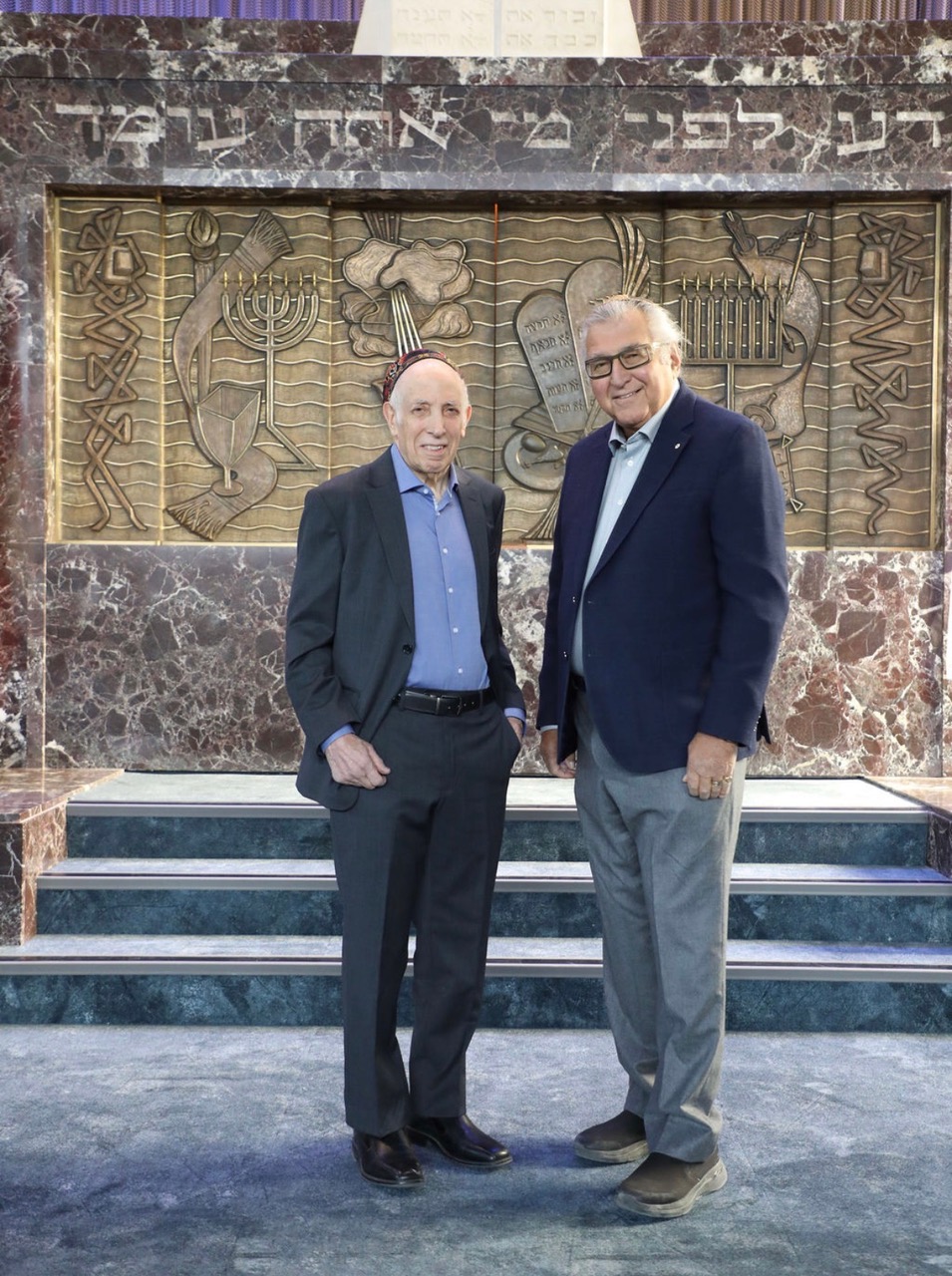
By GERRY POSNER As we pass down the corridor of life, there are certainly times we can identify as moments we will never forget. I had such a moment on April 11 at my second Bar Mitzvah, at the Shaarey Zedek Synagogue, shared with Dr. Ted Lyons, or E. A. as I called him over the years. We were celebrating this life cycle event at the very same synagogue as the first one, that is – the Shaarey Zede. For me, it was some 70 years ago or 25,557 days – from April 21, 1956 to April 11, 2026. The notion of returning to the original place of Bar Mitzvah 1.0 was too powerful a force, causing me to abandon my plan to do this in Toronto where my wife, Sherna and I have lived for the last 13 plus years.
It was quite the weekend. We started just before Erev Shabbat with photos of our two families on the bimah. Ted had his whole family there, including his daughter Mara, her husband Sheldon, and their two daughters, as well as his son Sami, his wife Rose, and their three kids, all of whom live In Calgary, not to forget his sister Ellen and her husband Howard Goldstein, from Toronto. Our three kids: Ari, Rami and Amira, all of whom live in Toronto, along with two of my grandchildren, as well as my brother Michael from Toronto were also present.
After the Shabbat service, we stayed on in the building for our Shabbat dinner. There were 23 of us, including Michael’s partner, Ruth Grubert, (formerly Mozersky), also a former Winnipegger, as well as Rabbi Mass,his son Ranan, Rabbi Carnie Rose and his wife Pauline. It was a warm group and the dinner was gobbled up and appreciated by all of us. We were all surprised when independently, the respective grandchildren of the Bar Mitzvah “bochers” presented both of us with a kind of tribute – funny and sincere in their affection for their Zaidas.
Then came the big day. It lived up to and even exceeded my expectations. It was a sell-out crowd. I was overwhelmed just at that fact. The only thing missing from the building was the electronic ark. The respective families all participated with aliyahs and indeed Torah readings by Sami Lyons and the 83-year-old Bar Mitzvah boy Ted Lyons. Now, “leyning” from the Torah was not something Ted had done at the first go-round 70 years ago. (In fact, almost all of us were deficient in that area).
One particular moment during the service was especially meaningful for Sherna and me. In the first part of the service, there is a prayer called “Mi Chamocha.” My son Ari had written music for that prayer several years ago and now he was at Shaarey Zedek, where he had his Bar Mitzvah long ago. This time though the clergy had arranged to use his music and to sing his melody. (It had been used many times previously, but without Ari. ) Not only that, he was invited to play his composition at the service as Cantor Leslie Emery sang it. Those few moments – as we watched and listened, at this – my second Bar Mitzvah, at a place where my parents had been members for years and whose names are on the memorial plaque in the chapel, well, that was powerful, to put it mildly.
Ted and his family had various honours as did my family. I was given the Haftorah to chant. Now, I have few talents, but I can chant a Haftroah (not the most marketable skill), so that was not that much of an obstacle for me. In fact, I rather enjoyed doing this part of the service. Rabbi Rose had also given me permission to deliver a D’var Torah on the portion of the week, “Shemini”, and to discuss the meaning of this, my second Bar Mitzvah. Once I had the mic and the stage, I was ready to go in spite of my wife’s protestations that it was too long. And, in fact, as I rolled along into my Haftorah, after about 10 minutes, my parter in the double Bar, Ted, came up from behind me where he was sitting, and nudged me gently, or to put it more accurately, gave me the hook, announcing that it was time to wrap up. It was kind of comical, in fact. I got a large charge from that sudden intervention. To top it off, as I had been speaking, I noticed a congregant on my left near the front who had apparently passed out. It was alarming to me at first, but the medics came and were able to revive this person. I was told later that other first words out of the mouth were “Has he finally finished?”
We concluded the day with a rather large kiddish luncheon highlighted at least for me by traditional party sandwiches, which were a staple of the kiddishes of my youth. I met with so many people of my past, which was a treat and a half for me. I was so into the moment that It was hard to get me out of the building.
As I reflect on the day and the service, I recognized that for all of us, we have times in our lives, whether it be an hour, a day or a week, that we will never forget. This day was for me one such moment. It is etched in my memory to be relived through the Youtube video now in my possession. The gift that keeps on giving, I say.
My first Bar Mitzvah was good, for sure. This one was far better. I knew what I was doing.
Post script (After Gerry had sent us his story, he sent us something else that he said should have been included in the story): True, Ted and I had the Bar Mitzvah no 2. But we only had it because there was one person who did the real work and yet received no credit. She made all the arrangements with the synagogue for both the Friday night Shabbat dinner and the kiddish lunch after the service. She dealt with various people in the synagogue and basically took charge of our simcha. I speak, of course, of Harriet Lyons. That I failed to mention her was due to my excess focus on the eating of the party sandwiches and not enough on the reason we had them in the first place. Harriet teaches the weaving of tallits, but she stands tall in the arranging of Bar Mitzvahs.