


Local News
New Federation program connects Winnipeggers with Israeli teens trying to improve their English
By MYRON LOVE Last fall, the Jewish Federation of Winnipeg signed onto Israel Connect, an online initiative that brings together community volunteers with Israeli teens seeking to improve their English.
According to the Israel Connect website, the outreach program was founded in 2013 by Sarah Gordon, a former teacher at the Torah Day School in Ottawa, with the goal of creating a grassroots network of Canadian volunteers who answered the call of Israeli educators to provide their students with English language tutoring.
The website points out that “mastering English is crucial for success in Israel. Universities and high-paying jobs require a high level of English language proficiency. However, the current educational landscape presents a significant challenge. Immersive language experiences, proven to be the most effective way to learn, are impractical in overcrowded classrooms. It is virtually impossible for 30-40 students to engage in effective English conversations and interactions, and experiences outside the classroom are prohibitively expensive.”
Israel Connect’s results were dramatic, the website reports. English proficiency among that first group of students quickly improved, and the demand for native English tutors became clear. Within two short years, the informal network grew into a global non-profit organization that has more than 1,000 volunteer mentors strong.
Today, Israel Connect partners with the Israeli Ministry of Education to support hundreds of students in dozens of schools across the country. In just over 10 years, the organization has become the world’s largest external provider of services to Israel’s Department of Education – helping hundreds of 14- and 15-year-olds to perfect their English simply by chatting once a week with a mentor via Zoom.
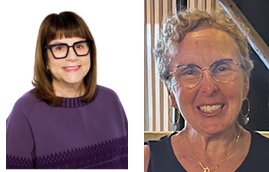
Winnipegger Rietta Floom says that she learned about Israel Connect from relatives in Edmonton. “I was looking for volunteer opportunities,” notes the retired investigator, mediator and hearing officer with the province, who does some casual work as an education assistant. She filled out an application in September 2022, and, shortly after, she was assigned her first student, a girl in grade 12, living outside of Tel Aviv. Her second student, this year, lives in northern Israel and goes to school in Tiberias.
Tannis Mindell, a former chairperson of Liquor and Lotteries Corporation, was also looking for a volunteer opportunity. “I learned about Israel Connect from my sister-in-law in Ottawa,” she says.
Mindell signed on last fall. She notes it was she who suggested that the Federation might want to support this initiative.
“I connected with Mariana Sussi – who is a member of the Federation Board (as chair of the Israel and Overseas committee) – and Abby Flackman (the Federation’s Youth and Overseas Engagement co-ordinator),” she says. “Both Abby and Mariana are also enthusiastic about Israel Connect.”
Both Mindell and Floom point out that you don’t have to have been an educator to participate as an Israel Connect mentor, and there is little preparation required. All that is necessary is to commit to a weekly 45-minute Zoom session with the student that is convenient for both parties.
Each Thursday, the Israel Connect organizers send out a weekly lesson plan. At the appointed time, the student reads aloud the assigned paragraph and goes over with the mentor proper pronunciation and the meaning of new words. After that, mentor and student chat about any number of subjects
The goal of the program, according to the Israel Connect website, is that by the end of the school year, students have the skills and confidence they need to succeed in the national university entrance exams.
Not surprisingly, the events of October 7 and resultant ongoing conflict have introduced a new psychological element into the tutoring. Students share in the national trauma and most have family members engaged in the fighting. The Winnipeg mentors have had a session with Mariana Sussi – who is also a psychotherapist – and who provided them with some strategies in offering some help to their Israeli students with their trauma.
“My work with my student through Israel Connect has been one of the most gratifying experiences I have ever had,” Mindell says.
Both she and Floom would like to encourage others in our community to consider donating a little bit of their time to Israel Connect.
Interested individuals can contact Abby Flackman at 204 477-7424 or send an email to AFlackman@jewishwinnipeg.org.
“I would love to help anyone who is interested in volunteering to get started,” Flackman says.






Local News
Jewish Federation now says Jewish population of Winnipeg in 2021 (according to the census) was 13,940 – not the 16,000 figure that the Federation had been touting for years

By BERNIE BELLAN (Posted Oct. 27, 2026) Longtime readers of The Jewish Post & News (and this website) would probably know that I have long had a very strong interest in establishing as accurate figures as possible when it has come to reporting the size of Winnipeg’s Jewish community.
For years I argued that our Jewish Federation was exaggerating the size of our Jewish population. I heard the figure of 16,000 bandied about by leaders in our community quite often when it came to reporting the size of our Jewish population – without any empirical evidence to back that figure up.
I had long maintained that the only reasonably accurate figures when it came to reporting the size of Winnipeg’s Jewish population were those produced by the late Evelyn Katz, when she was the unofficial demographer for the Jewish Federation – over 30 years ago. What Evelyn would do is keep careful track of births, deaths, numbers of newcomers but, perhaps most important: the number of people who had left our community.
Thus, in August 2022 when I interviewed Faye Rosenberg Cohen who, at the time, was just about to retire as the Jewish Federation’s Chief Planning and Allocations Officer, I was somewhat astonished to hear Faye say, when I asked her what proportion of our Jewish community was made up of immigrants, she answered that “I can honestly say when I look at those numbers it’s somewhere around 1/3 of the community.”
In response, I asked: “So you’d say it’s somewhere between 4-5,000?”
Faye said: “I think it’s more than that.”
I wrote in that article, “I indicated my skepticism at that time, saying ‘You know that I’ve always been skeptical about the numbers that have been used by the Federation for the population of the Jewish community. I think though that it’s always been more of a case of identification – who identifies as Jewish.’ ”
Later, after the results of the 2021 census were released, I wrote that “if you take into account the results of the 2021 census, the Jewish community cannot be larger than 14,270 at a maximum. But that figure would also include anyone who had either said either their ethnic origin was Jewish or their religion was Jewish.”
Since many of the individuals who had said on the 2021 census that their ethnic origin was Jewish, but their religion was something else, I maintained that ascertaining the real size of our Jewish community was highly problematic.
Still, for the sake of argument I was willing to accept that, realistically, it was somewhere between 13,000-14,000 – but nowhere close to the figure of 16,000 that had come to be suggested by our then president of the Jewish Federation or by other leading figures in our community.
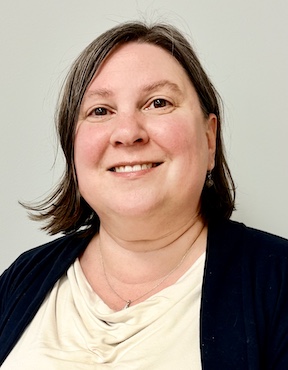
So, it was with a sense of satisfaction that I heard Sharon Graham, who is now the Jewish Federation’s Community Planning and Allocations Lead say to an audience of over 50 people who were at the Gwen Secter Centre on Thursday, October 22, that the Jewish community in 2021 was – at a maximum: 13,940.
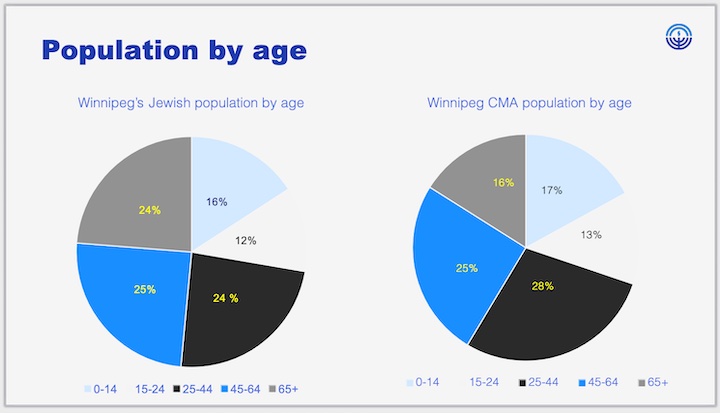
Sharon was at the Gwen Secter Centre to speak to Remis Lecture attendees. Her presentation preceded a presentation by Jewish Federation CEO Jeff Lieberman. Sharon used a PowerPoint presentation to provide some very interesting insights into where our Jewish community was at in 2021- and I’m offering some parts of her presentation here for you to read because I thought they were so interesting.
I had actually made many of the same observations about the results of the 2021 census in my own reporting back in 2022, but seeing what I had written confirmed by the Jewish Federation’s point person on planning told me that Sharon has a much more realistic view of our community than did Faye Rosenberg Cohen.
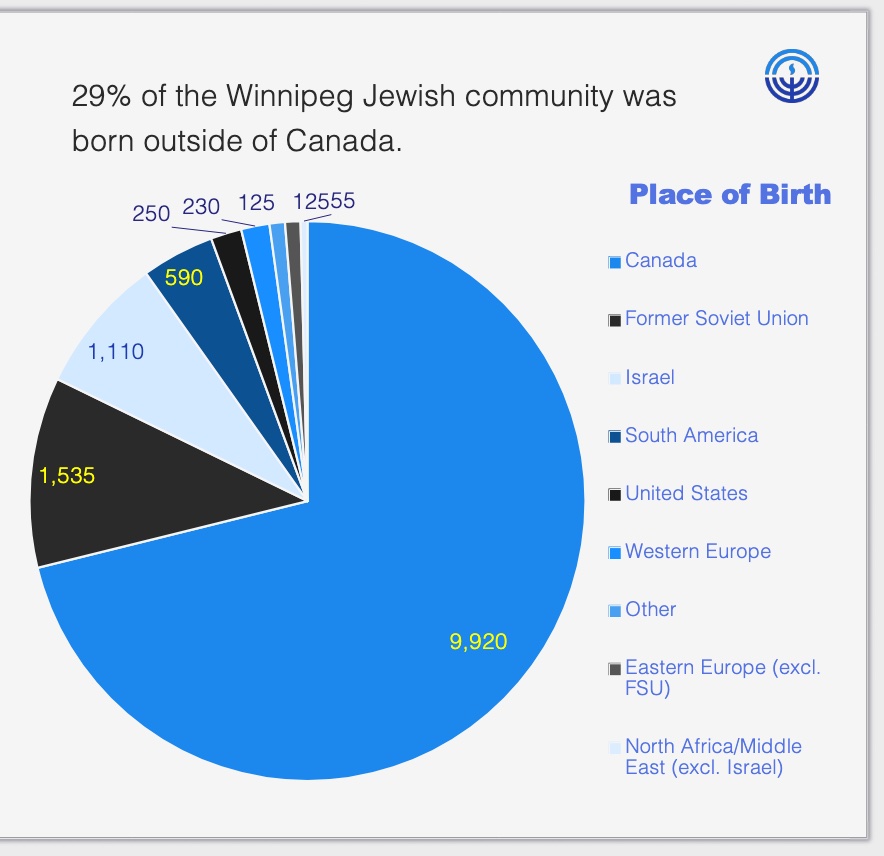
Here, for instance, is a slide that shows the proportion of our Jewish community that is made up of immigrants. It’s slightly under one fifth, not the one third percentage that Faye had suggested.
But, what really set Sharon’s presentation apart from anything else I’ve ever seen presented by someone from the Jewish Federation – other than the aforementioned Evelyn Katz, was the slide she projected which showed that, while there had been a large influx of newcomers to Winnipeg’s Jewish community between 2016-2021 there had also been a significantly high number of people who had left our Jewish community in those same years, as you can see in the following slide:
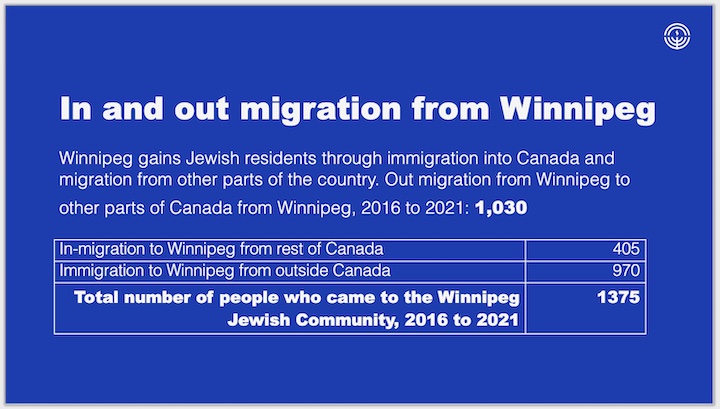
That is something we just don’t hear discussed by leaders of our Jewish organizations, but let’s be realistic: For many newcomers who came to Winnipeg and were counted as new members of our Jewish community, Winnipeg – for a variety of reasons, was a stepping stone to other communities. It may have been for reasons of better job opportunities, moving closer to other family members, or – the reason that we hear so often when it comes to people saying they want to leave Winnipeg: the weather.
But, whatever the reason, Sharon’s figures show that, as much as GrowWinnipeg may have been an abiding success when it’s come to attracting newcomers to our Jewish community here, getting them to stay long term is a different story.
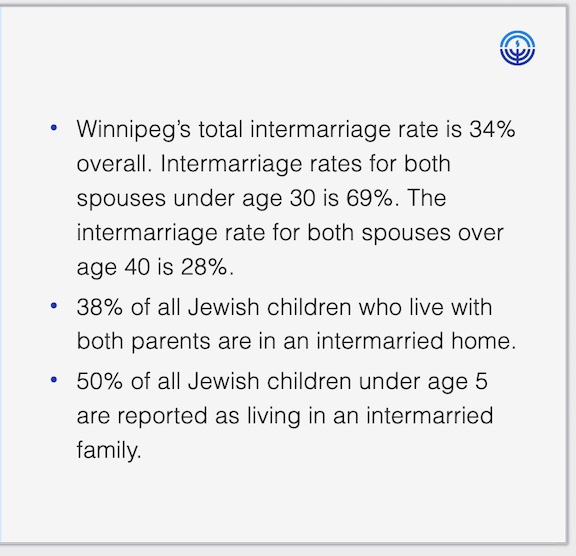
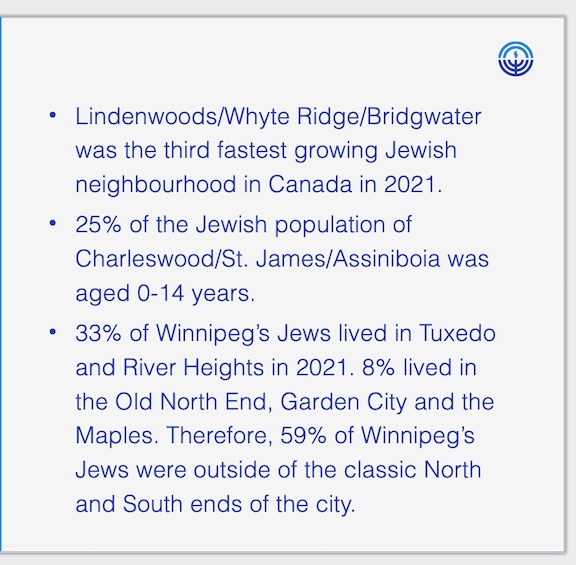
And, while there were other aspects of Sharon’s presentation that certainly merit discussion, especially the figures she produced about intermarriage, rather than delving into them here, I thought it useful simply to insert them for you, the reader, to see – and draw your own conclusions.
Local News
Marty Green expands his protest against extremist Jewish settlers to two more venues – and is arrested twice more
(Tuesday, October 27) We received the following press release about Marty Green being arrested again, both at the University of Manitoba and at Shaarey Zedek Synagogue:
Both sides came to blows on Saturday, October 24, at the Shaarey Zedek Synagogue as security personnel sought to prevent Marty Green from interfering with synagogue traffic as he protested just outside synagogue grounds against the actions of religious settlers in Israel’s occupied West Bank territory. Synagogue Executive Director Rena Secter Elbaze quickly intervened to prevent further escalation. Police arrived shorty thereafter and detained Green for 45 minutes before driving him home and releasing him. It is not clear whether their decision not to lay charges was the result of their own onsite investigation or whether it was at the request of the synagogue executive.
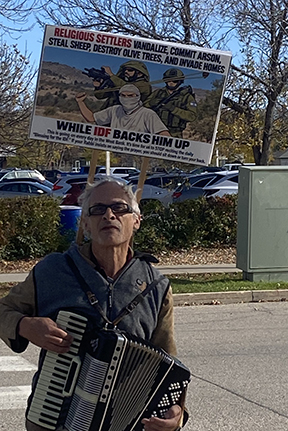
Green has now been arrested four times in the last month and faces multiple charges for disturbing the peace, including two episodes at the Asper Campus and one more this past Friday (Oct. 23) at the University of Manitoba. While Green says initially he was merely handing out leaflets (at the Asper Campus), since his first arrest on September 23, he has returned to the campus with a large placard and an acccordion, accompanying himself while singing songs with lyrics that include such phrases as “The Jews Are Bananas….B-A-N-A-N-A-S”. In addition to listing actions of the religious settlers as including arson, vandalism, and theft, he pointedly alleges that the IDF has been backing up the settlers in their actions.
Green had earlier notified the Shaarey Zedek that he was contemplating bringing his protest to the synagogue. He was told that if he attempted to enter the grounds he would be prevented from doing so. At that time, Secter Elbaze told Green that his intentions were inappropriate, declaring the synagogue to be “a house of worship dedicated to prayer, learning, community, and spiritual engagement.” Green responded that if the synagogue were willing to contact the Crown and inform them that “that there was never any legal basis for their claims that I was conducting myself inappropriately at the Asper Campus” (with regard to his earlier arrests) that he would “voluntarily refrain from carrying his informational campaign to the synagogue(s).”
Green further argues that the recent “psak” (religious ruling) by leading Israeli rabbi Rov Dov Lior, in which Lior declares that it is not merely permissible but praiseworthy for Jews to steal olives from Arab orchards….that this ruling brings his protest within the proper realm of religious discourse. He says further that if the local rabbis were willing to speak out to their congregations against the aforesaid psak, that he might have refrained from taking his campaign to their grounds.
Although Green was released on Saturday without charges, police confiscated his placard. They explained that it was being held as evidence pending an investigation by Major Crimes as to whether it constituted hate literature.
There was no further information given as to what happened at the University of Manitoba.
Local News
Third annual JFest Winnipeg will be offering programs for all ages
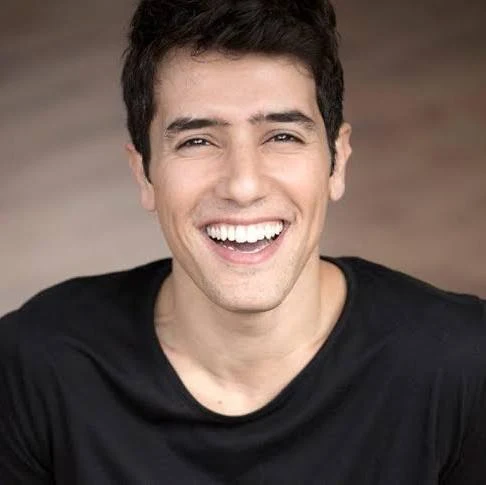
By MYRON LOVE JFest Winnipeg is back with a good variety of musical performances, a book launch, popular Jewish-themed films, children’s activities, and a family-oriented Shabbat dinner.
“JFest,” observes Laura Marjovsky, the Rady JCC Director of Programming, “is an opportunity for our community to experience Jewish art and culture. With our range of JFest events, we are trying to reach out beyond what has been our base audience and appeal to all ages. We have a commitment to bring top notch Israeli performers to share the highest caliber of Israeli entertainment with our audiences.”
The week-long festival (November 14-21) kicks off with a performance by top-ranked Israeli singer-songwriter Harel Skaat. The popular Israeli star began singing as a child. He shot to fame when he finished second in the second season of “Kochav Nolad” – Israel’s version of “American Idol.” His first album was released in 2006 and achieved Platinum status – with one of the songs being ranked as “song of the year.” He followed that up in 2009 with a second album that reached Gold status. In 2010, he represented Israel at the Eurovision competition.
Skaat’s performance is scheduled for the Seven Oaks Performing Arts Centre (which is attached to Garden City Collegiate) beginning at 8:00 P.M. on Saturday, November 14. Patrons will have the opportunity to purchase an enhanced ticket to attend a meet and greet with Harel.
All other JFest programs and activities will be at the Rady JCC.
Music Producer Karla Berbrayer says Ben Caplan’s performance on Saturday, November 21 will also be another highlight. “Ben Caplan redefines what it means to be a modern folk artist,” Berbrayer says. “His music and stories are matched by his larger-than-life stage presence. This concert focuses on how his Jewish upbringing has influenced his entire performance career.”
“Flatland Famous” is returning by popular demand. This quintet, known for its performances at Winnipeg Jets games, will be presenting its concert, “Jewish Soul of Rock and Roll,” on Wednesday, November 18, at 7:30 pm. This year’s show will feature songs by Amy Winehouse, Neil Diamond, Barbra Streisand, Simon and Garfinkel, and other famous Jewish icons.
On Tuesday, November 17, local author Deborah Schnitzer will be taking centre stage with the launch of her new book, “The Woman Who Swallowed West Hawk Lake.” The University of Winnipeg English Professor Emeritus’s new novel explores intergenerational trauma related to Nazi breeding programs. Joining Schnitzer on stage will be a panel of professionals who have experience working with children who have experienced trauma.
And of course, “Best of the Fest” is back. Films to be presented will include“The Floaters” and “We Met at Grossingers,” two wildly popular movies at last spring’s Winnipeg International Jewish Film Festival.
“The Floaters,” to be screened on Monday , November 16 at 7:00 pm is a funny and bang-on depiction of Jewish summer camp culture.
“We Met at Grossingers” is a loving look back at the Borscht Belt in New York’s Catskills, where generations of young Jewish performers earned their dues and developed their acts. The film will be screened on Thursday, November 19 at 7:00 P.M.
On Friday November 20, JFest will host a Family Shabbat dinner featuring Anat Kriger, an Israeli-born, Toronto-based musician, actor, and children’s performer, who has made several appearances in Winnipeg at major communal events.
Kidfest on Sunday, November 15, will be a day-long potpourri of programming that will include live performances, workshops, bouncy castles, games and crafts, and much more.
Readers seeking more information about JFest can contact Laura Marjovsky at 204 477-7539 or lmarjovsky@radyjcc/com
