


Uncategorized
As Slovenia takes a hard line against Israel, its tiny Jewish community feels increasingly isolated
(JTA) — LJUBLJANA, Slovenia — In June 2024, Slovenia’s parliament voted to recognize a Palestinian state only one week after Spain, Ireland and Norway had taken that dramatic step.
Half a year later, Slovenian public broadcaster RTV — citing the ongoing war in Gaza—became the first in Europe to demand Israel’s exclusion from the 2025 Eurovision Song Contest. This past May, RTV warned it might boycott future editions of Eurovision if Israel isn’t expelled.
Over the summer, Slovenia banned imports from Jewish settlements in the West Bank, only a week after prohibiting all weapons trade with Israel — the first EU member to do so. That ruling followed on the heels of another one declaring two right-wing Israeli officials persona non grata. Last week, it became the first EU country to impose a travel ban on Israeli Prime Minister Benjamin Netanyahu.
“People are dying in Gaza because they are systematically denied humanitarian aid,” the government said in announcing the arms embargo. “In such circumstances, it is the duty of every responsible country to act, even if that means taking a step before others do.”
Some analysts have pegged the aggressive anti-Israel stance as a gambit ahead of the country’s upcoming elections, when the country’s pro-Israel right will try to retake control after losing power in 2022.
But for Slovenia’s roughly 100 Jews, the campaign against Israel is part of a pattern of hostility that transcends the vagaries of politics. Barely five years ago under a right-wing government, a Slovene court voided the 1946 treason conviction of executed Nazi collaborator Leon Rupnik, who nearly liquidated the country’s Jewish population.
“Slovenes always want to be on the side of the underdog, and the media perception over the last 40 years is of poor Palestinians and big, imperialist Israel who took their land,” said Robert Waltl, president of the Liberal Jewish Community of Slovenia. “But now, because of the war, it’s worse here than any other former Yugoslav republic.”
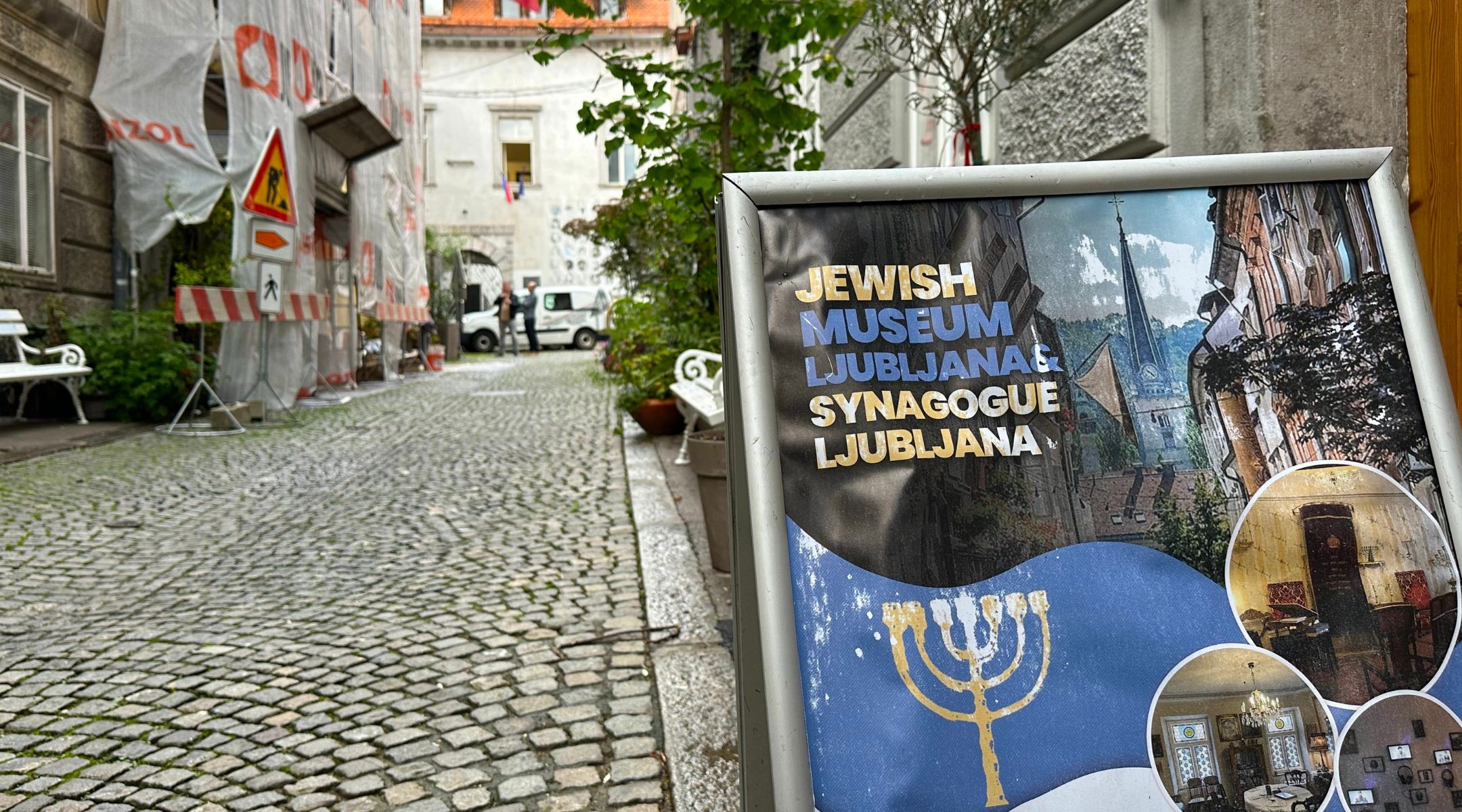
Waltl spoke to JTA from his office at the Mini Theater, which since 2013 has also housed the Jewish Cultural Center and Slovenia’s only active synagogue. The 500-year-old building, which Waltl renovated with $1.6 million in donations, fronts Krizevniska Street in Ljubljana’s old city.
Its 6,500 square feet — crammed with prayer books, menorahs, historic photographs and an entire exhibit on the Holocaust — has become the focus of Jewish culture in Slovenia, with 2.1 million people the smallest and most prosperous of the six republics that once comprised Yugoslavia.
Unlike neighboring Croatia — whose center-right government has pursued a stridently pro-Israel policy despite a rising, homegrown fascist movement — Slovenia has veered sharply to the left in recent years.
“Christian antisemitism was very visible here before World War II,” Waltl, 60, explained as his dog, Umbra, repeatedly barked at passersby. “At the beginning of the 20th century, there was no university here, so people studied in Vienna — and the mayor of Vienna was very antisemitic. Students learned it there and brought it back home with them.”
The presence of Jews in Slovenia dates back to Roman times, with the first synagogue in Ljubljana built around 1213. During the Middle Ages, the most important community was in Maribor, though Jews were expelled from that town in 1496, and then from Ljubljana in 1515.
By the early 20th century, Slovenia’s Prekmurje region had become home to two-thirds of the country’s 1,400 Jews, mostly in the towns of Murska Sobota and Lendava. Yet antisemitism was pervasive; an outbreak of Jew-hatred during the 1929 economic crisis followed accusations that Jewish moneylenders were profiting from exorbitant interest rates. By the end of World War II, the Nazis and their collaborators had killed all but a handful of the country’s Jewish inhabitants.
During Israel’s 1948 War of Independence, Yugoslavia under Tito helped the fledgling Jewish state, but later, as head of the Non-Aligned Movement, he befriended Yasser Arafat and switched his allegiance. After Yugoslavia disintegrated in the early 1990s, the region was plunged into years of ethnic warfare that left an estimated 130,000 dead and millions homeless.
Only Slovenia escaped serious bloodshed, with only 62 deaths reported during its 10-day war of independence against the dominant republic, Serbia. Nevertheless, the Alpine republic — the same one that has just declared an arms embargo against Israel — became embroiled in a massive scandal involving weapons sales to Croatia and Bosnia & Herzegovina, both of which were fighting Serbia, despite a 1991 United Nations arms embargo.
Waltl said his country’s policy toward Israel, as well as domestic media, is riddled with hypocrisy and misinformation.
“In Croatia, the government strongly criticized what Hamas did on Oct. 7 and they stand with Israel. In Slovenia, it was the same for the first few days, but then all attention shifted to the plight of the Palestinians,” he said. “Today in Slovenia, 99% of the media isn’t just pro-Palestinian but anti-Israel. You will never hear that Israel was attacked by Hamas or Hezbollah, only that Israelis kill women and children.”
He added: “It’s also true, however, that the right-wing government in Israel has crossed all acceptable lines and limits of humanity, triggering a wave of hatred towards Jews worldwide.”
It doesn’t help that Israel has never established an embassy in Ljubljana — even though Slovenia has maintained one in Tel Aviv for the past 30 years.
Polona Vetrih, a prominent stage actress whose father survived World War II as a partisan, said she’s had several unpleasant encounters with local antisemites. Recently, she sang at a peace concert where she performed the Ladino song “Adios Querida.”
“One girl from Palestine was very loud. She was screaming, and they threatened me. I was scared to death,” she said. “I went to the police afterwards.”
Frequently, she hears Slovenes complain that Jews are mean and think only of themselves.
“They don’t have a clue. Even during the Middle Ages, they blamed Jews for the plague,” she said. “I think it’s up to us to show them it’s not true.”
During communism, Slovenia had virtually no organized Jewish life. In 1991, the Liberal Jewish Community was established, and in 2002, local Jews contracted with a Chabad rabbi from Trieste, Italy, to conduct High Holiday services. The following year, said Waltl, the community received a Torah scroll from a British donor, and turned a nearby cigarette factory into a small synagogue with the help of the American Joint Jewish Distribution Committee.
Ten years ago, with the help of Lustig Branko — producer of the film “Schindler’s List” — the museum established a Festival of Tolerance. Last year, some 6,000 elementary school students came to see performances of “The Diary of Anne Frank.” Currently, liberal rabbis Alexander Grodensky of Luxembourg and Tobias Moss of Vienna visit Slovenia for special occasions.
In April 2024, a 10-member delegation from the World Jewish Congress traveled to Slovenia to meet with government officials, but they were ignored, Waltl said. And when swastikas were discovered scrawled on the walls of the Jewish Cultural Center one night, he said, “no one from the government came, and no one called me — not even the mayor of the city.”
Maya Samakovlija, the organization’s executive director of community relations, went even further.
“We were not merely ignored. What happened to us is something no other government in the world has done ever in the long history of the WJC,” said Samakovlija, who is based in Zagreb, Croatia. “Neither the prime minister, the president, the speaker of parliament, nor the minister of foreign affairs made any effort to meet with us. Instead, they sent only deputies and lower-ranking officials.”
At that meeting, Blanka Jamnišek, deputy head of Slovenia’s delegation to the International Holocaust Remembrance Alliance, asked the visitors what they were doing “to promote a ceasefire and stop the killing of children, and the famine in Gaza,” according to Samakovlija and a statement that the AJC released at the time. The IHRA definition of antisemitism cites holding Jews collectively responsible for Israel’s actions as an example of antisemitism.
“Her colleagues were visibly shocked,” the WJC official said. “Once she had finished, I made the decision that we’d leave as a delegation. We stood up, ended the meeting and walked out.”
Ernest Herzog, the WJC’s executive director of operations, was also part of that delegation. He said Slovenia’s Jews “face an alarming rise in antisemitism, evident in acts of vandalism, threats and hostile rhetoric.”
“It is deeply troubling that certain officials have sought to justify this climate of intolerance through a distorted interpretation of the Middle East conflict — an excuse that is wholly unacceptable,” he added.
Politicians on the right more often support Israel. This past April, the Slovenia-Israel Allies Caucus was established by lawmaker Žan Mahnič of the Slovenian Democratic Party. Former Slovene Prime Minister Janez Janša, who supports the caucus, has said that if he returns to power, he will relocate his country’s embassy from Tel Aviv to Jerusalem and rescind Ljubljana’s recognition of Palestine.
Steve Oberman, an attorney in Knoxville, Tennessee, and past president of that city’s Arnstein Jewish Community Center, visited Slovenia in 2024 to teach a law class at the University of Ljubljana. He has since become a passionate defender of Waltl’s efforts.
“I’m disappointed that the Slovenian government isn’t doing a better job of supporting the Jewish community of Slovenia, given the country’s history,” Oberman told JTA in a phone interview. “Poor Robert has carried this task, almost singlehandedly, to revive Jewish life there and create a synagogue. I’m trying to work through our local Jewish community here in Knoxville to raise awareness, and hopefully some money.”
Meanwhile, the situation for the few Jews remaining in Slovenia isn’t getting easier.
Sophia Huzbasic, a native of Kyrgyzstan who lived for a time in Israel but settled in Slovenia nine years ago, said she was born with Soviet citizenship but chose to retain her Israeli passport.
A graphic designer, she lives in Ljubljana with her husband Igor, who’s from Sarajevo, Bosnia.
“For local Jews, I truly believe the antisemitism is really terrible,” she said. “I was raised in Moscow in the 1990s, so for me this is nothing. I’m not scared but I’m angry.”
Huzbasic, 43, said her bank refused to approve a car lease when officials learned she was an Israeli citizen — just one example, she said, of the insidious antisemitism that seems to be prevalent.
“We feel very angry because of the official position of the Slovenian government. What they’re doing is propaganda from a very poorly educated point of view, and they don’t want to widen their knowledge about the conflict,” Huzbasic said. “I totally disagree with the Israeli political situation, and I chose to keep my Israeli citizenship and live here. But now I’m very close to changing my mind. I cannot stop being a Jew.”
The post As Slovenia takes a hard line against Israel, its tiny Jewish community feels increasingly isolated appeared first on The Forward.
Uncategorized
VIDEO: A Hasid gives us a tour of Morocco in Yiddish
דער ירושלימער יוטוב־שטערן וועלוול קירשנבוים האָט לעצטנס אַרויסגעשטעלט אַ ווידעאָ אויף ייִדיש פֿון אַ פּרעכטיקן וויזיט, וואָס ער האָט געמאַכט אין מאַראָקאָ. עס באַגלייט אים זײַן חבֿר אַבֿרהם פּרץ.
אינעם ווידעאָ זעט מען ווי קירשנבוים דאַוונט שחרית מיט די אָרטיקע ייִדן און באַזוכט אַ גוט אָפּגעהיטענעם בית־עולם, וווּ עס ליגן באַערדיקט גרויסע צדיקים ווי למשל הרבֿ חיים בן עתר (1696–1743), באַקאַנט ווי דער „אור החיים“. „מענטשן מיינען, אַז נאָר אין אייראָפּע זענען דאָ קבֿרים פֿון צדיקים!“ זאָגט קירשנבוים.
מיר זעען אַ גרויסע, שיינע שיל מיט אַ פֿײַנער אַרכיטעקטור אין קאַזאַבלאַנקאַ; דעם גרויסן אַראַבישן שוק, וווּ קירשנבוים קויפֿט זיך אײַן מלבושים פּונקט ווי די מאַראָקאַנער גייען אָנגעטאָן. ער באַוווּנדערט אויך די שיינע טיי־גלעזער און טשײַניקן, וואָס מע פֿאַרקויפֿט דאָרט, און באַקענט זיך מיט אַ ייִדישן סוחר וואָס האַנדלט מיט זילבער און גאָלד, פּונקט אַזוי ווי זײַן טאַטע און זיידע האָבן געטאָן פֿאַר דור־דורות.
The post VIDEO: A Hasid gives us a tour of Morocco in Yiddish appeared first on The Forward.
Uncategorized
Conservative and Christian movies are coming for Hollywood
A star-studded new movie set in a Soviet prison is coming out in November. James Franco and Rob Lowe anchor the cast of Confession, playing a brutal prison guard and an imprisoned dissident professor, and a disheveled Nick Nolte appears as a fellow prisoner.
These actors were once huge gets, and their names could convey legitimacy to a project. Nolte and Franco both have received Academy Award nominations. Lowe was a member of the Brat Pack, and was a regular on The West Wing.
Confession, written by Ben Shapiro and produced by the rightwing tabloid-esque news site The Daily Wire, is not the expected fare for actors with that kind of name recognition; Shapiro’s screenwriting aspirations have been the target of ridicule for years.
Nevertheless, this isn’t the only Daily Wire production getting big names; Danny Trejo signed onto a pro-ICE movie about Minneapolis in the aftermath of the Renee Good shooting, and Jonathan Majors led Run, Fight, Hide: Infidels earlier this year.
Each one of these actors has been, in some way, canceled or in career doldrums so may have been more open to working with The Daily Wire. And some have claimed that they did not know who Shapiro was, or what his politics were; Trejo’s son, Gilbert, said his 82-year-old father did not endorse ICE and was misled about the movie before he signed his contract.
Movie studios have struggled through the pandemic and the streaming era, both of which have tanked box office receipts, leaving the field open for movies from offbeat production studios. In addition to The Daily Wire, there has been a whole ream of Christian movies attempting to shift the stereotype of bible movies — that they’re preachy, low-budget straight-to-TV affairs with cardboard acting — to something more prestigious, or at least profitable.
The Christian company Angel Studios has been placing screenings of the half philo-semitic, half-antisemitic Jesus TV series The Chosen in movie theaters across the country, produced the right-wing hit The Sound of Freedom and is pumping out faith-based movies like the animated King of Kings Christmas story and David, a kiddie movie about the biblical king. Recently, Pinnacle Peak Pictures, another faith-based production company, premiered Daniel and the Fiery Furnace, another bible movie that was notable enough to merit a review in The New York Times. (Though admittedly it wasn’t a particularly positive one.)
For decades, Hollywood, and the media industry at large, has been associated with liberalism, progressive politics and diversity. (This is part of why conservative conspiracy theorists often insist that Jews control the media.) Even when conservatives are in power, satirical movies have poked fun at the ruling class — Team America: World Police spoofed George W. Bush’s foreign policy, while M*A*S*H critiqued Richard Nixon. During the current Trump administration, we’ve seen One Battle After Another lambasting immigration policies and rising white nationalism, Eddington on misinformation and populism, and The Apprentice depicting Trump directly.
But a rising number of higher-budget, bigger releases from the right wing, whether The Daily Wire’s conservative political parables or the Christian fables, are bringing a new kind of messaging — about the importance of God and country, about gender roles, about about the centrality of Jesus to the U.S. — to the American movie-going public.
This is no accident. A group of powerful conservative Christians, many of whom worked on Project 2025, are proponents of the Seven Mountains Mandate, a blueprint for Christian nationalism that instructs Christians to gain influence and control over the “seven mountains” of society — which include media, entertainment and the arts. The Mandate is part of the New Apostolic Reformation, a decentralized evangelical movement embraced by millions of Americans.
Jeremy Boreing, the director of many Daily Wire movies — though he has since left the company — said on a podcast hosted by businessman Patrick Bet-David that “It had always been part of our strategy to move into making culture, not just criticizing culture” as a way of proving that “there is a future where conservatives aren’t losing. There’s a future where we have political power and cultural power.”
Cultural power, of course, requires more than just a lot of movies; they have to be well-done, or at least appear to be. Previous Daily Wire productions, as well as other right-wing, MAGA movie ventures, have been hacky. Lady Ballers, about an unsuccessful men’s basketball team pretending to be women so they can dominate the league, was an unsubtle, unfunny and ultimately unwatchable spoof of transgender athletes. And even plenty of higher-budget attempts, like Daniel and the Fiery Furnace, can still fall victim to wooden acting and writing.
But now, with the financial success of movies like The Sound of Freedom and biblical parables like The Chosen, bigger stars are being drawn to projects like the Daily Wire’s lineup of pro-ICE, anti-immigration and anti-LGBTQ movies. With those bigger stars may come new audiences who might not have watched a Christian movie or Daily Wire project otherwise. And where there is money and viewers, mainstream Hollywood will go, too, no matter how progressive people expect the industry to be. We’ve already gotten a biblical epic from Amazon Prime, with The House of David, and there are likely to be many more to come.
After all, it wasn’t so long ago, after all, that Cecil DeMille’s The Ten Commandments was the biggest movie in town.
The post Conservative and Christian movies are coming for Hollywood appeared first on The Forward.
Uncategorized
‘Heil’ Mary? New Atlanta Falcons logo inspires Nazi comparisons
If there was something off about the logo the Atlanta Falcons unveiled on social media Wednesday, whoever runs their accounts did, uh, not see it.
Behind the black falcon graphic that began appearing on the football team’s helmets in the 1960s was a new background — a flag of red, tan, black and white vertical stripes. To thousands of people who responded to the logo, it looked distinctly German — in a 1930s kind of way.
“The Atlanta Falcons are preparing to invade Poland,” one fan wrote.
A day after its posting, the new profile picture had unleashed a deluge of Nazi memes in the 4,000-plus replies on X. One picture swapped in the logo for Nazi flags in the background of a historical photo of a Hitler rally. Another edited the Falcon claw to look like a Nazi salute.
Others depicted Hitler in a Falcons cap, references to Inglourious Basterds and the Battle of the Bulge and a World War II joke invoking a blown lead in Super Bowl LI.
“Falcons were up 28-3 at Dunkirk,” that tweet read.
The Falcons’ snafu enters a small but growing catalogue of Reich-coded brand mixups. Who can forget the German national soccer team’s ‘44’ soccer jerseys? There was also the swastika-emblazoned Hallmark gift wrap; the accidental Hitler mugs; and (for my money) the worst of the bunch, Zara’s concentration camp uniform shirt.
All of those have been addressed; so far, the Falcons’ has not. We’ve reached out to them for comment.
The post ‘Heil’ Mary? New Atlanta Falcons logo inspires Nazi comparisons appeared first on The Forward.
