


Uncategorized
Their art was whimsical, elegant, ‘scandalous,’ and colorful. It was also revolutionary.
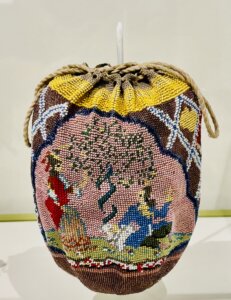
Even under glass, designer Fritzi Löw’s intricately beaded “Adam and Eve” bag manages to sparkle.
One of 200 objects and artifacts on display in “Modernity and Opulence: Women of the Wiener Werkstätte,” a major new exhibition at the Jewish Museum, presented in cooperation with the MAK — Museum of Applied Arts, Vienna, the piece captures the show’s theme of casting off old ways and old fashions.
Founded in 1903 and active through 1932, the Wiener Werkstätte, or Vienna Workshops, gave women, who were entering public life and the workforce in greater numbers, a way to turn specialized artistic skills into lifelong professions, including architecture, decorative arts, ceramics and textiles. In so doing they changed the way they and women outside the workshop saw themselves.

“For some, their first opportunities for paid artistic work were through the Wiener Werkstätte, which became a vital professional pipeline for women artists while also bringing an influx of virtuosic experimentation to the workshop,” Kristina Parsons, the museum’s assistant curator, said.
At least one-quarter of the nearly 200 women who worked for the multidisciplinary collective were of Jewish faith, Jewish descent, or came from Jewish families.
While the exhibition features many Jewish artists, it spotlights Vally Wieselthier and Felice Rix-Ueno. Their prolific work in ceramics and textile design has had a lasting influence on both disciplines.
The exhibit “brings together art, design, fashion and Jewish history to illuminate the central role Jewish women played in shaping modernity, both as visionary makers and as influential patrons,” said James S. Snyder, director of the Jewish Museum.
For example, Rix’s fanciful, colorful designs appeared on toys, tableware, wallpaper and dresses. The exhibit showcases her elegant tasseled cigarette case, a chiffon cinched waist dress as well as whimsical designs for a papier-mâche bird and another for a toy carriage pulled by a dog.
The early 1900s ushered in the era of the “New Woman,” a time when women were shedding the boned and corseted fashions of the past in favor of more fluid, and even fanciful, garments. It was also a time when women increasingly pursued higher education, fought for suffrage, and challenged restrictive gender roles and clothing.
That sensibility is captured in the dozens of fashion postcards on display, which served as both advertisements and collectibles. In one, a woman wearing a sky-blue turban and a form-fitting white-and-black dress trimmed with fur glances casually over her right shoulder as she walks a small black dog. In another, a woman peers assuredly from beneath a plumed hat, her curly hair cut in a bob, scarlet red lipstick her only hint of makeup.
As Parsons explained, the Wiener Werkstätte’s fashion department allowed women to directly address public perceptions of modern femininity by designing clothes and accessories that they, and other like-minded women, could incorporate into daily life.
“Women’s dress was an important point of convergence between larger impulses toward reform and feminist politics — fashion was then, as now, understood for its capacity to be a revolutionary statement,” she said.

It’s an idea captured in Wilhelm List’s 1910 “Young Woman in Undergarments.” The oil painting depicts a woman believed to be Wally Neuzil, who later trained as a nurse. She wears ruffled “umbrella drawers,” which fall loosely around her knees, and a sleeveless chemise. The garments allow for ease of movement and comfort in one’s own skin.
The exhibition also shows how Jewish women such as the noted socialite and arts patron Adele Bloch-Bauer and the journalist and salon hostess Berta Zuckerkandl helped ensure the workshop’s success.
In turn, upper-class clientele, including progressive Jewish intellectuals, commissioned furniture and interiors, wore Werkstätte fashions, sent Rosh Hashanah greetings on Werkstätte-designed stationery, and celebrated the workshop’s creations.
During its 30 years of operation, the workshop produced hundreds of patterns. Between 1910 and 1917 alone, it created more than 500 designs. One wall of the gallery is given over to textiles. Bold reds and purples evoke coral formations, while zigzag patterns combine purple and orange with chocolate and persimmon.
Aside from textiles and illustrations, there are also dozens of ceramics, such as Susi Singer’s design for a green and gold oven that, with its cake-like tiers, looks as if it belongs in a Disney animated film.
Artist Vally Wieselthier’s mirror, fashioned from glazed earthenware and adorned with a trio of busts, hangs near a collection of her outsized ceramic heads. The heads, some of which stand nearly two-feet tall, were modeled after mythological and classical figures, but also shopkeepers and everyday people. The works drew both praise and ridicule, dismissed by one newspaper as “scandalous bimbo business.”
While the Werkstätte sputtered out in 1932 for a host of reasons, including poor management, financial troubles, a resistance to mass production, and a decline in wealthy patrons, its influence remains.
According to Parsons, “In bringing together highlights from the remarkable body of work made by Jewish women for the Werkstätte, this exhibition spotlights their creativity, ambition, and influence, while inviting visitors to explore a group of artists who embraced decoration as a central expression of modernity.”
Modernity and Opulence: Women of the Wiener Werkstätte continues through Nov. 15, 2026 at the Jewish Museum.
The post Their art was whimsical, elegant, ‘scandalous,’ and colorful. It was also revolutionary. appeared first on The Forward.
Uncategorized
In Oct. 7 blame game, former Shin Bet chief sues Netanyahu ahead of elections
(JTA) — The bitter battle that has raged between Israel’s security and political establishments over who bears responsibility for the failures ahead of the Oct. 7 attacks is kicking into high gear as Israel prepares to hold its first election since the Hamas invasion in 2023.
This week, former Shin Bet chief Ronen Bar upped the stakes by filing a defamation lawsuit against Israeli Prime Minister Benjamin Netanyahu. The premier has blamed the intelligence head for the failures leading up to the attack even as many in the security establishment have pointed the finger at Netanyahu. Bar in his lawsuit lists a litany of occasions Netanyahu allegedly ignored or rejected advice that might have prevented the attacks.
In the run-up to the national vote on Oct. 27, Israeli media have been preoccupied with reports of intelligence that was purportedly shared with top government officials ahead of the attacks. What Netanyahu knew about the Hamas threat before the invasion — and when he knew it — has become a central issue in the campaign and a line of attack for his political rivals.
Gadi Eisenkot, leader of the Yashar party and Netanyahu’s leading challenger, said in response to the lawsuit that “Netanyahu was warned and did not act,” and that he would not allow Netanyahu to “evade the truth.” Opposition leader Yair Lapid said that “Netanyahu can no longer claim that he didn’t know,” while Yair Golan, leader of the left-wing “The Democrats” party, said Netanyahu’s responsibility for “the worst massacre in Israel’s history is direct and clear.”
A range of political and security leaders who were in charge at the time have assumed responsibility and left their posts: Among them are Bar, IDF Chief of Staff Herzi Halevi, Defense Minister Yoav Gallant and military intelligence chief Aharon Haliva.
Not Netanyahu. He has rejected accusations that he is responsible for the failures even as he has prevented the establishment of a state commission of inquiry to investigate those responsible. He has argued that such a commission, whose members would be appointed by the president of the Supreme Court, as is traditionally the case in Israel, would be biased and would not enjoy public trust.
Beyond blaming the security establishment, Netanyahu has also sought to shift responsibility onto political rivals and previous governments. He has pointed to the actions, or failure to act, of political opponents, including Eisenkot, Naftali Bennett and Benny Gantz, when they held senior positions, as well as Israel’s 2005 withdrawal from the Gaza Strip, as factors that contributed to the Oct. 7 massacre.
In the lawsuit itself, Bar accuses Netanyahu of “trying to rewrite history and completely evade his responsibility for the events of Oct. 7.” The filing sets out a series of alleged warnings Bar gave Netanyahu before the attack, as well as Netanyahu’s alleged refusal to adopt Bar’s recommendations for offensive action in the months leading up to the massacre.
The lawsuit details more than a dozen instances in which Bar allegedly warned of Hamas’ growing strength and its intentions to attack Israel, alongside repeated recommendations that Netanyahu take more aggressive action against the group.
Among the warnings cited in the lawsuit, Bar said he presented Netanyahu in January of 2023 with his assessment that Hamas leader Yahya Sinwar wanted a multifront campaign against Israel.
In February, Bar allegedly sent Netanyahu a personal letter warning that terrorist organizations saw an opportunity to act and that the combination of Israel’s internal divisions and instability in the Palestinian arena could bring the country closer to a “perfect storm.”
In July, Bar said he told Netanyahu directly that he was conveying a strategic warning of war.
In September, he allegedly warned that Hamas wanted to escalate the conflict during October.
Netanyahu responded to the lawsuit in a post on X, addressing one specific claim in the filing: that he had never given Bar his personal phone number.
“Ronen, are you serious? You had my red phone number and could have called me immediately, as all heads of the security establishment do,” Netanyahu wrote. “How many lives could we have saved if only you had called in time.” Netanyahu has claimed recently that had security officials awoken him earlier on Oct. 7, he would have somehow stemmed the attack.
Bar’s suit also alleges that he consistently recommended initiating offensive operations against Hamas, including a “preemptive strike” and targeted killings. According to the lawsuit, Netanyahu strongly opposed those recommendations because he wanted to keep Hamas as a secondary concern. Bar also said Netanyahu reprimanded him for dealing with “strategy.”
“The defendant had been in a state of slumber for many long months beforehand and refused to wake up despite the alarm bells the plaintiff sounded in his ears incessantly,” the lawsuit alleges, alluding to Netanyahu’s plaints that he was not awoken early on Oct. 7. “The gap between the professional warnings and recommendations the plaintiff presented to the defendant and the response the defendant gave them is beyond comprehension.”
The defamation claim focuses in particular on a post Netanyahu published on X late last month, in which he claimed that Bar “knew about the real danger” in the early hours of Oct. 7 but chose not to wake him or take other preventive measures. Netanyahu accused Bar of trying to shift responsibility for “all of Ronen Bar’s failures and crimes” onto him.
In a press statement after filing the suit Wednesday, Bar called Netanyahu’s post a “blood libel” and announced that he was suing for 3 million shekels ($968,500) in damages and seeking a correction of Netanyahu’s statements.
Bar repeatedly emphasized in the lawsuit that he was not seeking to absolve himself or the Shin Bet of responsibility for the failures that led to the Oct. 7 massacre. Rather, he said, the suit was a response to Netanyahu’s attempt to “shift the responsibility exclusively onto Bar.”
“I waited quietly for three years for the establishment of a commission of inquiry that would finally expose the Shin Bet’s work, alongside its failures, in the face of an ongoing blood libel,” Bar said.
This article originally appeared on JTA.org.
The post In Oct. 7 blame game, former Shin Bet chief sues Netanyahu ahead of elections appeared first on The Forward.
Uncategorized
When ‘Nuke Jews, Save Lives’ note was left at the Center for Jewish History, its message was a window into antisemitic thinking
As hate manifestoes go, this one was terse: “Nuke Jews, Save Lives.”
Our security team at the Center for Jewish History, where I serve as president, recently discovered a notecard bearing this hateful message by our front entrance, just blocks from Union Square in Manhattan.
The Center for Jewish History was created a quarter century ago to help scholars research the Jewish past and disseminate that knowledge to the public. An institution that is sometimes likened to the national archives of Diaspora Jewry, the Center houses more than 65 million documents and artifacts painstakingly collected by its distinguished partner organizations. Countless books and articles on Jewish history have been published using this archival source material, all pursuing the goal of historical understanding.
This hateful note was a direct rebuke to our mission and a window into antisemitic thinking. The declaration confirmed antisemites’ tendency to see their hatred as virtuous. By claiming that “saving lives” was their ultimate goal, the author sought to avoid any suspicion of ulterior motives. Hitler did something similar in Mein Kampf, writing that by combating the Jews he was “fighting for the work of the Lord.”
The historical record also teaches that while the charges brought by antisemites against Jews vary considerably, they serve a consistent function. Whatever threat Jews are accused of posing – whatever the reason why “lives” need to be “saved” – the accusation channels society’s deeper fears. These fears often differ between the left and right political positions, but they converge in the antisemite’s belief that a solution rests with solving the Jewish “problem.”
Jews have traditionally believed that understanding history can solve the problem of antisemitism. From antiquity to modernity, Jews have penned eloquent, historically informed rebuttals to antisemitic accusations, believing that public opinion can be swayed by truth. Whether Flavius Josephus’s reply to the hostile claims of the Egyptian scholar, Apion, in the first century C. E. or the Central Association of German Citizens of the Jewish Faith’s response to the Nazis in the 1930s, history shows that Jews have consistently sought to defend themselves through rational argument.
The Center for Jewish History is no different. We regularly organize public programs on a range of topics in the interest of fostering knowledge and dialogue. Of late, out of necessity, we have been sponsoring events that address the history of antisemitism.
Shortly before the hateful note was left on our doorstep, the Silicon Valley investor, Michael Moritz, was in conversation with The New York Times Company CEO, Meredith Kopit Levien, about his new book, Ausländer, which movingly chronicles the tragic story of his German Jewish family in the Nazi era. The book also raises discomforting comparisons about Jew hatred yesterday and today.
The event was a bittersweet affair. While we were gratified that our fully packed auditorium validated our institutional mission, the conversation’s main takeaway – that what was old is new again – was sobering.
That feeling was further compounded when we encountered the words, “Nuke Jews, Save Lives,” one week later. We could easily have thrown up our hands in despair at the futility of our mission. That, of course, would have served the antisemite’s goal.
Antisemitism’s impact is akin to that of the heckler’s veto. By wielding crude, simplistic slogans in the spirit of Der Stürmer’s tagline, “The Jews Are Our Misfortune,” antisemites use hate asymmetrically to undermine cultural and intellectual traditions assembled over centuries.
Antisemitism validates the core idea of Brandolini’s Law – that the work needed to refute calumnies dramatically exceeds the work needed to disseminate them. It calls to mind Edmund Burke’s remark in Reflections on the Revolution in France that “rage and phrensy will pull down more in half an hour, than prudence, deliberation, and foresight can build up in a hundred years.”
But my money is on archives.
The 65 million documents housed at the Center do not just numerically exceed the four hateful words left on our doorstep many times over. They testify to the authority of archives. Ever since they were invented in antiquity, archives have wielded tremendous power. Not for nothing does its Greek root, “arch,” denote “ruler” (as in “monarch”).
When belief in truth is challenged by a flood of lies, the archive offers a redoubt. It guards the facticity of history so that people of good faith can defend themselves against their enemies.
The campaign against antisemitism is complex and requires arguments and allies, resources and resolve. It cannot be won easily and may never be won decisively. But one thing is for sure: it cannot be won without facts. In this latest war, the archive can serve as an arsenal.
The post When ‘Nuke Jews, Save Lives’ note was left at the Center for Jewish History, its message was a window into antisemitic thinking appeared first on The Forward.
Uncategorized
NPR investigation finds evidence of widespread fraud at mall kiosks tied to Israeli skincare brand
They are a common feature at American shopping malls across the U.S.: skincare kiosks staffed by charming Israeli salespeople. For American Jews, they can be a place to practice your Hebrew, greet expats or play Jewish geography.
But for hundreds of shoppers, an experience that began with a smile and a free sample at one of those kiosks ended in thousands of dollars of unauthorized credit card charges, according to an investigation published Monday by NPR.
Drawing on court documents, online reviews, consumer complaints obtained through the Freedom of Information Act and interviews with more than 50 customers, NPR linked the apparent fraud to Mazal Group, a conglomerate of dozens of skincare brands owned by Eli Weingarten and Daphna Oded Weingarten, an Israeli American couple who live in the Los Angeles area.
Many of the company’s alleged victims were elderly, disabled or otherwise vulnerable to exploitation, NPR reported.
NPR reported instances of overcharging and forced purchases at thousands of independent kiosks, stores and spas selling Mazal products around the country. An elderly man with dementia in Michigan was unknowingly charged $42,000 for skincare products and devices, NPR reported; in Hawaii, a disabled woman wrote in a complaint to the state that a spa salesperson took her walker, and refused to let her leave for hours until she spent $2,600, NPR said.
A similar pattern was uncovered by the FBI at Mazal-connected kiosks a decade ago — which the agency referred to as a “credit card overcharge scheme.” That investigation culminated in more than a dozen guilty pleas and prison terms for two store owners, Shai Cohen and Omer Gur. Today, the company contracts with some 2,000 stores worldwide, according to a former employee quoted by NPR, though the exact number is unknown.
Mazal Group, which is headquartered in Chatsworth, Calif., responded to NPR’s questions by shifting responsibility for the overcharging onto individual store owners — but as the story was about to be published, the company terminated its own business license. Today, their headquarters bears the logo of Innovation Brands Inc., a company founded by the Weingartens in 2024.
Mazal ran dozens of skincare brands, including Voupre, Avinichi, Introstem, CbGäRDN, Venofye, Lionesse and Orogold Cosmetics.
Though the kiosks are independently owned — sometimes bearing the name of those brands — NPR obtained documents showing Mazal Group’s aggressive pricing recommendations, sometimes with markups of more than 100 times the wholesale cost.
For example, the company suggested selling Voupre’s Cannabis Caviar Transforming Mask for $3,000 — 130 times the wholesale price of $23. Luxury skincare brands rarely stretch the suggested retail price to even 20 times the wholesale cost, according to a retail expert quoted in the article. The products themselves would not have any price tag on them, making it easier for customers to be overcharged at checkout, former employees told NPR.
But NPR also said the makeup itself was a flawed product whose labels may have falsely advertised their contents. Lab testing paid for by NPR showed that a Mazal anti-aging cream called Voupre Anti-Aging Rescue Solution that claimed to contain Vitamin A and Vitamin E appeared to have neither.
Another element of the investigation involved immigration fraud. According to former employees, many kiosk salespeople were Israelis in the U.S. on tourist visas — a direct violation of the terms of the visa, which forbids performing labor or services for pay. When an NPR reporter posing as a prospective employee messaged a recruiter to ask whether it was okay if she only had a tourist visa, the recruiter reportedly said yes.
Mazal Brands could not be reached for comment.
The post NPR investigation finds evidence of widespread fraud at mall kiosks tied to Israeli skincare brand appeared first on The Forward.
