


Uncategorized
US Aims for International Gaza Force Deployment Early Next Year, Say US Officials

The Beaver Moon supermoon rises above destroyed buildings amid a ceasefire between Israel and Hamas, in Gaza City, Nov. 5, 2025. Photo: REUTERS/Dawoud Abu Alkas
International troops could be deployed in the Gaza Strip as early as next month to form a UN-authorized stabilization force, two US officials told Reuters, but it remains unclear how Palestinian terrorist group Hamas will be disarmed.
The officials, speaking on condition of anonymity, said the International Stabilization Force (ISF) would not fight Hamas. They said lots of countries had expressed interest in contributing and US officials are currently working out the size of the ISF, composition, housing, training, and rules of engagement.
An American two-star general is being considered to lead the ISF but no decisions have been made, the officials said.
Deployment of the force is a key part of the next phase of US President Donald Trump’s Gaza peace plan. Under the first phase, a fragile ceasefire in the two-year war began on Oct. 10 and Hamas has released hostages and Israel has freed detained Palestinians.
“There is a lot of quiet planning that’s going on behind the scenes right now for phase two of the peace deal,” White House spokesperson Karoline Leavitt told reporters on Thursday. “We want to ensure an enduring and lasting peace.”
INDONESIA PREPARING TROOPS
Indonesia has said it is prepared to deploy up to 20,000 troops to take on health and construction-related tasks in Gaza.
“It is still in the planning and preparation stages,” said Rico Sirait, spokesperson of the Indonesian Defense Ministry. “We are now preparing the organizational structure of the forces to be deployed.”
Israel still controls 53% of Gaza, while nearly all the 2 million people in the enclave live in the remaining Hamas-held area. The plan – which needs to be finalized by the so-called Board of Peace – is for the ISF to deploy in the area held by Israel, the US officials said.
Then, according to the Trump peace plan, as the ISF establishes control and stability, Israeli troops will gradually withdraw “based on standards, milestones, and timeframes linked to demilitarization.”
A UN Security Council resolution adopted on Nov. 17 authorized a Board of Peace and countries working with it to establish the ISF. Trump said on Wednesday that an announcement on which world leaders will serve on the Board of Peace will be made early next year.
DEMILITARIZING GAZA
The Security Council authorized the ISF to work alongside newly trained and vetted Palestinian police to stabilize security “by ensuring the process of demilitarizing the Gaza Strip, including the destruction and prevention of rebuilding of the military, terror, and offensive infrastructure, as well as the permanent decommissioning of weapons from non-state armed groups.”
However, it remains unclear exactly how that would work.
US Ambassador to the UN Mike Waltz noted on Thursday that the ISF was authorized by the Security Council to demilitarize Gaza by all means necessary – which means use of force.
“Obviously that’ll be a conversation with each country,” he told Israel’s Channel 12, adding that discussions on rules of engagement were under way.
Hamas has said the issue of disarmament hasn’t been discussed with them formally by the mediators – the US, Egypt, and Qatar – and the group’s stance remains that it will not disarm until a Palestinian state is established.
Israel’s Prime Minister Benjamin Netanyahu said in a speech on Sunday that the second phase would move toward demilitarization and disarmament.
“Now that raises a question: Our friends in America want to try and establish a multinational task force to do the job,” he said. “I told them I welcome it. Are volunteers here? Be my guest,” Netanyahu said.
“We know there are certain tasks that this force can perform … but some things are beyond their abilities, and perhaps the main thing is beyond their abilities, but we will see about that,” he said.
Uncategorized
US Sen. Bill Cassidy Demands Answers From Mamdani on Taxpayer-Funded Anti-Israel Activity

New York City Mayor Zohran Mamdani holds a press conference at the New York City Office of Emergency Management, as a major winter storm spreads across a large swath of the United States, in Brooklyn, New York City, US, Jan. 25, 2026. Photo: REUTERS/Bing Guan
A senior Republican lawmaker in the US Congress is sounding the alarm over actions by New York City Mayor Zohran Mamdani’s administration, arguing that the use of public resources to advance what he describes as a politically charged, anti-Israel agenda risks alienating Jewish residents and may conflict with federal funding requirements.
Sen. Bill Cassidy (R-LA), chair of the Senate Health, Education, Labor, and Pensions (HELP) Committee, on Monday expanded an investigation into whether New York City agencies have improperly incorporated geopolitical advocacy into taxpayer-funded programs. The move reflects growing scrutiny in Washington over how local governments engage with issues related to Israel amid heightened tensions and record levels of antisemitic hate crimes following the conflict in Gaza.
In a new letter to Mamdani, Cassidy said he is concerned that certain city initiatives, particularly within public health programming, may be framing Israel in a way that undermines inclusivity and raises potential civil rights concerns. He pointed to reports of internal discussions and working groups within the New York City Department of Health and Mental Hygiene that examine global conflicts, including Israel’s war against Hamas, through an “oppression” or “equity” lens.
“These taxpayer dollars are meant to improve New Yorkers’ health, not push a far-left agenda that discriminates against Jewish families,” Cassidy said in a statement announcing the letter and expanded probe. “At a time of rising antisemitism, Mamdani is failing Jewish New Yorkers.”
The senator also warned that merging political advocacy with federally supported programs could jeopardize compliance with federal guidelines, potentially putting funding streams at risk. His office has requested documentation and clarification from city officials regarding the scope and purpose of the “Global Oppression and Public Health Working Group” and to turn over all documents disseminated at the meeting sessions.
In February, a cohort of staffers within the New York City Department of Health and Mental Hygiene reportedly formed the group and declared its purpose is to explore how supposed “global oppression” operates and affects health equity and the wellbeing of certain communities in the city. In its initial meeting, which lasted one hour, a presenter explicitly cited the conflict in Gaza as an “ongoing genocide” and framed it along with other forms of alleged oppression as relevant to health outcomes, the New York Post reported.
“We really developed in response to the ongoing genocide in Palestine,” one presenter said, according to video acquired by the Post. “And the working group aims to address the growing interests among the health department staff to learn about current and ongoing global oppression in its many forms and how it influences the advancement of health equity.”
Critics, including City Council leaders, say the working group crossed a line by focusing on international politics and critiques of a foreign government instead of core public health responsibilities like managing diseases, especially on city time with taxpayer-funded time and resources.
“The department’s focus on the Israeli-Palestinian conflict and the creation of an internal ‘working group’ organized around a particular ethnic or national group underscores the need to ensure that workplace initiatives are administered in a manner that does not leave other employees — in this case, Jewish employees — feeling excluded or marginalized,” Cassidy wrote in his letter.
“Additionally, the question remains as to whether the department will hold similar discussions through either this or separate working groups for other ethnic or national groups affected by global geopolitical conflicts, or whether the department’s sole interest is in denouncing the Israeli-Palestinian conflict to the exclusion of all others,” the senator added. “These circumstances warrant review of whether the agency’s internal activities are being structured in a manner consistent with federal nondiscrimination requirements.”
Cassidy initially announced a probe into the matter in early February but expanded his requests for documentation in this week’s letter. He also noted recent statements by the city’s new health commissioner, Dr. Alister Martin, who said in an interview that the department is “not gonna stop doing that work on equity,” even if the federal government “comes and messes with our money.”
“Statements made by Dr. Martin suggesting that the agency will continue advancing certain equity initiatives despite federal policy changes, warrant careful review of the department’s adherence to federal requirements governing programs supported by federal funds,” Cassidy wrote.
His investigation comes amid ongoing concern over Mamdani’s approach to the Jewish community and antisemitism in New York City,
Mamdani, a far-left democratic socialist and anti-Zionist, is an avid supporter of boycotting all Israeli-tied entities who has been widely accused of promoting antisemitic rhetoric. He has repeatedly accused Israel of “apartheid” and “genocide”; refused to recognize the country’s right to exist as a Jewish state; and refused to explicitly condemn the phrase “globalize the intifada,” which has been associated with calls for violence against Jews and Israelis worldwide.
Leading members of the Jewish community in New York have expressed alarm about Mamdani’s election, fearing what may come in a city already experiencing a surge in antisemitic hate crimes.
Uncategorized
Mamdani voices concerns about synagogue buffer zone bill poised to pass NYC Council
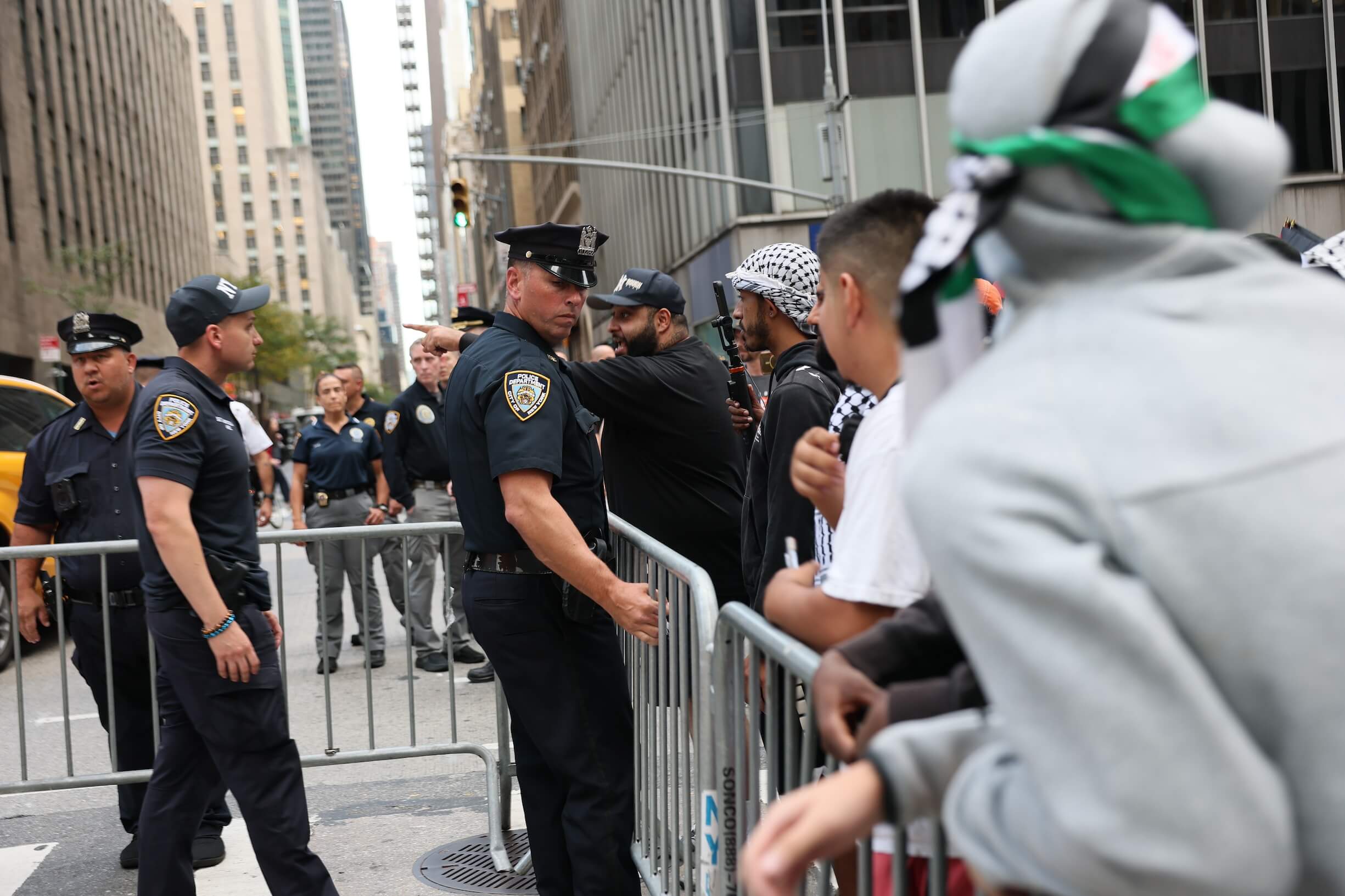
The New York City Council is poised to pass legislation aimed at curbing disruptive protests outside synagogues, as officials weigh Jewish security concerns against free speech protections for pro-Palestinian and progressive activists. Mayor Zohran Mamdani has not taken an official position on the legislation.
The 51-member legislative body is set to vote Thursday on two bills directing the NYPD to develop a plan for protest buffer zones around houses of worship and educational centers. It is part of Council Speaker Julie Menin’s five-point plan to combat antisemitism, as anti-Jewish incidents continue to make up a majority of reported hate crimes in New York City. In recent months, at least two protests outside synagogues featured antisemitic slogans and chants, heightening tensions and drawing condemnation. Some see Menin as a check on the mayor and a potential guardrail against his actions.
The package of bills includes $1.25 million in funding to the Museum of Jewish Heritage for Holocaust education and the creation of a hotline to report antisemitic incidents.
Mamdani allies’ opposition
The buffer zone proposal is facing pushback from allies of Mamdani, a strident Israel critic who faces scrutiny from mainstream Jewish organizations over his response to antisemitism and pro-Palestinian protests. The Democratic Socialists of America and some progressive Jewish groups, as well as free speech advocates, claim the legislation unfairly targets pro-Palestinian protests and said it gives authorities too much discretion in how the rules are enforced.
Mamdani said in January that he ordered his law department and police leadership to review the proposal’s legality. Mamdani told the Forward he would veto it if he determines it’s illegal.
City Hall has not released the findings of the internal review. A Mamdani spokesperson didn’t say whether the mayor would sign the bills if they pass. But he might not need to. The bill has 35 co-sponsors, giving it the veto-proof, two-thirds majority needed to pass the legislation into law without the mayor’s signature.
Mamdani “is keenly aware of the serious concerns regarding these bills’ limiting of New Yorkers’ constitutional rights, and he will keep these concerns in mind for any bills that land on his desk,” Dora Pekec, a City Hall spokesperson, said in a statement provided to the Forward. “He wants to ensure both the right to prayer and the right to protest are protected here in New York City.”
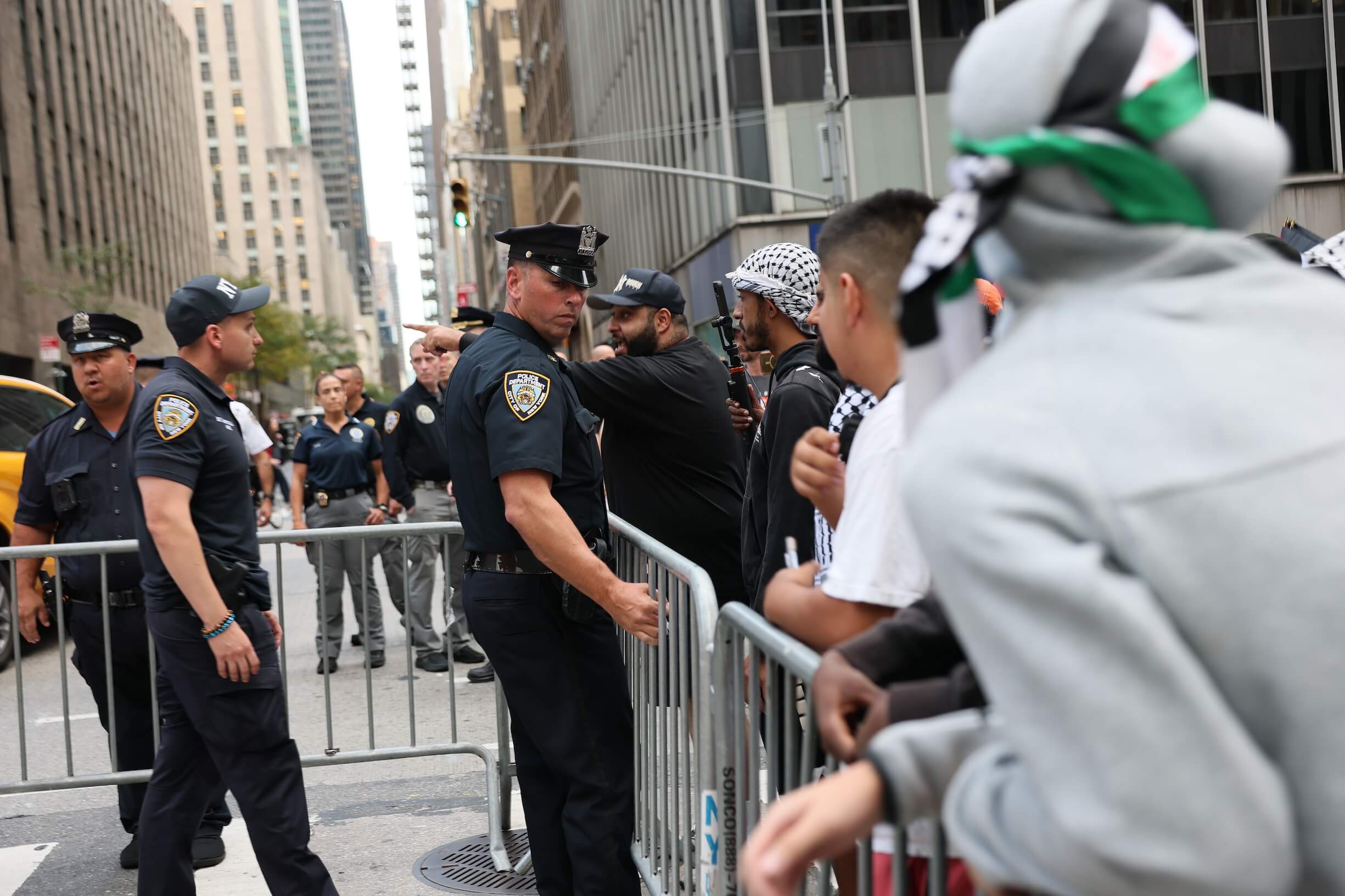
The bills do not explicitly bar protests or codify a specific distance requirement. Its initial proposal to establish buffer zones of up to 100 feet outside synagogues and other houses of worship was omitted following reservations expressed by Police Commissioner Jessica Tisch, who, like Menin, is Jewish, and cautioned that a one-size-fits-all rule might not withstand legal challenge and could prove unworkable across neighborhoods with vastly different street layouts. The Council agreed to revise the language of the bill, placing implementation authority squarely with the police department.
At the state level, Kathy Hochul has proposed similar legislation that would create a 25-foot buffer zone around houses of worship statewide. The measure is being negotiated as part of budget talks ahead of an April 1 deadline. A similar effort is also under consideration in California.
The post Mamdani voices concerns about synagogue buffer zone bill poised to pass NYC Council appeared first on The Forward.
Uncategorized
‘We Need to Wake Up’: Sylvan Adams Warns of Organized, Coordinated Antisemitism After Oct. 7

Canadian-Israeli philanthropist Sylvan Adams on The Algemeiner’s “J100” podcast. Photo: Screenshot
The protests began before the war did.
That, for Sylvan Adams, is the detail that should change how people understand everything that followed Hamas’s Oct. 7, 2023, massacre across southern Israel.
Speaking on The Algemeiner‘s “J100” podcast, the Canadian-Israeli philanthropist pointed to the anti-Israel demonstrations that erupted across Western cities on Oct. 8 — less than 24 hours after Hamas’s atrocities — as evidence that the global reaction was not simply emotional or spontaneous.
“Israel hadn’t even entered Gaza yet,” Adams said. “We were still counting our dead.”
The speed and coordination of those protests, he argued, suggest something deeper: a preexisting infrastructure of activism, funding, and ideology that was activated the moment the attacks occurred.
“It’s like they flicked a switch,” he said.
In Adams’ view, the surge of antisemitism that followed the Oct. 7 attack is not an isolated phenomenon, but the visible expression of a long-building system — one tied to Islamist movements, state-backed funding, and ideological allies across the West.
“We need to wake up,” he said.
At the same time, Adams was clear that the loudest voices are not the majority. Most people, he argued, are neither antisemitic nor deeply anti-Israel — but they are not organized, not activated, and not nearly as visible.
“The majority is there,” he said. “But they’re not activists.”
That imbalance has allowed more extreme narratives to dominate public discourse, particularly among younger audiences shaped by social media and campus environments.
Adams’ response to this challenge has not been confined to analysis.
A businessman who built his career in Canada before making aliyah a decade ago, he has become one of Israel’s most prominent philanthropists, directing major investments toward institutions in the country’s south.
In the aftermath of Oct. 7, he announced $100 million gifts to both Ben-Gurion University of the Negev and Soroka Medical Center — moves he framed not as charity, but as long-term investments in Israel’s resilience.
The goal, he said, is not just to rebuild, but to reinforce.
Alongside those efforts, Adams has pursued a less conventional form of advocacy: using sports and culture to reshape how Israel is perceived abroad.
An accomplished cyclist and world champion in his age category, he has helped bring major international events to Israel, including global cycling races and high-profile appearances by figures such as Lionel Messi.
The strategy is to reach audiences that are not tuning in for politics — and introduce them to a different version of Israel.
“People are always surprised,” Adams said. “It’s not what they thought.”
That approach reflects a broader philosophy: that Israel must be strengthened not only on the ground, but in the way it is seen.
Adams’ worldview is rooted in his own family history. Born to Holocaust-surviving parents from Romania, whose journeys passed through pre-state Israel before settling in Canada, he grew up in a deeply Zionist home before eventually building a life in Montreal.
His decision to move to Israel later in life was, in his telling, less a break than a return.
“I always thought we would end up there,” he recalled his wife saying.
Now based in Israel, Adams has positioned himself as both a builder and a messenger —investing in the country’s future while trying to influence how it is understood beyond its borders.
His message to Jews outside Israel was direct.
“We’re one people,” he said. “Israel belongs to all of us.”
In the current moment, that idea carries added weight — not just as a statement of identity, but as a call to responsibility.