


Uncategorized
What will become of the Dutch farm school that saved my father from the Nazis?
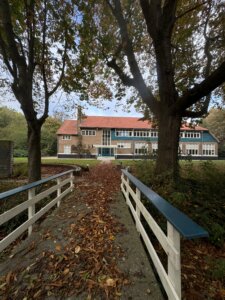
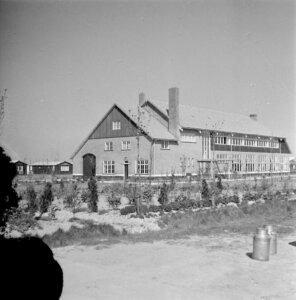
In North Holland, a grand community house rises above neighboring farms. Built in 1936 by students of Werkdorp Wieringermeer (Werkdorp means “work village”; Wieringermeer was the name of the township), the building held the dining room and classrooms of a Jewish farm school. A stunning example of Amsterdam School architecture, the Werkdorp’s brick and cobalt-blue facade dominates the polder, or land claimed from the sea.
Today, the land grows tulips. Nearby, Slootdorp (“Ditch Village”) honors the canals that carry the water away.
In 1939, the school sheltered 300 German-speaking Jewish students, including this reporter’s father, who arrived, his head shaved, on Jan. 4, from Buchenwald.
Why a Jewish farm school? In the 1930s, most young German and Austrian Jews were city dwellers and had no idea how to milk a cow, raise chickens, or plow land. But as the Nazis barred Jews from education and professions, farm laborers were the immigrants most wanted by the handful of countries accepting Jewish refugees.
Some 30 such training schools were established in Germany, modeled on the hachsharah throughout Europe that taught Jewish youth the skills to settle in what was then Palestine. The Werkdorp, the largest in Holland, was non-Zionist. Its objective was to send young farmers to any country that would take them.
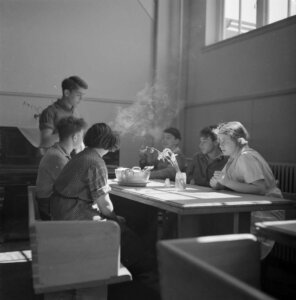
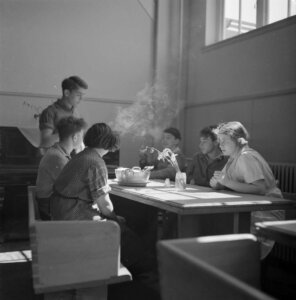
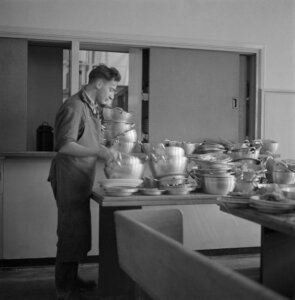
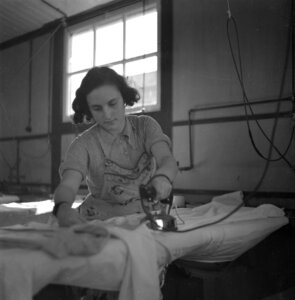
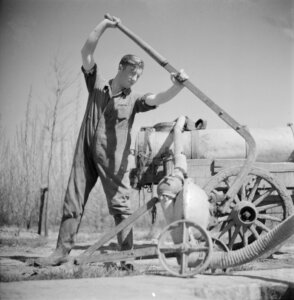
Today, volunteers have assembled a grassroots museum that showcases the Werkdorp’s years, 1934 to 1941. Pinned to the walls inside are pictures taken by the Russian-American photographer Roman Vishniac, who visited in 1938, and by the Dutch photojournalist Willem van de Poll. They show students haying, plowing, feeding chickens, baking bread.
Also on the walls are images of the nearly 200 Werkdorpers who were not as lucky as my father. The Nazi official Klaus Barbie — who became known as the “Butcher of Lyon” for his harsh treatment of resistance fighters there — rounded up the Werkdorpers in 1941 and sent them east to concentration camps, where they were murdered.
A scroll of those victims’ names hangs near the entrance. In the huge kitchen, you can still see the kosher sinks, one tiled red and white for dishes for meat, the other black and white for dairy. Otherwise, the three floors of the great hall stand largely empty.
Protected from demolition by the Netherlands Agency for Cultural Heritage, the community house and its land have been owned since 2008 by Joep Karel who runs a private real estate company that builds housing. Karel pays for the building’s upkeep and opens it to cultural groups and schools.
But the developer has a grander plan. He wants to create a modern memorial center that tells the story of the Werkdorpers and the polder. To fund his venture, he would erect housing behind the community house, to be rented by migrant workers. In April 2020, the council of Hollands Kroon — the Crown of Holland, as the township is called today — approved such housing for 160 workers.
The organizers of the museum are uncertain: Will the project enhance their efforts, or thwart them?
A hero or a collaborator?
North Holland juts like the thumb of a right mitten into the North Sea. A decade before the community house was inaugurated in January 1937, the land beneath it was seabed. The first students, 11 boys and four girls, arrived in 1934 to live in barracks that had housed the polder’s builders. Their task: to build a school.
The farm school admitted refugees for a two-year course. Its purpose was to help them emigrate, the only way The Hague would allow the school to function. Residents spoke German; there was no need to learn the language of one’s temporary home.
Gertrude van Tijn, a leader of the Dutch Jewish refugees committee — tasked with finding countries that would accept thousands of Germans and Austrians forced to flee the Nazis — handled admissions. Most of the Werkdorp’s budget came from Dutch Jewish donors, with contributions from Jewish groups in Britain and America. Students’ families paid fees if they could.
The school was internationally recognized. James G. McDonald, the American high commissioner for refugees of the League of Nations, attended its opening ceremony. The legal scholar Norman Bentwich praised the village in The Manchester Guardian. Although the school was non-Zionist, Henrietta Szold, a leader of Youth Aliyah, brought 20 German teenagers there in 1936.
Werkdorp Wierengermeer helped at least 500 German and Austrian Jews, ages 15-25, escape the Nazi regime.
It was Van Tijn, a German Jew who’d married a Dutchman, who got my father, George Landecker, out of Buchenwald. He had been arrested in Frankfurt on Kristallnacht, the November 1938 pogrom, and sent east by train to Buchenwald.
In the camp he met his friends and teachers from Gross Breesen, a farm school in eastern Germany, from which he had graduated that May. Breesen was the Werkdorp’s sister farm school. By admitting the Breeseners and my father to the Werkdorp, Van Tijn got Dutch entry permits for all.
For the Gestapo in January 1939, such proof that a prisoner could leave Germany secured freedom.
Van Tijn saved thousands of young people like my father, but she worked with the Nazis to do so. After the war, historians and people seeking to repatriate Dutch Jews called her a collaborator. She moved to the United States and wrote a memoir, in which she criticized other Jewish leaders for their decisions under German rule. According to her biographer Bernard Wasserstein, she never published the memoir because she didn’t want to make money from describing the atrocities she had seen.
When my father arrived in 1939, the Werkdorpers were cultivating 150 acres — there was wheat, oats, rye, barley, and sugar beets for the animals: 60 cows, 40 sheep, and 12 workhorses. The residents raised chickens, grew vegetables, and baked their own bread. The school taught carpentry, welding and plumbing, skills I would see my father use, not always deftly, later as a dairy farmer in New York state. (Dad was a good farmer, but he was less than expert in all the other skills a farmer needs.)
My father got a visa to America and left Rotterdam on the steamship Veendam, arriving in New York on Feb. 5, 1940. Three months later, the Nazis invaded Holland, cutting off all routes of escape.
‘Their names should be spoken’
Over the decades, Wieringer residents have found ways to commemorate the residents who died.
Marieke Roos, then a board member of the Jewish Work Village Foundation, proposed a monument of their names. She raised funds and recruited volunteers. Completed in 2021, the memorial comprises 197 glass blocks embedded in a semicircle at the building’s gateway. They mirror the layout of the dorms, now long gone, which once embraced the rear of the community house. Each block commemorates a student, teacher, or family member deported and murdered. One honors Frits Ino de Vries (1939–43), killed at Auschwitz with his mother and sister, Mia Sara, who was 5.
Corien Hielkema, also from the foundation, teaches local middle schoolers about the Werkdorpers’ fate. Each student creates a poem, painting, or website about a Werkdorper because “their names should be spoken and their stories told,” she told me.
Rent from migrant workers may sound like an unusual way to fund a memorial center. But in Joep Karel’s plan, such housing would be built behind the community house, and would be reminiscent of the dormitories where my father lived. Hollands Kroon’s biggest exports are flowers, cultivated by workers from the eastern EU. The region desperately needs housing for these temporary workers. In 2024, the province gave Karel 115,000 Euros to start the project.
Joël Cahen, who chairs the fundraising for Karel’s Jewish Work Village Cultural Center, says that attracting tourists here won’t be easy — it’s a 45-minute drive from Amsterdam, “along a boring road,” he said. Nevertheless, he said he thinks Karel’s idea will work, though “it will take time.”
Some neighbors objected to housing migrant workers, Cahen said. They feared noise pollution, traffic and drugs. Months of legal delay produced a court decision in Karel’s favor, but by then construction costs had skyrocketed.
Now, Cahen said, Karel needs an investor. The developer did not answer a question about how that search is going, except to say, via Cahen, that he would break ground “as soon as possible.” Roos says she has been hearing “soon” for years.
And if the housing were to be completed and the workers arrived, where would they hang their laundry, store their recycling, hide their trash? It would be hard to hide the chaff of daily living on the site’s four acres. Who would visit such a memorial center, and how would the owner keep it running?
Those are legitimate questions, Cahen said. But “we need people to help us push this thing forward. This is a chance.”
Kees Ribbens, a senior researcher at the NIOD Institute for War, Holocaust and Genocide Studies, in Amsterdam, told me that the community house has no “comparable examples in the Netherlands.” It is a “special building,” and a memorial center “would certainly be appropriate.”
Most of the agricultural training centers that saved German Jewish youth have been destroyed or reused. The director’s house of a farm school in Ahlem, Germany, is now a museum. But it became the local Gestapo headquarters, so it also tells that story. The Ahlem school buildings are gone. Gross Breesen, now in Poland, is a fancy golf spa.
The Werkdorp is one of a very few farm schools in Europe whose original building is dedicated to its history.
What my father did and didn’t tell me
My father talked a lot about his first farm school, Breesen. Survivors from Breesen, in America and around the world, remained his closest friends.
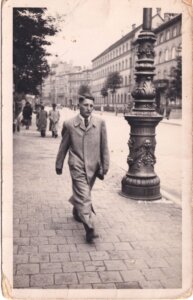
Yet he mentioned his time in the Netherlands only once. My mother had served a Dutch cheese to some guests. Dad told us how he’d been hitchhiking in Holland with a friend, when a truck carrying Edam cheeses had picked them up. They rode in the truckbed, hungry, surrounded by giant cheese wheels.
It was such a slim memory. I assumed he had lived in Holland for a few weeks. I learned only recently that Werkdorp Wieringermeer had protected him from January 1939 until February 1940.
Now I think my father didn’t want to remember his Dutch year. Because like refugees today, everywhere, he was terrified.
Dad once told an interviewer how he’d read a memoir by a man who was arrested on Kristallnacht and transported by train to Buchenwald. My father realized, “That’s me. I did that too.” He had no memory of actually doing it at all.
The brain is good at shielding us from trauma. His year at Werkdorp Wieringermeer may have been like his train ride after Kristallnacht, a time he needed to forget. He was worrying about his parents and siblings, who would not escape Germany until November. (One brother, his wife, and toddler would not survive the war.) He was anxious about the U.S. visa the Breeseners had applied for as a group (they circumvented the American quota on Germans, another story). He had been forced to watch people hanged at Buchenwald for trying to escape.
Yet my father was an optimist when I knew him, and never dwelled on suffering. And I never thought, “I should ask about his experience in the Holocaust because I will want to write about it one day.”
So the only thing I knew about his experience in the Netherlands was that he’d hitched a ride in a truck full of cheese.
An hour’s drive beyond the Werkdorp from Amsterdam, there’s a memorial to the 102,000 people deported from the transit Kamp Westerbork and murdered during the Second World War. It draws 150,000 visitors annually. Cahen hopes the Werkdorp could attract 10,000.
Like Westerbork, the Werkdorp was a transit point — but with a key difference: Many of its residents were saved.
As the daughter of one of them, I hope the tension over the future of its community house will ease, and that someone will make a grand memorial center flourish there.
The post What will become of the Dutch farm school that saved my father from the Nazis? appeared first on The Forward.
Uncategorized
50 years after the Dirty War, Argentinians remember the Jews who ‘disappeared’
(JTA) — BUENOS AIRES — As Argentina marks the 50th anniversary of the 1976 military coup, a lesser-known aspect of the dictatorship is gaining attention: the disproportionate number of Jews among the disappeared.
Estimates suggest that as many as 1,900 Jews were abducted, tortured and murdered by the military junta during the six-year Dirty War, when many sources say 30,000 people were disappeared. Depending on the source, Jews represented 5% to 8% of the total, even though Jews made up less than 1% of Argentina’s population at the time.
That grim history is being explored in educational initiatives by Argentina’s Jewish community, aimed at younger generations and focused on understanding how the dictatorship operated and the disproportionate suffering it inflicted on Jews.
“The Jews were subjected to a particular form of treatment that resulted in greater brutality on the part of the repressive forces,” according to a new curriculum released by the education department of AMIA, the Jewish community center in Buenos Aires. “The experience of Jewish Argentines who were victims of state terrorism was marked by a strong antisemitic imprint among many members of the task forces.”
The AMIA project includes meetings between Jewish youth and relatives of the Jewish “disappeared,” as well as visits to memorial sites. Some 1,000 students are expected to take part this month.
A parallel digital project, Eduiot (“Testimonies”), documents the stories of Jewish victims of the military dictatorship and includes meetings between relatives of the disappeared and high school students.
The materials rely on personal testimonies to explain the human impact of the dictatorship and to put individual stories in the broader historical context.
Eduiot includes the story of Fernando Ruben Brodsky, a 22-year-old student who disappeared in 1979, including accounts from relatives who continue to seek answers. His mother, Sarah Brodsky, shares accounts of her son, a psychology student and kindergarten teacher who was abducted from his home on Aug. 8 and never seen again.
The testimonials relate how security forces subjected Jews to antisemitic abuse when they were kidnapped or detained, including Nazi language and symbols and “special” interrogations reserved for Jews.
The anniversary comes amid renewed debate over how Argentina interprets the dictatorship. President Javier Milei’s government has called for a broader account that also includes victims of left-wing guerrilla violence, which some suggest is a way to minimize the crimes of the dictatorship. Milei and other voices close to the government have also questioned the 30,000-victim figure, promoting a lower number (often 9,000).
Under the junta, the military and state security forces targeted suspected left-wing sympathizers, including students, unionists, journalists and activists.
In 1979, Jewish advocacy groups such as the Anti‑Defamation League expressed grave concern over the disappearances, focusing on the Jewish victims, and Jewish families in Argentina and abroad helped compile lists of the missing. According to an ADL official at the time, “Jews are not specifically targeted as Jews. However, the security agents tend to be suspicious of Jews.”
The best-known Jewish target of the state was journalist Jacobo Timerman, who published a left-leaning newspaper, La Opinion. In 1977, the generals who ruled Argentina shut down the paper and imprisoned Timerman. Among other things, Timerman was accused of masterminding a plot to establish a Jewish homeland in the remote Patagonia region of southern Argentina.
He survived, and in his 1981 memoir, “Prisoner Without a Name, Cell Without a Number,” he recounted how he was subjected to torture during his 2 1/2 years in confinement.
According to Eduiot, Jewish advocacy for the disappeared “proved effective in bringing early attention to human rights violations.” The U.S. Congress launched investigations, and in a 1978 article in Le Monde, novelist and Holocaust survivor Marek Halter compared the persecution of Argentine Jews to Nazi-era atrocities.
The Eduiot site includes photographs and audiovisual material, and features the accounts of parents, siblings, cousins, nephews and nieces of Jews persecuted and disappeared under the dictatorship.
“Because every testimony matters and holds great value,” according to its website. “Because these dark episodes of our history must never be repeated, and because we want each of the disappeared to have a space of remembrance on this site, helping families sustain their memory and uphold the call for justice.”
The post 50 years after the Dirty War, Argentinians remember the Jews who ‘disappeared’ appeared first on The Forward.
Uncategorized
Fortnite tops ADL’s new ‘leaderboard’ ranking video games on antisemitism safeguards
(JTA) — The online video game Fortnite tops the Anti-Defamation League’s “leaderboard” ranking online video game companies on their efforts to curb antisemitism and extremism on their platforms.
The Online Gaming Leaderboard, which the antisemitism watchdog billed as the “first comprehensive public evaluation” of how online multiplayer games address antisemitism, ranked 10 popular online games based on safety features, moderation, player protections and written policies meant to address antisemitism and hate.
Fortnite was followed at the top of the rankings by Grand Theft Auto Online, Call of Duty and Minecraft. Games labeled as having “limited protection” by the ADL included Counter-Strike 2 and PUBG: Battlegrounds.
Madden NFL, Valorant, Clash Royale and Roblox, a collaborative computer gaming platform for children as young as 7, were ranked as having “moderate protection.”
“Without strong safeguards, these platforms can become breeding grounds for harassment and hateful activity that harms players directly, normalizes hateful ideologies and damages trust,” Jonathan Greenblatt, the CEO of the ADL, said in a statement Wednesday. “This leaderboard provides the transparency that parents, gamers and the industry need to understand where companies are succeeding and where urgent improvements are necessary.”
The leaderboard’s release coincided with a landmark Los Angeles jury verdict finding Meta and YouTube liable for harming a young user through addictive design features.
In the virtual worlds of online gaming, players have posted abusive messages in chats, created antisemitic imagery and even given themselves bigoted usernames.
While Fortnite ranked first, the popular online game has also previously faced scrutiny over allegations that it enabled antisemitic content. Last September, it disabled a character dance feature after users said its gestures resembled a swastika.
Roblox, which has long faced criticism over content moderation, has also been the subject of controversy, including in 2022 when it removed a user-created simulation of a Nazi gas chamber. In the wake of the Oct. 7 attacks in 2023, the Israeli government also urged users to report pro-Palestinian activity in the game that it said included antisemitic content.
The post Fortnite tops ADL’s new ‘leaderboard’ ranking video games on antisemitism safeguards appeared first on The Forward.
Uncategorized
Iran Posts AI Video Showing Missile Striking Statue of Liberty

An Israeli air defense system intercepts a ballistic missile barrage launched from Iran to central Israel during the missile attack, February 27, 2026. Photo: Eli Basri / SOPA Images via Reuters Connect
Iran on Tuesday released an AI-generated video depicting a missile striking the Statue of Liberty in New York Harbor, a global symbol of American freedom and democracy, in one of the regime’s latest propaganda efforts to influence public perception abroad.
Shared by Iranian state broadcaster IRIB as well as a Telegram channel affiliated with the Islamic Revolutionary Guard Corps (IRGC), the minute-long video ends with the slogan “One vengeance for all.”
IRGC Official Telegram Channel Releases AI Video Depicting Iranian Ballistic Missile Strike on United States, Hitting New York City and Toppling Statue of Liberty Shown as Idol of Baal Holding Babylonian Talmud pic.twitter.com/JhgNgHW2Zz
— MEMRI (@MEMRIReports) March 25, 2026
The video was also circulated by Russian state outlet RT, in what appears to be a stark and symbolic threat against the United States.
‘ONE VENGEANCE FOR ALL’ — Iran ‘bombs’ the Statue of Liberty WITH THE HEAD OF BAAL pic.twitter.com/6tPH15fqkZ
— RT (@RT_com) March 25, 2026
Since the start of the US-Israel war with Iran, which began on Feb. 28, Iranian officials have ramped up their propaganda and disinformation efforts, trying to portray Washington and Jerusalem as responsible for decades of regional conflict while seeking to influence left-leaning Americans to mobilize domestic opposition to the war.
This latest widely circulated video presents a striking sequence portraying the United States as the world’s enemy, drawing on imagery from the dispossession of Native Americans and the atomic bombings of Japan to the Vietnam War and more recent Middle Eastern conflicts to craft a sweeping narrative of American aggression.
The clip also features footage alluding to a child on Jeffrey Epstein’s private island — a recurring theme in Iran’s messaging used to suggest that US President Donald Trump launched the current war to distract the public from the Epstein scandal, in which the late financier was convicted of running a sex-trafficking ring involving underage girls and, allegedly, various influential figures.
Later in the video, AI-generated figures of Iran’s former Supreme Leader Ayatollah Ali Khamenei and the late Iranian Major General Qassem Soleimani are shown gazing skyward. Khamenei was killed in an Israeli airstrike on Feb. 28, and Soleimani was killed in a US drone strike in 2020.
The final sequence of the video depicts a missile in Iranian colors striking the Statue of Liberty in New York Harbor, whose head has been replaced with that of Baal, a false god from the Bible, while the statue holds the Talmud, a key collection of Jewish religious teachings and laws.
This video is the latest example of AI-generated propaganda released since the start of the war with Iran.
Last week, Chinese state television CCTV released a separate AI-generated clip illustrating Beijing’s perspective on the Strait of Hormuz crisis, featuring Persian cats in martial arts combat and an eagle-headed human representing the United States.
Experts note that Russian dissemination of Tehran’s video reflects a broader coordinated effort to use visual propaganda to challenge US foreign policy and influence global perceptions amid rising regional tensions.
The latest video came as the US and Iran began engaging in diplomacy over a possible resolution to the war, although Tehran has reportedly responded negatively to Washington’s proposal.