


Uncategorized
We have seen the Jewish future, and it is all about choice
There was a young lady of title
Who insisted on wearing a sheitel.
She didn’t care much
For kashrut and such,
“But the sheitel,” said she, “now that’s vital!”
(JTA) — As the old limerick suggests, there has long been a tradition of picking and choosing Jewish observance in America, whether it involved keeping kosher or observing Shabbat, or, in this case, covering your hair with a wig (a sheitel) if you’re a married woman.
But in America today, choice has come to occupy a central place not merely in how Jews practice Judaism but in the very way they conceive their religious identity.
Over the past several decades, Americans have come to regard their religion less and less as an ascribed identity — as something they were born into — and increasingly as what they choose to be at the present time. This shift has had a particularly dramatic effect on Jewish Americans, in whose tradition religious identity had for millennia been ascribed at birth. The tension between ascription on the one hand, and choice on the other, informs American Jewish religion.
How is the Jewish community responding to this new regime of choice? That is the central concern of our new book, “The Future of Judaism in America.” Understanding religious identity as chosen is crucial to understanding the future of Judaism in the context of its denominations, its numbers, its relationships with other faith communities, its stance on public affairs — and, perhaps most important, its ability to renew itself in response to pressures from outside and from within.
Let’s consider the different denominational streams.
Reform, after steady growth in synagogue membership from the late 1970s until the new century, is no longer the fastest-growing movement. Still, Reform in America, while it struggles with the boundaries of “who is Jewish,” has lowered the barriers to participation in its brand of Judaism. “Inclusiveness” is the byword for contemporary Reform, both externally (outreach to non-Jewish spouses), and internally, by welcoming those Reform Jews who choose to embrace rituals — tallit and kippah and tefillin, mikveh, full synagogue services — traditionally considered outside the sphere of a movement that does not regard halacha, or traditional rabbinic law, as binding. “Reform Judaism teaches that each of us is an autonomous individual, able to make thoughtful, religious choices,” said Rabbi Rick Jacobs, the president the Union for Reform Judaism, at his installation a decade ago.
Have Reform’s accommodations worked? So far, the answer appears to be “yes,” as the percentage of Reform in American Jewry has remained stable at around 35-40% for decades.
For its part, the question for the Conservative movement is more about ascribed identity than about anything else. The movement is struggling with the question of how long it can sustain its policy of forbidding its rabbis from performing marriages between Jews and non-Jews. (The question is of a piece with the angst always felt by Conservative leaders when their commitment to halacha collides with the movement’s commitment to change.) The question of intermarriage is central to the future of Conservative Judaism, as its contemporary identity is defined and has always been defined by the clear line it draws between Jew and non-Jew. This dilemma, in addition to the host of serious issues that plague the movement — not the least of which is a precipitous decline in Conservative’s numbers, from 43% to 17% of those who identify with a denomination over some two decades — suggests that the future of the Conservative qua independent movement is highly uncertain.
Many analysts (including several authors in our book) suggest that Reform and Conservative Judaism will ultimately merge and become a single heterodox movement. That, or Conservative will remain as a smaller movement, concentrated in large population centers.
Orthodoxy, meanwhile, claims 17% of Jews ages 18 to 29, compared with just 3% of Jews 65 and older, according to Pew. If current trends continue, their proportion of the entire Jewish population in America will grow from a small minority to a dominant majority by the end of the century.
Yet there is no one “Orthodoxy” in America. Orthodoxy is expressed in Modern and Centrist forms, the many flavors of Hasidism, the numerous forms of non-Hasidic “haredi” Orthodoxy, Chabad-Lubavitch and the Orthodoxies that push the religious and ritual envelope in countless ways. It’s about choice.
But the price for Orthodoxy may be high, as the increased fractionalization of the movement demonstrates. Haredi groups (what we call Sectarian Orthodox, and others call “ultra-Orthodox”) operate by preventing choice, especially in some of the more sectarian Hasidic groups that create barriers to prevent adherents from leaving. More progressive Orthodox groups have adopted strategies that accommodate choice.
Orthodoxy will remain strong, but its future presents no consistent pattern.
Understanding Jewish Renewal is central to understanding the present and future of American Judaism. The varied expressions of Jewish Renewal that took root in the 1960s and ’70s — the havurah movement, Jewish feminism, practices that bear its spiritual approach — found newer expressions in communities such as Kehillat Hadar in New York; Yeshivat Maharat, which provides Orthodox ordination to women; The Kitchen in Los Angeles; “partnership” minyanim that maximize women’s participation within the parameters of traditional halacha, or Jewish law, and New York’s unaffiliated B’nai Jeshurun congregation. Indeed, while the formal structures that generated Renewal recede in memory, Renewal has had a broad and deep impact on American Judaism and on American Jewish life.
The impulse of Renewal, whatever its varied expression, was and is to create alternatives to the prevailing Jewish movements and forms. These alternatives are “chosen” ways of participation, and Renewal is yet vibrant.
The wildcard in American Judaism is, of course, the “nones,” those who identify as Jews of no religion. According to Pew, the percentage of U.S. Jews who do not claim any religion is 27% — higher among the young and going up. The future of Judaism in America will depend in part on the relative percentages of Jews with religion and Jews of no religion: Which will grow, and which will decline?
What has changed in American Jewish religious life? It is what Will Herberg, in his landmark book “Catholic-Protestant-Jew,” did not see in the 1950s: There is no longer any pressure to remain within any given religious community, nor in any movement or stream of Judaism, nor within Judaism itself (as the rise of the “nones” suggests). The American Jewish religious future — for all the movements, denominations and post-denominationalists — will be positioned in this dynamic.
When religious identity is increasingly seen as a matter of personal choice, groups that have depended upon ascribed identity to guarantee their numbers will be challenged to develop not only new means of keeping and attracting members but also new ways of conceptualizing and communicating who and what they are.
—
The post We have seen the Jewish future, and it is all about choice appeared first on Jewish Telegraphic Agency.
Uncategorized
How the Yiddish project took root in the U.S. after the Holocaust
How did the YIVO Institute for Jewish Research find a new home in the United States after the Holocaust? Kalman Weiser (York University, Toronto) narrates this dramatic story in a new book, Yiddish Scholarship Comes to America.
Initially, YIVO’s success wasn’t a sure thing. It was “hardly clear to YIVO’s staff and supporters in the 1940s that an organization dedicated to serving the intellectual and cultural needs of a global, Yiddish-speaking Jewish nation could take root in the radically different circumstances of postwar America,” Weiser writes.
Before the war, YIVO already had an American branch in New York but its main goal was raising money for the institute in Vilna. Several YIVO activists also focused on researching Yiddish culture and history — but again, mainly in Eastern Europe.
The truth was, most American Jews had little interest in Yiddish and didn’t think highly of Jewish studies at all.
After the Holocaust, YIVO stood at a crossroads: It could either become an archive dedicated to Yiddish life destroyed in Eastern Europe, or it could further develop Yiddish scholarship to give Yiddish a new lease on life in America.
Weiser guides the reader through the fierce debates among YIVO’s associates over the direction the institute should take. Yudel Mark maintained that YIVO should focus primarily on Holocaust research, while former Bundists argued that it should study the conditions of the Jewish masses in America.
Max Weinreich, YIVO’s intellectual godfather, had an altogether different vision. He believed that American Jewry could actually play the leading role in the Jewish world after the Holocaust. At the same time, though, he didn’t think they were ready to assume this responsibility. They needed the Yiddish-speaking refugees and immigrants, such as himself and other East European intellectuals, to guide them.
According to Weinreich, YIVO should concern itself not only with visnshaft (scholarship), but with visn vos shaft (“knowledge that creates”). In other words, Yiddish scholarship needed to enable American Jews to preserve their Jewishness and secure the continuity of Yiddish.
The success of this monumental undertaking depended on the Yiddish language itself. Yiddish needed to serve as a bridge between generations of Jews, a spiritual and intellectual connection between the old country and the new.
For this reason, Weinreich held that the American Jewish intellectual leaders needed to be “de-assimilated,” and the prestige of Yiddish needed to be raised in American academia.
But despite Weinreich’s efforts, YIVO remained on the margins of the Jewish mainstream and received limited support from major Jewish philanthropic organizations. Relations between YIVO and the American Yiddish literati were also strained.
The normative, standard Yiddish that YIVO wanted to promote drew criticism from some American Yiddish writers and journalists. They argued that “YIVO Yiddish” differed considerably from the authentic, natural Yiddish they were raised with.
In his articles in the Forward, Isaac Bashevis Singer ridiculed neologisms as kadmen-yidish (proto-Yiddish) and breyshes-yidish (old Yiddish), linguistic concepts that Weinreich had invented to describe different historical phases in the development of the Yiddish language.
At the heart of the conflict between YIVO and Yiddish writers, Weiser explains, was the question: “To whom does Yiddish belong?” YIVO’s goal was to create a normative language that could be taught like other foreign languages. In this way, the future of Yiddish could be secured even if a living community of Yiddish speakers no longer existed.
The tensest chapters in YIVO’s history revolved around the struggle to recover the materials that formerly belonged to the institute in Vilna.
The Nazis sent some of the books and documents to Germany for the archives of the museum the Nazis were planning, “Institute for Research on the Jewish Question.” After the war these materials fell into the hands of the American military administration in Germany.
Recovering these materials was an incredible feat on the part of Weinreich and his colleagues, among them Lucy Schildkret (better known by her married name, Dawidowicz), who later made her name as a Holocaust scholar. Legally, the American military administration was obligated to return the plundered materials to Poland or the Soviet Union. The Hebrew University in Jerusalem was a claimant as well.
Weinreich worked his contacts among the American elite, and in 1947, YIVO recovered the archives. He also succeeded in presenting YIVO as the heir to other cultural institutions in Vilna. As a result, YIVO received the collections of the renowned Strashun Library and the S. Ansky Historical and Ethnographic Society.
The second chapter of YIVO’s history occurred after the collapse of the Soviet Union in the 1990s. A significant collection of YIVO materials was discovered in Lithuania, thanks to a Lithuanian librarian who had hidden it in the warehouse of the national book chamber.
This time, YIVO had to negotiate with the government of the Lithuanian Republic, which had recently become independent. Ultimately, a compromise was reached, and these materials can now be accessed digitally.
Weiser’s history of YIVO is an engaging, well-researched book. Max Weinreich was far from the only European Jewish refugee to find a new home in America and build a successful career there. But he may be the only one who single-handedly rebuilt an important European Jewish scholarly institute that remains active till the present day.
The post How the Yiddish project took root in the U.S. after the Holocaust appeared first on The Forward.
Uncategorized
A great Jewish sculptor gave a gift to America. The Trump administration is taking it away.
By the time Joel Shapiro’s Blue showed up in my morning feed Wednesday, it had already lost its legs. Shapiro’s 24-foot aluminum figure had spent seven years kicking at the sky outside the Kennedy Center in Washington. Now workers were taking it apart. In the photograph, the legs lay on the grass; the rest hung in straps, and a few guys in hard hats were standing underneath it, discussing something.
“Holy shit,” I said, then enlarged the picture, as if one of those men might explain what they were doing to the work of a man I had liked so much. Yes, I know they aren’t legs. That was Joel’s trick, to join a few rectangles and, without a face or a finger in sight, make you worry that some poor guy was about to fall.
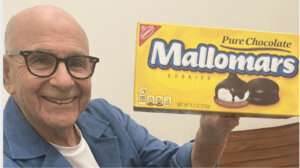
The first — and only — time I met Joel Shapiro in 2024, he was eating a Mallomar. Same surname, no relation, though the speed with which he opened my box raised questions. Mallomars are a reporter’s trick of mine: I bring them to interviews during their brief season because they are Kryptonite to Jewish men of a certain age; even if nobody bites, the box gets a laugh. My father, who made it to 99 without losing interest in either nurses or cookies, taught me their power. Later, Julian Schnabel arrived in an all-white jumpsuit and wanted one too. I considered the theory proved.

We were at Pace, two days before his solo show Out of the Blue opened, standing in front of ARK — almost 12 feet of painted wood that looked as if it had thrown out an arm to stop a fall.
“Let’s do something we shouldn’t,” Joel said. “Touch the work.”
The guard didn’t move, so I put my hand on a Joel Shapiro.
I never understood how he did it. You’re looking at a few rectangular forms joined at unlikely angles, and then there it is, a person in trouble with gravity. No face, no hands, and still I worried about the poor thing falling—somehow it was precarious without looking afraid. Nine months later, he was dead.
Joel made Blue for that lawn of the Kennedy Center. It wasn’t on loan, and it didn’t wander in from a warehouse; he built it for the opening of the REACH in 2019 and gave it to the Kennedy Center as a permanent installation, which is to say he gave it to us. On Wednesday, it took a crane and a six-in-the-morning closure of the northbound lanes of Rock Creek and Potomac Parkway to get it off the grass.
The Kennedy Center thanked him, saying it was “deeply grateful” for the years Blue spent “animating our campus” and “honored to have been stewards” of his “enduring legacy.” It added, by the way, that institutions deinstall donated work all the time. I read the statement twice, sure I’d missed the reason. There isn’t one.
Once I might have shrugged and called it housekeeping. Then Trump took the place over, cleared out the leadership and got himself elected chairman by a board of his own appointees, and I stopped being charitable about coincidences.
Josef Palermo, a curator there until he was laid off in March, told Artnet that on Sept. 5 of last year he was called into the office of Richard Grenell, who was running the center then, and told to get rid of all the outdoor art because the president wanted all-new art for the reopening — the one that’s supposed to come after the two-year closure the board sanctioned last month. Palermo says he “delayed and obfuscated” as long as he could. He bought Blue almost another year on that lawn.
Ivy Shapiro, Joel’s daughter, runs the foundation that will now decide where it goes. I met her at Pace that afternoon; she stopped in before the show opened and shared a Mallomar with her father. She has declined to comment.
Joel had no patience for meanings he hadn’t put in the work himself. When I told him Wikipedia connected his blue to Judaism, he laughed.
“I don’t know about that. People love talking about Yves Klein Blue. This is just blue — like the ocean, the sky. It’s not mine, but it’s definitely sublime.”
So I’m not going to tell you Blue came down because Joel was Jewish. There’s no evidence for it, and the suggestion would have irritated him. But his Jewish life is not incidental, and it is not the part of him anyone is going to put in a statement.
He was born in 1941 and spent his first years at Camp Wolters in Texas, where his father was chief of medical services and treated German prisoners of war. The family came back to New York in 1945, and Joel and the other kids played a game they called “Burn the House of Hitler.” Children do that. They take whatever horror the adults have left lying around and turn it into something you can win.
A mile and a half from Blue’s empty patch of ground is his Loss and Regeneration, at the United States Holocaust Memorial Museum: a small house tipped onto its roof and, some distance off, a figure that is also a tree. He made it for the murdered children. It imagines starting over.
Blue wasn’t about any of that and didn’t need to be. It was absurd and intimate and alive, out on the grass with its enormous kick — “a celebration of possibility,” he called it.
Near the end of the afternoon I asked why he was still working so hard when his legacy was long since safe.
“I’m still improving,” he said. Then he told me what he was after: “Work you cannot refute.”
If I could call him for a comment, I suspect he’d check the rigging before saying anything grand, and then say something that wouldn’t have occurred to me. The Kennedy Center thanked him for his enduring legacy after his sculpture’s legs were already on the ground. In the photograph, the straps are pulled tight around what my eyes still insist on calling its chest.
The post A great Jewish sculptor gave a gift to America. The Trump administration is taking it away. appeared first on The Forward.
Uncategorized
Germany has found the culprit behind a deadly antisemitic arson fire. It still hasn’t learned its lesson.
The only way out of the Jewish old-age home at Reichenbachstrasse 27 in Munich ran through a four-story wooden stairwell. On the evening of Feb. 13, 1970, someone soaked that stairwell with gasoline and set it on fire.
It became a chimney. Flames and smoke raced upward, cutting off the residents above. Firefighters rescued many of the roughly 30 people inside, but seven Jewish residents aged 59 to 71, died. 15 people were injured, four seriously. All seven victims had survived Nazi persecution. Auschwitz had been liberated just 25 years earlier.
For 56 years, no one could identify the culprit.
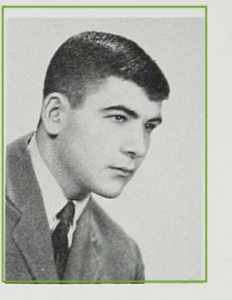
In August, the Munich General Prosecutor’s Office announced that it now believes a right-wing extremist started the fire. Earlier this year, the German newsmagazine Der Spiegel identified him as Bernd V., providing only his first name and last initial in accordance with German privacy laws. Der Spiegel also ran a black and white police photo of the suspect. It shows a man with a broad forehead, deep-set eyes and weak chin, wearing an unsmiling, withdrawn expression. The caption read, “Raised with Love for the Führer.”
Bernd V. was 25 at the time of the arson attack and died in 2020. His death means there will be no trial, though prosecutors say the evidence now points clearly to his responsibility. They found no reliable evidence of accomplices.
After his death, a woman contacted authorities and told the police that Bernd V. and two other men had been involved in a botched burglary at a jewelry store close to the Jewish community center on the night of the attack. Bernd V. ranted to his accomplices that the Jews had everything while Germans like him had nothing and verbally threatened to set Jews on fire. Roughly 15 minutes later, the building at Reichenbachstrasse 27 was ablaze.
In April 2025, investigators in Munich reopened the case, which had been closed in 2017 for lack of evidence. Old acquaintances of Bernd V, including relatives of the woman who had provided the new statement and who corroborated her account, remembered a man with a deep hatred of Jews who was obsessed with Hitler. He played records of the Führer’s speeches and practiced shooting around Berchtesgaden, where Hitler once had an idyllic residence. As a juvenile, Bernd V. had been sentenced for blowing up two telephone booths.
More strikingly, he was not a new suspect in the arson case. A former cellmate from one of Bernd V.’s prison stints in the early 1970s told investigators that Bernd V. had boasted to him of carrying out the Reichenbachstrasse attack and described details that, according to prosecutors, were not publicly known. Prosecutors questioned Bernd V. in 1972; he denied involvement, and the case against him was dropped two years later for lack of evidence.
The Reichenbachstrasse fire changed Jewish life in Germany — and the long uncertainty about its perpetrator helped shape a comforting German story about the sources of postwar antisemitism.
Bernhard Purin, the founding director of Munich’s Jewish Museum, has called the attack, quite simply, “the rupture.” Purin, who died in 2024, explained in a 2020 interview that before Feb. 13, 1970, people entered Jewish community centers much as they entered Christian ones. Afterward came police cars, cameras and heightened security, including metal detectors. Jews in Germany drew the bleak conclusion that they could only live under protection.
That security regime has become so routine here that it passes for normal. Police officers and Israeli security stand guard outside synagogues and Jewish schools. Visitors pass barriers and identity checks before entering institutions devoted to worship, education and community.
Permanent security presence has an unintended consequence: It marks official Jewish life as something fundamentally separate from ordinary life. A synagogue behind police barriers may be safer, but that fortification tells Jews and non-Jews alike that Jewish institutions are a world apart.
The attack also has another legacy. Because nobody knew who committed it, the crime gradually became evidence in a wider argument about left-wing antisemitism. In 1969, German left-wing radicals planted a bomb that failed to detonate at the Jewish community center in West Berlin on the anniversary of Kristallnacht. Parts of the revolutionary left embraced an anti-Zionism that could turn antisemitic. The Red Army Faction later celebrated the Palestinian terrorists who murdered 11 members of the Israeli Olympic team in Munich in 1972; German left-wing terrorists subsequently collaborated with Palestinian militants at Entebbe.
But the history of left-wing antisemitism gradually absorbed a crime for which no such attribution had been proved. It fed into the narrative that, as the political scientist Yascha Mounk put in his 2014 book Stranger in My Own Country, “since 1945, the Germans who have committed the most radical attacks on Jews were not right-wing radicals.” Many Germans found it psychologically convenient to believe that the Reichenbachstrasse victims had died at the hands of German antifascists rather than neo-Nazis.
The generation of 1968 performed an indispensable service by forcing West Germany to confront questions its parents had largely evaded: What had Germans done under Hitler? Why had former Nazis returned to positions of authority? What did Auschwitz demand of the generations that followed?
The discovery that some of those self-proclaimed antifascists themselves became antisemites produced a terrible historical irony. It also offered Germans a way to relocate antisemitism. The Jew-haters were now the rebellious children, the revolutionary leftists, the Palestinians and not necessarily the political descendants of the very people who had murdered Europe’s Jews.
Mounk himself called the radical left’s projection of fascism onto Jews and Israel a “psychological coping mechanism.” The apparent solution of the Munich case suggests a parallel mechanism in postwar Germany: antisemitism has often been easiest to recognize when it belongs to somebody else.
Today, that somebody else is frequently Muslim.
At the reopening of the Reichenbachstrasse synagogue last September, German Chancellor Friedrich Merz explicitly acknowledged that antisemitism “was never gone” from the Federal Republic. But within minutes he turned to immigrants, arguing that Germany had ignored the fact that a “considerable” number came from countries where antisemitism was effectively state doctrine. Months earlier, he had told Fox News that Germany suffered from “a kind of imported antisemitism.”
Since Oct. 7, 2023, Jews in Germany have faced alarming hostility connected to Israel and Gaza, including from Islamist and radical anti-Zionist milieus. But that’s only part of the story. Germany’s principal civil-society monitoring network for antisemitism, RIAS, recorded 8,725 antisemitic incidents in 2025. It linked 807 of them to right-wing extremism, the highest number in that category since nationwide monitoring began. And Germany now has a far-right party of enormous electoral strength whose leading figures have repeatedly tested the boundaries of the country’s postwar taboos.
That party, Alternative for Germany (AfD), is currently polling around 41% in Saxony-Anhalt ahead of next month’s state election. One of its most prominent politicians, Björn Höcke, has twice been convicted for using the banned slogan of Hitler’s SA.
Fifty-six years after seven Jews died in a burning building, prosecutors now believe the likeliest perpetrator was a German neo-Nazi whose fanatical hatred had been visible for years. That finding comes too late to punish him. It does not come too late to unsettle the story Germans have often told themselves about the crime.
And the other legacy of that night remains all around us. The rupture of 1970 has never fully healed. German Jews still worship, study and gather behind cameras, guards and police barricades: constant reminders that Jewish life here is somehow separate.
The challenge is not only to safeguard Jewish life, but to stop treating permanent protection as its natural condition. That requires Germany to confront antisemitism wherever it appears, including on a resurgent far right whose danger is easier to minimize when attention is fixed elsewhere.
The post Germany has found the culprit behind a deadly antisemitic arson fire. It still hasn’t learned its lesson. appeared first on The Forward.
