


Uncategorized
Best Gambling Sites for Canadians in 2026: Gambling Nerd Ranks the Top Picks
Gambling Nerd approaches Canadian gambling sites with a simple question: does the platform actually work well for someone in Canada? Accepting Canadian registrations is only the beginning. CAD accounts, Interac availability, withdrawal times, licensing, provincial restrictions, games and sportsbook coverage can make two apparently similar sites very different once real money is involved.
There is also no universal “best” gambling site. An NHL bettor looking for player props has different priorities from someone interested in slots, live blackjack or poker-style games. Gambling Nerd’s Nerd Nook Hub adds an educational layer to that comparison by examining concepts such as RTP, house edge, probability, sportsbook margins and odds.
For a broader look at the market, the Gambling Nerd guide to gambling sites in Canada covers Canadian casinos, sports betting, banking and regional considerations.
Best Gambling Sites for Canadians in 2026
For Canadian players, Gambling Nerd currently places IZZI Casino first overall, with Betway standing out for slots, North Casino for its welcome package and Hell Spin for poker variants. Sports Interaction is also particularly relevant to players who want casino games and Canadian-focused sports betting within the same platform.
The important distinction is that these sites have different strengths. Instead of treating the ranking as five interchangeable casinos, Canadian players can use it to identify the platform that most closely matches how they actually play.
| Rank | Gambling Site | Gambling Nerd Score | Best For | CAD Support | Interac | Sportsbook |
| 1 | IZZI Casino | 4.5/5 | Overall experience | Yes | Check current cashier | No |
| 2 | Betway | 4.5/5 | Online slots | Yes | Yes | Yes |
| 3 | North Casino | 4.5/5 | Welcome package | Yes | Yes | No |
| 4 | Hell Spin | 4.5/5 | Poker variants & game variety | Yes | Yes | No |
| 5 | Sports Interaction | 4/5 | Sports + casino | Yes | Available payment options vary | Yes |
Payment methods, promotions and availability can change, so current conditions should always be checked before opening or funding an account.
1. IZZI Casino – Best Overall for Canadians
Gambling Nerd score: 4.5/5
IZZI takes the overall position because its strengths aren’t concentrated in a single area. Gambling Nerd’s Canadian research highlights its game variety, promotions and flexible banking, while its minimum deposit starts at $5.
The casino has more than 600 video slots alongside digital table games, live blackjack, roulette and baccarat. Providers include Yggdrasil, Betsoft, BGaming and Evolution.
Banking includes cards, e-wallets and several cryptocurrencies, including Bitcoin, Ethereum, Litecoin and Tether.
That makes IZZI a better fit for someone looking for an all-around casino than a player choosing exclusively according to one promotion.
Main advantage: Strong balance between games, banking and promotions.
Potential drawback: Players specifically looking for Interac should confirm its current availability in the cashier before depositing.
Best for: Canadians who want a balanced casino rather than choosing primarily according to bonus size.
2. Betway – Best for Canadian Slot Players
Gambling Nerd score: 4.5/5
Betway is Gambling Nerd’s specialist pick for slots.
Its library includes established titles and providers, while progressive jackpot games provide another reason it stands apart from smaller casino platforms. Canadian players can also access familiar banking methods, including Interac.
Betway additionally operates a sportsbook, making it relevant to players who might spend Saturday on NHL markets and use the casino at another time without maintaining completely separate accounts.
The drawback is that its promotions shouldn’t automatically be considered the strongest simply because the platform itself is well established. Bonus terms still need to be compared independently.
Main advantage: Strong slot selection combined with casino and sportsbook products.
Potential drawback: Bonus value should be compared with newer, more promotion-focused competitors.
Best for: Slot players who value established software providers and also want access to sports betting.
3. North Casino – Best Welcome Package
Gambling Nerd score: 4.5/5
North Casino demonstrates why bonus size and bonus value aren’t necessarily the same thing.
Its Canadian welcome package advertises up to C5,000acrossthefirstfivedeposits.Thefirstdepositreceivesa100%matchuptoC1,000, followed by four 50% matches worth up to C$1,000 each.
The headline number is substantial, but so is another figure: 60x wagering requirements apply to the package.
That needs to be considered before opting in.
North Casino also supports CAD and Canadian-friendly banking methods including Interac. Its game library covers thousands of slots alongside table and live dealer games.
Main advantage: Large multi-deposit welcome package and broad game selection.
Potential drawback: The 60x wagering requirement makes reading the complete bonus terms particularly important.
Best for: Canadians who prioritize promotions but are comfortable evaluating wagering requirements before claiming them.
4. Hell Spin – Best for Poker Variants and Banking Choice
Gambling Nerd score: 4.5/5
Hell Spin is particularly useful for demonstrating the difference between a poker room and casino poker.
It doesn’t operate a traditional player-versus-player poker room, but its large casino library includes games such as Casino Hold’em and Caribbean Stud alongside live dealer poker formats.
Its banking selection is another strength for Canadians. Options include Interac, Interac e-Transfer, cards, e-wallets and cryptocurrencies such as Bitcoin, Litecoin and Ethereum.
The casino has more than 4,000 games, so players who regularly move between slots, table games and live dealer products have considerably more variety than they would at a smaller specialist platform.
Main advantage: Extensive game library and broad Canadian banking support.
Potential drawback: Players seeking traditional online poker against other players will need a dedicated poker room instead.
Best for: Casino players who enjoy poker variants and want Interac and crypto payment choices.
5. Sports Interaction – Best for Canadian Sports Fans
Gambling Nerd score: 4/5
Sports Interaction fills a different role in this ranking.
Its biggest attraction is the combination of a sportsbook and casino with a distinctly Canadian focus. CAD support and coverage of sports popular with Canadian audiences make it particularly relevant to people who consider sports betting their primary activity and casino games a secondary feature.
For an NHL bettor, that may be more useful than joining a casino with thousands more slots but a weaker sportsbook.
The trade-off is that its casino isn’t as extensive as some casino-first competitors.
Main advantage: Strong combination of Canadian sports betting and casino gaming.
Potential drawback: Casino-first players can find larger game libraries elsewhere.
Best for: Canadians who primarily follow sports but want casino games available through the same platform.
Best Gambling Sites That Accept Canadians
The phrase “Canadian gambling site” can be misleading because it can describe several different things.
A site might be operated within a provincial regulatory framework. Another could be an international gambling site that accepts Canadian customers. A third may specifically support Canadian dollars and local payment methods.
Those characteristics aren’t interchangeable.
This matters particularly when evaluating international sites. Accessibility tells you whether an account can be created from a location. Licensing tells you which regulatory framework governs the operator.
The Gambling Nerd-check: Don’t assume that accepting Canadian players means a gambling site is regulated by a Canadian provincial authority.
Which Canadian Gambling Site Fits You?
Someone who mainly plays slots should start the comparison with Betway. Its strength is its slot library rather than simply having the largest headline promotion.
A player prioritizing a substantial welcome package might look more closely at North Casino, but its 60x wagering requirement should be evaluated alongside the C$5,000 advertised package.
Hell Spin makes more sense for someone who regularly switches among slots, live dealer tables and poker-style casino games.
Sports Interaction has the clearest role for sports fans who want to combine betting with occasional casino play.
IZZI is the more balanced choice when none of those individual specializations dominates the decision.
This is ultimately more useful than declaring that one gambling site must be best for every Canadian.
Which Canadian Gambling Sites Accept Interac?
Interac is one of the clearest ways a gambling site can adapt its banking experience for Canadians.
Betway, North Casino and Hell Spin are among the ranked platforms offering Interac support. However, players should check the cashier before depositing because payment availability can change and deposit options aren’t necessarily identical to withdrawal options.
| Gambling Site | Interac | CAD | What to Check |
| Betway | Yes | Yes | Current deposit and withdrawal limits |
| North Casino | Yes | Yes | Minimums and maximums |
| Hell Spin | Yes | Yes | Interac vs Interac e-Transfer options |
Interac transactions can be considerably easier for someone accustomed to Canadian online banking than dealing with foreign currency or unfamiliar payment processors.
The detail beginners often miss is two-way support.
A casino might allow a payment method for deposits but require another method for withdrawals.
The Gambling Nerd-check: Before making an Interac deposit, verify whether Interac is also available for withdrawals on your account.
Why CAD Support Matters
Imagine starting with a C$200 bankroll.
With a CAD account, a C$10 wager represents exactly 5% of that starting amount. The deposit, balance, individual bets and eventual withdrawal remain easy to interpret in the same currency.
A USD-denominated account introduces exchange rates into that process.
That doesn’t automatically make a USD gambling account unsuitable for Canadians. It simply creates an additional variable, particularly if conversion fees or exchange-rate changes apply.
For a Canadian choosing between otherwise similar sites, native CAD support can therefore be a genuinely useful feature rather than a minor convenience.
The Gambling Nerd-check: Confirm the account’s base currency before depositing, not when requesting your first withdrawal.
Which Canadian Gambling Sites Have the Fastest Withdrawals?
There isn’t a single payout time that applies to every Canadian gambling site.
The payment method can matter almost as much as the operator.
Interac and e-wallet withdrawals can often be relatively quick. Cards and bank transfers may require additional business days. Crypto can process particularly quickly after the casino approves a withdrawal.
That last distinction matters.
Casino processing time describes how long the operator takes to approve and send a withdrawal.
Payment processing time describes what happens after the transaction enters Interac, an e-wallet, banking network or blockchain.
Gambling Nerd’s Canadian methodology includes testing withdrawals rather than relying entirely on advertised payout claims. Its real-money casino testing has also found particularly fast crypto withdrawals at some operators.
The Gambling Nerd-check: When a site says “fast payouts,” determine whether that claim refers to casino approval time, payment processing or the entire withdrawal.
Real Money Gambling Sites in Canada: What Does That Actually Mean?
“Real money gambling site” is a broad term.
It can describe an online casino where money is wagered on slots or blackjack, a sportsbook accepting wagers on the Stanley Cup, an online poker room or a platform combining several products.
It also distinguishes these platforms from free-play casino games and social casino products where the economic model and prize structure can work differently.
For beginners, this distinction matters because different real-money products require different comparisons.
A slot player should understand RTP and volatility. A sports bettor should understand odds and sportsbook margin. A poker player needs to distinguish games played against the house from poker played against other users.
The word “gambling” connects them, but the underlying products are very different.
Best Gambling Sites for Canadian Sports Fans
Canadian sports bettors have several locally relevant markets to consider.
NHL coverage is an obvious priority. A Toronto Maple Leafs or Edmonton Oilers fan may want player props, period markets, puck lines and live betting in addition to a simple game winner.
CFL bettors might care more about market depth around regular-season games and the Grey Cup.
Toronto Raptors fans introduce NBA player props and same-game markets, while Toronto Blue Jays followers need MLB coverage across a much longer season. NFL betting also remains important despite Canada not having an NFL franchise.
The best sportsbook shouldn’t therefore be determined solely by its welcome offer.
Check whether it actually provides strong coverage of the sports you follow, then compare the prices.
Two sportsbooks can offer the same Maple Leafs moneyline at different odds. That difference directly changes the potential return.
The Gambling Nerd-check: Compare sportsbook odds before sportsbook bonuses. A promotion is temporary; pricing affects every qualifying wager.
What Casino Games Should Canadians Compare?
A casino advertising 5,000 games isn’t automatically better than one offering 1,500.
The more useful question is what those games actually are.
Slot players should look at software providers, RTP information, volatility and bonus mechanics. Jackpot players may prioritize progressive networks. Live casino players need to consider table availability, limits and streaming quality.
Table rules can also affect the mathematics.
European roulette generally uses one zero, while standard American roulette adds a double zero. That changes the house edge despite both games being called roulette.
Blackjack works similarly. Rules concerning dealer actions, doubling and payouts can alter the mathematical return.
This is why Gambling Nerd treats game quality as more than a count of how many thumbnails appear in the lobby.
Are Bigger Canadian Gambling Bonuses Better?
Consider two hypothetical promotions.
Casino A offers 200% up to C$2,000.
Casino B offers 100% up to C$500.
The first appears obviously better until the terms are opened.
If Casino A requires 60x wagering while Casino B requires 20x, the comparison becomes substantially more complicated. Game contribution, expiry dates, maximum bets and cash-out restrictions can change it further.
North Casino provides a practical example. Its C$5,000 package is one of its most noticeable features, but the 60x wagering requirement belongs in the same conversation.
The Gambling Nerd-check: Don’t compare bonus percentages until you’ve compared what must be wagered to use them.
Best Gambling Sites in Ontario vs the Rest of Canada
Ontario needs to be treated separately when discussing Canadian online gambling.
The province has a competitive regulated iGaming market overseen through Ontario’s provincial framework. Players participating within that market use operators authorized for Ontario.
International gambling sites available elsewhere in Canada shouldn’t simply be presented as Ontario alternatives.
This means a national ranking needs an important qualification: a site that Gambling Nerd evaluates for players in Alberta, British Columbia or Quebec may not be the appropriate recommendation for someone located in Ontario.
Ontario players should confirm that an operator is authorized for the provincial market before creating an account.
The Gambling Nerd-check: A national “Canada” ranking doesn’t override provincial availability. Check your province before evaluating the rest of the site’s features.
Do the Best Gambling Sites Change by Province?
Yes, because Canada doesn’t have one identical online gambling environment from coast to coast.
Ontario has its competitive regulated iGaming framework. British Columbia operates PlayNow through the British Columbia Lottery Corporation. Quebec has its provincial offering through Loto-Québec, while other provinces follow their own models.
That creates a distinction between what exists provincially and which international gambling sites may be accessible from different parts of Canada.
Alberta is another particularly relevant market for online gambling research, while Quebec players may additionally care about French-language accessibility.
The practical lesson is simple: check provincial availability before spending time comparing bonuses, games or payment methods.
What Should Quebec Players Look For?
Quebec introduces several additional considerations.
CAD support and familiar banking remain important, but French-language accessibility may also matter. Players should determine whether the site itself, its terms and its customer support are available in a language they’re comfortable using.
Quebec also operates its own provincial gambling products through Loto-Québec.
International sites should therefore be evaluated separately rather than being presented as though they operate within the same provincial framework.
For a beginner, understanding that distinction is more important than immediately comparing welcome bonuses.
How Gambling Nerd Tests Canadian Gambling Sites
Gambling Nerd’s rankings aren’t based solely on reading promotional pages.
The site’s Canadian methodology includes practical testing of the player experience, including registration, deposits, mobile usability and withdrawal requests. Licensing, game software, customer support and bonus terms are also evaluated.
Canadian reviews introduce additional questions.
Does the platform support CAD? Which Canadian banking methods are actually available? How does the site handle withdrawals? Is it appropriate for the player’s province?
That testing matters because advertised specifications don’t always describe the complete user experience.
A casino can advertise thousands of games but have inconvenient banking. Another might promote fast withdrawals while requiring a lengthy internal approval process. A huge welcome offer can lose much of its appeal once the wagering conditions are examined.
The goal is therefore to assess the platform rather than one headline feature.
Nerd Nook Hub: The Site Doesn’t Change the Mathematics
The Nerd Nook Hub approach becomes particularly useful once players move beyond comparing operators.
Consider a slot advertised with 96% theoretical RTP.
That does not mean someone depositing C100shouldexpecttofinishasinglesessionwithC96. RTP is a theoretical long-run measurement calculated across a very large number of plays.
Sports betting has its own mathematics.
Decimal odds of 2.00 correspond to a 50% break-even probability before accounting for how the wider market has been priced. If another sportsbook offers a better price on the exact same outcome, the underlying basketball or hockey game hasn’t changed—the price has.
Bonuses, site design and payment methods don’t alter these underlying mathematical principles.
That’s why choosing a gambling site and understanding the games are two separate decisions.
The Gambling Nerd-Check Before Joining a Canadian Gambling Site
Start with location rather than the welcome bonus. Confirm that the platform is appropriate for your province and understand which regulatory framework applies.
Then check the currency. If you want to manage your bankroll in Canadian dollars, confirm CAD support.
Next comes banking. Verify that your preferred deposit method is available and, crucially, determine how you will withdraw.
After that, examine what you actually want to play. A sports bettor should compare markets and odds. A slot player should look at providers and games. Someone interested in both needs a platform that performs well in both areas.
Only then does it make sense to evaluate the welcome offer.
That produces a useful rule for Canadian beginners:
Don’t ask only whether a gambling site accepts Canadians. Ask whether it actually works well for Canadians.
Frequently Asked Questions About Canadian Gambling Sites
What are the best gambling sites in Canada?
Gambling Nerd currently ranks IZZI as its best overall option for Canadian casino players, while Betway stands out for slots, North Casino for its welcome package and Hell Spin for poker-style casino games. Sports Interaction is particularly relevant to players who prioritize sports betting alongside casino gaming.
Which gambling sites accept Canadians?
Numerous international gambling sites accept Canadian customers, but availability can differ by province. Acceptance from Canada also shouldn’t be confused with regulation by a Canadian provincial authority.
Which Canadian gambling sites accept Interac?
Betway, North Casino and Hell Spin are among the ranked sites offering Interac banking. Players should verify current cashier availability and whether Interac is supported for both deposits and withdrawals.
Which gambling sites accept Canadian dollars?
Several gambling sites targeting Canadians offer CAD-denominated accounts. CAD support can make deposits, bankroll tracking and withdrawals easier to understand by removing the need to continually translate balances into another currency.
What are the best gambling sites outside Ontario?
The answer depends on the player’s province and preferred product. Gambling Nerd evaluates international sites including IZZI, Betway, North Casino and Hell Spin for Canadian audiences, while Ontario requires separate treatment because of its regulated provincial market.
Are gambling sites different in Ontario?
Yes. Ontario operates a distinct competitive regulated online gambling market. Players in Ontario should verify that a platform is authorized for use within the province rather than assuming that a general Canadian recommendation applies there.
How long do Canadian gambling sites take to pay out?
It depends on the operator and withdrawal method. E-wallets, Interac and cryptocurrency can be relatively fast, while cards and bank transfers may take longer. Casino approval time should also be distinguished from the time required by the payment network.
What should Canadians check before joining a gambling site?
Province availability, licensing, CAD support, deposit and withdrawal methods, payout conditions, games or sports markets, bonus terms and player-control features should all be checked before depositing.
Finding the Best Gambling Site for You
The best gambling site for a Canadian NHL bettor doesn’t necessarily have to be the best casino for a slot player.
Someone following the Maple Leafs may prioritize hockey markets and sportsbook pricing. A slots player might care about software providers and Interac withdrawals. A Quebec user could put French-language support higher on the list, while an Ontario resident first needs to establish whether the operator is authorized for the provincial market.
That is why Gambling Nerd’s Canadian approach works better as a decision process than as a simple list of five brands.
For Gambling Nerd, the best gambling site for Canadians isn’t necessarily the platform advertising the biggest bonus. It’s the one that combines suitable games or betting markets, transparent terms, appropriate licensing and banking options that genuinely work for the individual Canadian player.
About Gambling Nerd
Gambling Nerd is the editorial brand and collective byline of GamblingNerd.com, an independent gambling media website that publishes experience-based reviews, guides, and analysis of online casinos, sportsbooks, and poker sites for gamblers of all experience levels worldwide. Its Nerd Nook Hub provides educational resources that break down sports betting mathematics, casino game theory, probability, odds, and other key concepts to help players make more informed decisions.
Uncategorized
Will this election end the battle over drafting Haredi men into the Israeli army?
(JTA) — Whether to extend military conscription to haredi men, a longstanding question fueling political tensions in Israel, has boiled over since Hamas launched the current war with Israel with its deadly raids on Oct. 7, 2023.
Hundreds of thousands of Israeli soldiers and reservists battled on Israel’s southern and northern fronts and the manpower needs, especially in combat units, increased dramatically. Reservists served for extended periods and many of those serving in the standing army were forced to remain for an extra four months or longer – at an enormous price to soldiers’ families and to Israel’s economy. For the ultra-Orthodox, the Torah study that young men carry out in place of military service provides an important spiritual defense for the Jewish state. Community leaders are extremely fearful that young men will be unable to practice or outright abandon a haredi lifestyle as a result of army service with secular and modern Orthodox Jews.
In some parts of the country, families continue to bury their dead from the battlefield, while in others Haredi protestors block roads and tussle with police to avoid the draft. The preferred political solution of kicking the can down the road on this deeply divisive issue – which has lingered in legislative limbo for decades – might finally come to an end with the Oct. 27 elections.
Which Israelis are currently drafted to the army, and what are their conditions of service?
Most Jewish Israeli men and women are subject to compulsory service at age 18. Men currently serve 32 months, and women generally serve 24, although some roles require longer service. Conscripts are generally allowed to defer service for a year or two in order to attend pre-military programs. Exemptions for service may apply for medical, religious, family or other legally recognized reasons. Druze and Circassian men are generally drafted, while Israeli Arabs are generally not. Conscripts who ignore draft orders are subject to sanctions that can ultimately lead to imprisonment.
Upon completion of compulsory service, most soldiers are placed in reserve units, and are called up periodically for training and for active duty in wartime. Reserve duty is generally mandatory until age 40 for non-officers and 45 for officers. Enforcement of a call up order for reserve duty is traditionally less severe than enforcement of compulsory service; sanctions against reservists who avoid call ups are rare.
Following the outbreak of war on Oct. 7, hundreds of thousands of reservists were called up for extended periods. Between the outbreak of war and the end of 2025, some 28% of male reservists and 20% of female reservists served for over 150 days. Current IDF policy allows for up to 55 days of reserve duty per year for combat soldiers, compared to a cap of 54 days over three years (18 days per year on average) prior to the war.
Are Haredim legally exempt from IDF service?
No. Historically, a small number of full-time haredi yeshiva students were allowed to defer service until they aged out of eligibility, amounting to a de-facto exemption. As the share of Haredim in the population grew, so did legal challenges to their exemption, on grounds of inequality. Since June 2023, there are no longer any legal exemptions in place for haredim, and all haredi men face the same legal requirement to enlist as non-haredim.
What is the mainstream haredi approach to IDF service?
Haredim generally oppose IDF service, although recently some small groups of modernizing haredim appear more open to it. Haredi officials and spiritual leaders argue the Torah study that young men carry out in place of military service provides an important spiritual defense for the Jewish state. At the same time, haredi community leaders view the IDF as a bastion of secularism and are fearful that haredi men will not be able to maintain their lifestyle during service.
Historically, how did the draft exemption for Haredi men begin?
In 1948, Prime Minister David Ben-Gurion agreed to exempt about 400 yeshiva students so Torah scholarship could be rebuilt after the Holocaust. The arrangement expanded gradually, as the military and political leadership tolerated the arrangement for practical and coalition-building reasons. In 1977, Menachem Begin’s government removed important limits on the haredi exemption. As a result, the number of draft-age Haredi men outside the army grew from roughly 7,000 in the late 1970s to tens of thousands by the 2020s.
When did opposition to the exemption first arise?
Opposition grew sharply in the 1980s and 1990s as the haredi IDF exemption grew significantly. Legal challenges to the exemption were initially rebuffed by the court, but were eventually successful, as the Supreme Court in 1998 first deemed the exemption illegal, and ruled that such an exemption needed to be anchored in legislation that met constitutional standards of equality.
Following the 1998 ruling, how did ensuing coalitions deal with this issue?
The two decades following the 1998 ruling saw various legislative and policy proposals aimed at increasing haredi enlistment. Two laws passed, in 2002 and 2014, but both were eventually struck down by the court on grounds of inequality, as they still enabled widespread haredi exemptions. The second law was struck down in 2017, but the court approved numerous extension requests by the government for the provisions of the law to continue to apply until it could come up with a new law. This left the de-facto exemption in place until the law finally expired in June 2023.
Why did coalitions keep trying to exempt significant numbers of haredim instead of drafting them?
First, haredi parties wield significant political power. In recent decades they have usually occupied 15-20 seats in the 120-member Israeli Knesset, and since 2009 have been part of Netanyahu’s right-wing bloc, save for two years (2013-2015). Governments have been wary of enlisting haredim en masse so as not to lose the support of haredi politicians.
Second, the IDF has not always been keen on drafting haredim. Haredim require special accommodations in terms of Kashrut and mixed-gender military bases. Haredim also go through an autonomous education system and special efforts are required to instill in them the motivation and sense of duty that are prevalent in general Israeli society.
So have any haredim served in the IDF in recent decades?
Yes, some specific programs have opened up for haredim, mainly in technology-oriented units. The numbers of annual haredi draftees has fluctuated, but in the years leading up to the expiration of the draft law the average was slightly over 1,000.
What changed in the IDF’s perspective and the perspective of the general public after Oct. 7?
The mass call-up of reservists for extended periods of time brought many Israelis to experience the inequality between them and the haredi public first hand. In addition, the expansion of the war to numerous fronts and new security requirements led to a manpower shortage in the IDF, especially of combat soldiers. Officials have described the shortfall as a national-security issue, and the roughly 100,000 Haredi men aged 18 to 29 are viewed as the only large available pool of potential combat recruits. Researchers have also pointed out that without a new policy the inequality in Israeli society will continue to grow – by 2050 over 40% of the 18-year-old potential male Jewish recruits will be haredi.
What was the outgoing Netanyahu government’s policy after Oct. 7?
The government did not implement significant policy changes to begin drafting haredim in significant numbers, and refrained from instituting sanctions that could have increased the price of draft evasion. The government’s inaction was challenged in court, and the Supreme Court ruled in June 2024 that barring a new law, the continued exemption was illegal. However, the government has continued to push back on attempts by the Attorney General, who leads Israel’s law enforcement apparatus, to abide by the ruling and begin taking measures to increase haredi draft numbers. The government argued in its defense that it was working on a new law which required time.
Did the government pass a new law?
No. The Netanyahu government attempted to pass a new law that would have incrementally increased haredi draft numbers while enabling the majority of haredim to remain exempt. The attempts failed due to push back from legal authorities, the political opposition, the general public, and a number of politicians from within the coalition. Instead, in July 2026, in the final weeks of parliamentary activity prior to the election recess, the Netanyahu-led coalition passed a law to freeze enforcement against haredi draft evaders until after the election. On September 3rd, the Supreme Court struck down this law as well.
So haredi draft numbers have remained at pre-war levels?
No. In order to abide by the 2024 Supreme Court ruling and the Attorney General’s interpretation of that ruling, government officials working within the different ministries removed certain subsidies and privileges from draft evaders, and the police and IDF gradually increased their enforcement efforts. The number of haredi draftees rose as a result. Between July 2025 and the end of June 2026, some 4,298 haredim enlisted, as opposed to 2,811 haredim in the parallel period in 2024-25.
How have haredi rabbis, politicians and the general public responded to growing demands that they enlist?
Leading rabbis affiliated with the three main haredi parties – the non Hasidic Degel Hatorah party, the Hasidic Agudat Yisrael party and the Sephardic Shas party – forcefully opposed IDF service, with some explicitly calling on young haredi men to ignore draft orders should they receive them. Politicians from the three parties also voiced strong opposition to a large increase in haredi draftees, and were willing only to consider minor increases.
A large majority of haredim who received draft orders ignored them, and approximately 90,000 haredi men are legally considered draft evaders, with levels of severity increasing the longer they ignore the orders. Some arrests of draft evaders were met by mass protests and disturbances, including in recent weeks. Some more modernized haredim have increasingly expressed a willingness to serve. These views are represented in two new haredi parties participating in the current election, called Hakahal (roughly translated as “the community”) and Hatzibur Haharedi (“the haredi public”).
Is the haredi draft issue prominent in the election campaigns?
Yes. In a recent poll by the Israel Democracy Institute, a proposition that the next government should draft haredim equally received the most support among a series of propositions. Nearly all of the Zionist opposition parties have made their intention to increase the haredi draft a prominent part of their campaigns. Some opposition party leaders have attempted to frame the election as a choice between the “draft evasion bloc” and the “bloc that serves.” On the other hand, some haredi rabbis and party leaders have expressed their disappointment with Netanyahu’s failure to manufacture a new exemption, and have stated that they no longer view themselves as part of the Netanyahu bloc. However, they have not stated support for any other candidate and are likely to side with Netanyahu again if he is able to form a new government.
What are the most likely scenarios after the next government is formed?
Three outcomes are plausible:
- A compromise: full-time Torah scholars receive a narrow exemption, while others perform military or civilian service under threat of sanctions.
- Continued stalemate: the government delays enforcement, leading to further court battles and coalition crises.
- Broad enforcement: a government less dependent on haredi parties implements substantially wider enlistment.
The first scenario is probably the most politically workable, but the details will determine whether the courts accept it.
This article originally appeared on JTA.org.
The post Will this election end the battle over drafting Haredi men into the Israeli army? appeared first on The Forward.
Uncategorized
The discovery of a Jewish Negro League star forces a rewrite of Jewish baseball history
(JTA) — For more than a century, Oscar Levis was hiding in plain sight.
He pitched a no-hitter and dominated the Cuban Winter League. He tallied five straight seasons without losing a game against one of the Northeast’s toughest white semiprofessional clubs. He was so dominant that W. Rollo Wilson, the preeminent Black sportswriter of his era, held him up as a benchmark of pitching excellence — the kind of player a younger star would aspire to equal.
For all of that, Oscar Levis does not appear on any official roster of Jewish major leaguers.
The reason is straightforward and ugly: the Negro Leagues — the professional leagues Black players built and played in after being barred from the White major leagues — were not recognized as major leagues until 2020. For decades, that exclusion meant that players like Levis were not considered major leaguers at all.
And there was another reason: Levis was Black, and the prevailing assumption was that Blackness and Jewishness were identities that seldom, if ever, overlapped.
But months of archival research, family testimony, and genealogical detective work have now established what Levis’ contemporaries occasionally hinted at but never fully acknowledged: Oscar Levis was Jewish. The son of a Jewish father from Jamaica whose family roots stretched through the Caribbean back to Portugal, Levis carried a Jewish identity that his world did not know how to fully accommodate — and that baseball history, until now, did not know how to find.
A clue left in the digital margins
In 2018, Gary Ashwill, the foremost authority on Negro League statistics and co-creator of the comprehensive database Seamheads, published an article identifying Oscar Levis as Jamaican by birth — a fact that had itself been hidden for decades, since Levis routinely identified himself as Panamanian, the country where he grew up and learned to pitch. Ashwill noted that Levis’ father was a man named Amos DaCosta Levy, but that beyond the name, he had been unable to learn much more about him.
What happened next was the digital equivalent of a message in a bottle. Readers who recognized the Levy name began leaving comments on Ashwill’s webpage. One, who identified himself as Amos Levy’s great-great-nephew, wrote that Amos was Jewish. Another commenter was more specific. “I’ve never heard of [Oscar],” she wrote, “but just wanted to say that Amos DaCosta Levy is one of my ancestors. He was not a black man, he was a white, yes Jewish, man.”
Those comments caught my attention. My previous foray into Jewish baseball history had already produced one meaningful discovery — the posthumous identification of one-game major leaguer Monte Pfeiffer as Jewish. But where Pfeiffer had played a single game, Levis had played and been a star for more than a decade.
The blog comments served as a starting point, not a conclusion. Tracking down their claims took months. I reviewed digitized editions of The Gleaner, Jamaica’s newspaper of record, which confirmed DaCosta Levy’s public prominence — his election to the Legislative Council, his Masonic leadership, his business dealings. Jamaican civil and ecclesiastical records, accessible through genealogical archives, corroborated the synagogue marriage record for DaCosta Levy’s parents. I contacted historians specializing in Caribbean Jewish history, including Stanley Mirvis, whose scholarship on Jamaican Jewry provided crucial context for understanding how Jewish identity operated in that world.
I communicated directly with DaCosta Levy’s descendants, who were able to confirm, from within their own family history, what the blog commenters had suggested. And I called Shaare Shalom Synagogue in Kingston — the historic heart of Jamaica’s Sephardic Jewish community — where staff were able to confirm the existence of records connecting the Levy family to the congregation. The picture that emerged from these independent sources was consistent: DaCosta Levy was a member of Jamaica’s Jewish community, and Levis was his son.
When the evidence pointing to Levis’ Jewish identity began to solidify, I reached out to Rebecca Alpert, a professor of religion at Temple University who had spent years thinking about exactly this kind of story. Her 2011 book, “Out of Left Field: Jews and Black Baseball,” examined the largely overlooked history of Jewish involvement in the Negro Leagues — and her expertise at the intersection of religion and sports made her the ideal partner for a discovery that sat squarely in both. Together, we reviewed the historical record, stress-tested the evidence and considered what Levis’ story means for our understanding of Jews in baseball — a conversation that only deepened my confidence in what the research had found.
An upbringing at the margins of Jamaica’s Jewish world
DaCosta Levy was born in 1848 in Port St. Mary, Jamaica, to parents whose marriage is recorded in synagogue records. According to family history, DaCosta Levy’s family lineage traced to Portugal, where his ancestors had been mariners — almost certainly Sephardic Jews who scattered across the Atlantic world after the Inquisition. By the late 19th century, DaCosta Levy had built a prosperous mercantile firm, Levy Brothers & Company, that imported goods from the United States and England. He was elected to Jamaica’s Legislative Council for St. Mary’s Parish. He was also a Worshipful Master of the Caledonian Masonic Lodge, helped found Jamaica’s Masonic Benevolence Association, and served as a justice of the peace. A 1919 article in the Kingston Daily Gleaner, written when DaCosta Levy was living in Panama, called him “the oldest foreign Mason on the Isthmus” and praised him for “faithful services.”
Levis’ mother, Theodosia Foreman, was a Black Jamaican woman who worked as a dressmaker. The union between DaCosta Levy and Foreman was not uncommon in the Caribbean Jewish world of the era. Mirvis has explained that relationships between Jewish men and women of color were relatively widespread in Jamaica and throughout the Caribbean, shaped by the power dynamics of the plantation economy. The children of such relationships occupied a complicated place — neither fully inside nor fully outside the Jewish community, a status scholars have described as “peripheral inclusion.” Contemporary observers, including one 20th-century American rabbi, noted that many Black Jamaicans bore Jewish surnames and took pride in their heritage. Levis was among them.
That identity, however, needs to be understood on its own historical terms — rooted in the Caribbean Sephardic world Levis was born into, not the standards prevalent elsewhere. Mirvis has explained that Jamaica’s Jewish community in this period was composed almost entirely of former Portuguese conversos and their descendants, a population that had never developed the same rigidity around matrilineal descent that characterizes Orthodox practice. Within this particular Sephardic tradition, patrilineal descent carried more communal weight than it did elsewhere — a distinction that shaped how men like Oscar were understood by those around them. In the Caribbean context specifically — where relationships between Jewish men and women of color were common and children of those unions were frequently integrated into Jewish social and economic life, however conditionally — the boundaries of who belonged were porous in ways that defy easy categorization.
Levis appears to have understood himself within this tradition. His family has confirmed that he was proud of his Jewish heritage and aware of it throughout his life, though he rarely foregrounded it publicly — a pattern consistent with Black Jews of the period, who frequently navigated skepticism from both White Jewish communities and the broader Black community. Jewish Baseball News — an independent organization that maintains the definitive roster of Jewish players in professional baseball — applies a deliberately inclusive standard. “We define the term ‘Jewish’ broadly,” the organization states. “If a player has at least one Jewish parent … does not practice another faith, and is content to be identified as a Jew, we include him.” Levis had a Jewish father, was publicly identified as Jewish by contemporaries and his family confirms he was proud of that heritage throughout his life.
Growing up on the color line
By the time Levis was a young man, his family had relocated to Panama, drawn by the economic opportunities opening up around the canal. It was a decision that shaped him as much as his father’s bloodline.
The U.S.-controlled Panama Canal Zone was a masterclass in racial hierarchy. White American workers received higher wages, better housing and superior facilities on what the system called the “gold roll.” Black workers — among them the tens of thousands drawn from Jamaica and Barbados to perform the most grueling excavation labor — were paid lower wages, housed in substandard quarters, and segregated at pay windows, hospitals, and schools. Levis, known locally as “Chick Levy,” would have understood the color line intimately before he ever set foot in the United States.

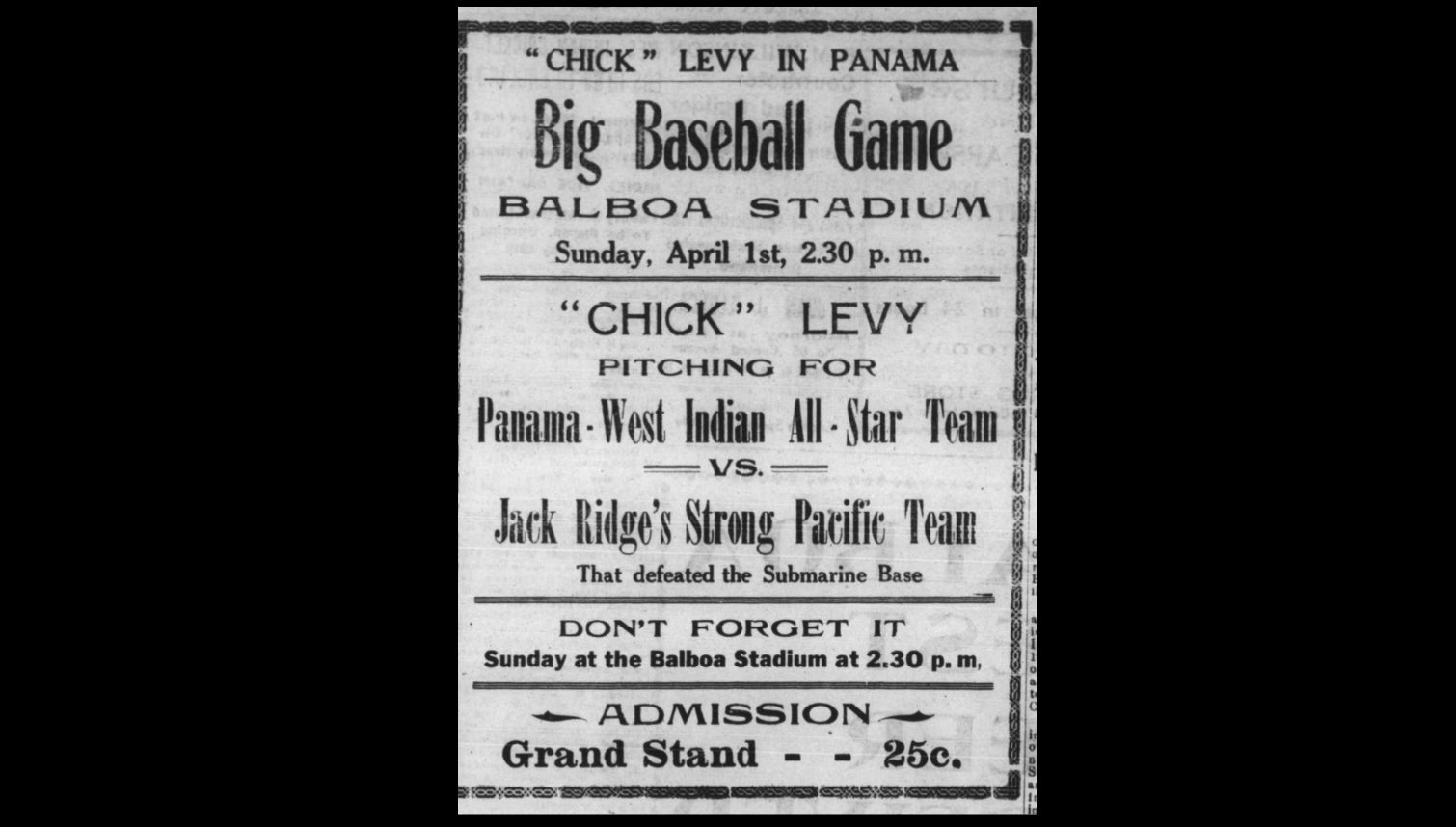
Despite those conditions, it was in Panama that he became a baseball star. He emerged as the premier pitcher on the isthmus, a “popular figure in the baseball world” celebrated for his dominance of the local clubs. Even after his American career took off, Levis returned in 1923 to pitch for a combined Panama–West Indian All-Star team before massive crowds at Balboa Stadium. Two years later, the Panamanian government awarded him a medal for his baseball achievements, and in the 1930s, he was offered – but declined – the opportunity to coach Panama’s national team for the Central American Olympics.
The Cuban stars and a career in the shadows
Levis arrived in New York in 1918. By 1921, Alex Pompez — the Cuban-American entrepreneur who owned the Cuban Stars and would eventually be inducted into the Baseball Hall of Fame — had recruited him to join the team. Levis became one of the first non-Cuban international players in the Negro leagues, and one of their most effective pitchers.
What followed was a career of genuine distinction. Levis pitched in the Negro leagues for the Cuban Stars (East) and the Hilldale Daisies across more than a decade, supplementing the short Negro League season with year-round appearances in exhibition games, barnstorming tours and the Cuban Winter League, where he pitched for the Almendares, the Habana Reds and the Marianao Grey Monks. On Oct. 11, 1924, he threw the first no-hitter in Cuban baseball history. He was voted to the All-Eastern Team in 1925 and led the Eastern Colored League in shutouts in 1927. He went five straight seasons without losing a game to a rival club which fielded white players, the Brooklyn Bushwicks. Cuban sports editor Jose Massaguer calculated that Levis pitched in more than 500 games across his career, and Cuban pitching records attributed to him reportedly stood for decades beyond his retirement.
None of that success saved him from the color line that excluded Black players from what was known at the time as Major League Baseball. Ashwill, the statistician, has assessed Levis as a very good pitcher whose talent was more than sufficient for the white majors — a verdict echoed by sportswriter Rollo Wilson, who in 1929 called Levis one of the sharpest and most effective right-handers in the game.
In 2020, Major League Baseball officially recognized the Negro Leagues as major leagues, and in 2024 incorporated their statistics into its historical record. By that accounting, Levis pitched in 102 major league games and accumulated a career WAR (wins above replacement) of 12.9, which ranks eighth all-time among Jewish pitchers: Sandy Koufax (48.9), Max Fried (32.3), Ken Holtzman (27.3), Dave Roberts (23.6), Barney Pelty (19.2), Steve Stone (17.1) and Erskine Mayer (13.5).
Based on his officially recognized statistics alone, Levis had the most successful professional career of any Jewish player in the 1920s.
Hidden in plain sight
What makes Levis’ story even more compelling is that his Jewish identity was not entirely hidden — it surfaced in scattered notices buried in the newspaper record.

In 1926, after Max Rosner — the Jewish immigrant who owned the rival white semi-pro team the Brooklyn Bushwicks — signed Levis’ naturalization papers, a Brooklyn newspaper ran the headline: “Oscal, Cuban Pitcher, Is a Spanish Jew.” The following year, a New York sportswriter named Aloysious Palma made the point plainly. John McGraw, manager of the (baseball) Giants, had recently signed a Jewish infielder named Andy Cohen specifically to attract Jewish fans to the Polo Grounds. Palma wrote that Levis had the talent and ability to pitch for the New York Giants — that he should have been McGraw’s Jewish star. He was the right religion. He had the right arm. He was the wrong color.

A third article, published during his managerial tenure in the 1930s, again noted his Sephardic Jewish heritage. “Oscal Levis, pitcher and manager,” the Brooklyn Times Union reported, was “of Spanish-Jewish extraction.”
Taken together, the three articles form a quiet paper trail — Levis’ Jewish identity was occasionally noted, but never coherently recognized or integrated into the broader baseball record.
He was neither the mainstream white Jewish player typically celebrated in the New York press, nor the Black player whose Jewish identity was fully acknowledged and chronicled in the Black press. He belonged to both worlds, an identity for which mainstream America had no framework.

Harlem, and the life after
When Levis’ playing and managing days ended, he built a second life in Harlem, New York. He and his wife, Lovana, operated Chick’s Bar and Grill on Seventh Avenue — a short walk from the Apollo Theater — for 35 years, making it a mainstay of the neighborhood. He served as chairman of the Harlem Riverside Tavern Owners Association, raising money for hospitals, the YMCA, the Police Athletic League and the Boy Scouts. He organized interracial boxing events at the Golden Gate Arena to keep youth out of trouble. And he was a 33rd-degree Prince Hall Freemason — the highest rank of the Scottish Rite — following directly in the tradition of his father, who had served as Worshipful Master of a Masonic lodge in Jamaica.
But even in retirement, Levis never left the game of baseball. Friends recalled that he loved to “stick his finger in the baseball pie whenever he got a chance.” He returned to Cuba just to sit in the stands “day and night.”
He was also, in his own quiet way, a witness to the great transformation of the sport he had played under the cruelest constraints. As chairman of the Jackie Robinson Day Committee, Levis helped organize the celebration and personally presented the ceiling-shattering Black major leaguer with gifts from fans across the country. New York Amsterdam News reporter George Palmer captured what the day meant to him:
“He claims that one of his biggest thrills was Jackie Robinson Day — when he had the chance to see how the public took to Jackie. He, as a former ball player, knew the hardships and obstacles which Jackie had to overcome to reach the top. To him, Jackie Robinson’s Day was what every colored ball player dreams about — so much so that it was like a dream come true.”
A name that belongs on the list
In 1943, Rollo Wilson wrote a column pushing back against the habit of comparing Black ballplayers to white stars. The “Black Babe Ruth” formulation, he argued, was both lazy and diminishing — to the player being praised and to the tradition being ignored. Black baseball had produced its own immortals, and Wilson listed Oscar Levis among them. To be considered their equal, Wilson wrote, was a standard worth chasing for any young baseball star.
Just as Wilson named Levis among the immortals of Black baseball, this research names him among the greats of Jewish baseball. His inclusion changes the historical record — and adds a dimension to the story of Jewish contributions to the game that has long been hiding in plain sight.
He was one of the finest pitchers of his era. He was Black and he was Jewish. And for a century, baseball didn’t have the categories to say so.
It does now.
This article originally appeared on JTA.org.
The post The discovery of a Jewish Negro League star forces a rewrite of Jewish baseball history appeared first on The Forward.
Uncategorized
Why a new ultra-Orthodox party supports drafting Haredi men to the IDF
(JTA) — JERUSALEM – Yehoshua Pfeffer is a popular British-born haredi rabbi in Jerusalem. He is unusual among the religious leaders in the ultra-Orthodox world because he believes that haredim can and should integrate into and contribute more to the wider Israeli society even as they uphold their Torah observance.
Arguably the most fraught implication of this belief is that large numbers of haredi men should join the Israeli military rather than receive draft exemptions that allow them to spend their early adulthood studying instead of serving. After Israel’s High Court struck down the decades-long exemption for haredi yeshiva students in 2024, the vast majority of draft-age haredi men have refused to serve in the military.
The issue of whether to force them to do so is at the center of Israeli politics heading into the Oct. 27 elections.
When asked last month which issues will have the “greatest influence” for them at the ballot box, Jewish respondents to an August 2026 Israel Democracy Institute poll ranked haredi IDF conscription in third place. Only foreign affairs/security and the economy/high cost of living took precedence.
Another survey, by Hiddush: Freedom of Religion for Israel, found that 66% of Jewish Israelis would prefer a broad post-election government that either excludes haredi parties entirely or loudly rejects their demand for a sweeping military exemption and large government subsidies.
Pfeffer’s party could bridge that gap. He chairs the rabbinic committee of a new haredi political party called The Haredi Public. The party promotes the introduction of secular studies in haredi K–12 schools (most boys’ schools currently teach only the most basic math and English); the normalization of employment for those who seek it; and IDF conscription for men who are not full-time yeshiva students.
The party hopes to attract the unknown percentage of haredi voters who want to work full-time and not rely on public assistance or philanthropy.
An estimated 34-40% of Haredi families live at or below the poverty line, due to the community’s high birthrate and the fact that only about half of Haredi men are employed. For those who work, employment can be limited by their lack of knowledge in the secular subjects needed for an advanced degree or even jobs that require a high school education.
Israel’s long-standing haredi political parties, which promote the views of the country’s most powerful rabbis, are dead set against requiring haredi young men to serve whether or not they’re studying.
Pfeffer explained that he sees things differently, and not just because “Israel needs the haredi community to contribute more to society; we need it for our own sustainability.”
The war that followed the Oct. 7, 2023, attacks by Hamas has changed perceptions among at least some haredim, he said.
“It internalized for us that whatever was before isn’t going to continue. We have to be part of Israel,” he explained. “If the haredi community at large wants to ensure that true Torah scholars can continue to study and be great rabbinic leaders, we have to ensure that everyone else serves in the IDF, doing their part, protecting our nation.”
However, he doesn’t want draft dodgers to be arrested. That type of crackdown “plays into the hands of the extremists,” he said, referring to people who want to stop the draft of haredim at all costs. Instead, the next government “needs to establish a way to incentivize those who go into the army.”
Pfeffer’s party probably won’t receive the number of votes needed to win a place in the Knesset, according to the polls, and Pfeffer understands it’s a steep uphill climb to surpass the 3.25% of the nationwide vote that a party needs to win at the ballot box to sit in the Knesset.
As a brand new party just establishing itself, its members have only recently gotten the word out through interviews, podcasts and parlor meetings. Additionally, it’s not clear how strongly its message resonates with the haredi public, which largely continues to vote for the party their rabbis tell them to support.
But Pfeffer sees a victory just in establishing the new party, which also stands out from the established ultra-Orthodox parties by making two of its top four candidates women.
Even if they don’t get into the Knesset, he said, “We are presenting an alternative, a voice, a vision of what this new idea looks like. If we don’t make it this time, we’ll make it next time. There’s a palpable excitement.”
Pfeffer said members of his party and its mission have been “very warmly received” by greater Israeli society, and that many members of the haredi public have privately expressed support for the party and its principles.
“There is an understanding that the sheer size of our community doesn’t give us the ability to continue the way we did in the past,” he said. Today, the haredi community represents about 14% of the Israeli population. When Prime Minister Ben-Gurion granted 400 full-time yeshiva students an exemption from IDF service in 1948, he could never have imagined that in 2026, tens of thousands of haredi men would refuse to serve.
Mixed feelings among haredim
In contrast with Pfeffer, on a recent morning in the ultra-Orthodox Jerusalem neighborhood of Geula, many people refused to discuss the issue. Those who did shared radically different opinions.
Like most haredi young men, Moshe Shmaya, a 33-year-old full-time yeshiva student, rejected calls for change within haredi society, because, he said, it would expose the community to values contrary to Torah and destroy its unique way of life.
“Israel considers itself a democracy, yet forcing people into the army is anti-democratic. The government starts wars and then expects us to participate,” Shmaya said while waiting for a bus to take him from the ultra-Orthodox neighborhood of Geula to prayers at the Western Wall. “But the main issue is that army service is incompatible with a haredi lifestyle: non-kosher food, female soldiers, not having enough time to pray and learn Torah.”
In response to these concerns, the IDF has created a haredi battalion to meet the specific requirements of haredi soldiers. The battalion has no female instructors and its food abides by the highest level of kosher certification. Prayer three times a day and Jewish study are a given, except under certain combat conditions. About 1,000 active-duty ultra-Orthodox soldiers serve in the battalion, while another 2,000 or so serve in other units.
Shmaya was aware of the unit but said it didn’t ease his concerns. “I personally don’t trust the army, and it’s really all about trust,” he explained.
However, David Levy, a Hassid man wearing a black bekishe, white knee socks and a tall streimel on his head, was more open to the idea.
While he had not heard of the Haredi Public party, he said its vision for haredi conscription “sounds interesting.”
“Since the war, I’ve come to realize that we can’t take Israel’s survival for granted,” Levy, a school administrator, said. “While I think that every young man should spend a few years in yeshiva study, I understand that the army needs soldiers right now. Hopefully we can find a way to allow thousands of young men to study in yeshiva while removing the stigma of military service for those who want to serve.
“Regardless of what anyone says, we all want Israel to survive and prosper,” Levy said.
Exhausted reservists
For one IDF reservist who has spent more than 600 days in uniform since the outbreak of war on Oct. 7, 2023, ensuring a haredi draft cannot come soon enough.
“It would be impossible to draft all of the tens of thousands of haredim who refuse to serve, but ensuring that more do serve would decrease the burden on those who do service,” said the reservist, a businessman whose livelihood has been impacted by his lengthy absences. He asked that his name not be published due to his position in the army.
Adding to the hardship that so many days of reserve duty have caused his family – who became temporarily homeless after their community on the Gaza border was attacked on Oct. 7, leading to its extended evacuation and their relocation to Jerusalem – is the lack of respect many haredim have for soldiers risking their lives and their families, the IDF reservist observed.
“For much of the war my wife has been alone with our children, and for a long time she didn’t know whether the next time I left home would be the last time she saw me alive,” he recalled while sitting in his home with his family in south Jerusalem. Meanwhile, “there are rabbis telling their students that military service is incompatible with being Orthodox, and to not pray for soldiers. I studied Gemorra for several years. The two aren’t incompatible.”
When Avi Losice, a Jerusalem resident, goes to vote on Oct. 27, the refusal of most haredi young men to serve in the IDF will be on the top of his mind.
Losice’s adult children have served around 700 and 400 days respectively in the IDF reserves over the last three years. While repeated stints in the military made it impossible for them to work and study for long stretches of time since Oct. 7, army-age yeshiva students who have evaded Israel’s mandatory military service have continued to study with the Netanyahu government’s blessing.
“Our reserve soldiers are stretched beyond thin,” Losice said of the dozens of reservists he knows personally, many of them married with children. “Their professional, academic and personal lives are being hammered by extensive service. The only way to give them relief is to spread the responsibility for the country’s security by including the haredi population.”
Modern Orthodox Rabbi Doron Perez, whose son, Captain Daniel Perez, was abducted and murdered by Hamas on Oct. 7, said the haredi draft issue is a “national priority” for the country, and that the need for security and unity, and not his son’s tragic death, will influence his voting choices.
Israel needs “a large and strong army,” Perez said, pointing to the long war and the toll it has taken on reservists. “We need to share the burden. With the haredi population continuing to grow, the issue must be addressed now.”
At the same time, Perez said he has “sympathy for haredim,” noting that for decades, every Israeli government, both left- and right-wing, kept the status quo. Prior to Oct. 7, the IDF itself spent years reducing personnel and shortening service.
“It’s not so easy to turn around a 75-year inertia we’ve allowed,” he said.
Losice agrees that change won’t happen overnight.
The fact that in the decade prior to the Oct. 7 attack, the military began to rely more on technology and intelligence while assuming it needed fewer foot soldiers was a miscalculation, Losice said. “We need haredi soldiers now more than ever before.”
This article originally appeared on JTA.org.
The post Why a new ultra-Orthodox party supports drafting Haredi men to the IDF appeared first on The Forward.
