


Local News
Nathaniel Lisak is the complete package: brawn and brain
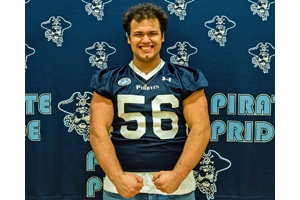
By BERNIE BELLAN Recently we published a story about nominees for Jewish Athlete of the Year. One of those nominees is Nathaniel Lisak, an outstanding football player from Grant Park High School. The picture we ran of Nathaniel, however, was not Nathaniel. We apologize for that error. A correct picture of Nathaniel appears with this story.
We admit though, that impressive a background as Nathaniel has as an athlete, of all the six nominees for Jewish Athlete of the Year, Nathaniel is the only one about whom we hadn’t published a story in this paper – until now.
We were contacted by Nathaniel’s father, Roman, after that issue came out. Roman informed us that the picture we had of Nathaniel was not Nathaniel. I responded contritely, apologizing as best I could, and asked Roman whether Nathaniel might be amenable to being interviewed so that we could do a fuller account of his accomplishments. In short order Nathaniel texted me, saying that he’d be glad to talk about his football career.
When we connected later that day I asked Nathaniel about his family’s background. Nathaniel explained that his parents, Roman and Maria, came to Manitoba from Israel in 2004. They both had originally come from Ukraine, he noted. Nathaniel also has a sister, Priel, who is six years older than him and who was born in Israel.
Upon arriving here Roman began working for Manitoba Hydro in Gillam as a Certified Engineering Technologist, Nathaniel said – and that was where he was born and lived until he was nine. In 2014 the family moved to Winnipeg when his father was offered a job in Winnipeg. (His mother Marina, by the way, works in the Rady JCC day care.)
Nathaniel began attending Brock Corydon School when the family moved to Winnipeg – in the English program. I asked him whether he was “a big kid” back then, given how big he is now.
“No,” he answered, “I was average as a kid.”
But somewhere between Grade Six and Grade Nine, Nathaniel said, he began to grow…and grow. In those three short years, he told me, he grew an astounding 11 inches – going from 5’ 3” to 6’ 2”, and gained an impressive 100 pounds. (If you look at his picture you’ll see that those 100 pounds turned mostly into muscle.)
It wasn’t until he was in Grade 8 that Nathaniel even strapped on pads and began playing tackle football, he noted. Prior to that the sport he played the most was basketball. He had also become a shot putter as he started to grow.
Now, if you consider how quickly Nathaniel grew, you might wonder how he adjusted to that sudden growth spurt. He said that it wasn’t easy and that at times it was quite uncomfortable given how rapidly he grew in height and added weight but, given his success on the football field, it’s clear that he’s adapted himself to his increased size with flying colours.
As the blurb that was sent to us by the Rady JCC in describing the nominees for Jewish Athlete of the Year noted, “Lisak excelled at the defensive tackle position for the Grant Park Pirates Football team this past season. After helping his team compile a 5-1 regular season record and a spot in the championship final, Lisak was honoured with numerous personal accolades. He was named to the CFC (Canada Football Chat) All-Canadian First Team and was the recipient of the Winnipeg High School Football League (WHSFL) Kas Vidruk Lineman of the Year. At the school level he was named the Grant Park Football Most Valuable Player and was awarded the school’s Football Captain Award. He was runner up for the 2021 WHSFL Defensive MVP & 2021 Harry Hood Citizenship Award. In grade 10 he became a known player in Manitoba and was named a Nationally ranked top 100 player in Canada, being a top 5 Manitoban and top three defensive tackle in the 2022 graduating class.”
I wondered whether there are any particular professional football players that Nathaniel has tried to emulate since he started playing football?
“I remember watching J.J. Watt (an extremely mobile, although quite large defensive end) play,” Nathaniel observed. “I was amazed how someone that big could move that fast.”
Yet Nathaniel now says that his role model is Aaron Donald, the huge defensive tackle for the Super Bowl champion Los Angeles Rams, who is legendary for his quickness despite weighing 280 pounds. (Donald, by the way, stands 6’1”, so in terms of comparison, he and Nathaniel are roughly the same height and weight.)
As the blurb about Nathaniel in our last edition also noted, he received numerous scholarship offers from universities across Canada. He said though that he’s chosen to go to McMaster University in Hamilton. Not only does McMaster have a great football program, it also has an excellent business school. Nathaniel told me that his plan is to enter that school. Given that he’s also been an honour roll student at Grant Park and that his favourite subject is math, he told me, it should be a good fit.
In addition to his studies and his athletic pursuits, for the past year Nathaniel has been serving as the Regional B’nai Brith Youth Organization president. (He’s a member of “Alaphim,” he noted.) His term will end this June.
Quite the package: An outstanding athlete, a terrific student, and an active member of BBYO. He was also quite forgiving of my running the wrong picture of him. On the other hand I interviewed Nathaniel over the phone. I’m not sure I would have been prepared if it turned out that he wanted to practice a bull rush on me to retaliate for my faux pas.
Local News
Marty Green arrested second time after appearing in front of Asper Campus protesting Israeli settler attacks on Palestinians
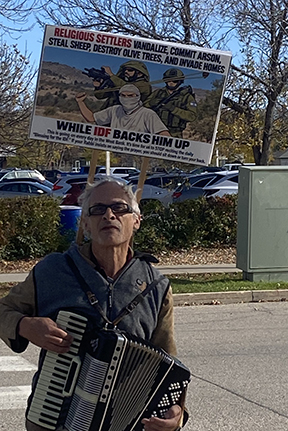
By BERNIE BELLAN (Posted Oct. 18) On Sept. 23 we reported on an incident wherein Marty Green was arrested by members of Winnipeg Police Service after he had been walking in front of the Asper Campus holding out leaflets to passersby. You can read our account of what happened if you continue reading here.
On Saturday, October 17 Marty was arrested once again by WPS, although this time he tells us that he was arrested at his home at 5 pm, rather than at the Asper Campus itself.
Marty admitted that he had been in breach of a bail condition that he not set foot anywhere near the Asper Campus, yet he decided to continue his protest of Israeli settler attacks on Palestinian civilians, this time however, not by handing out leaflets, but by wearing a sign and singing a song – while playing his accordion – on Saturday afternoon, Oct. 17.
Here is a video of Marty singing his song (sung to the tune of Hollaback Girl, by Gwen Stefani):
And, for readers who had a hard time just what the heck Marty was singing, here is a transcript of his lyrics:
Well you heard that I was talkin smack
And you must have thought that you could stop me
Whatchagonnado? Gonna tow my car? Gonna call the cops on me?
Well I’m here to talk shit. Get used to it
Cause the Jews in the West Bank gone too far now
That’s right put your yomakas down gettin everybody riled up.
Few times I been round that track
And it ain’t never gonna happen like that
Cause I aint gonna back down.
No I ain’t no one to back down
Few times I been round that track
And it ain’t my first time talkin smack
And I ain’t no one to back down
It ain’t me gonna back down
This shit is bananas BANANAS
yeah the Jews gone bananas BANANAS
No I ain’t no friend of Hamas, HAMAMAS
but the Jews gone bananas BANANAS
Following his arrest, Marty informs us he spent the night locked up in the Winnipeg Remand Centre. He was released Sunday, October 18, at noon.
Marty informs us that he has been charged a second time with disturbing the peace.
I happened to be at the Asper Campus Saturday afternoon. This is the second time I’ve been there when Marty Green has been carrying out his protest. I did see a number of individuals engage Marty in angry conversation. One of them (an individual I know) got quite close to Marty and was angrily asking him (in Hebrew) why he was there? Marty did reply, in Hebrew, “Al tigah lee” (Don’t touch me.) His speaking in Hebrew seemed to anger the individual who was confronting Marty even more when he realized Marty spoke some Hebrew. He let Marty know how angry he was that a Jew was protesting in front of the campus.
I did ask the lone security guard who was on duty at the campus security desk whether she had called police, and she said she had. She also told me that she was under instruction to call the police if Marty were to appear in front of the campus.
Marty says he won’t be carrying on his protest himself any more, but he did tell me that, if anyone else wants to distribute the leaflets he was holding out to passersby on Sept. 23, he has lots more of those leaflets. Rather than contacting Marty directly, if you’re interested in taking up Marty’s offer, you can contact me at jewishp@mymts.net
In case you’re wondering why I’m even giving space to what many people would consider nothing more than provocative behaviour which is bound to anger many attendees at the Asper Campus, it’s because Marty Green is making a point of exercising his right to protest peacefully. I’ve written often enough about how our organized Jewish community is not interested in hearing any discussion of what Israeli settlers are doing on the West Bank to Palestinians – or anything else that’s even the least bit critical of Israeli government behaviour. Yet, I’ve heard from enough other members of our Jewish community who are sickened by what they are seeing happening – yet those individuals admit they will not voice their opinions publicly for fear of retaliation – even from friends or members of their own families.
It’s a sad state of affairs when members of the Jewish community who are critical of much of what they see happening in Israel are cowed into silence. You may not agree with Marty Green and you may find his manner of protest annoying, but what has our community come to when an individual is arrested simply for protesting Israeli settlers’ behaviour on the West Bank?
Here is my original story, posted Sept. 23:
Incident at Asper Campus Sept. 23 leads me to wonder: Are members of Winnipeg Police Service overreacting to threats of antisemitism?
By BERNIE BELLAN (Posted Sept. 23, 8:49 pm) I was coming out of the Asper Campus today around 5:30 pm when I saw a familiar figure – my second cousin Marty Green (son of the late Sid Green) standing on the sidewalk. Marty was walking around quietly. He seemed to be holding some kind of papers in his hand.

The leaflet that Marty Green was handing out
I called out to him, he came over and handed me a purple leaflet that had a drawing and some printing on it. I read what was on the leaflet and thought: “Okay, this is reasonable enough. Surely he’s entitled to express his opinion.”
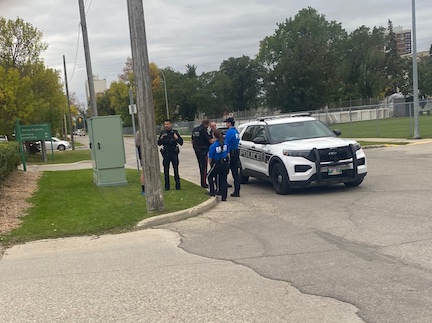
Boy, was I wrong! In short order three police cars arrived on the scene. There must have been at least eight police there at one point, along with two cadets. Wow! All this for distributing leaflets?
I continued watching what ensued – but I’m not exactly sure what happened. All that I know is that at one point Marty was handcuffed with his hands behind his back and put into a police car. What the hell was going on? I wondered.
Had Marty said something to the police? I should note that, in all fairness, Marty has a track record of getting himself into trouble with the law.
But still, is it now a crime to hand out leaflets in a public space? I again wondered. I stayed around for about 1/2 hour, but I had to go somewhere else for a while. I did return though about 1/2 hour later and there was still one police car there. I saw two policemen engaged in conversation with Ruth Ashrafi, who’s Regional Director for B’nai Brith in Manitoba. I asked one of the policemen whether Marty had broken any laws.
His response was: “Read Section 319 of the Criminal Code, Subsection 2.”
I waited unit I got home to look up Section 319 of the Criminal Code, Subsection 2. Here’s the Google description of what that section of the criminal code is about: “Section 319(2) of the Canadian Criminal Code governs the wilful promotion of hatred. It is a criminal offence to intentionally promote hatred against an identifiable group through statements made outside of private conversation. [1, 2, 3]”
”You’ve got to be kidding,” I thought. A Jew handing out a leaflet that’s critical of what fanatic settlers are doing on the West Bank is guilty of a hate crime?
Surely there must be more to this than that.
So I called WPS and asked whether there was a report of an incident outside the Asper Campus between 5:30 and 6:30 this evening? The person answering the phone said there was an incident, but said they couldn’t provide any further information.
I did call the media line and left a message, asking someone to call me because I was interested in learning more about what had happened – and why so many police were at the scene for what, for all intents and purposes, seemed nothing more than one person handing out leaflets.
I was so perplexed by what I had seen that I also posed this question to Google: “Is it against the law to hand out leaflets outside the Asper Campus?” (I thought that maybe there was some new kind of bylaw that had been passed of which I was unaware.) Here’s the answer I got:
No, it is not against the law to hand out leaflets on a public sidewalk outside the Asper Campus. Under Canadian law, peaceful distribution of leaflets on public property is a constitutionally protected right under Section 2(b) of the Canadian Charter of Rights and Freedoms, which guarantees freedom of expression. [1]
However, the legal landscape shifts significantly based on exactly where you are standing, what your leaflets say, and how you behave.
Where You Stand Matters
I • Public Sidewalks: If you are on the public city sidewalk outside the perimeter of the campus, you have the legal right to distribute pamphlets peacefully. A City of Winnipeg proposal in early 2026 (the Safe Access to Vulnerable Infrastructure Bylaw) attempted to ban “nuisance demonstrations” within 100 metres of community and cultural hubs, but after a major public outcry regarding Charter rights, the city councillor withdrew the proposed law. No such buffer zone exists today.
[1, 2, 3]
• Inside the Campus Property: The Asper Jewish Community Campus in Winnipeg’s Old Tuxedo neighbourhood is private property. Private property owners have the legal right to control or ban the distribution of materials on their premises. If you step onto campus property (such as their courtyard, parking lot, or inside buildings) to pass out leaflets, campus security can legally ask you to stop or leave. Refusing to do so can result in a fine under provincial trespassing laws. [1, 2]
Legal Limitations on Leafleting
While you can hand out leaflets on the public sidewalk, you must follow general laws regarding your conduct and the content of your message:
• No Obstruction: You cannot physically block or trap people, prevent them from entering the building, or obstruct pedestrian or vehicle traffic. [1]
• No Harassment or Intimidation: Leafleting must be peaceful. Loudly shouting, using unauthorized megaphones, or intimidating visitors can lead to police intervention or local noise violations. [1]
• Hate Speech Laws: The content of your leaflets cannot cross into criminal territory. Under Canada’s Criminal Code, distributing materials that promote hatred or contain antisemitic or defamatory statements against individuals can trigger police investigations and criminal charges. [1, 2]
Okay, with all that in mind, you be the judge. Do you think the leaflet Marty was handing out would constitute “hate speech?”
I’ve placed a call to Marty, asking him to call me to let me know what actually happened once the police came over to talk to him. At this point I know nothing more about the matter, but gee, is this what it’s come to: A citizen quietly handing out leaflets that I dare suggest have nothing at all to do with hate speech is apprehended by WPS?
And sure, I got an earful from one of the police who said to me that after what happened in Belleville you can’t be too careful these days, but come on, show a little common sense fellas – (and they were all men except for one female cadet).
(Updated Sept. 23 10:54 pm and amended Sept. 24 5:02 pm) I just got off the phone with Marty Green. He gave me a further clarification of what happened. Apparently he had been at the Campus on several other occasions – handing out the same leaflet. Marty said that he had received a lot of angry comments, but it wasn’t going to dissuade him from handing out the same leaflet as you’ve already seen. Until today though, the police hadn’t shown up.
This time they told him he was going to be charged with a hate crime and disturbing the peace. It was at that point he was handcuffed and put into a police car, he told me.
It seems though that, after some discussion among various officers who were there – and from what I could see it was two older, grey-haired police who seemed to be the ones in charge (Correction Sept. 24: Marty says it was two younger officers who arrested him, not the older guys) – the decision was taken to release Marty (Correction Sept. 24: Marty says: “They released me on an “‘undertaking’ that I wouldn’t go within 200m of 123 Doncaster, but I refused to sign the undertaking. So I didn’t agree to it. But I would be arrested immediately if I violated it. I’ll have to talk to my lawyer to see if I can challenge the undertaking (that’s why I refused to sign it). I was unable to contact a lawyer while I was in custody and was told that the hate crime charge would be dropped.”
The disturbing the peace charge, however, Marty was told, will still stand, and he can expect to have to make a court appearance at some point in the future. (He guessed it would be some time in December.)
Marty said that he thought there had been strong pressure put on the police to do something about his handing out leaflets, although when I asked him if he could give any specific names as to who might have exerted that pressure, he said he didn’t know.
I’ve deliberately avoided editorializing as I’ve been writing this, but my last word on what happened today is that if we can’t allow peaceful criticism of some aspects of Israeli policy – and I’m not talking about the kind of sloganeering we’re all so used to hearing and seeing from true haters of Israel, such as condemnation of Israeli “genocide,” “settler colonialism,” “apartheid”, and similar epithets, then we’re not the democratic Jewish community Winnipeg used to be.
I hope to have more on this story – which to me represents the kind of fissure that has developed within Jewish communities in so many parts of the world. So, keep checking back (and it’s not so that I can make any money by having you read this story. If you haven’t noticed yet, there are only two ads on this website. I maintain this website to provide an alternative point of view from the kind you’re going to get from all our established community organizations in Winnipeg.)
(Added Sept. 24): I have phoned the WPS media line twice now trying to get some understanding how an individual walking on a public sidewalk in front of the Asper Campus, handing out leaflets to anyone who was willing to take them – and not confronting or yelling at anyone, can be charged with “disturbing the peace,” let alone a “hate crime.” (At least the WPS officers who were going to charge Marty with a hate crime came to their senses on that one and dropped that charge.)
Look, I can understand people being on edge – especially with what happened in Belleville. I’m not naive or deliberately trying to downplay people’s nervousness. But heck, are we now at a point where anyone handing out leaflets in front of the Campus can be arrested? I realize members of the WPS are under tremendous pressure to “do something,” and I could tell by that comment from the young officer who told me to go read Section 319 Subsection 2 of the Criminal Code that members of the WPS have been given lessons about “hate crimes” and particular instruction to be on the watch for anything that might look like a potentially dangerous situation for members of the Jewish community, but come on fellas – use some common sense. Is that all it takes to get someone arrested: An individual or individuals say that they don’t feel “safe” – simply because someone is exercising his lawful right to hand out leaflets in front of the Campus?
If you want to comment on this story, I can withhold your name if you don’t want it published. Simply click on the button below that says : “Click to comment”
Comment received Sept. 26 from “Vika”: “You know too many fanatics like Marty Green coming to the Asper Campus. If you don’t know there is kids, our kids! And we want to keep them safe from the people like him. So we’re glad police was there very quick and they will continue to do this good job to protect Asper Campus from this crazy people.
Comment received Sept. 29 from “Wpg Jewish”: In response to Vika’s comment and community at large: Feeling uncomfortable is different than feeling unsafe. A man handing out flyers is not a violent or hateful act. If you are concerned about the content of the flyers, you should stand up for your beliefs and engage in respectful debate, just as this gentlemen appeared to do. You should be confident enough in your beliefs that the presence of a piece of paper should not make you crumple and fold (pun intended).
Comment received Oct. 1 from Wpg Jewish: There is something deeply unsettling in our community about those at the top controlling what information gets brought to the public’s attention and who gets to represent the community (yourself included). Makes me wish we had elections for our leadership.
Bernie Bellan: I’ve just got to respond to that comment. Me “at the top controlling what information gets brought to the public’s attention?” I’d hardly put myself “at the top” – more like “the bottom” as far as what a lot of people would say. And as far as “controlling information” goes, this website is open to anyone to contribute if it’s about the Jewish community in Winnipeg. You’ve emailed me before. Your comments are always interesting, but you’ve never asked to have me post anything to this website. I’d be glad to do that – so long as it’s not defamatory – and reasonably well written – which I already know you’re capable of doing.
Local News
Regan Katz manages not just one, but two different – and successful baseball teams in two different cities
By BERNIE BELLAN About three months ago I wrote a story about an up and coming local football star by the name of Gavin Katz – who, although only 14 years old, had already received widespread recognition for his defensive abilities on the football field. (You can read that story at “Gavin Katz: ‘The next great Jewish football player’.”)
Gavin had been both a linebacker and defensive lineman for his pee-wee Fort Garry Lions Bantam football team – and he was voted most outstanding defensive player on his team by his coach, John Makie.
One thing that stood Gavin in especially good stead as a football player was that, in his 14th year, he grew 4 inches to 5’8″ and added 35 pounds to weigh 170 pounds at the time I spoke to him in July.
With him graduating from Ecole River Heights last June and moving on to Kelvin High School this September, Gavin had hopes to make the Kelvin football team, but he was realistic about his chances, saying that he thought he would probably “end up on the practice roster” for the Clippers varsity team “where he will be fighting for a playing role,” because if he did make the team he’d be among the youngest players on the team (which is usually made up predominantly of players from Grades 11 & 12).
Well, as I noted in my introduction to my story about Gavin Katz, the idea for doing that story came from sportswriter Scott Taylor. Recently, Scott sent me another email about a story, but this time the idea he suggested was to do a story about Gavin’s father, Regan.
I had mentioned Gavin’s parents’ names in my story about Gavin – also that Regan is former Mayor Sam Katz’s nephew (His father is Sam’s older brother, David), but other than adding Gavin’s mother’s name (Mandy), I didn’t go into any detail about Regan Katz and his own very successful career.
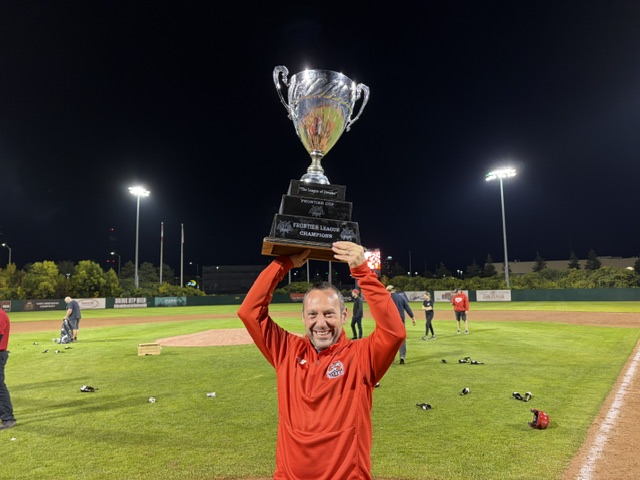
Then I received another email from Scott Taylor, this time about Regan (with a photo attached):
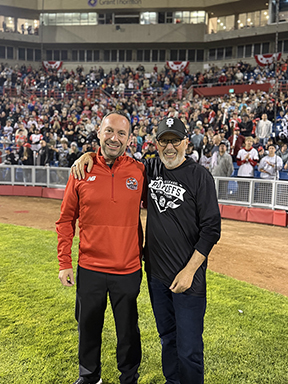
“Here’s a photo of the best baseball executive in Canada — Regan Katz.
“He runs both the Goldeyes and the Ottawa Titans. He helped get the Goldeyes to the playoffs, just won a championship with the Ottawa Titans and also set the affiliated minor league attendance record in Ottawa with more than 10,000 fans for the Frontier League opener and again for the Championship series.
“This guy has his shit together.”
And so, since my story about Gavin Katz was one of the most widely read stories on this website this past summer (It was also very widely read in the print Jewish Post newspaper.), I decided that, if Scott Taylor sends me a story idea, it’s an idea worth following up.
Which led me to contacting Regan Katz again. (The last time I contacted him it was to see whether he could wake Gavin up to talk to me. After all, like most teenagers, Gavin likes to sleep in when he can, but it was already 11 am on a Saturday morning when I was calling, so I figured: “Dad, go wake up your son. There’s a not-so-important journalist who wants to talk to him.”
Which is how I ended up having a very enjoyable interview with a very personable and unassuming young man – who did seem a little bit drowsy as I talked to him.
This time though, when I spoke with Gavin’s father, Regan was very much alert. Considering the hectic schedule he maintains though during baseball season, I could have forgiven him for sounding just a wee bit tired himself. But, at the time we did our phone interview, Regan’s baseball season had wound up. He sounded quite relaxed – still very much enjoying the accolades he had received for his work running not just one, but two different minor league baseball teams.
Before I began to ask Regan about his life in baseball, however, I wanted to touch base with him about Gavin’s football career. By now, the high school football season was in full tilt, and I was curious to know whether Gavin had made the Kelvin football team?
Regan told me that Gavin was one of only three “freshmen” to make the team and “Gavin’s the only one who started every game, and, yesterday got defensive player of the game” (which would have been played Thursday, Oct. 1, as our interview was conducted Friday, Oct. 2.)
I asked Regan whether Gavin was still playing linebacker (which, Gavin had told me, was his preferred position on defense)?
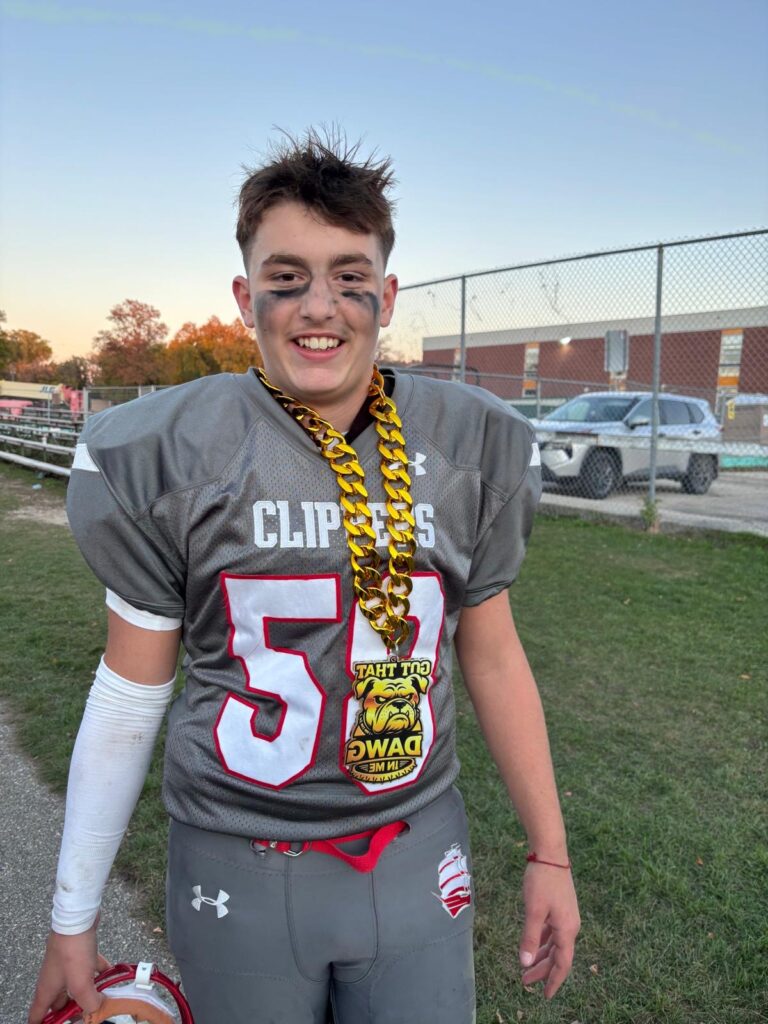
Regan responded that “they moved him to defensive tackle, so he’s right in the front line instead of at the back, but he’s breaking through the offense and helping the linebackers take down the tackles. He got two sacks yesterday and two running back tackles, which is not his job, but he’s breaking (through) kids larger than him and making his way through.”
At some point, as we follow Gavin’s football career, I hope to provide further updates as to his success on the “gridiron.” (By the way, the term “gridiron” – which refers to a football field and which used to be used quite often by sportswriters in the past “comes from the historical layout of the field, which was marked with intersecting lines every few yards that made it look like a metal cooking grate (or gridiron) used for broiling food over an open fire.”)
Enough about Gavin. Now, here’s the main point of why I wanted to do this story, which was to write about Regan.
I asked him how long he’s been involved with organized baseball?
He answered: “I’m in my 28th year.” As Regan observed, although he was born in Winnipeg, “when I was three, my dad decided he was allergic to snow and moved the family west (to Victoria). I came back in my late teens and joined up with the Winnipeg Goldeyes.”
Even before Regan moved back to Winnipeg, however, he had already embarked on a business career in his early teens, working for Westfair Foods (owners of Superstore and Wholesale Club) in British Columbia, helping to build grocery stores all over the province.
As he explained it, “So, when they would open up a new store, I would be the regional person who would go in and ensure that the setup and the staff was on plan.”
Regan was also responsible for training the staff and making “sure that everyone was ready” – traits that were to prove indispensable to what was to come during his current career in baseball. ”I was part of seven store openings in a two-year span, in that role” (with Westfair), Regan added.
He noted that when he left, he told them he was taking a “two-year sabbatical from the job.”
Regan added though, that “since I haven’t gone back, I assume they figured out I’m not returning.”
I asked: “Well, have they sent you a message saying, ‘Hey, the door’s still open?’ “
Regan answered: “No, but every year I get my superannuation for the time I served with them.”
He went on to note that he got married in 2010, “to a wonderful Manitoba woman, ” (Mandy, whose maiden name Gavin had told me, was Falk.)
Sam Katz actually revived the Winnipeg Goldeyes as a baseball franchise in 1994, when the team played out of the north end of what was then Winnipeg Stadium – in what was a very oddly shaped baseball field.
Regan, who came on board full-time with the Goldeyes in early 1999, says that he had spent some time with the team during a few previous summers spent in Winnipeg and had been able to see the Goldeyes play on that field which, he says, was affectionately known as “Deformity Field.”
(The left field fence was only 225 feet from home plate. It was a hitter’s dream – knocking easy home runs over that very short distance to the fence.)
Regan arrived in Winnipeg, however, just in time for what was to be the first season in what was to become the Goldeyes’ new home – what was then called CanwWest Park (now Blue Cross Park), in 1998.
His first title with the Goldeyes, he said, was “account executive, but I was truly a ‘gofer,” he observed.
“At the time construction was on full throttle at the new ballpark – downtown. And so, we were commuting from our offices on Maroons Road (where Winnipeg Stadium was located), and on McDermot – at Sam’s offices for Nite Out (Entertainment), as well as the ballpark trying to get things set up.
“So, when I wasn’t hauling or setting things up, I was making calls off a list to try and convince people to buy tickets.”
In those early years with the Goldeyes, as Regan noted, he was mostly involved in ticket sales, and in “2003, I moved to director of group sales and looked after all of our group sales, which are the outings where people are coming out (for things like) birthday parties, baseball teams, family gatherings, that kind of thing.”
In 2005, Regan moved up from director of group sales to assistant general manager, then in 2016 to vice president and chief operating officer – which are the positions he holds to this day.
In March 2020, however, Regan and his uncle Sam Katz took a trip to Ottawa – just as Covid was beginning to shut down things everywhere – including sporting venues.
There was a baseball park in Ottawa – called Ottawa Stadium, owned by the city, that was sitting empty.
As Regan explained, the city was “taking RFPs for an operator. (It had) sat empty for a year and a bit, and its previous occupant had left all kinds of turmoil and unpaid bills and whatnot.
“So they were looking for a team, trying to decide what to do with the venue. So we went out to tour – just as COVID shutdowns were starting in late March. We toured the venue, contemplated for a bit. And so, we went back and forth for a while, trying to decide if this was something we wanted to take on.
“In September of 2020, we agreed to terms with the city on a lease for the venue. We couldn’t travel across the border, so we started the team in 2022.”
The Ottawa team, known at the Titans, play in what is called the “Frontier League (which will be rebranding in 2027 to become the “National Association.” The Goldeyes, by the way, are in a league known as the “American Association.”)
There is a difference in the calibre of baseball players in the two leagues, as Regan explained to me: Players in the Frontier League would move up to Single A baseball, while players in the American Association would move up either to Double A or Triple A. (The level of baseball in the American Association is at a level wherein you can often see former major leaguers playing on teams.)
As vice-president and chief operating officer for both the Winnipeg Goldeyes and the Ottawa Titans, Regan said that he oversees general operations for both teams, but is not involved with the day to day management of players or coaches of the teams. That is the responsibility of the teams’ general managers and field managers, he clarified.
While there is no specific award for executive of the year in either the Frontier League or the American Association, when Scott Taylor wrote to me that Regan Katz is “the best baseball executive in Canada,” he didn’t say that he was referring only to minor league baseball.
As Regan noted, the Goldeyes received an award for “Game Presentation of the Year” this year, while the “Ottawa Titans received the Commissioner’s Award of Excellence.”
“When we started the (Ottawa) team five years ago,” he observed, “we were averaging about 1,200 fans. This year we were in excess of 2,600. We set attendance records, both for the ballpark in Ottawa, as well as for the league. We also sold 10,278 tickets to our opener, which is a record that will probably stand true for the rest of time.”
As far as the Winnipeg Goldeyes’ season went, not only did the team perform well on the field, making it to the first round of the playoffs, average attendance was the highest it’s been since before Covid, with games averaging over 4,000 fans.
Not only that, but the Goldeyes received a number of accolades for how they produce their games.
“Our broadcaster got Broadcaster of the Year,” Regan noted. (The games are broadcast on Nostalgia Radio Station CJNU. The play by play announcer is Trevor Curl.)
“We (also) received Game Presentation of the Year, which, you know is a big one because that’s what we work so hard on. What we’re selling – it’s all about fan experience.”
Regan continued: “Obviously, we try to put together a winning team, but to us, it’s all about having fun at the ballpark, win or lose – even if you don’t like baseball. So that one meant the most to us.
“We also won Social Media Team of the Year – for Winnipeg. All three of (those awards) are big ones to us because they’re pieces that we choose and work hard on.
“The essence of what I do (is) we’re trying to put on family entertainment that happens to have a baseball game in the background. ..and that’s what we built in Winnipeg.”
I asked Regan whether “in terms of, of how you rate in in Minor League Baseball – without trying to blow your own horn, I know the Goldeyes have always been considered a top-notch operation. Have the Goldeyes received any particular awards from organizations that look at all of minor league baseball and compare all teams?”
“ ‘Baseball Digest’ has acknowledged us a number of times over our 33 years for various pieces of what we do,” Regan answered, “whether it be attendance or game experience or most creative promotion. We’ve certainly received many, many mentions in ‘Baseball Digest,’ which is probably the most well-known for all of Minor League Baseball and independent leagues for sharing what’s out there.”
I asked Regan – and it was based on everything he had told me to that point: “Has anyone in a much more senior league tried to recruit you?”
He responded: “Are there headhunters out there who have called me? Absolutely, yes. Many, many teams call me to consult all the time, but I do keep my advice and recommendations to those within our league because I want to see the leagues that we’re in succeed.”
Regan added: “I have a young family. (In addition to Gavin, the Katz’s have a daughter, Brynlee, who is nine). I like where I’m at. I don’t think any other team is going to come to Winnipeg, so I’m well-planted here.”
My final question was about how difficult it is to run two separate teams that are so far apart?
He answered: “Anybody else who has overlap between two teams has a much shorter commute than I do – with a three-hour flight each way. It’s incredibly challenging. Fortunately, technology’s made it a lot easier with virtual meetings and things like that. I speak with my staff in Ottawa every single day. I’m in constant contact with at least some of them, if not all of them. All of our meetings are virtual so that I can be part of them.”
Only 47 years old, Regan Katz has been working full time since he was a young teenager. I didn’t even mention that, while he was working for the Goldeyes here after he had just moved to Winnipeg, he managed to finish university, where he studied business administration. If anyone would be interested in learning about business administration, with everything he has accomplished so far, Regan Katz could be the perfect teacher.
Local News
Federation mission to Poland mix of heartbreak and celebration
By MYRON LOVE For Sheila Rabb, her first visit to Poland was “both heartbreaking and heartwarming.”
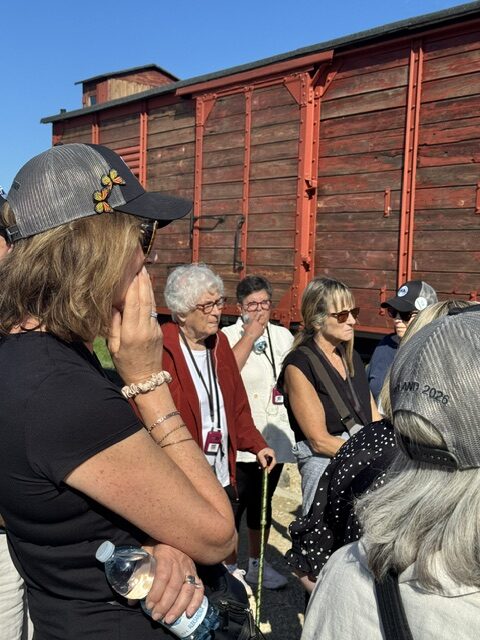
The 90-year-old Rabb was one of 34 participants in the Jewish Federation of Winnipeg’s first ever organized Adult Mission to Poland. The group toured Poland from Wednesday August 26 – Monday August 31, with an entourage of Israel and Polish tour guides, a security guard ,and two bus drivers.
It was Jeff Lieberman, CEO of the Jewish Federation of Winnipeg (and whose late father, Aron Lieberman, was a Holocaust survivor who was originally from Poland) who initiated the trip. “In 2023,” he recounted, “shortly after I was appointed CEO, I learned we had never organized an adult mission to Poland. Given the passage of time since the Holocaust and the tragedy of October 7th, I thought there would be interest in offering this meaningful trip to our community.“
The six-day journey,” Lieberman continued, ”taught us about the 1,000 years of mostly good and impactful Jewish life in Poland before 1939, as well as what happened during the Holocaust. We visited several sites including the Warsaw Jewish Cemetery, the Polin Museum, synagogues, the Krakow Jewish Community Centre, the Lodz Ghetto, Majdanek and Auschwitz-Birkenau concentration camps, and the Chelmo death camp.
Lieberman noted that the group bonded very quickly. ”We learned so much,” he said. “We cried together and we celebrated together. Many of the people that went on this mission have said how life-changing this trip was for them.”
In particular, the Federation CEO singled out the presence of Sheila Rabb. He describes her as “incredible”. It was a difficult tour with much walking and standing at sites, he noted.
“She was a real trooper,” Lieberman said. “Sheila was able to able to experience this meaningful journey with her children. It was truly special for us to have Sheila and her children, Ian and Irene (Zimmer), join us.”
“There was a wheelchair available for me if I needed it,” said Rabb, who looks much younger than her years. “I must admit that the heavy schedule of 12-hour days and late dinners was a challenge. But everyone was so nice and helpful and protective of me.”
Sheila Rabb’s connection to Poland was through her mother, Molly (Horn) Pitch. Fortunately, she was able to emigrate in the early 1930s. (Sheila’s father, Willy, came here from Russia about the same time.) Molly was able to bring one brother over but sadly, all but one sister were subsequently murdered by the Nazis.
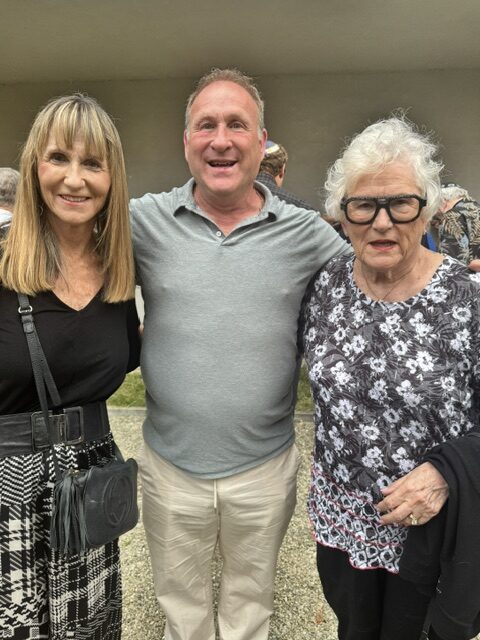
The group began their journey in Warsaw with a visit to the Polin Museum which – Rabb noted – was built by Ron Lauder, president of the Estee Lauder Foundation. The museum recounts over 1,000 years of Jewish life in Poland.
“We learned about Jewish life, how Jews contributed to Polish society and the rich communities that existed throughout the country,” Lieberman reported.. “You can’t talk about Poland without including the impact of what Jews did for Poland.”
Both Rabb and Lieberman have fond memories of a group of Israeli high school students that that they met at the museum, who were from Ulpanat Chorev High School in Jerusalem. “We joined them in singing Hatikvah and other songs and danced a hora with them,” Lieberman said. “We ran into them again at Mila 18 and Auschwitz, and their Head of School invited us to join them for Kabbalat Shabbat in Krakow.
“Our group had the amazing experience of celebrating Shabbat with them,” he continued. “The women were so joyous, and their enthusiasm helped us emotionally after what we had experienced during the first few days of the mission. Their presence and the sorrow they expressed at the sites we shared with them had a profound impact on all of us.”
The group’s time in Warsaw also included a visit to a Jewish cemetery with over 250,000 graves and a walking tour of the famed Warsaw Ghetto.
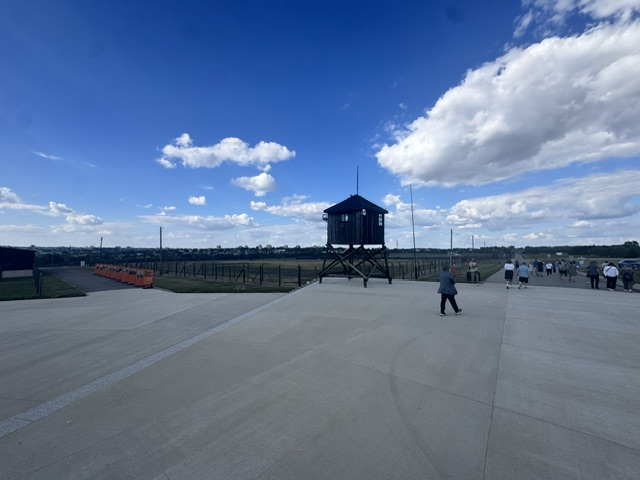
The next stop was Lublin and the Majdanek death camp.
“One can read the books, watch the films and visit the museums, but nothing prepares you for walking the grounds of the death camps and mass grave sites and the profound sadness and shock that accompany them,” observed Jewish Federation staffer Abby Flackman, who was also part of the mission. “Walking in Auschwitz, Majdanek and the forest graves of Chelmno, I felt, validated the lives that were taken. We take the memories of their experiences and assure that they will not be lost with time.
“But,” she added, “we also showed that we are still here. We are still laughing and feeling joy, supporting one another and proud of who we are.”
On the other side of the coin, the group witnessed the ongoing rebirth of Poland’s Jewish community. One site that Sheila Rabb recalled in particular was the reconstituted Lublin yeshiva. The yeshiva, which opened in 1930, was one of the largest in the world. The building was restored by the Jewish community in 2003 and reopened as a synagogue in 2007.
On the Friday of the tour, the group arrived in Krakow, where they toured the old Jewish quarter where, Ian Rabb noted, there are still many Jewish-owned businesses – also the Schindler factory museum. He reported that Krakow has a Jewish population of about 1,200, as well as home to the internationally known annual Krakow Jewish Festival.
Sheila Rabb spoke about a 97-year-old Holocaust survivor the group encountered, who told his story. Although he had lived in California most of his life, he felt the need to return to Poland two years ago.
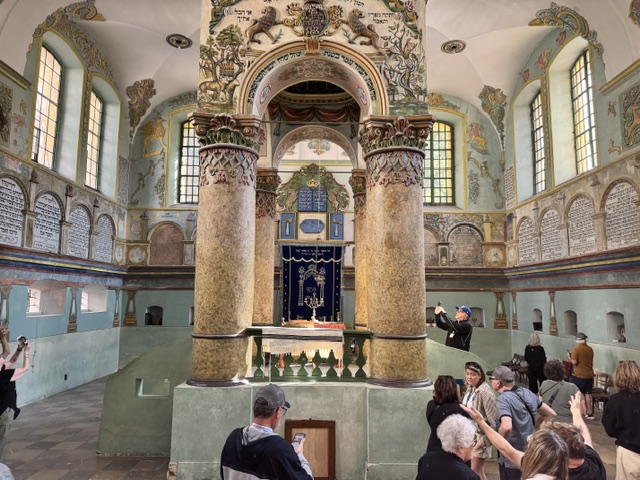
While in Krakow, the group made a day trip to nearby Lancut, formerly a Hasidic stronghold, where the members of the group toured the synagogue that was built in 1761 and has been well preserved.
“The synagogue was unreal,” Ian Rabb commented. “It has an art deco design that exudes spirituality and kabbalah.”
The Winnipeggers finished their tour with a visit to the Lodz ghetto. Lodz was an industrial city and the last Polish city to be made “Judenrein” because the Nazis needed the Jewish factory workers to build tanks and sew German soldiers’ uniforms.
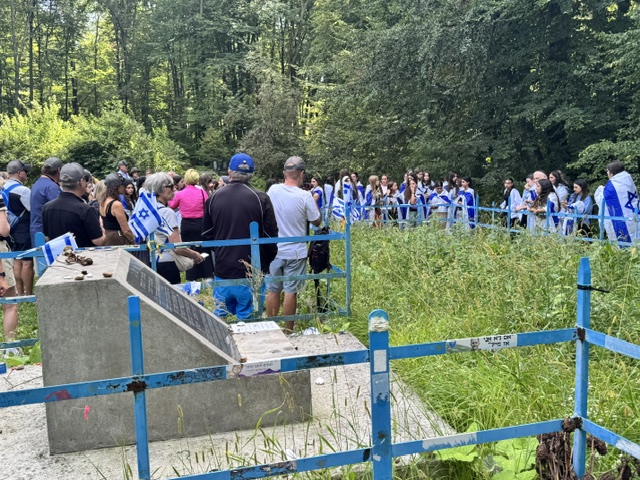
For Sheila Rabb, one of the most difficult moments was standing on the site of the mass grave in the forest near the Chelmno death camp, not far from Lodz, where up to as many as 300,000 victims of the Chelmno gas chambers were buried.
“We recited kaddish over the site,” she said.
Sheila Rabb hac high praise for the Winnipeggers’ Polish and Israeli tour guides, Janush and Mordechai. ”They were outstanding,” she said. “They really brought history alive for us.”
Ian Rabb reports that his cousin (and Sheila’s nephew), Alan Pitch, who was also part of the group, is working on a documentary of the trip.
The last word goes to Abby Flackman. “My biggest takeaway,” she said, “is that we will control how our story ends. The Nazis tried to end our story of the Holocaust. They failed. We went elsewhere, built communities and institutions, grew again in numbers and continue to strive to become stronger, more resilient and thrive.”
