



Local News
Sharon Graham winner of the 2020 Switzer-Cooperstock Prize in Western Canadian Jewish History
By MARTIN ZEILIG
The Winnipeg Jewish Orphanage housed children from 1917 until 1948, and for a long portion of its existence it was served by an untrained social worker, Pearl Finkelstein (later Silver), Sharon Graham, PhD, writes in her paper, “Pearl Finkelstein, Unknown Hero: the Winnipeg Jewish Orphanage and Social Work in the Winnipeg Jewish community in the 1930s”.
Finkelstein is an unknown hero because “I could not find any information about her work as the social worker in the many Orphanage documents that are held by the archives of the Jewish Heritage Centre,” according to Dr. Graham.
Dr. Graham’s 25 page (intensively researched) paper was the winner of the 2020 Switzer-Cooperstock Prize in Western Canadian Jewish History. The Switzer-Cooperstock comes with a $6,000 award. It was established by the Switzer family in memory of their parents and grandparents. This year, the public presentation will be presented online on October 15th, 2020 at 7 pm.
Graham worked on her PhD at the University of Manitoba, Faculty of Graduate Studies, Department of History.
The title of her dissertation was “Building Canadian Jewish Citizens out of the abandoned children of Western Canada: The Winnipeg Jewish Orphanage, 1917-1948.” Graham was awarded the U of M’s 2019 Faculty of Graduate Studies Research Completion Scholarship for her dissertation.
This article is based on excerpts from her prize winning essay, as well as a recent email interview she did with The Jewish Post & News.
“I researched the history of the Orphanage for my doctoral dissertation, and in my research I came across Finkelstein (her later married name was Silver), and my interest was piqued,” Graham said.
“Miss Finkelstein had volunteered with the Jewish Orphanage as a young woman, and was hired to succeed the Orphanage’s first social worker, Bertha Koyle. Unlike Koyle, who had worked at the Orphanage as a nurse, Finkelstein had not worked professionally within a child care setting. But instead of searching for a trained social worker, the Board and Superintendent of the Orphanage chose a woman who had grown up within the Jewish community of Manitoba and who intimately knew the families she served. By doing so the Jewish community gained a worker who was emotionally invested in protecting her community’s children and families from illness and distress.”
Pearl Finkelstein (Silver) worked very hard without much historical recognition, Graham, who noted that Finkelstein died at age 95 in 1991, emphasized.
“As a working woman, she was able to use her experience as a dedicated volunteer to transition into a new career as a social worker,” she said.
“This career became her life for many years, and it is undeniable that she was able to help many Winnipeggers. When reading her notes, I was struck by how friendly her tone was to her clients, and how willing she was to see their virtues instead of their flaws. Finkelstein tended not to deliver lectures. Instead she dedicated herself to her clients’ difficulties, and was willing to listen to their needs. Finkelstein chose a life of service, similar to the choice made by Jane Wisdom, and both women stated that they were glad they had done so.”
Because of her choice, the Orphanage children were found jobs, foster homes or boarding homes, and had a softer launch into the world, Graham observed.
“Families who needed the Orphanage temporarily for child care were given help in finding new homes, jobs or medical care in order to be able to bring their children home,” she said.
“The history of the Winnipeg Jewish community often focuses on the men who established institutions and ran them, but the women who often fundraised, planned and ran the institutions as paid staff can sometimes remain anonymous. The extent of Pearl Finkelstein’s work was unaccounted for in official histories, but the Jewish Orphanage Children’s Records revealed just how much work she did to help Winnipeg families and children during the Depression.”
Graham noted that she’s submitted a proposal to turn her dissertation into a book to a publisher.
“I’d be honoured to bring the history of the Winnipeg Jewish Orphanage, including Finkelstein’s pioneering role, to a larger audience,” she said.
She also labelled the JHC a wonderful resource for the Winnipeg community.
“I’m grateful for all their help, especially when I was researching my dissertation,” she said. “I also want to thank the prize committee and the Switzer family for this generous award. I look forward to presenting this essay to the community.”
Local News
Hundreds rally against opening of Nakba exhibit at Human Rights Museum
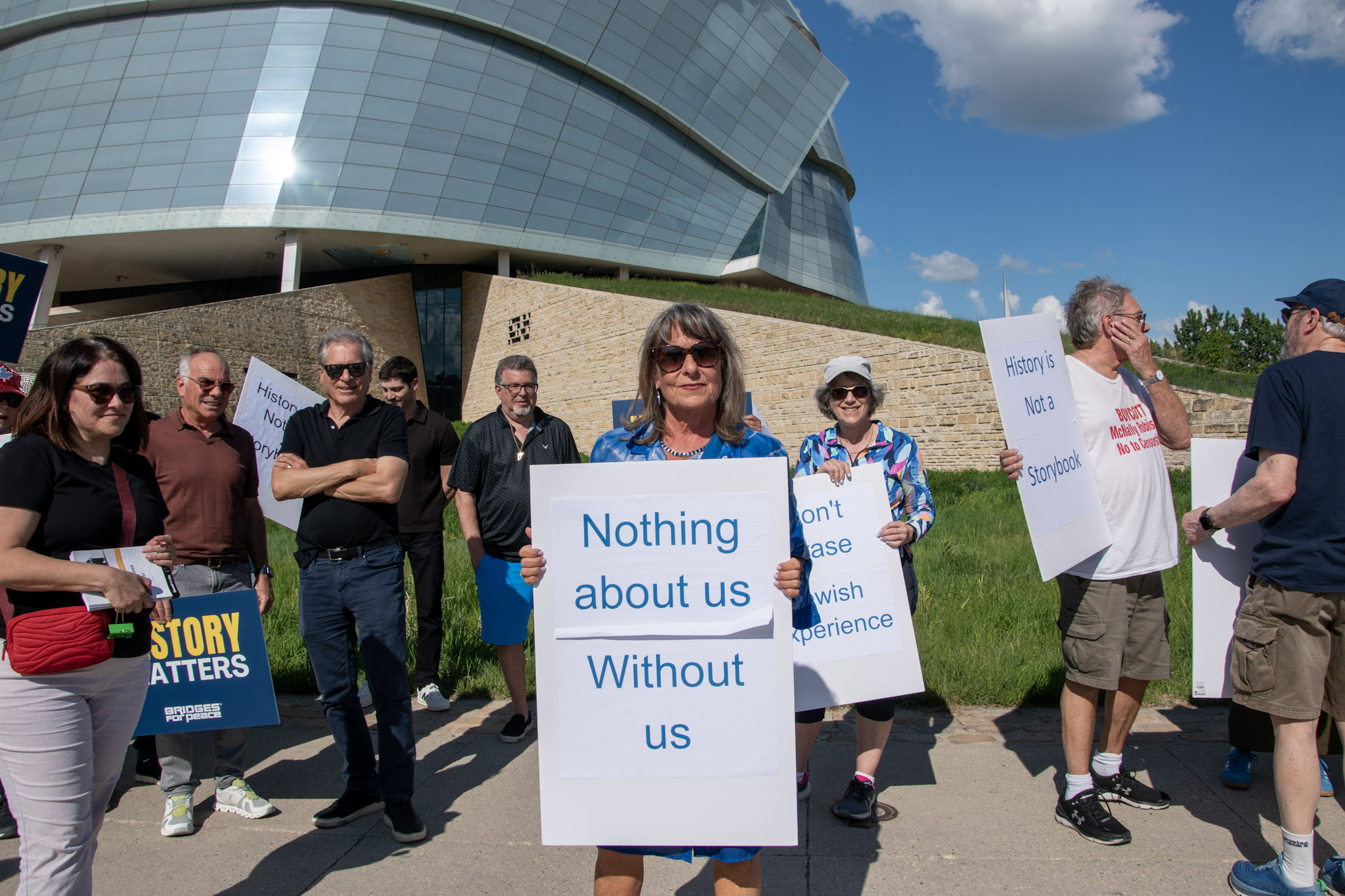
By NOAH STRAUSS Around 300 people gathered outside the Canadian Museum for Human Rights on Friday during the grand opening of the museum’s newest exhibit, “Palestine Uprooted: Nakba Past and Present.” (Ed. note: The CBC report on the protest said there were “100” people at the rally. I know there were more than 100, but I’m not sure there were 300 either.) The exhibit, which had a limited number of tickets available for opening night, sold out. The Canadian Palestinian Association of Manitoba had originally planned a rally in support of the exhibit’s opening, but it was cancelled just days before the event.
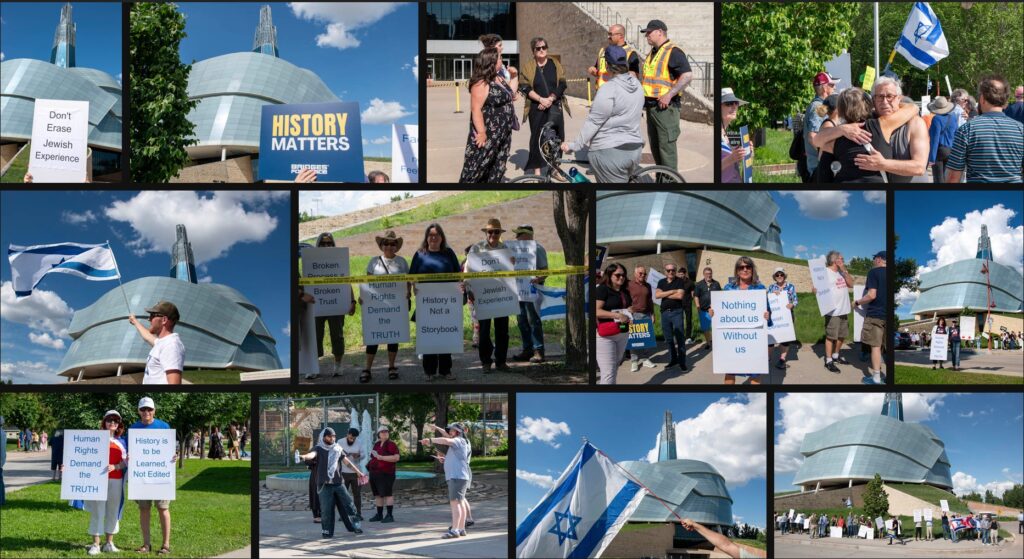
The Nakba, which means “catastrophe” in Arabic, refers to the displacement of an estimated 750,000 Palestinians during the 1947–1949 war surrounding the establishment of the State of Israel. The exhibit has drawn criticism from members of Winnipeg’s Jewish community and others who argue that it does not acknowledge the displacement and persecution of Jewish communities in many Arab and Muslim-majority countries following Israel’s independence and the 1948 Arab-Israeli War. Historians estimate that between 850,000 and 950,000 Jews left or were expelled from Arab and Muslim-majority countries during the decades surrounding Israel’s establishment. In countries including Iraq, Egypt, and Yemen, many had their property confiscated, while others left because of persecution or increasing hostility.
Supporters of the Jewish community came from all faiths and backgrounds. The Jewish Post spoke with Lisa Lewis, a longtime supporter of the Jewish community.
“I think there is a crisis of antisemitism happening right now,” Lewis said.
She was one of many non-Jewish community members who attended the rally. Lewis said she has been an active ally since the 2000s, helping Argentine immigrants come to Canada. Following the October 7 attacks on Israel, she said she has become a more vocal supporter of the Jewish community. During the rally, she wore a Magen David necklace.
Lewis also criticized the museum’s approach to the exhibit.
“The Jewish community organizations that represent the majority of the Jewish community weren’t consulted on something like this,” she said.
Cindy Clubb, another ally of the Jewish community who attended the rally, also voiced her concerns.
“I grew up with prominent businesspeople and members of the academic and medical communities. I don’t know what we would do without our Jewish cooperation. So I’m up here to support them, and I think all of Winnipeg should be out here,” Clubb said.
One protester, who identified herself as Michelle, said, “We are against the Nakba exhibit. It’s all lies.”
Gustavo Zentner, Vice President of CIJA Manitoba and Saskatchewan, said, “We are calling on Minister Miller to hold the museum leadership accountable. The Minister of Canadian Heritage needs to ensure that national institutions are not weaponized against Canadians to serve a one-sided political agenda. These concerns were expressed not only by the Jewish community, but by many concerned Canadians. At its core, this is a Canadian issue.”
Zentner did not participate in the community rally. He went on to say, “We are proud of the many community members, allies, and organizers who gathered at the museum before Shabbat began to demonstrate their concerns.”
The museum defended its decision to present the exhibit. CEO Isha Khan said that “human rights matter precisely when they are inconvenient.” She added that the museum “belongs in the collective memory of Canadians.”
The exhibit is scheduled to remain on display until November 2028.
Local News
Interviews with the curator of the Nakba exhibit and the CEO of the Human Rights Museum
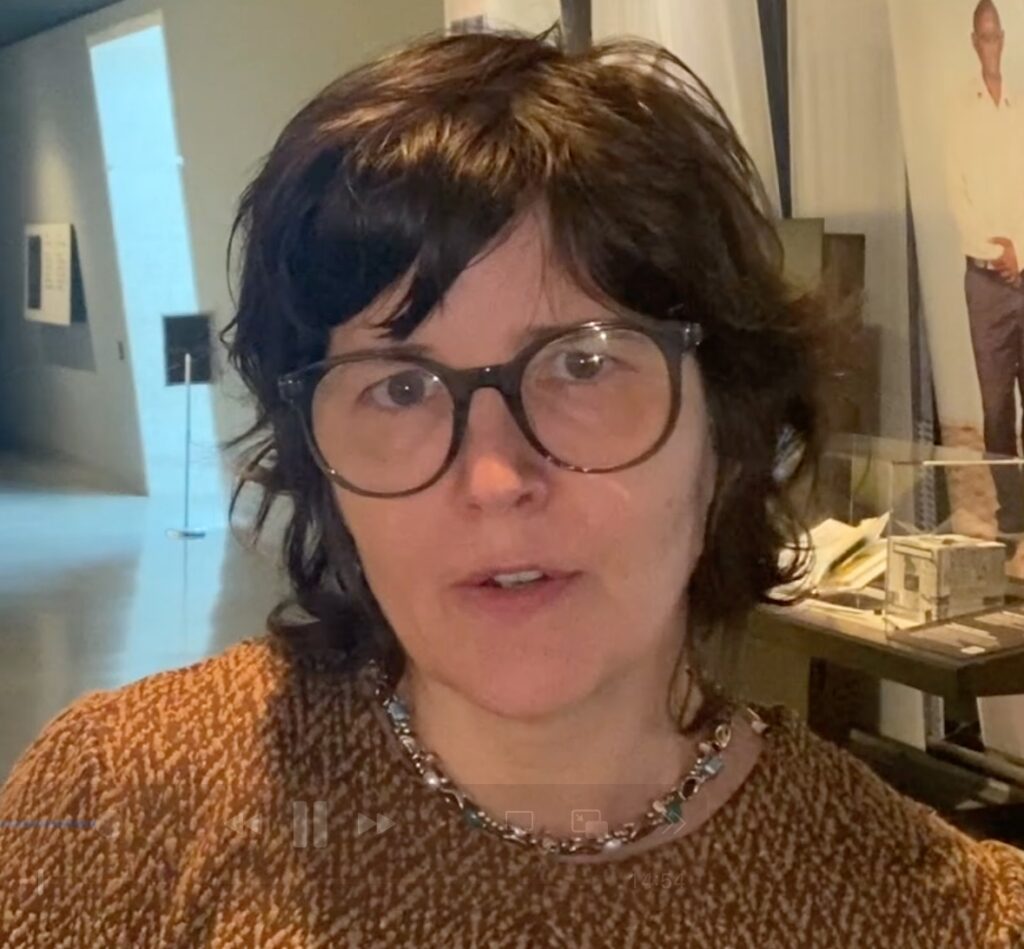
By BERNIE BELLAN On June 26, I was invited to attend the Canadian Museum for Human Right to see the Nakba exhibit prior to its being opened to the public. While I was there I was given the opportunity to interview the curator for the exhibit, Isabelle Masson, along with CMHR CEO Isha Khan. What follows are the transcripts of those interviews (edited only to remove pause words like “uh” and phrases that were repeated). The first interview was with Isabelle Masson:
Jewish Post: Several representatives of Winnipeg Jewish community organization say that they weren’t fairly consulted on this exhibit. How do you respond to that?
Masson: We came to this project with an awareness that Palestinian voices are often marginalized, even silenced, and an awareness that Islamophobia and anti-Palestinian racism have an impact on whose voice is heard and whose suffering is recognized. And so we intentionally chose to centre Palestinian voices with this exhibition.
JP: But to the point that many Jewish representatives of organizations and people within the community at large feel that the Jewish community should have been consulted on an issue that had such a direct impact on the Jewish community – did you not feel an obligation to consult with the Jewish community?
Masson: I think the best person to talk further about this issue is our CEO, Isha.
JP: In terms of the exhibit itself, I must say it really stresses the suffering that Palestinians have endured. But, in looking at other refugee situations around the world, the Palestinian situation seems to me to be unique in that there has never been an effort to resettle Palestinians within the countries to which they were forced to flee.
Do you not think that separates their situation (from other refugee situations) and, in some ways, it has made their situation worse than it could have been?
Masson: Well, the exhibit not only centres that experience of forced displacement and disposition as a longstanding experience across five generation that you know is tied to human rights violations that are ongoing today, but it also I want to point out, you know, foregrounds beauty, foregrounds resilience, foregrounds the maintenance of identity and belonging across time and across that experience. So there’s also these elements about this exhibition because it was also about humanizing Palestinians – about people with families with stories, with creativity – and coming back to some of the videos what interviewees say, right, we hope that Palestinians can be seen as fully human and hope that they can see Palestinians as having human rights and this this story today in this gallery is is a story about human rights.
JP: If I can focus on one particular aspect of the exhibit that I read this morning when I was sent the preview, it referred to what happened between the years 2000 and 2005 as a Palestinian uprising. But the Israeli term would be the Intifada which for them meant large-scale attacks – terrorist bombings by some Palestinians. Did you not think it necessary to include that in a larger context?
Masson: Well, we use uprising because it’s the most more accessible term in the exhibition and we, you know, we’re focusing really here on an artwork by artists – Palestinian American artist Reggie Cook and with an artwork that was trying to translate the experience of of occupation into what is created. So that’s the context in which we talk about that.
JP: But to ignore what happened during the uprising seems to me to leave out a major part of the context.
Masson: I don’t think that we are ignoring that. This exhibit is not about the full story of what has happened in Palestine, in Israel. It’s not, you know, the scope of this small exhibition. This small exhibition has a scope and the scope was really to create an opportunity and a place for Canadians to be able to encounter Palestinian Canadians and hear their voices.
JP: Given the current mood in the Middle East and the ongoing tensions between Israel and various other actors, the concern among many in the Jewish community that this is going to lead to a heightening of antisemitism and an exhibit like this seems that it’s not going to do much to improve relations between Jews and Palestinians when it focuses on only one side of the story. How do you respond to that?
Masson: Well, this is only one exhibit of of many, of many stories that we have.
Following is my interview with Isha Khan. Khan began by explaining that she is “the CEO at the Canadian Museum for Human Rights and I’ve been here as CEO of the museum since August of 2020. So almost six years.”
JP: So let’s get right down to discussing (the exhibit). I spoke to the curator. I asked a lot of questions about the exhibit itself. I’m more interested in asking (you) about the general context and the atmosphere in the community. The accusation has been made repeatedly by various leaders of Jewish organizations that you have not been willing to consult on this exhibit. How do you respond to that?
Khan: I think the word consult can mean many things. We have a community engagement practice. So for us that means that depending on the scope of the exhibit and this exhibit is about Palestinian Canadians and their experiences, the impacts of the human rights impacts, of forced displacement, which means we engage with that community as we share their stories. Many folks in the Jewish community will say we haven’t consulted with them and yet we have met with leaders of Jewish organizations from across Canada, main uh, major federations, foundations, local Jewish organization representatives many times to talk about this exhibit, to explain what its scope is, what it’s about, what it’s intended to do, and most importantly, what it isn’t. And unfortunately there continues to be misconceptions about what it is. So we hope people will come and see it.
JP: I think the fear in the community – and I think it’s well founded is that this will foment an increase in antisemitism. Can you understand that concern?
Khan: Absolutely. I personally and any member of our team who’s talked to folks about this has said that we unequivocally share the concern about antisemitism in Canada today. That is part of our mandate. And we will continue to do that work and we can also share these stories of Palestinian Canadians – you know, telling the story of one community’s human rights violation in no way should negate or minimize the experience of another community. That’s what this museum was designed to do….designed to build understanding of shared humanity and that’s what we believe we’re doing responsibly.
JP: Just before I began this interview, I was taken (down to the fourth floor; the Nakba exhibit is on the fifth floor) to see the gallery of other human rights violations. I’m not sure what it’s called. (It’s where there is a ) recitation of various human rights violations, including what happened in 1947 and 1948 (in Palestine). They offer passing reference to the displacement of both Jewish and Palestinian refugees. Would you consider ever having an exhibit about the displacement of Jewish refugees from Arab lands in 1948 and subsequent years?
Khan: We would absolutely consider it and in fact have shared with leaders of the Jewish organizations months ago that yes, these are important stories that need to be told (and) invited them to work constructively with us on developing that content. Unfortunately we didn’t really receive much response.
JP: How long is this exhibit supposed to be on for?
Khan: So this exhibit right now we’re saying is a minimum of two years. That’s because it is an exhibit in a standing gallery and so it also depends on our updating of our other galleries and, you know, exhibits take a bit of time. This one is four years in the making and so we’ve just committed that it’ll be a minimum of two years and we’ll see where things go.
JP: There are a lot of other refugee situations in the world – (for instance) South Sudan, and just this morning I was saying to Isabelle that I received an email about the situation for people from Burundi in the Democratic Republic of the Congo.
I didn’t realize that was a problem. I know that the Congo has had ongoing problems with displacement of populations. It it seems to me it’s not an unlimited number of stories like this you could tell, but there are a lot of others. How do you decide which ones take priority?
Khan: We’re often asked the question of how we decide, and it comes back to how this museum is designed. Each gallery is intended to tell a different story. It has an objective. So this exhibit, Palestine Uprooted, is in our Rights Today gallery. It’s to talk about global human rights issues. And we know that people want to better understand human rights of Palestinians. There’s no question. It’s being talked about, debated, discussed all over the world. And so we’re being responsive there to that need. And we know that Palestinian experiences were under represented in our galleries and have heard that for years. To your point though that there are other stories – the design of this museum is that you ought to be able to feel something, understand something about the forced displacement of one community and apply it to another. So now this story stands along the forced displacement of the Rwanda people, indigenous peoples, Ukrainian people, the Igbo people. You’ve named a number of others that we do need to develop content on over time, but it’s done depending on what gallery it is, what we are trying to invoke…because we’ll never be the encyclopedia of all human rights atrocities in the world. That’s actually why we’re called the Canadian Museum for Human Rights rather than the Canadian Museum of Human Rights.
We’re here to to develop an understanding through the stories that will impact people.
JP: Okay. I want to ask a politically loaded question.
Khan: Okay.
JP: The Jewish population of Canada is at best 450,000. In that range, Jews don’t have the political impact that they used to. At most, there are 12 to 16 ridings where the Jewish vote can make a difference. The Muslim population has grown substantially. It has a much larger political impact. Did that factor in to this exhibit being mounted in any way?
Khan: Absolutely not.
JP: So, I’ll ask the question that I asked the curator of the exhibit. Where did the impetus for this come from? Did it come from Palestinian Canadians?
Khan: This exhibit came from a recognition, our decision. I hold responsibility ultimately for the decisions made by my team. It was made based on the recognition that Palestinian experiences were under represented in this museum. We absolutely heard from the Palestinian community organizations in Canada and had heard for many years that their stories were underrepresented. Ultimately, the decision was ours. And as we look at this gallery and updating our content, this is ‘rights today’ – global human rights. We know that the world is talking about Palestinian human rights and the stories of Palestinian Canadians naturally belong in our collective memory alongside many other stories that are told here.
JP: There was one particular aspect on one of the panels when I was sent a preview this morning and it referred to the Palestinian uprising from 2000 to 2005 which led to a lot of Israeli deaths that we generally refer to as the Intifada. There’s no mention of Israeli deaths on that panel. Would you agree that might have been an oversight?
Khan: I mean I know that there the factual point is absolutely accurate. The decisions on the curation of the exhibit are not ones that I make, but certainly if that is a concern that we will look at.
Local News
Nakba exhbit at CMHR now open – here’s what it looks like
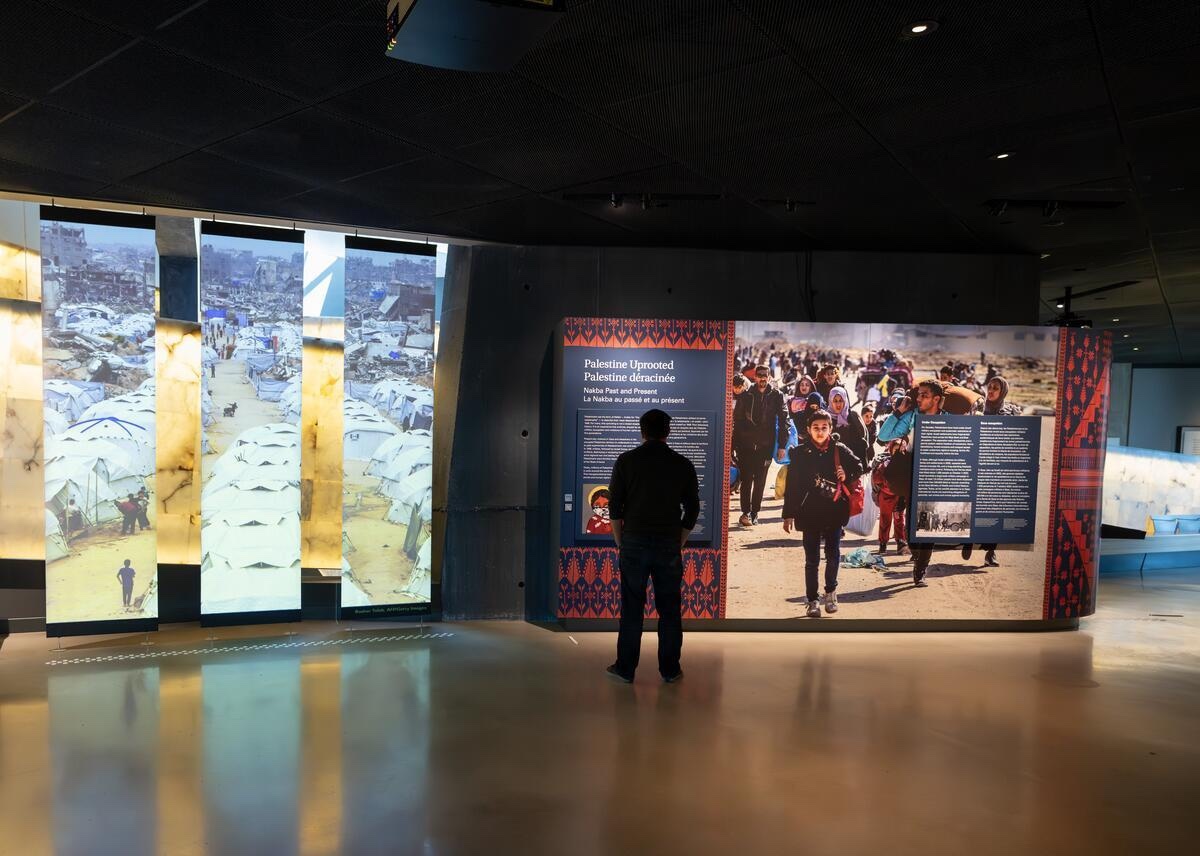
By BERNIE BELLAN (Posted June 26)The following press release was sent to me early Friday morning June 26 (Photos supplied by Annie Kierans, CMHR) Nothing that follows has been edited. I leave it to you to form your own opinion:
Winnipeg, MB — June 26, 2026 — The Canadian Museum for Human Rights (CMHR) will open a new exhibit tomorrow that explores human rights violations related to the ongoing forced displacement of Palestinian Canadians.
Palestine Uprooted: Nakba Past and Present will be on display in the Rights Today gallery on Level 5 until 2028. Featuring personal stories told through artifacts and video testimonies, the exhibit presents Palestinian Canadians reflecting on their ongoing struggle for human rights. The small exhibit reveals enduring patterns of loss and resilience, helping visitors understand more about this contemporary human rights story.
Palestinian Canadian stories are now included alongside many other stories of forced displacement and human rights violations featured in the Museum’s galleries. Each of these stories contribute to our visitors understanding of human rights and help the Museum fulfill its mandate to foster reflection and dialogue.
Exhibition highlights
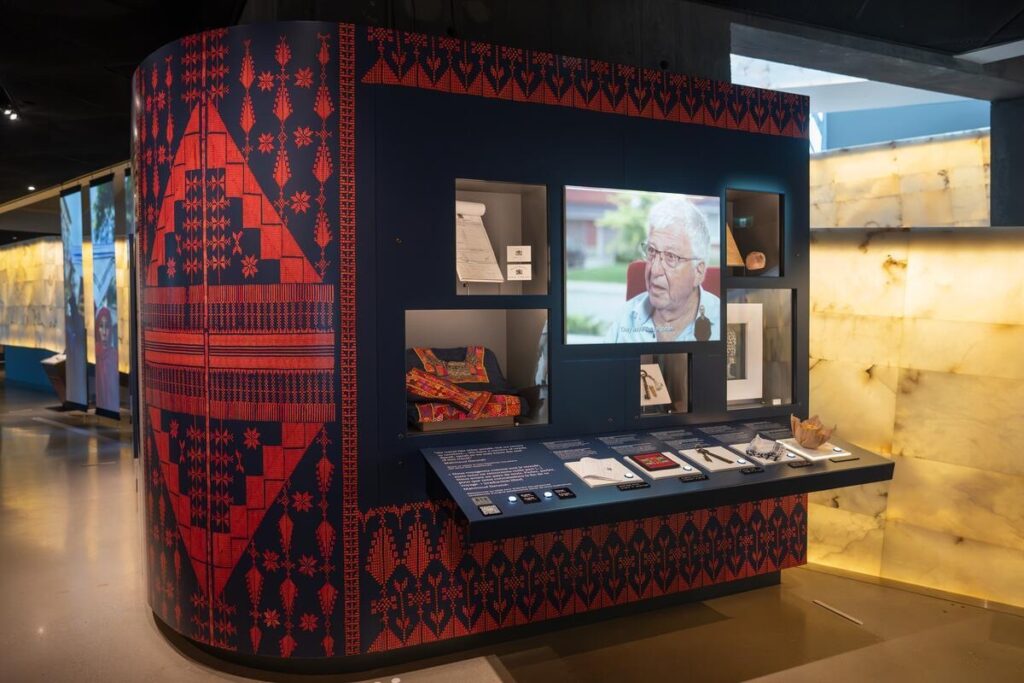
Personal stories and artifacts: Experience firsthand accounts from Palestinian Canadians sharing their journeys of displacement and memory through a series of five artifacts. Cases display artifacts like property deeds, house keys, and a traditional Palestinian embroidered dress, accompanied by short videos that deepen understanding of the impacts of displacement.
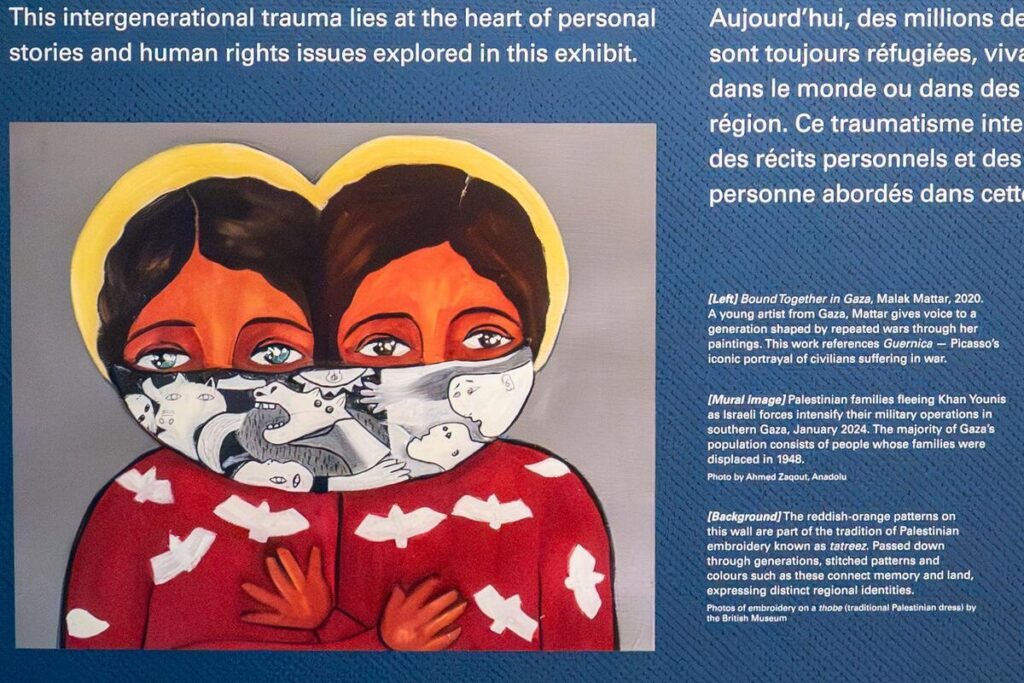
Powerful artworks: In her painting Bound Together in Gaza, Malak Mattar, a Gazan artist, captures the struggles and resilience of her generation shaped by conflict. Her work pays homage to Guernica, Picasso’s powerful masterpiece depicting civilian suffering during war.
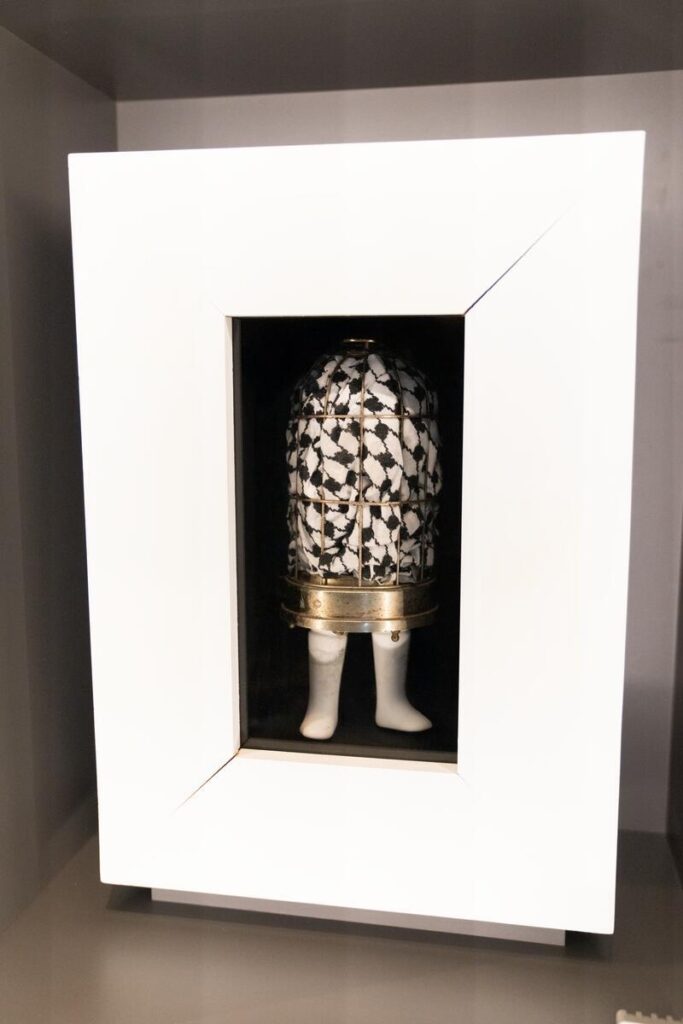
Curfews and Closures, by Rajie Cook, bears witness to life under military occupation during the 2000–2005 Palestinian uprising, when curfews and closures were expanded and further limited basic rights and freedoms.
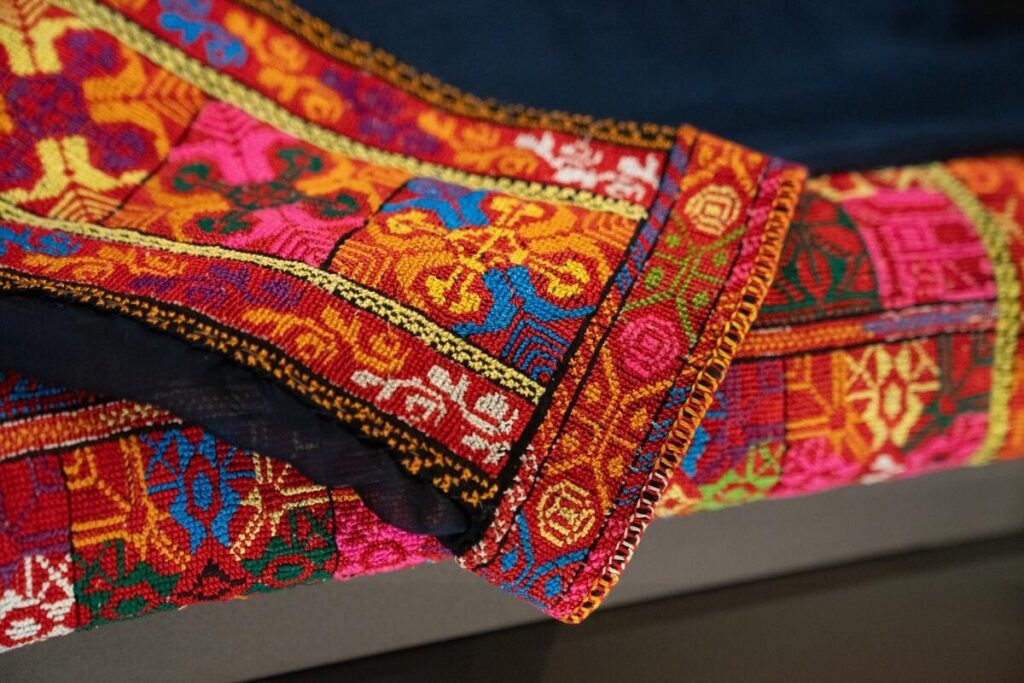
Cultural heritage: Discover traditional Palestinian embroidery called tatreez. Tatreez motifs and colours are tied to place, family history and regional identity. Patterns are associated with particular towns, villages or areas of Palestine. In this way, tatreez is a form of storytelling: a way of preserving memory, sustaining identity and expressing resilience across displacement and exile.
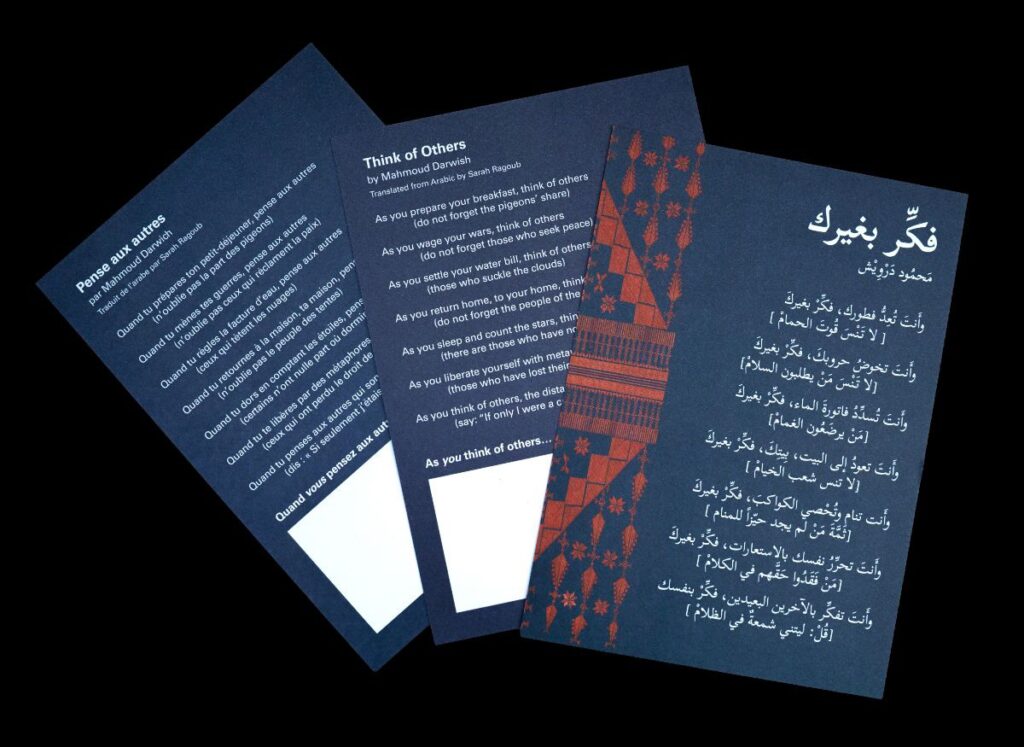
Poetry and reflection: Engage with Mahmoud Darwish’s evocative verses, inspiring personal reflection on exile, voice, and responsibility. Visitors can take a card containing Darwish’s poem and add a personal note, fostering ongoing dialogue beyond the exhibit.
Contemporary context: Witness striking images of current events in Gaza and the West Bank, connecting past displacement to ongoing struggles.
Quotes:
“No force can silence the truth we carry. Growing up in Canada, my children lived the Nakba through our stories. And now we watch it happen again, live, on our phones. When I see the images coming out of Gaza, I am not watching the news. I am watching my history repeat itself.” -Fouad Sahyoun, a Palestinian Canadian featured in the exhibit
“We developed this exhibit with a clear awareness that Palestinian Canadian voices have too often been marginalized, silenced or spoken over — and that anti-Palestinian racism affects whose stories are heard and whose suffering is recognized. That is why we intentionally centred Palestinian Canadian voices throughout the exhibit.” -Isabelle Masson, Curator of Palestine Uprooted
“Human rights matter precisely when they are inconvenient, when the question of who deserves the dignity of having their rights recognized is genuinely contested. These are the moments where having a national museum for human rights is most important.
There are people who believe this exhibit should not exist in its current form. There are people who believe it should have existed sooner. There are people who will visit this exhibit and feel that it does not say enough, and others who will feel it says too much.
We have listened to every one of these voices. We have reflected. And we have renewed our resolve to continue the difficult, sometimes contested, and often controversial work of building understanding about human rights. We are a museum grounded in Canada’s human rights framework, whose mandate requires us to bear witness to the full complexity of the human story. We are proud to open this exhibit because the story it tells will help achieve that mandate, and because this story belongs in the collective memory of Canadians.”
- – Isha Khan, CEO
